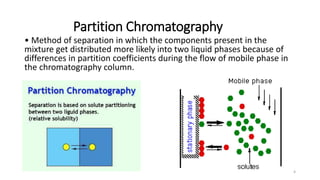
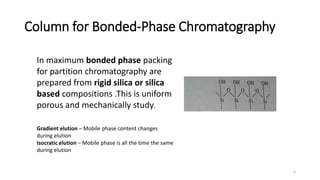
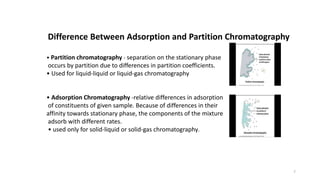
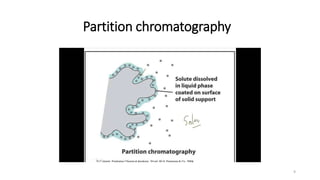
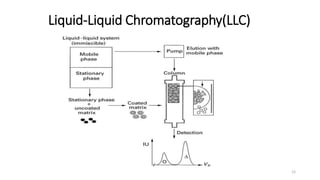
This presentation discusses partition column chromatography. It begins with an introduction and presenter information. It then defines partition chromatography as a method of separation where components in a mixture distribute between two liquid phases due to differences in partition coefficients. The presentation notes that partition chromatography is the most widely used type of HPLC, where the stationary phase is a second immiscible liquid bonded to the column. It discusses the principles of how separation occurs due to differences in how components partition between the two phases. Finally, it provides examples of applications such as separation of compounds in biological and environmental samples and determination of water quality.