By
KAUSHAL KUMAR SAHU
Assistant Professor (Ad Hoc)
Department of Biotechnology
Govt. Digvijay Autonomous P. G. College
Raj-Nandgaon ( C. G. )
SYNOPSIS:-
• INTRODUCTION
• INSTRUMENTATION OF HPLC
• TYPES OF HPLC
• PARAMETERS
• APPLICATION
• CONCLUSION
• REFERENCE
INTRODUCTION
• High-performance liquid chromatography ( HPLC) is a
specific form of column chromatography generally
used in biochemistry and analysis to separate, identify,
and quantify the active compounds.
• HPLC mainly utilizes a column that holds packing
material (stationary phase), a pump that moves the
mobile phase(s) through the column, and a detector
that shows the retention times of the molecules.
• The sample to be analyzed is introduced in small
volume to the stream of mobile phase and is retarded
by specific chemical or physical interactions with the
stationary phase.
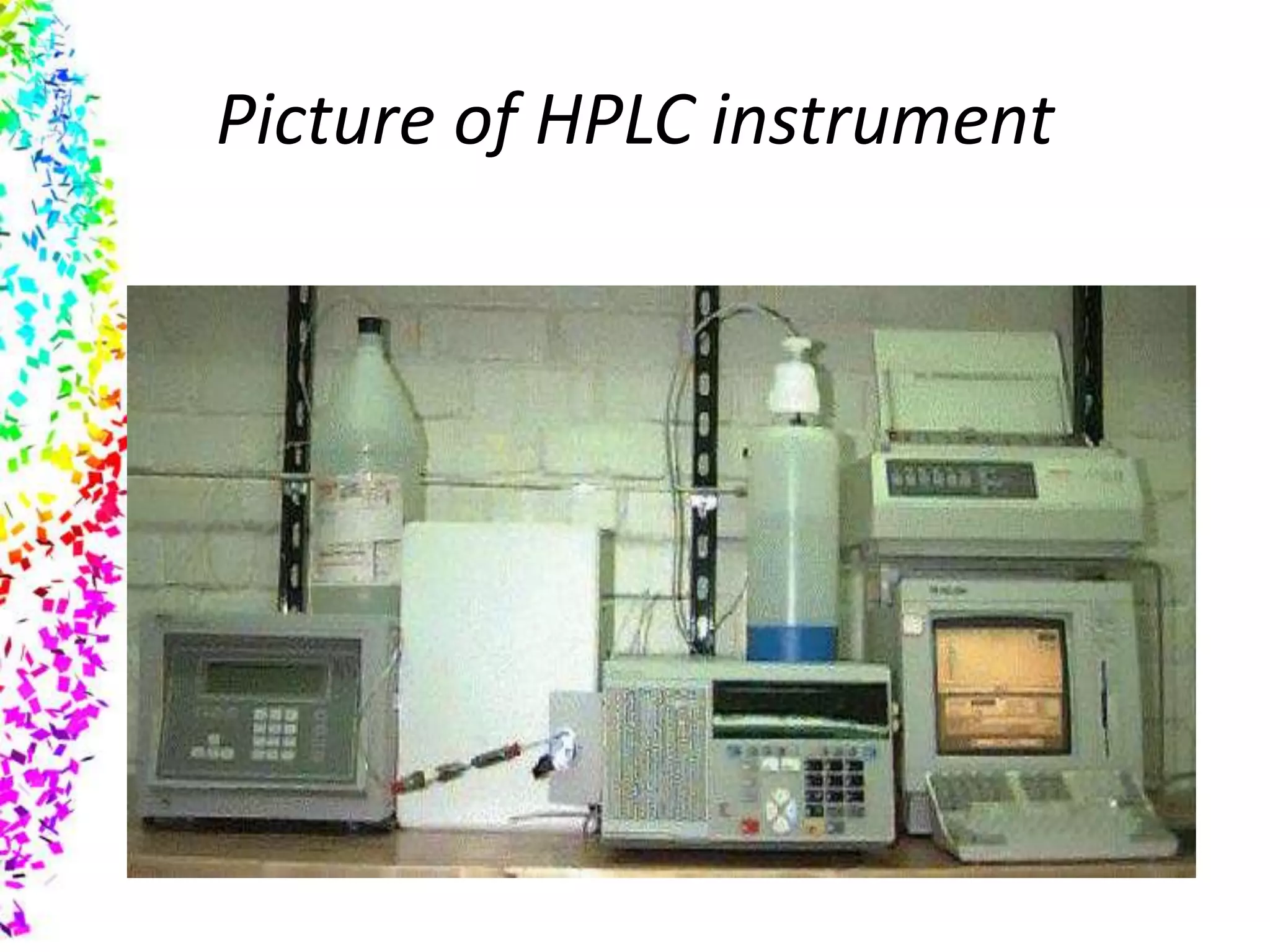
Picture of HPLC instrument
Instrumentation of HPLC
HPLC instrumentation includes :-
• Solvent Reservoirs
• Pump
• Sample Injector
• Column(s)
• Detector
• Data System
6
Pump
Sample injection unit
(injector)
Column
Column oven
Detector
Eluent
(mobile phase)
Drain
Data processor
Degasser
Flow Channel Diagram for High
Performance Liquid Chromatograph
Mobile Phase Reservoirs
• The type and composition of the mobile phase affects
the separation of the components.
• Different solvents are used for different types of
HPLC.
• For normal-phase HPLC, the solvent is usually
nonpolar, and in reverse-phase HPLC, the solvent is
normally a mixture of water and a polar organic
solvent.
Pumps
• High-pressure pumps are needed to push the
mobile phase through the packed stationary
phase.
• Pumps are typically known to be robust, but
adequate maintenance must be performed to
maintain that characteristic.
• Inability to build pressure, high pressures or
leakage could indicate that the pump is not
functioning correctly.
• Proper maintenance of the pump system will
minimize down time.
Pump
Sample Injector
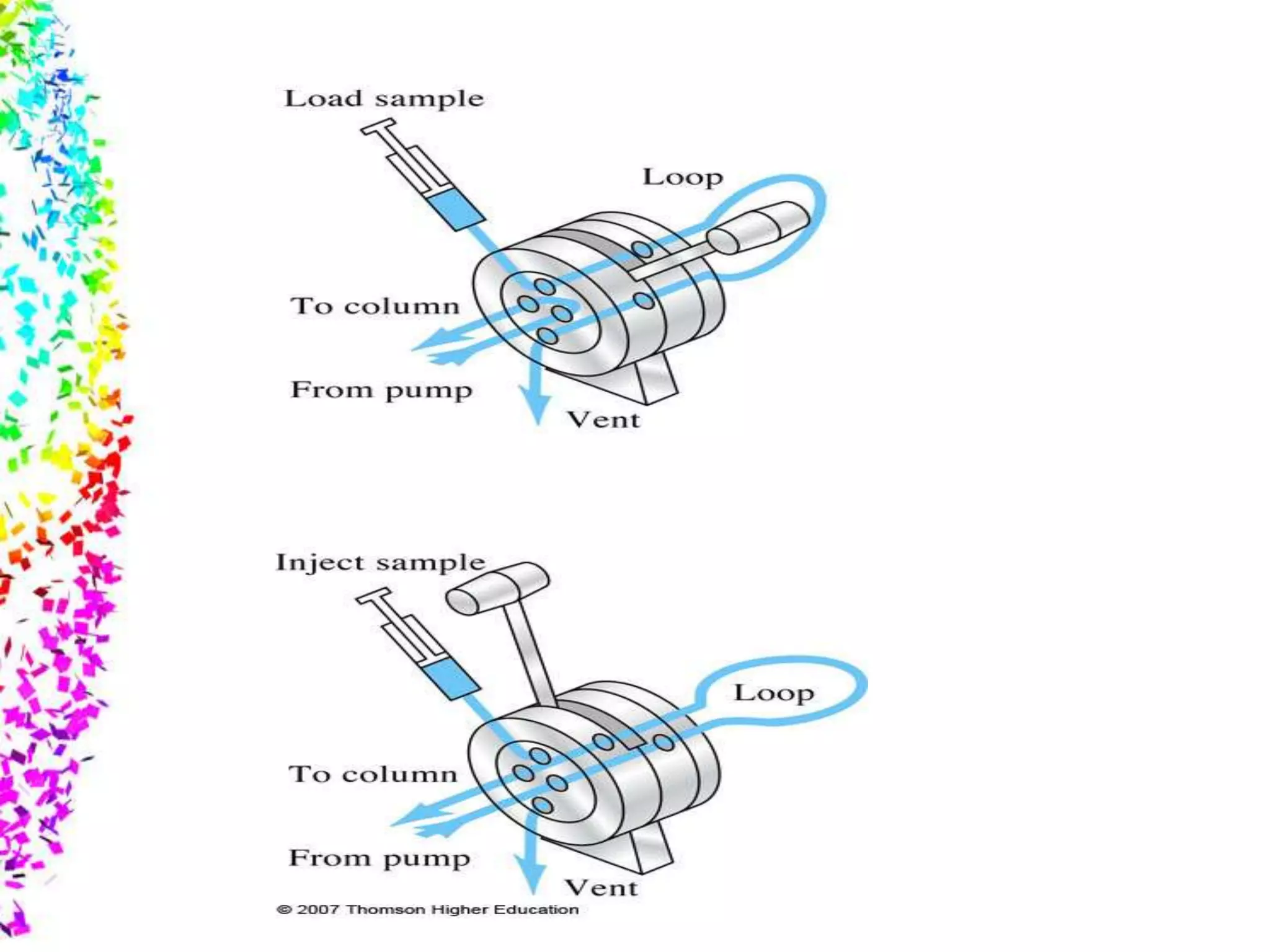
• The injector can be a single injection or an
automated injection system.
• An injector for an HPLC system should provide
injection of the liquid sample within the range
of 0.1-100mL of volume with high
reproducibility and under high pressure (up to
4000 psi).
• For liquid chromatography, liquid samples can
be directly injected and solid samples need
only to be diluted in the appropriate solvent.
Column(s)
• The column or stationary phase is the core of
any chromatographic system.
• Columns are commercially available in
different lengths and packing materials.
• The use of the correct combination of length
and packing material in correlation with the
appropriate mobile phase can assist in the
most effective separation of a sample
compound.
Detector
• The detector is used to sense the presence
of a compound passing through and to
provide an electronic signal to a data-
acquisition device.
• The main types of detectors used in HPLC
are refractive index (RI), ultraviolet (UV-Vis)
and fluorescence, but there are also diode
array, electrochemical and conductivity
detectors.
• Each detector has its assets, limitations and
sample types for which it is most effective.
Data Display Systems
• Since the detector signal is electronic, use of
modern data- acquisition techniques can aid
in the signal analysis.
• The data- acquisition system of most HPLC
systems is a computer.
• The computer integrates the response of the
detector to each component and places it
into a chromatograph that is easy to read
and interpret.
TYPES OF HPLC
• Normal phase chromatography: Also known
Normal phase HPLC (NP-HPLC), this method
separates analytes based on polarity. NP-HPLC
uses a polar stationary phase and a non-polar
mobile phase.
• Reversed phase chromatography: Reversed
phase HPLC (RP-HPLC or RPC) has a non-polar
stationary phase and an aqueous, moderately
polar mobile phase. RPC operates on the
principle of hydrophobic interactions, which
result from repulsive forces between a polar
eluent, the relatively non-polar analyte, and the
non-polar stationary phase.
• Size exclusion chromatography: Size exclusion
chromatography (SEC), also called as gel
permeation chromatography or gel filtration
chromatography mainly separates particles on
the basis of size. It is also useful for determining
the tertiary structure and quaternary structure
of proteins and amino acids.
• Ion exchange chromatography: In Ion-exchange
chromatography, retention is based on the
attraction between solute ions and charged
sites bound to the stationary phase. Ions of the
same charge are excluded.
• Bio-affinity chromatography: Separation
based on specific reversible interaction of
proteins with ligands. Ligands are covalently
attached to solid support on a bio-affinity
matrix, retains proteins with interaction to
the column-bound ligands.
PARAMETERS
• For the accurate analysis of a compound,
there are some parameters which are used
as a standard for a particular compound.
• Internal diameter
• Particle size
• Pore size
• Pump pressure
APPLICATION
• Chemical Separations:- It is based on the
fact that certain compounds have different
migration rates given a particular column
and mobile phase, the extent or degree of
separation is mostly determined by the
choice of stationary phase and mobile
phase.
Purification:- Purification is defined as the
process of separating or extracting the
target compound from a mixture of
compounds or contaminants.
Identification :- Generally assay of
compounds are carried using HPLC. The
parameters of this assay should be such that
a clean peak of the known sample is
observed from the chromatograph.
Other applications of HPLC
Pharmaceutical applications
Shelf-life determinations of pharmaceutical products .
Identification of active ingredients of dosage forms.
Pharmaceutical quality control
Environmental applications
Detection of phenolic compounds in Drinking Water
Bio-monitoring of pollutant
Forensics
Quantification of the drug in biological samples.
Identification of anabolic steroids in serum, urine, and hair
Determination of cocaine and metabolites in blood
Clinical
Quantification of ions in human urine Analysis
of antibiotics in blood plasma.
Estimation of bilirubin and bilivirdin in blood
plasma in case of hepatic disorders.
Food and Flavor
Ensuring the quality of soft drink and drinking
water.
Analysis of beer.
Sugar analysis in fruit juices.
Analysis of polycyclic compounds in vegetables.
CONCLUSION
• It can be concluded that HPLC is a versatile,
reproducible chromatographic technique for
the estimation of drug products.
• It has wide applications in different fields in
term of quantitative and qualitative
estimation of active molecules.
REFERENCE
• High-performance liquid chromatography.
Pdf file
• 208-528-1-pb.pdf file

Instrumentation of HPLC, principle by kk sahu

  • 1.
    By KAUSHAL KUMAR SAHU AssistantProfessor (Ad Hoc) Department of Biotechnology Govt. Digvijay Autonomous P. G. College Raj-Nandgaon ( C. G. )
  • 2.
    SYNOPSIS:- • INTRODUCTION • INSTRUMENTATIONOF HPLC • TYPES OF HPLC • PARAMETERS • APPLICATION • CONCLUSION • REFERENCE
  • 3.
    INTRODUCTION • High-performance liquidchromatography ( HPLC) is a specific form of column chromatography generally used in biochemistry and analysis to separate, identify, and quantify the active compounds. • HPLC mainly utilizes a column that holds packing material (stationary phase), a pump that moves the mobile phase(s) through the column, and a detector that shows the retention times of the molecules. • The sample to be analyzed is introduced in small volume to the stream of mobile phase and is retarded by specific chemical or physical interactions with the stationary phase.
  • 4.
    Picture of HPLCinstrument
  • 5.
    Instrumentation of HPLC HPLCinstrumentation includes :- • Solvent Reservoirs • Pump • Sample Injector • Column(s) • Detector • Data System
  • 6.
    6 Pump Sample injection unit (injector) Column Columnoven Detector Eluent (mobile phase) Drain Data processor Degasser Flow Channel Diagram for High Performance Liquid Chromatograph
  • 7.
    Mobile Phase Reservoirs •The type and composition of the mobile phase affects the separation of the components. • Different solvents are used for different types of HPLC. • For normal-phase HPLC, the solvent is usually nonpolar, and in reverse-phase HPLC, the solvent is normally a mixture of water and a polar organic solvent.
  • 8.
    Pumps • High-pressure pumpsare needed to push the mobile phase through the packed stationary phase. • Pumps are typically known to be robust, but adequate maintenance must be performed to maintain that characteristic. • Inability to build pressure, high pressures or leakage could indicate that the pump is not functioning correctly. • Proper maintenance of the pump system will minimize down time.
  • 9.
  • 10.
    Sample Injector • Theinjector can be a single injection or an automated injection system. • An injector for an HPLC system should provide injection of the liquid sample within the range of 0.1-100mL of volume with high reproducibility and under high pressure (up to 4000 psi). • For liquid chromatography, liquid samples can be directly injected and solid samples need only to be diluted in the appropriate solvent.
  • 12.
    Column(s) • The columnor stationary phase is the core of any chromatographic system. • Columns are commercially available in different lengths and packing materials. • The use of the correct combination of length and packing material in correlation with the appropriate mobile phase can assist in the most effective separation of a sample compound.
  • 13.
    Detector • The detectoris used to sense the presence of a compound passing through and to provide an electronic signal to a data- acquisition device. • The main types of detectors used in HPLC are refractive index (RI), ultraviolet (UV-Vis) and fluorescence, but there are also diode array, electrochemical and conductivity detectors. • Each detector has its assets, limitations and sample types for which it is most effective.
  • 14.
    Data Display Systems •Since the detector signal is electronic, use of modern data- acquisition techniques can aid in the signal analysis. • The data- acquisition system of most HPLC systems is a computer. • The computer integrates the response of the detector to each component and places it into a chromatograph that is easy to read and interpret.
  • 15.
    TYPES OF HPLC •Normal phase chromatography: Also known Normal phase HPLC (NP-HPLC), this method separates analytes based on polarity. NP-HPLC uses a polar stationary phase and a non-polar mobile phase. • Reversed phase chromatography: Reversed phase HPLC (RP-HPLC or RPC) has a non-polar stationary phase and an aqueous, moderately polar mobile phase. RPC operates on the principle of hydrophobic interactions, which result from repulsive forces between a polar eluent, the relatively non-polar analyte, and the non-polar stationary phase.
  • 16.
    • Size exclusionchromatography: Size exclusion chromatography (SEC), also called as gel permeation chromatography or gel filtration chromatography mainly separates particles on the basis of size. It is also useful for determining the tertiary structure and quaternary structure of proteins and amino acids. • Ion exchange chromatography: In Ion-exchange chromatography, retention is based on the attraction between solute ions and charged sites bound to the stationary phase. Ions of the same charge are excluded.
  • 17.
    • Bio-affinity chromatography:Separation based on specific reversible interaction of proteins with ligands. Ligands are covalently attached to solid support on a bio-affinity matrix, retains proteins with interaction to the column-bound ligands.
  • 18.
    PARAMETERS • For theaccurate analysis of a compound, there are some parameters which are used as a standard for a particular compound. • Internal diameter • Particle size • Pore size • Pump pressure
  • 19.
    APPLICATION • Chemical Separations:-It is based on the fact that certain compounds have different migration rates given a particular column and mobile phase, the extent or degree of separation is mostly determined by the choice of stationary phase and mobile phase.
  • 20.
    Purification:- Purification isdefined as the process of separating or extracting the target compound from a mixture of compounds or contaminants. Identification :- Generally assay of compounds are carried using HPLC. The parameters of this assay should be such that a clean peak of the known sample is observed from the chromatograph.
  • 21.
    Other applications ofHPLC Pharmaceutical applications Shelf-life determinations of pharmaceutical products . Identification of active ingredients of dosage forms. Pharmaceutical quality control Environmental applications Detection of phenolic compounds in Drinking Water Bio-monitoring of pollutant Forensics Quantification of the drug in biological samples. Identification of anabolic steroids in serum, urine, and hair Determination of cocaine and metabolites in blood
  • 22.
    Clinical Quantification of ionsin human urine Analysis of antibiotics in blood plasma. Estimation of bilirubin and bilivirdin in blood plasma in case of hepatic disorders. Food and Flavor Ensuring the quality of soft drink and drinking water. Analysis of beer. Sugar analysis in fruit juices. Analysis of polycyclic compounds in vegetables.
  • 23.
    CONCLUSION • It canbe concluded that HPLC is a versatile, reproducible chromatographic technique for the estimation of drug products. • It has wide applications in different fields in term of quantitative and qualitative estimation of active molecules.
  • 24.
    REFERENCE • High-performance liquidchromatography. Pdf file • 208-528-1-pb.pdf file