High Performance Liquid Chromatography
(HPLC)-an Introduction
Bhupander Kumar (Scientist)
National Reference Trace Organic Laboratory
Central Pollution Control Board, Delhi
Liquid Chromatography Origins
• Michael Tswett (1906) separated the plant
pigments by organic solvent as mobile phase &
chalk as stationary phase
• Martin and Synge (1941) won the Nobel prize in
chemistry in 1952 for performing liquid-liquid
partition chromatography
HPLC- Introduction
• HPLC is a form of column chromatography used in
chemistry to separate, identify and quantify compounds
based on polarities (affinity) and interactions with column’s
stationary phase
• HPLC utilized column’s stationary phase, a pump that
moves the mobile phase and analyte through column and a
detector that provides a retention time for the analyte
• A pump provides high pressure to propels the mobile phase
and analyte through packed column and allows for better
separation, so it is also called high pressure liquid
chromatography
Liquid Chromatography - Types
• Partition Chromatography
i.e. paper chromatography and Thin layer
chromatography (TLC). Partition
chromatography uses a retained solvent on
the solid support and separates analytes
based on polar differences. The polar analytes
diffuses into a stationary water layer
associated with the polar stationary phase and
are thus retained. This method uses polar
stationary phase (silica or alumina) and a non
polar water miscible mobile phase.
•Adsorption or Normal chromatography
This NP-HPLC uses a polar stationary phase and a
non-polar, non aqueous mobile phase for separating
analytes readily soluble in non-polar solvents. The use
of more polar solvents in mobile phase decrease the
retention time of a analyte. Very polar solvents in
mixture deactivate the stationary phase by creating a
stationary bound water layer because its behavior is
purely an adsorptive mechanism
•Ion exchange chromatography
This chromatography is based on the
interaction between solute ions and charged
sited bound to the stationary phase. Ions of
same charge are excluded. Types of ion
exchangers includes:
Polystyrene resins
Cellulose and dextran ion exchangers (gels)
Porous silica
This form of chromatography is widely used in
water purifications
•Size exclusion chromatography
This is also known as gel permeation
chromatography (GPC), separates particles
on the basis of size. The large molecules
simply pass by the pores as they are too large
to enter the pores. There fore large molecules
flow quicker through the column than smaller,
that is smaller the molecule, larger the
retention time. This technique is widely used
for the molecular weight determination of
polysaccharides and proteins
•Reverse phase chromatography
RP-HPLC has a non-polar stationary and an
aqueous, moderately polar mobile phase. One
common stationary phase is a derivatized silica
with R, where R is a alkyl group such as C8 H17
or C18H37
. With these stationary phases,
retention time is longer for molecules which
more non-polar, while polar molecules elutes
more readily
HPLC vs LC
HPLC as compared with LC is characterized by:
• High resolution
• Small diameter (4.6 mm), stainless, glass column
• Column packing with very small (3,5, and 10 µm)
particles
• relatively high inlet pressures and controlled flow of
the mobile phase
• Continuous flow detectors capable of handling small
flow rates and detecting very small amounts
• Rapid analysis
HPLC – Analytical Scope
In addition, it is used for analyzing air and water pollutants,
and for monitoring pesticide levels and other POPs in the
environment.
HPLC commonly used for analysis of
– Biological compounds: Amino acids, proteins, lipids
– Pharmaceuticals: Antibiotics, steroids, analgesics
– Inorganic compounds: Antioxidants, Afflatoxin
– Environmental pollutants: PAHs, PCBs, Herbicides, Pesticides,
Carbamates & Phenol
– Forensic: Drugs, Poisons, Narcotics
This technique is used for chemistry and biochemistry
research analyzing complex mixtures, purifying chemical
compounds, isolating natural products, or predicting physical
properties.
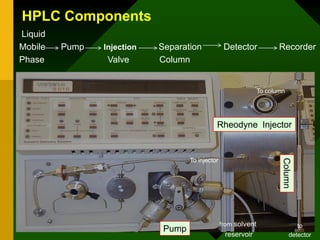
HPLC Components
Pump
Rheodyne Injector
Column
from solvent
reservoir
to
detector
To injector
To column
Liquid
Mobile Pump Injection Separation Detector Recorder
Phase Valve Column
HPLC Pumps
 Pressure to 6000 psi-In order to achieve flow
rates of 0.5 to 5.0 ml/min for a 10 -30 cm column,
pressure of 70 to 400atm (1000 to 6000 psi) are
required
Binary, tertiary or quaternary pump for delivery of
multiple solvents
Control flow rate from 0.1 to 10 ml/min
Controlled pressure range1 to 5000psi
Injection valve
The function of the injector is to place the sample into the
high pressure flow in narrow volume so that the sample
enters the column as a homogenous
 Injection valve consists of a rotor and fixed sample tube
called “loop” (1 – 100 µl)
 Reproducibility: 0.1 %
HPLC Columns
Guard Column: A 0.5 to 2.0 µm Guard Columns are placed
anterior to the separating column. This serves as a protective
factor that prolongs the life and usefulness of the separation
column.
1) particles that clog the separation column;
2) compounds and ions that could ultimately cause "baseline
drift", decreased resolution, decreased sensitivity, and
create false peaks;
3) compounds that may cause precipitation upon contact with
the stationary or mobile phase; and
4) compounds that might co-elute and cause extraneous
peaks and interfere with detection and/or quantification.
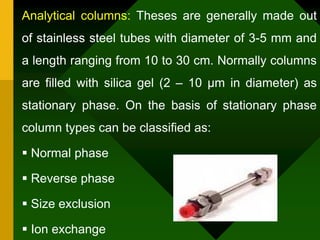
Analytical columns: Theses are generally made out
of stainless steel tubes with diameter of 3-5 mm and
a length ranging from 10 to 30 cm. Normally columns
are filled with silica gel (2 – 10 µm in diameter) as
stationary phase. On the basis of stationary phase
column types can be classified as:
 Normal phase
 Reverse phase
 Size exclusion
 Ion exchange
The stationary phase in HPLC refers to the solid
support contained within the column over which
the mobile phase continuously flows. Columns
containing various types of stationary phases are
commercially available. The chemical
interactions of the stationary phase and the
sample with the mobile phase, determine the
degree of migration and separation of the
compounds contained in the sample.
Stationary phase
Liquid-Solid Phase
Liquid-solid phase operates on the basis of polarity.
Compounds that possess functional groups capable of strong
hydrogen bonding will adhere more tightly to the stationary
phase than less polar compounds. Thus less polar
compounds will elute from the column faster than
compounds that are highly polar.
Liquid-Liquid Phase
This phase operates on the same basis as liquid-solid.
However, this technique is better suited for samples of
medium polarity that are soluble in weakly polar to polar
organic solvents.
Normal phase:
OH OH OH OH
This phase operates on the basis of hydrophilicity
and lipophilicity by using the polar parts of the
stationary phase and less polar mobile phase. The
packing of the column must be more polar than the
mobile phase with respect to the sample. Thus
hydrophobic compounds elute more quickly than
hydrophilic compounds.
SiO2
Reverse phase
This phase also operates on the basis of hydrophilicity
and lipophilicilty but the stationary phase consists of
silica based packing with long chain hydrocarbon
compounds to decrease the polarity of columns. For
example, C8 signifies an octyl chain and C18 an
octadecyl ligand in matrix. Typical stationary phases
are nonpolar and the solvents are polar aqueous-
organic mixtures such as Methanol-Water or
Acetonitrile-Water. Thus hydrophilic compounds elute
more quickly that do hydrophobic compounds.
Size exclusion Phase
In size exclusion the HPLC column stationary
phase consists of porous beads of substance
which have controlled pore size and is able to be
filtered in an ordinary phase according to its
molecular size. Small molecules penetrate into
the pores within the packing while large
molecules only partially penetrate the pores. The
large molecules elute before the smaller
molecules.
Ion Exchange Phase
This phase contains charge bearing functional
groups attached to a polymer matrix and sample
analytes are separated based upon attractive ionic
forces between molecules carrying charged groups
of opposite charge to those charges on the
stationary phase. Separations are made between a
polar mobile liquid , usually water containing salts or
small amounts of alcohols, and stationary phase
containing either acidic or basic fixed sites.
•relatively polar surface
O O O
| | |
OSiOSiOSiOH
| | |
O O O
| | |
OSiOSiOSiOH
| | |
O O O
•bulk (SiO2)x •surface
• relatively nonpolar surface
Silica Gel
O O O
| | |
OSiOSiOSiOR
| | |
O O O
| | |
OSiOSiOSiOR
| | |
O O O
•bulk (SiO2)x
•surface
Derivatized Silica Gel
•Where R = C18H37
hydrocarbon chain
•(octadecylsilyl
deriv.
silica or “C18”)
•“normal phase” •“reversed phase”
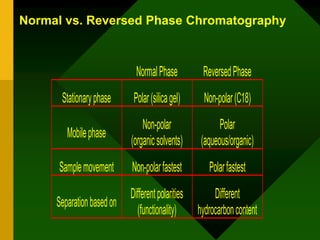
Normal vs. Reversed Phase Chromatography
NormalPhase ReversedPhase
Stationaryphase Polar(silicagel) Non-polar(C18)
Mobilephase
Non-polar
(organicsolvents)
Polar
(aqueous/organic)
Samplemovement Non-polarfastest Polarfastest
Separationbasedon
Differentpolarities
(functionality)
Different
hydrocarboncontent
HPLC solvents for Mobile phase
Experience plays a major role in the selection of an
HPLC solvents
 Generally there should be significant difference
between the polarities of the S.P. and M.P., the reason
is that separation is based on the solubility differences
between the M.P. and S.P.
 Almost all reversed phase separations (polar m.p. and
nonpolar s.p.) can be carried out with combination of
acetonitrile , and /or methanol, and water as M.P.
 The polarity of common HPLC solvent are as :
Water > Acetonitrile >Methanol > Ethanol > Acetone >
Ethyl acetate > cyclohexane > Hexane
Practical Note
 Separation of most organic compounds can be
done by C - 18 stationary phases
 Solvents must be miscible e.g. water/methanol.
An immiscible solvent such as water/toluene would
create a mess in the column
Mobile phase elution
 Isocratic elutions –
This is equivalent to isothermal separations in GC
Constant solvent composition, mobile phase polari
stay constant throughout elution process. In isocrat
elution, peak width increases with retention time, th
leads to the disadvantage that late eluting peaks ver
flat and broad, Their shape and width may keep them
being recognized as peaks. In this elution, the selectivi
does not change if the column dimensions (length an
inner diameter) change – that is , peaks elute in th
same order
Gradient Elutions –
This is equivalent to temperature programming in
GC. A separation in which the mobile phase
composition is change during the separation
process is described as gradient elution. One
example is a gradient starting at 10% methanol and
ending at 90% methanol after 20 minutes. In
gradient elution, the elution order may change as
the dimensions of the column or flow rates of the
mobile phase change.
HPLC Chromatograms
•Rt = 3.0 min.
•faster moving
•less retained
•Rt = 5.2 min.
•slower moving
•more retained
• 0 1 2 3 4 5 6 7
•Time (minutes)
•response

Approximation
of peak area by
triangulation
Area = base x height
2
•base
•height
•Peak A •Peak B
Detectors in HPLC
Selection of detector depends on analysis of interest
 Detector should be ideal for analyte
 Should give fast response to flowing system
Commonly used detectors in HPLC are:
 Refractive Index (RI) Detector
 UV-Visible Absorbance Detector (UV)
 Diode Array Detector (DAD)
 Fluorescence Detector (FLD)
 Fourier Transform Infrared Detector (FTIR)
 Evaporative Light Scattering Detector
 Electrochemical Detector
Refractive Index (RI) detector
 Nearly universal but poor detection limit
 Passes visible light through 2 compartments, sample &
reference
 When the solvent composition are the same, the light
passing through the compartments is recorded as zero
 When a solute is passing through the sample
compartment, refractive index changes and sensed by the
detector
UV-Visible Absorbance Detector
 Based on electronic transitions within
molecules
 Most common type of detector for LC
 Work with fixed wavelengths
 Selectable for specific wavelengths
Diode Array Detector
 Allows for the recording of the entire spectrum of
solute as it passes through the DAD
Fluorescence Detector
 Based on fluorescent light emission of excited
state molecules
Light
source
Many
wavelength
Excitation
monchromator
One
wavelength
Sample
cell
Luminescence at
many wavelength
Emission
monchromator
One wavelength
Detector
IR Detector
 IR Detector allows for spectrum records of flowing system
similar to DAD
 Water & Alcohol are the major interferences to solute
detection
Evaporative Light Scattering Detector
 Responds to any analyte that is significantly less volatile
than the mobile phase
 Elute is mixed with N2 gas and forms a fine mist
 Solvent (M.P.) evaporates leaving fine particles of analyte.
The particles are detected by light scattering
 Response is proportional to analyte mass
Electrochemical Detector
 Based on amperometry, voltametry and conductivity
response of analyte to electrode usually held at constant
potential
 If the analyte is electro active, can be highly sensitive
since response is based on surface phenomenon rather
than a solution bulk property (e.g. UV-Vis absorbance)
Comparison of commercial HPLC detectors
Detector Approx LOD (ng) Useful with gradient
Ultraviolet 0.1 – 1.0 Yes
Refractive Index 100 – 1000 No
Evaporative Light Scattering 0.1 – 1.0 Yes
Electrochemical 0.01 – 1.0 No
Fluorescence 0.001 – 0.01 Yes
Conclusion
 HPLC most suitable system for analysis of nonvolatile,
semi-volatile or thermally unstable compounds.
Commonly used for analysis of environmental pollutants like
PAHs, PCBs, herbicides, pesticides, Carbamates, phenol
 Most common mobile phases are Water, Acetonitrile,
methanol and mixture of these solvents
C - 18 containing stationary phase column is most suitable
for separation of all organic compounds
Dad Array Detector (DAD) and Fluorescence Detector (FLD)
are the most common detectors used for environmental
Preventive maintenance
•General Recommendations
•Avoid solvents corrosive to stainless steel
•Use only HPLC water
•Consider miscibility of solvents, solubility of salts and
buffers
•Filter mobile phase before use (0.4 micron)
•Filter sample before use
•Degas mobile phases before use (or use vacuum
degassing)
•After use flush the HPLC to remove buffers and additives

Introduction to hplc

  • 1.
    High Performance LiquidChromatography (HPLC)-an Introduction Bhupander Kumar (Scientist) National Reference Trace Organic Laboratory Central Pollution Control Board, Delhi
  • 2.
    Liquid Chromatography Origins •Michael Tswett (1906) separated the plant pigments by organic solvent as mobile phase & chalk as stationary phase • Martin and Synge (1941) won the Nobel prize in chemistry in 1952 for performing liquid-liquid partition chromatography
  • 3.
    HPLC- Introduction • HPLCis a form of column chromatography used in chemistry to separate, identify and quantify compounds based on polarities (affinity) and interactions with column’s stationary phase • HPLC utilized column’s stationary phase, a pump that moves the mobile phase and analyte through column and a detector that provides a retention time for the analyte • A pump provides high pressure to propels the mobile phase and analyte through packed column and allows for better separation, so it is also called high pressure liquid chromatography
  • 4.
    Liquid Chromatography -Types • Partition Chromatography i.e. paper chromatography and Thin layer chromatography (TLC). Partition chromatography uses a retained solvent on the solid support and separates analytes based on polar differences. The polar analytes diffuses into a stationary water layer associated with the polar stationary phase and are thus retained. This method uses polar stationary phase (silica or alumina) and a non polar water miscible mobile phase.
  • 5.
    •Adsorption or Normalchromatography This NP-HPLC uses a polar stationary phase and a non-polar, non aqueous mobile phase for separating analytes readily soluble in non-polar solvents. The use of more polar solvents in mobile phase decrease the retention time of a analyte. Very polar solvents in mixture deactivate the stationary phase by creating a stationary bound water layer because its behavior is purely an adsorptive mechanism
  • 6.
    •Ion exchange chromatography Thischromatography is based on the interaction between solute ions and charged sited bound to the stationary phase. Ions of same charge are excluded. Types of ion exchangers includes: Polystyrene resins Cellulose and dextran ion exchangers (gels) Porous silica This form of chromatography is widely used in water purifications
  • 7.
    •Size exclusion chromatography Thisis also known as gel permeation chromatography (GPC), separates particles on the basis of size. The large molecules simply pass by the pores as they are too large to enter the pores. There fore large molecules flow quicker through the column than smaller, that is smaller the molecule, larger the retention time. This technique is widely used for the molecular weight determination of polysaccharides and proteins
  • 8.
    •Reverse phase chromatography RP-HPLChas a non-polar stationary and an aqueous, moderately polar mobile phase. One common stationary phase is a derivatized silica with R, where R is a alkyl group such as C8 H17 or C18H37 . With these stationary phases, retention time is longer for molecules which more non-polar, while polar molecules elutes more readily
  • 9.
    HPLC vs LC HPLCas compared with LC is characterized by: • High resolution • Small diameter (4.6 mm), stainless, glass column • Column packing with very small (3,5, and 10 µm) particles • relatively high inlet pressures and controlled flow of the mobile phase • Continuous flow detectors capable of handling small flow rates and detecting very small amounts • Rapid analysis
  • 10.
    HPLC – AnalyticalScope In addition, it is used for analyzing air and water pollutants, and for monitoring pesticide levels and other POPs in the environment. HPLC commonly used for analysis of – Biological compounds: Amino acids, proteins, lipids – Pharmaceuticals: Antibiotics, steroids, analgesics – Inorganic compounds: Antioxidants, Afflatoxin – Environmental pollutants: PAHs, PCBs, Herbicides, Pesticides, Carbamates & Phenol – Forensic: Drugs, Poisons, Narcotics This technique is used for chemistry and biochemistry research analyzing complex mixtures, purifying chemical compounds, isolating natural products, or predicting physical properties.
  • 11.
    HPLC Components Pump Rheodyne Injector Column fromsolvent reservoir to detector To injector To column Liquid Mobile Pump Injection Separation Detector Recorder Phase Valve Column
  • 12.
    HPLC Pumps  Pressureto 6000 psi-In order to achieve flow rates of 0.5 to 5.0 ml/min for a 10 -30 cm column, pressure of 70 to 400atm (1000 to 6000 psi) are required Binary, tertiary or quaternary pump for delivery of multiple solvents Control flow rate from 0.1 to 10 ml/min Controlled pressure range1 to 5000psi
  • 13.
    Injection valve The functionof the injector is to place the sample into the high pressure flow in narrow volume so that the sample enters the column as a homogenous  Injection valve consists of a rotor and fixed sample tube called “loop” (1 – 100 µl)  Reproducibility: 0.1 %
  • 14.
    HPLC Columns Guard Column:A 0.5 to 2.0 µm Guard Columns are placed anterior to the separating column. This serves as a protective factor that prolongs the life and usefulness of the separation column. 1) particles that clog the separation column; 2) compounds and ions that could ultimately cause "baseline drift", decreased resolution, decreased sensitivity, and create false peaks; 3) compounds that may cause precipitation upon contact with the stationary or mobile phase; and 4) compounds that might co-elute and cause extraneous peaks and interfere with detection and/or quantification.
  • 15.
    Analytical columns: Thesesare generally made out of stainless steel tubes with diameter of 3-5 mm and a length ranging from 10 to 30 cm. Normally columns are filled with silica gel (2 – 10 µm in diameter) as stationary phase. On the basis of stationary phase column types can be classified as:  Normal phase  Reverse phase  Size exclusion  Ion exchange
  • 16.
    The stationary phasein HPLC refers to the solid support contained within the column over which the mobile phase continuously flows. Columns containing various types of stationary phases are commercially available. The chemical interactions of the stationary phase and the sample with the mobile phase, determine the degree of migration and separation of the compounds contained in the sample. Stationary phase
  • 17.
    Liquid-Solid Phase Liquid-solid phaseoperates on the basis of polarity. Compounds that possess functional groups capable of strong hydrogen bonding will adhere more tightly to the stationary phase than less polar compounds. Thus less polar compounds will elute from the column faster than compounds that are highly polar. Liquid-Liquid Phase This phase operates on the same basis as liquid-solid. However, this technique is better suited for samples of medium polarity that are soluble in weakly polar to polar organic solvents.
  • 18.
    Normal phase: OH OHOH OH This phase operates on the basis of hydrophilicity and lipophilicity by using the polar parts of the stationary phase and less polar mobile phase. The packing of the column must be more polar than the mobile phase with respect to the sample. Thus hydrophobic compounds elute more quickly than hydrophilic compounds. SiO2
  • 19.
    Reverse phase This phasealso operates on the basis of hydrophilicity and lipophilicilty but the stationary phase consists of silica based packing with long chain hydrocarbon compounds to decrease the polarity of columns. For example, C8 signifies an octyl chain and C18 an octadecyl ligand in matrix. Typical stationary phases are nonpolar and the solvents are polar aqueous- organic mixtures such as Methanol-Water or Acetonitrile-Water. Thus hydrophilic compounds elute more quickly that do hydrophobic compounds.
  • 20.
    Size exclusion Phase Insize exclusion the HPLC column stationary phase consists of porous beads of substance which have controlled pore size and is able to be filtered in an ordinary phase according to its molecular size. Small molecules penetrate into the pores within the packing while large molecules only partially penetrate the pores. The large molecules elute before the smaller molecules.
  • 21.
    Ion Exchange Phase Thisphase contains charge bearing functional groups attached to a polymer matrix and sample analytes are separated based upon attractive ionic forces between molecules carrying charged groups of opposite charge to those charges on the stationary phase. Separations are made between a polar mobile liquid , usually water containing salts or small amounts of alcohols, and stationary phase containing either acidic or basic fixed sites.
  • 22.
    •relatively polar surface OO O | | | OSiOSiOSiOH | | | O O O | | | OSiOSiOSiOH | | | O O O •bulk (SiO2)x •surface • relatively nonpolar surface Silica Gel O O O | | | OSiOSiOSiOR | | | O O O | | | OSiOSiOSiOR | | | O O O •bulk (SiO2)x •surface Derivatized Silica Gel •Where R = C18H37 hydrocarbon chain •(octadecylsilyl deriv. silica or “C18”) •“normal phase” •“reversed phase”
  • 23.
    Normal vs. ReversedPhase Chromatography NormalPhase ReversedPhase Stationaryphase Polar(silicagel) Non-polar(C18) Mobilephase Non-polar (organicsolvents) Polar (aqueous/organic) Samplemovement Non-polarfastest Polarfastest Separationbasedon Differentpolarities (functionality) Different hydrocarboncontent
  • 24.
    HPLC solvents forMobile phase Experience plays a major role in the selection of an HPLC solvents  Generally there should be significant difference between the polarities of the S.P. and M.P., the reason is that separation is based on the solubility differences between the M.P. and S.P.  Almost all reversed phase separations (polar m.p. and nonpolar s.p.) can be carried out with combination of acetonitrile , and /or methanol, and water as M.P.  The polarity of common HPLC solvent are as : Water > Acetonitrile >Methanol > Ethanol > Acetone > Ethyl acetate > cyclohexane > Hexane
  • 25.
    Practical Note  Separationof most organic compounds can be done by C - 18 stationary phases  Solvents must be miscible e.g. water/methanol. An immiscible solvent such as water/toluene would create a mess in the column
  • 26.
    Mobile phase elution Isocratic elutions – This is equivalent to isothermal separations in GC Constant solvent composition, mobile phase polari stay constant throughout elution process. In isocrat elution, peak width increases with retention time, th leads to the disadvantage that late eluting peaks ver flat and broad, Their shape and width may keep them being recognized as peaks. In this elution, the selectivi does not change if the column dimensions (length an inner diameter) change – that is , peaks elute in th same order
  • 27.
    Gradient Elutions – Thisis equivalent to temperature programming in GC. A separation in which the mobile phase composition is change during the separation process is described as gradient elution. One example is a gradient starting at 10% methanol and ending at 90% methanol after 20 minutes. In gradient elution, the elution order may change as the dimensions of the column or flow rates of the mobile phase change.
  • 28.
    HPLC Chromatograms •Rt =3.0 min. •faster moving •less retained •Rt = 5.2 min. •slower moving •more retained • 0 1 2 3 4 5 6 7 •Time (minutes) •response  Approximation of peak area by triangulation Area = base x height 2 •base •height •Peak A •Peak B
  • 29.
    Detectors in HPLC Selectionof detector depends on analysis of interest  Detector should be ideal for analyte  Should give fast response to flowing system Commonly used detectors in HPLC are:  Refractive Index (RI) Detector  UV-Visible Absorbance Detector (UV)  Diode Array Detector (DAD)  Fluorescence Detector (FLD)  Fourier Transform Infrared Detector (FTIR)  Evaporative Light Scattering Detector  Electrochemical Detector
  • 30.
    Refractive Index (RI)detector  Nearly universal but poor detection limit  Passes visible light through 2 compartments, sample & reference  When the solvent composition are the same, the light passing through the compartments is recorded as zero  When a solute is passing through the sample compartment, refractive index changes and sensed by the detector
  • 31.
    UV-Visible Absorbance Detector Based on electronic transitions within molecules  Most common type of detector for LC  Work with fixed wavelengths  Selectable for specific wavelengths
  • 32.
    Diode Array Detector Allows for the recording of the entire spectrum of solute as it passes through the DAD Fluorescence Detector  Based on fluorescent light emission of excited state molecules Light source Many wavelength Excitation monchromator One wavelength Sample cell Luminescence at many wavelength Emission monchromator One wavelength Detector
  • 33.
    IR Detector  IRDetector allows for spectrum records of flowing system similar to DAD  Water & Alcohol are the major interferences to solute detection Evaporative Light Scattering Detector  Responds to any analyte that is significantly less volatile than the mobile phase  Elute is mixed with N2 gas and forms a fine mist  Solvent (M.P.) evaporates leaving fine particles of analyte. The particles are detected by light scattering  Response is proportional to analyte mass
  • 34.
    Electrochemical Detector  Basedon amperometry, voltametry and conductivity response of analyte to electrode usually held at constant potential  If the analyte is electro active, can be highly sensitive since response is based on surface phenomenon rather than a solution bulk property (e.g. UV-Vis absorbance) Comparison of commercial HPLC detectors Detector Approx LOD (ng) Useful with gradient Ultraviolet 0.1 – 1.0 Yes Refractive Index 100 – 1000 No Evaporative Light Scattering 0.1 – 1.0 Yes Electrochemical 0.01 – 1.0 No Fluorescence 0.001 – 0.01 Yes
  • 35.
    Conclusion  HPLC mostsuitable system for analysis of nonvolatile, semi-volatile or thermally unstable compounds. Commonly used for analysis of environmental pollutants like PAHs, PCBs, herbicides, pesticides, Carbamates, phenol  Most common mobile phases are Water, Acetonitrile, methanol and mixture of these solvents C - 18 containing stationary phase column is most suitable for separation of all organic compounds Dad Array Detector (DAD) and Fluorescence Detector (FLD) are the most common detectors used for environmental
  • 36.
    Preventive maintenance •General Recommendations •Avoidsolvents corrosive to stainless steel •Use only HPLC water •Consider miscibility of solvents, solubility of salts and buffers •Filter mobile phase before use (0.4 micron) •Filter sample before use •Degas mobile phases before use (or use vacuum degassing) •After use flush the HPLC to remove buffers and additives