Presented by :
Arvind Singh Heer
MSc-I
(Sem-I)
Analytical Chemistry
MITHIBAI COLLEGE
 Introduction.
 Principle of HPTLC.
 Instrumentation of HPTLC.
 Difference between TLC & HPTLC.
 Steps involved in HPTLC.
 Applications of HPTLC.
 Sophisticated form of TLC.
 In 1973,Halpaap introduced first “Nano
TLC plates.’’
 In 1977,the first major HPTLC publication
is “HPTLC-high”
 Separation may result due to adsorption or
partition or by both phenomenon
depending upon the nature of adsorbents
used on plates and solvents system used
for development.
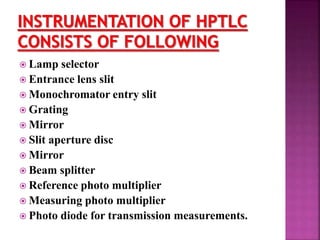
 Lamp selector
 Entrance lens slit
 Monochromator entry slit
 Grating
 Mirror
 Slit aperture disc
 Mirror
 Beam splitter
 Reference photo multiplier
 Measuring photo multiplier
 Photo diode for transmission measurements.
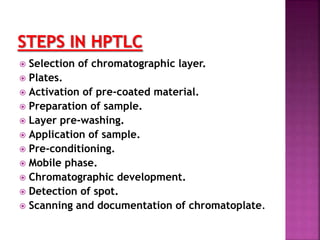
 Selection of chromatographic layer.
 Plates.
 Activation of pre-coated material.
 Preparation of sample.
 Layer pre-washing.
 Application of sample.
 Pre-conditioning.
 Mobile phase.
 Chromatographic development.
 Detection of spot.
 Scanning and documentation of chromatoplate.
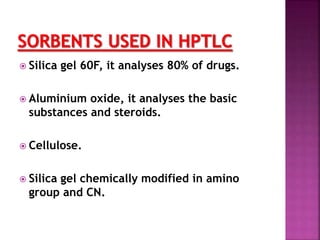
 Silica gel 60F, it analyses 80% of drugs.
 Aluminium oxide, it analyses the basic
substances and steroids.
 Cellulose.
 Silica gel chemically modified in amino
group and CN.
 Glass plates.
 Polyester/polyethylene plates.
 Aluminium plates.
 For normal chromatography , solvent
should be non-polar and volatile.
 For reversed chromatography , polar
solvent is used for dissolving the sample.
 Sample and reference substances should be
dissolved in the same solvent to ensure
comparable distribution at starting zones.
 Methanol.
 Chloroform: Methanol (1:1)
 Chloroform: Methanol: Ammonia (90:10:1 )
 Methylene chloride: Methanol ( 1:1 )
 Ammonia solution (1%)
The selection of sample application
technique and device to be used
depends primarily on,
• Sample volume
• No. of samples to be applied
• Required precision
 Micro syringes are preferred if automatic
application devices are not available.
 Volume recommended for HPTLC-0.5-5μl.
 Sample spotting should not be excess or
not low.
 Problem from overloading can be overcome
by applying the sample as band.
 By capillary tube,0.1-0.2μl volume sample
spot is applied.
 By micro syringes, 1μl sample can apply
either as spot or band.
 By automatic sample applicator.
 By micro bulb pipette.
 Time required for the saturation depends
on the mobile phase.
 If unsaturated chamber used for
development, the solvent evaporates from
the plate mainly at the solvent front and it
results in increased Rf values.
 Solvent composition expressed in v/v.
 Mobile phase should be of high graded.
 Chemical properties , analyses and
sorbent layer factors should be
considered while selection of mobile
phase.
 If possible mobile phase containing
more than 3 or 4 components should be
avoided.
 Prevents contamination of solvents.
 Multi-component of mobile phase once
used is not recommended for re-use.
 Chemical reaction avoided between SP &
MP. e.g. Acetic acid, Ammonia.
 Vertical development.
 Vario method development.
 Horizontal development.
 Automatic multiple development.
 First spots detects under UV light because
it is non destructive.
 Fluorescent compound spots can be seen
at 254nm or 366nm.
 For non fluorescent compound spots,
fluorescent stationary phase (silica gel GF)
is used.
 Non UV absorbing compounds detects by
dipping the plates in 0.1% iodine solution.
 Layer thickness.
 Mobile phase.
 Solvent purity
 Size of developing chamber
 Sample volume to be spotted
 Size of initial spot
 Solvent level in chamber.
 Pharmaceutical industry : quality control,
purity check etc.
 Food analysis : quality control, stability
testing etc.
 Clinical applications : metabolism studies,
drug screening etc.
 Forensic : poisoning investigations.
 HIGH PERFORMANCE THIN LAYER CHROMATOGRAPHY
Manmohan srivastava
-THANK YOU

HPTLC

  • 1.
    Presented by : ArvindSingh Heer MSc-I (Sem-I) Analytical Chemistry MITHIBAI COLLEGE
  • 2.
     Introduction.  Principleof HPTLC.  Instrumentation of HPTLC.  Difference between TLC & HPTLC.  Steps involved in HPTLC.  Applications of HPTLC.
  • 3.
     Sophisticated formof TLC.  In 1973,Halpaap introduced first “Nano TLC plates.’’  In 1977,the first major HPTLC publication is “HPTLC-high”
  • 4.
     Separation mayresult due to adsorption or partition or by both phenomenon depending upon the nature of adsorbents used on plates and solvents system used for development.
  • 5.
     Lamp selector Entrance lens slit  Monochromator entry slit  Grating  Mirror  Slit aperture disc  Mirror  Beam splitter  Reference photo multiplier  Measuring photo multiplier  Photo diode for transmission measurements.
  • 8.
     Selection ofchromatographic layer.  Plates.  Activation of pre-coated material.  Preparation of sample.  Layer pre-washing.  Application of sample.  Pre-conditioning.  Mobile phase.  Chromatographic development.  Detection of spot.  Scanning and documentation of chromatoplate.
  • 9.
     Silica gel60F, it analyses 80% of drugs.  Aluminium oxide, it analyses the basic substances and steroids.  Cellulose.  Silica gel chemically modified in amino group and CN.
  • 10.
     Glass plates. Polyester/polyethylene plates.  Aluminium plates.
  • 11.
     For normalchromatography , solvent should be non-polar and volatile.  For reversed chromatography , polar solvent is used for dissolving the sample.  Sample and reference substances should be dissolved in the same solvent to ensure comparable distribution at starting zones.
  • 12.
     Methanol.  Chloroform:Methanol (1:1)  Chloroform: Methanol: Ammonia (90:10:1 )  Methylene chloride: Methanol ( 1:1 )  Ammonia solution (1%)
  • 13.
    The selection ofsample application technique and device to be used depends primarily on, • Sample volume • No. of samples to be applied • Required precision
  • 14.
     Micro syringesare preferred if automatic application devices are not available.  Volume recommended for HPTLC-0.5-5μl.  Sample spotting should not be excess or not low.  Problem from overloading can be overcome by applying the sample as band.
  • 15.
     By capillarytube,0.1-0.2μl volume sample spot is applied.  By micro syringes, 1μl sample can apply either as spot or band.  By automatic sample applicator.  By micro bulb pipette.
  • 16.
     Time requiredfor the saturation depends on the mobile phase.  If unsaturated chamber used for development, the solvent evaporates from the plate mainly at the solvent front and it results in increased Rf values.
  • 17.
     Solvent compositionexpressed in v/v.  Mobile phase should be of high graded.  Chemical properties , analyses and sorbent layer factors should be considered while selection of mobile phase.  If possible mobile phase containing more than 3 or 4 components should be avoided.
  • 18.
     Prevents contaminationof solvents.  Multi-component of mobile phase once used is not recommended for re-use.  Chemical reaction avoided between SP & MP. e.g. Acetic acid, Ammonia.
  • 19.
     Vertical development. Vario method development.  Horizontal development.  Automatic multiple development.
  • 20.
     First spotsdetects under UV light because it is non destructive.  Fluorescent compound spots can be seen at 254nm or 366nm.  For non fluorescent compound spots, fluorescent stationary phase (silica gel GF) is used.  Non UV absorbing compounds detects by dipping the plates in 0.1% iodine solution.
  • 21.
     Layer thickness. Mobile phase.  Solvent purity  Size of developing chamber  Sample volume to be spotted  Size of initial spot  Solvent level in chamber.
  • 22.
     Pharmaceutical industry: quality control, purity check etc.  Food analysis : quality control, stability testing etc.  Clinical applications : metabolism studies, drug screening etc.  Forensic : poisoning investigations.
  • 23.
     HIGH PERFORMANCETHIN LAYER CHROMATOGRAPHY Manmohan srivastava -THANK YOU