A Description on HPLC
Presented by
Md. Ashraful Kader
4th yr 2nd semester
Department of Genetic Engineering and Biotechnology
Jessore University of Science and Technology
Jessore-7408, Bangladesh
1
HPLC in 1973
HPLC in 2009
Introduction
2
HPLC
• It means that High Performance Liquid Chromatography
•A popular analytical technique used for the separation, identification
and quantification of mixtures of organic compounds.
• It employs a liquid mobile phase and a very finely divided stationary
phase used to separate compounds that are dissolved in solution.
3
History of HPLC
• 1903- Chromatography was discovered to separated plant pigments.
• 1970- High pressure liquid chromatography was developed
• 1980- HPLC was commonly used for the separation of chemical
compounds.
4
Principle
• The principle of HPLC separation is Partitioning.
• Separation is based on the analyte’s relative solubility between two
liquid phases
• The analytes are dissolved in a mobile phase.
• mobile phase =driving force
• Stationary phase=retarding force
• Separations occur as a result of:
• Difference in affinity towards the stationary phase
• There is no 2 components have the same affinity.
5
TYPES OF HPLC
• Depending upon the phase system used in the process HPLC are of
following types:-
• Normal phase chromatography: It separates analytes based on polarity. A
polar stationary phase and a non-polar mobile phase is used. Used for
water-sensitive compounds, geometric isomers, cis-trans isomers and
chiral compounds.
• Reversed phase chromatography: Has a non-polar stationary phase and an
aqueous, moderately polar mobile phase. It can be used for polar, non
polar, ionizable and ionic samples.
• Size exclusion chromatography : It also called as gel permeation
chromatography or gel filtration chromatography. It separates particles
according to their relative size to the pore size. useful for determining the
tertiary structure and quaternary structure of proteins and amino acids.
6
TYPES OF HPLC
• Ion exchange chromatography: Stationary phase is having ionically
charged surface opposite to the sample charge. The mobile phase
used is aqueous buffer which will control pH and ionic strength. Used
to separate anions and cations.
• Bio-affinity chromatography: Separation based on specific reversible
interaction of proteins with ligands. Proteins bound to a bio-affinity
column can be eluted in two ways:
1. Bio specific elution
2. Aspecific elution:
7
Components of HPLC
• Solvent or mobile phase reservoir
• High pressure pump
• Injector
• Column
• Detector
• Computer
8
Common Solvents for HPLC Mobile Phase
n-Hexane (n-hex)
Iso-octane (iso-oct)
chloroform (CHCL2)
Dichloromethane (CH2CL2)
Ethylacetate (AcOEt)
Isopropaylalcohol IPA
Tetrahydrofran THF
Dioxane
Acetonitrile CH2CN
Ethanol EtOH
Methanol MeOH
Amines
Acids 9
HPLC system
10
Sample & solvent preparation
• Solvents also called mobile phase because it moves.
• Degas the mobile phase to avoid having a bubble.
• Filter the sample in time.
• If not immediately used, put it in the refrigerator.
11
Injection of the solvent & sample
• Mobile phase enters into the line at a specific flow rate.
• An injector introduce the sample into the continuously flowing
mobile phase stream.
12
Passage through the column
• Mobile phase enters the column with sample.
• Sample enters the column and begins to form a band.
• The sample shown by yellow, red, and blue dyes which appears at the
inlet of the column as a single black band.
• Individual dyes have moved in separate bands at different speeds.
• The yellow dye likes the mobile phase more than the other dyes.
13
Detection
• The separated dye bands pass immediately into the detector.
• The detector contains a flow cell that detects separated compound
band against a background of mobile phase.
• The detector detect the presence of a compound and send its
corresponding electrical signal to a computer data station.
• The most common are:
• Spectroscopic Detection
• Refractive Index Detection
• Fluorescence Detection
14
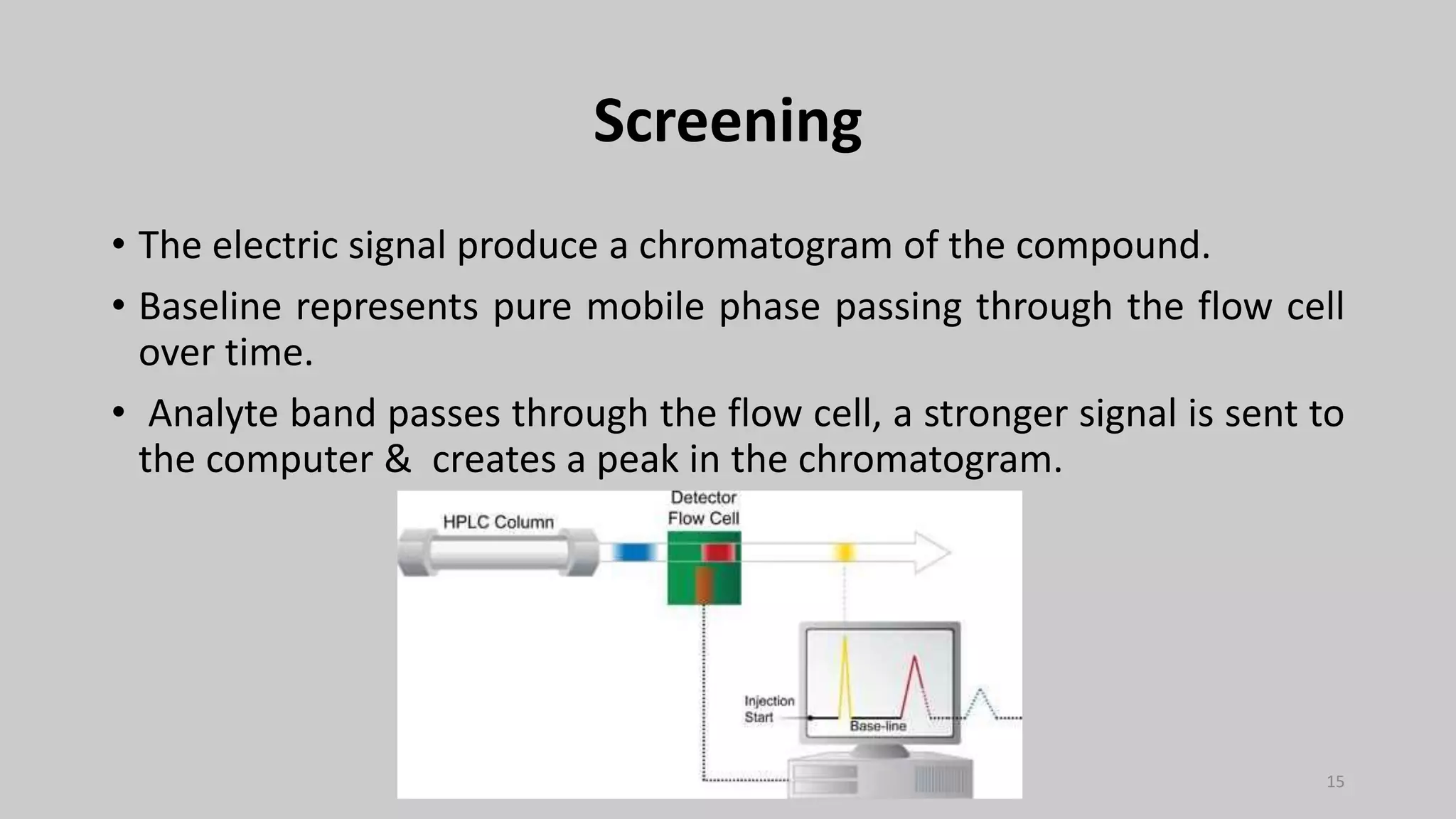
Screening
• The electric signal produce a chromatogram of the compound.
• Baseline represents pure mobile phase passing through the flow cell
over time.
• Analyte band passes through the flow cell, a stronger signal is sent to
the computer & creates a peak in the chromatogram.
15
Factors Influencing HPLC Separation
Parameters affecting efficiency:
•Flow rate
•Column length
•Particle diameter
•Particle size distribution
Parameters affecting retention
factor:
•Eluent type
•Eluent composition
•Stationary phase type
•Analyte nature
Parameters affecting selectivity:
•Stationary phase type
•Analyte nature
•Eluent additives
•Temperature
•Eluent composition (ionizable
analytes)
16
Application
• Pharmaceutical applications
• Environmental applications
• Forensics
• Clinical
• Diagnosis
• Food and Flavour Applications
17
Advantages of HPLC
• Simultaneous analysis
• High resolution
• High sensitivity
• Good repeatability
• Moderate analysis condition
• Easy to fractionate and purify
• Typical analysis time of 5-20 min, precision <0.5-1% RSD
18
Disadvantages of HPLC
• Costly, complex and doesn't work for all samples.
• Requiring large quantities of expensive organics.
• Tedious to detect elusion.
19
Why to use HPLC
• To test for the presence of a specific compound/metabolite.
• Quality control within the pharmaceutical industry.
• To analyze all of the compounds in a complex mixture.
• To separate and purify compound(s) of interest.
• Monitor chemical reactions.
• Assay platform for detection of metabolites.
• Compound identification.
• Quantification.
20
Comparison of HPLC and GC
HPLC
• No volatility requirement. Sample must be
soluble in mobile phase.
• Separates both polar and non polar
compounds.
• Analysis can take place at or below room
temperature.
• Sample size based upon column
GC
• Sample must be volatile.
• Samples are nonpolar and polar.
• Sample must be able to survive high
temperature injection port and column.
• Typically 1 - 5 L
21
Comparison of TLC and HPLC
Types of Analysis Qualitative only Qualitative &
Quantitative
Stationary Phase 2-dimensional
thin layer plate
3-dimensional
column
Sample Application spotting
(capillary)
injection
(Rheodyne injector)
Mobile Phase Movement capillary action
(during development)
high pressure
(solvent delivery)
Instrumentation minimal much! with many
adjustable parameters
Visualization of Results UV lightbox “on-line” detection
(variable UV/Vis)
22
Thank You
23

High Performance Liquid Chromatography

  • 1.
    A Description onHPLC Presented by Md. Ashraful Kader 4th yr 2nd semester Department of Genetic Engineering and Biotechnology Jessore University of Science and Technology Jessore-7408, Bangladesh 1
  • 2.
    HPLC in 1973 HPLCin 2009 Introduction 2
  • 3.
    HPLC • It meansthat High Performance Liquid Chromatography •A popular analytical technique used for the separation, identification and quantification of mixtures of organic compounds. • It employs a liquid mobile phase and a very finely divided stationary phase used to separate compounds that are dissolved in solution. 3
  • 4.
    History of HPLC •1903- Chromatography was discovered to separated plant pigments. • 1970- High pressure liquid chromatography was developed • 1980- HPLC was commonly used for the separation of chemical compounds. 4
  • 5.
    Principle • The principleof HPLC separation is Partitioning. • Separation is based on the analyte’s relative solubility between two liquid phases • The analytes are dissolved in a mobile phase. • mobile phase =driving force • Stationary phase=retarding force • Separations occur as a result of: • Difference in affinity towards the stationary phase • There is no 2 components have the same affinity. 5
  • 6.
    TYPES OF HPLC •Depending upon the phase system used in the process HPLC are of following types:- • Normal phase chromatography: It separates analytes based on polarity. A polar stationary phase and a non-polar mobile phase is used. Used for water-sensitive compounds, geometric isomers, cis-trans isomers and chiral compounds. • Reversed phase chromatography: Has a non-polar stationary phase and an aqueous, moderately polar mobile phase. It can be used for polar, non polar, ionizable and ionic samples. • Size exclusion chromatography : It also called as gel permeation chromatography or gel filtration chromatography. It separates particles according to their relative size to the pore size. useful for determining the tertiary structure and quaternary structure of proteins and amino acids. 6
  • 7.
    TYPES OF HPLC •Ion exchange chromatography: Stationary phase is having ionically charged surface opposite to the sample charge. The mobile phase used is aqueous buffer which will control pH and ionic strength. Used to separate anions and cations. • Bio-affinity chromatography: Separation based on specific reversible interaction of proteins with ligands. Proteins bound to a bio-affinity column can be eluted in two ways: 1. Bio specific elution 2. Aspecific elution: 7
  • 8.
    Components of HPLC •Solvent or mobile phase reservoir • High pressure pump • Injector • Column • Detector • Computer 8
  • 9.
    Common Solvents forHPLC Mobile Phase n-Hexane (n-hex) Iso-octane (iso-oct) chloroform (CHCL2) Dichloromethane (CH2CL2) Ethylacetate (AcOEt) Isopropaylalcohol IPA Tetrahydrofran THF Dioxane Acetonitrile CH2CN Ethanol EtOH Methanol MeOH Amines Acids 9
  • 10.
  • 11.
    Sample & solventpreparation • Solvents also called mobile phase because it moves. • Degas the mobile phase to avoid having a bubble. • Filter the sample in time. • If not immediately used, put it in the refrigerator. 11
  • 12.
    Injection of thesolvent & sample • Mobile phase enters into the line at a specific flow rate. • An injector introduce the sample into the continuously flowing mobile phase stream. 12
  • 13.
    Passage through thecolumn • Mobile phase enters the column with sample. • Sample enters the column and begins to form a band. • The sample shown by yellow, red, and blue dyes which appears at the inlet of the column as a single black band. • Individual dyes have moved in separate bands at different speeds. • The yellow dye likes the mobile phase more than the other dyes. 13
  • 14.
    Detection • The separateddye bands pass immediately into the detector. • The detector contains a flow cell that detects separated compound band against a background of mobile phase. • The detector detect the presence of a compound and send its corresponding electrical signal to a computer data station. • The most common are: • Spectroscopic Detection • Refractive Index Detection • Fluorescence Detection 14
  • 15.
    Screening • The electricsignal produce a chromatogram of the compound. • Baseline represents pure mobile phase passing through the flow cell over time. • Analyte band passes through the flow cell, a stronger signal is sent to the computer & creates a peak in the chromatogram. 15
  • 16.
    Factors Influencing HPLCSeparation Parameters affecting efficiency: •Flow rate •Column length •Particle diameter •Particle size distribution Parameters affecting retention factor: •Eluent type •Eluent composition •Stationary phase type •Analyte nature Parameters affecting selectivity: •Stationary phase type •Analyte nature •Eluent additives •Temperature •Eluent composition (ionizable analytes) 16
  • 17.
    Application • Pharmaceutical applications •Environmental applications • Forensics • Clinical • Diagnosis • Food and Flavour Applications 17
  • 18.
    Advantages of HPLC •Simultaneous analysis • High resolution • High sensitivity • Good repeatability • Moderate analysis condition • Easy to fractionate and purify • Typical analysis time of 5-20 min, precision <0.5-1% RSD 18
  • 19.
    Disadvantages of HPLC •Costly, complex and doesn't work for all samples. • Requiring large quantities of expensive organics. • Tedious to detect elusion. 19
  • 20.
    Why to useHPLC • To test for the presence of a specific compound/metabolite. • Quality control within the pharmaceutical industry. • To analyze all of the compounds in a complex mixture. • To separate and purify compound(s) of interest. • Monitor chemical reactions. • Assay platform for detection of metabolites. • Compound identification. • Quantification. 20
  • 21.
    Comparison of HPLCand GC HPLC • No volatility requirement. Sample must be soluble in mobile phase. • Separates both polar and non polar compounds. • Analysis can take place at or below room temperature. • Sample size based upon column GC • Sample must be volatile. • Samples are nonpolar and polar. • Sample must be able to survive high temperature injection port and column. • Typically 1 - 5 L 21
  • 22.
    Comparison of TLCand HPLC Types of Analysis Qualitative only Qualitative & Quantitative Stationary Phase 2-dimensional thin layer plate 3-dimensional column Sample Application spotting (capillary) injection (Rheodyne injector) Mobile Phase Movement capillary action (during development) high pressure (solvent delivery) Instrumentation minimal much! with many adjustable parameters Visualization of Results UV lightbox “on-line” detection (variable UV/Vis) 22
  • 23.