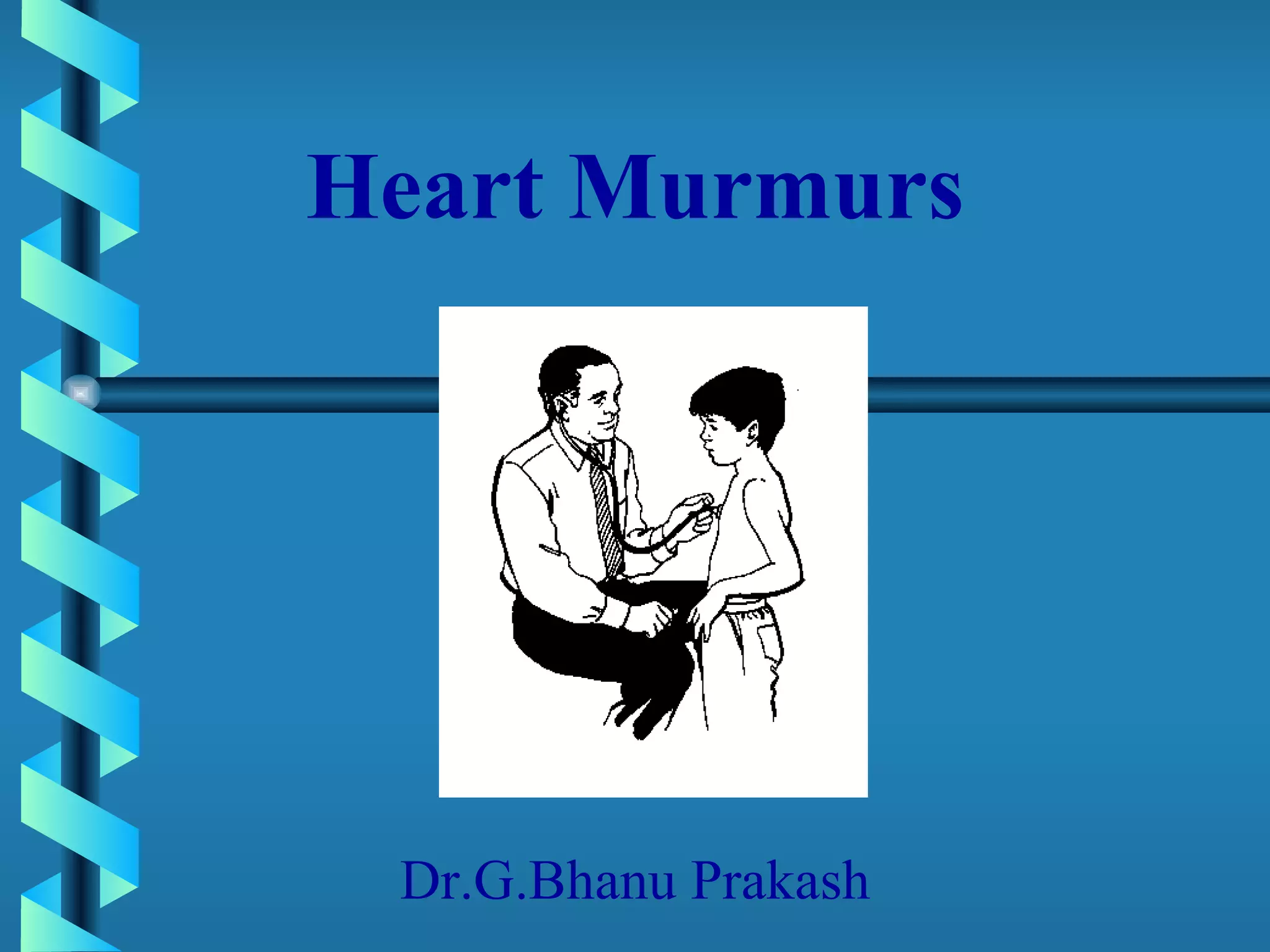
Heart Murmurs Dr.G.Bhanu Prakash
Outline I.  Basic Pathophysiology II.  Describing murmurs III.  Systolic murmurs IV.  Diastolic murmurs V.  Continuous murmurs VI.  Summary
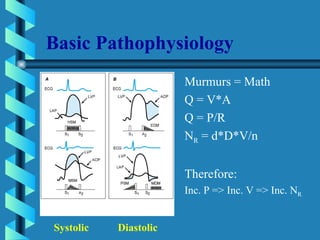
Basic Pathophysiology Murmurs = Math Q = V*A Q = P/R N R  = d*D*V/n Therefore: Inc. P => Inc. V => Inc. N R Systolic   Diastolic
Describing a heart murmur 1.  Timing murmurs are longer than heart sounds HS can distinguished by simultaneous palpation of the carotid arterial pulse systolic, diastolic, continuous 2.  Shape crescendo (grows louder), decrescendo, crescendo-decrescendo, plateau 3.  Location of maximum intensity is determined by the site where the murmur originates e.g.  A, P, T, M listening areas
Describing a heart murmur con’t: 4.  Radiation reflects the intensity of the murmur and the direction of blood flow 5.  Intensity graded on a 6 point scale Grade 1 = very faint Grade 2 = quiet but heard immediately Grade 3 = moderately loud Grade 4 = loud Grade 5 = heard with stethoscope partly off the chest Grade 6 = no stethoscope needed *Note:  Thrills are assoc. with murmurs of grades 4 - 6
Describing a heart murmur con’t: 6.  Pitch high, medium, low 7.  Quality blowing, harsh, rumbling, and musical 8.  Others: i.  Variation with respiration Right sided murmurs change more than left sided ii.  Variation with position of the patient iii.  Variation with special maneuvers Valsalva/Standing => Murmurs decrease in length and intensity EXCEPT:  Hypertrophic cardiomyopathy and Mitral valve prolapse
Systolic Murmurs Derived from increased turbulence associated with: 1.  Increased flow across normal SL valve or into a dilated great vessel 2.  Flow across an abnormal SL valve or narrowed ventricular outflow tract - e.g. aortic stenosis 3.  Flow across an incompetent AV valve - e.g. mitral regurg. 4.  Flow across the interventricular septum
Early Systolic murmurs 1.  Acute severe mitral regurgitation decrescendo murmur best heard at apical impulse  Caused by: i.  Papillary muscle rupture ii.  Infective endocarditis  iii.  Rupture of the chordae tendineae iv.  Blunt chest wall trauma 2.  Congenital, small muscular septal defect 3.  Tricuspid regurg. with normal PA pressures
Midsystolic (ejection) murmurs Are the most common kind of heart murmur Are usually crescendo-decrescendo They may be: 1.  Innocent common in children and young adults 2.  Physiologic can be detected in hyperdynamic states e.g.  anemia, pregnancy, fever, and hyperthyroidism 3.  Pathologic are secondary to structural CV abnormalities e.g.  Aortic stenosis, Hypertrophic cardiomyopathy, Pulmonic stenosis
Aortic stenosis Loudest in aortic area; radiates along the carotid arteries Intensity varies directly with CO A2 decreases as the stenosis worsens Other conditions which may mimic the murmur of aortic stenosis w/o obstructing flow: 1.  Aortic sclerosis 2.  Bicuspid aortic valve 3.  Dilated aorta 4.  Increased flow across the valve during systole
Hypertrophic cardiomyopathy Loudest b/t left sternal edge and apex;  Grade 2-3/6 Does NOT radiate into neck;  carotid upstrokes are brisk and may be bifid Intensity increases w/ maneuvers that decrease LV volume
Pansystolic (Holosystolic) Murmurs Are pathologic Murmur begins immediately with S1 and continues up to S2 1.  Mitral valve regurgitation Loudest at the left ventricular apex Radiation reflects the direction of the regurgitant jet i.  To the base of the heart = anterosuperior jet (flail posterior leaflet) ii.  To the axilla and back = posterior jet (flail anterior leaflet Also usually associated with a  systolic thrill , a  soft S3 , and a short  diastolic rumbling  (best heard in left lateral decubitus 2.  Tricuspid valve regurgitation 3.  Ventricular septal defect
Diastolic Murmurs Almost always indicate heart disease Two basic types : 1.  Early decrescendo diastolic murmurs signify regurgitant flow through an imcompetent semilunar valve e.g. aortic regurgitation 2.  Rumbling diastolic murmurs in mid- or late diastole suggest stenosis of an AV valve e.g. mitral stenosis
Aortic Regurgitation Best heard in the 2nd ICS at the left sternal edge High pitched, decrescendo Blowing quality => may be mistaken for breath sounds Radiation: i.  Left sternal border = assoc. with primary valvular pathology; ii.  Right sternal edge = assoc. w/ primary aortic root pathology Other associated murmurs: i.  Midsystolic murmur ii.  Austin Flint murmur
Mitral Stenosis Two components: 1.  Middiastolic - during rapid ventricular filling 2.  Presystolic - during atrial contraction;  therefore, it  disappears if atrial fibrillation develops Is low-pitched and best heard over the apex (w/ the bell) Little or no radiation Murmur begins after an Opening Snap; S1 is accentuated
Continuous Murmurs Begin in systole, peak near s2, and continue into all or part of diastole. 1.  Cervical venous hum Audible in kids; can be abolished by compression over the IJV 2.  Mammary souffle Represents augmented arterial flow through engorged breasts Becomes audible during late 3rd trimester and lactation 3.  Patent Ductus Arteriosus Has a harsh, machinery-like quality 4.  Pericardial friction rub Has scratchy, scraping quality
Back to the Basics 1.  When does it occur - systole or diastole 2.  Where is it loudest - A, P, T, M I.  Systolic Murmurs: 1.  Aortic stenosis - ejection type 2.  Mitral regurgitation - holosystolic 3.  Mitral valve prolapse - late systole II.  Diastolic Murmurs: 1.  Aortic regurgitation - early diastole 2.  Mitral stenosis - mid to late diastole
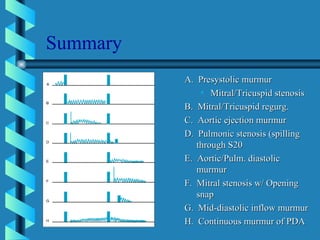
Summary A.  Presystolic murmur Mitral/Tricuspid stenosis B.  Mitral/Tricuspid regurg. C.  Aortic ejection murmur D.  Pulmonic stenosis (spilling through S20 E.  Aortic/Pulm. diastolic murmur F.  Mitral stenosis w/ Opening snap G.  Mid-diastolic inflow murmur H.  Continuous murmur of PDA

Heart murmurs

  • 1.
  • 2.
    Outline I. Basic Pathophysiology II. Describing murmurs III. Systolic murmurs IV. Diastolic murmurs V. Continuous murmurs VI. Summary
  • 3.
    Basic Pathophysiology Murmurs= Math Q = V*A Q = P/R N R = d*D*V/n Therefore: Inc. P => Inc. V => Inc. N R Systolic Diastolic
  • 4.
    Describing a heartmurmur 1. Timing murmurs are longer than heart sounds HS can distinguished by simultaneous palpation of the carotid arterial pulse systolic, diastolic, continuous 2. Shape crescendo (grows louder), decrescendo, crescendo-decrescendo, plateau 3. Location of maximum intensity is determined by the site where the murmur originates e.g. A, P, T, M listening areas
  • 5.
    Describing a heartmurmur con’t: 4. Radiation reflects the intensity of the murmur and the direction of blood flow 5. Intensity graded on a 6 point scale Grade 1 = very faint Grade 2 = quiet but heard immediately Grade 3 = moderately loud Grade 4 = loud Grade 5 = heard with stethoscope partly off the chest Grade 6 = no stethoscope needed *Note: Thrills are assoc. with murmurs of grades 4 - 6
  • 6.
    Describing a heartmurmur con’t: 6. Pitch high, medium, low 7. Quality blowing, harsh, rumbling, and musical 8. Others: i. Variation with respiration Right sided murmurs change more than left sided ii. Variation with position of the patient iii. Variation with special maneuvers Valsalva/Standing => Murmurs decrease in length and intensity EXCEPT: Hypertrophic cardiomyopathy and Mitral valve prolapse
  • 7.
    Systolic Murmurs Derivedfrom increased turbulence associated with: 1. Increased flow across normal SL valve or into a dilated great vessel 2. Flow across an abnormal SL valve or narrowed ventricular outflow tract - e.g. aortic stenosis 3. Flow across an incompetent AV valve - e.g. mitral regurg. 4. Flow across the interventricular septum
  • 8.
    Early Systolic murmurs1. Acute severe mitral regurgitation decrescendo murmur best heard at apical impulse Caused by: i. Papillary muscle rupture ii. Infective endocarditis iii. Rupture of the chordae tendineae iv. Blunt chest wall trauma 2. Congenital, small muscular septal defect 3. Tricuspid regurg. with normal PA pressures
  • 9.
    Midsystolic (ejection) murmursAre the most common kind of heart murmur Are usually crescendo-decrescendo They may be: 1. Innocent common in children and young adults 2. Physiologic can be detected in hyperdynamic states e.g. anemia, pregnancy, fever, and hyperthyroidism 3. Pathologic are secondary to structural CV abnormalities e.g. Aortic stenosis, Hypertrophic cardiomyopathy, Pulmonic stenosis
  • 10.
    Aortic stenosis Loudestin aortic area; radiates along the carotid arteries Intensity varies directly with CO A2 decreases as the stenosis worsens Other conditions which may mimic the murmur of aortic stenosis w/o obstructing flow: 1. Aortic sclerosis 2. Bicuspid aortic valve 3. Dilated aorta 4. Increased flow across the valve during systole
  • 11.
    Hypertrophic cardiomyopathy Loudestb/t left sternal edge and apex; Grade 2-3/6 Does NOT radiate into neck; carotid upstrokes are brisk and may be bifid Intensity increases w/ maneuvers that decrease LV volume
  • 12.
    Pansystolic (Holosystolic) MurmursAre pathologic Murmur begins immediately with S1 and continues up to S2 1. Mitral valve regurgitation Loudest at the left ventricular apex Radiation reflects the direction of the regurgitant jet i. To the base of the heart = anterosuperior jet (flail posterior leaflet) ii. To the axilla and back = posterior jet (flail anterior leaflet Also usually associated with a systolic thrill , a soft S3 , and a short diastolic rumbling (best heard in left lateral decubitus 2. Tricuspid valve regurgitation 3. Ventricular septal defect
  • 13.
    Diastolic Murmurs Almostalways indicate heart disease Two basic types : 1. Early decrescendo diastolic murmurs signify regurgitant flow through an imcompetent semilunar valve e.g. aortic regurgitation 2. Rumbling diastolic murmurs in mid- or late diastole suggest stenosis of an AV valve e.g. mitral stenosis
  • 14.
    Aortic Regurgitation Bestheard in the 2nd ICS at the left sternal edge High pitched, decrescendo Blowing quality => may be mistaken for breath sounds Radiation: i. Left sternal border = assoc. with primary valvular pathology; ii. Right sternal edge = assoc. w/ primary aortic root pathology Other associated murmurs: i. Midsystolic murmur ii. Austin Flint murmur
  • 15.
    Mitral Stenosis Twocomponents: 1. Middiastolic - during rapid ventricular filling 2. Presystolic - during atrial contraction; therefore, it disappears if atrial fibrillation develops Is low-pitched and best heard over the apex (w/ the bell) Little or no radiation Murmur begins after an Opening Snap; S1 is accentuated
  • 16.
    Continuous Murmurs Beginin systole, peak near s2, and continue into all or part of diastole. 1. Cervical venous hum Audible in kids; can be abolished by compression over the IJV 2. Mammary souffle Represents augmented arterial flow through engorged breasts Becomes audible during late 3rd trimester and lactation 3. Patent Ductus Arteriosus Has a harsh, machinery-like quality 4. Pericardial friction rub Has scratchy, scraping quality
  • 17.
    Back to theBasics 1. When does it occur - systole or diastole 2. Where is it loudest - A, P, T, M I. Systolic Murmurs: 1. Aortic stenosis - ejection type 2. Mitral regurgitation - holosystolic 3. Mitral valve prolapse - late systole II. Diastolic Murmurs: 1. Aortic regurgitation - early diastole 2. Mitral stenosis - mid to late diastole
  • 18.
    Summary A. Presystolic murmur Mitral/Tricuspid stenosis B. Mitral/Tricuspid regurg. C. Aortic ejection murmur D. Pulmonic stenosis (spilling through S20 E. Aortic/Pulm. diastolic murmur F. Mitral stenosis w/ Opening snap G. Mid-diastolic inflow murmur H. Continuous murmur of PDA