Acute Poststreptococcal
Glomerulonephritis
(APSGN)
Dr. Muhammad Sajjad
Sabir
MBBS, DCH, MCPS, FCPS
Assistant Professor of Paediatrics
Acute Nephritic
Syndrome
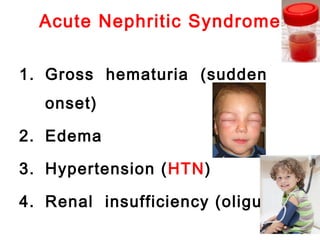
Acute Nephritic Syndrome
1. Gross hematuria (sudden
onset)
2. Edema
3. Hypertension (HTN)
4. Renal insufficiency (oliguria)
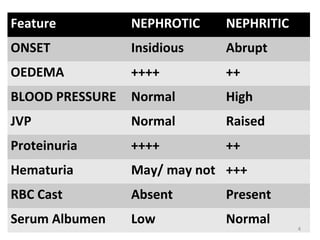
Feature NEPHROTIC NEPHRITIC
ONSET Insidious Abrupt
OEDEMA ++++ ++
BLOOD PRESSURE Normal High
JVP Normal Raised
Proteinuria ++++ ++
Hematuria May/ may not +++
RBC Cast Absent Present
Serum Albumen Low Normal
4
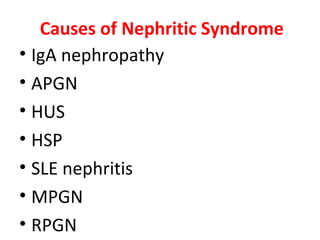
Causes of Nephritic Syndrome
• IgA nephropathy
• APGN
• HUS
• HSP
• SLE nephritis
• MPGN
• RPGN
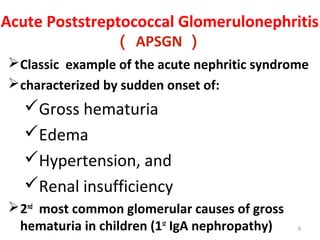
Acute Poststreptococcal Glomerulonephritis
( APSGN )
Classic example of the acute nephritic syndrome
characterized by sudden onset of:
Gross hematuria
Edema
Hypertension, and
Renal insufficiency
2nd
most common glomerular causes of gross
hematuria in children (1st
IgA nephropathy) 6
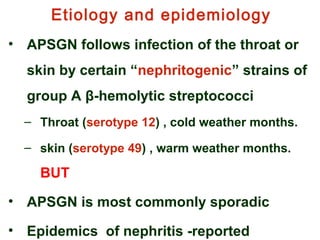
• APSGN follows infection of the throat or
skin by certain “nephritogenic” strains of
group A β-hemolytic streptococci
– Throat (serotype 12) , cold weather months.
– skin (serotype 49) , warm weather months.
BUT
• APSGN is most commonly sporadic
• Epidemics of nephritis -reported
Etiology and epidemiology
PATHOLOGY
• Kidneys →symmetrically enlarged
• Light microscopy,
• All glomeruli appear enlarged & relatively bloodless
• Diffuse mesangial cell proliferation
• Increase mesangial matrix
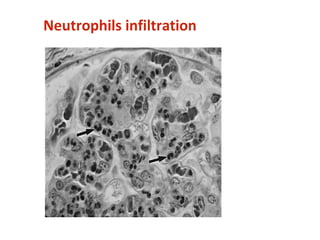
• Polymorphonuclear leukocytes in glomeruli
• Crescents and interstitial inflammation
• These changes are not specific for
poststreptococcal glomerulonephritis
8
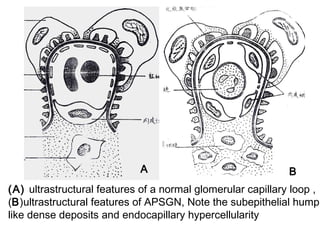
(A) ultrastructural features of a normal glomerular capillary loop ,
(B)ultrastructural features of APSGN, Note the subepithelial hump
like dense deposits and endocapillary hypercellularity
A B
Neutrophils infiltration
PATHOLOGY
 
Immunofluorescence microscopy
Lumpy-bumpy deposits of immunoglobulin
complement on glomerular basement
membrane (GBM)
in the mesangium.
Electron microscopy
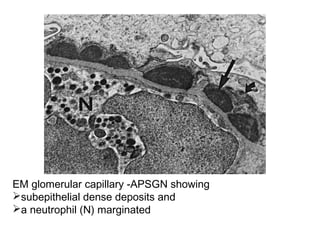
Electron-dense deposits, or "humps," on the
epithelial side of the GBM
EM glomerular capillary -APSGN showing
subepithelial dense deposits and
a neutrophil (N) marginated
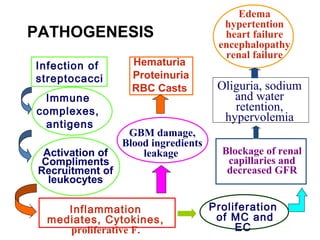
Immune
complexes,
antigens
Activation of
Compliments
Recruitment of
leukocytes
GBM damage,
Blood ingredients
leakage
Hematuria
Proteinuria
RBC Casts
Proliferation
of MC and
EC
Blockage of renal
capillaries and
decreased GFR
Edema
hypertention
heart failure
encephalopathy
renal failure
Oliguria, sodium
and water
retention,
hypervolemia
Inflammation
mediates, Cytokines,
proliferative F.
Infection of
streptocacci
PATHOGENESIS
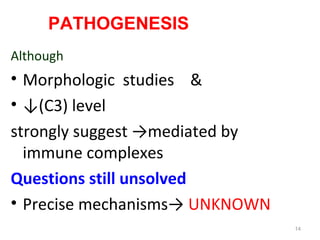
Although
• Morphologic studies &
• ↓(C3) level
strongly suggest →mediated by
immune complexes
Questions still unsolved
• Precise mechanisms→ UNKNOWN
14
PATHOGENESIS
Clinical
Manifestations
15
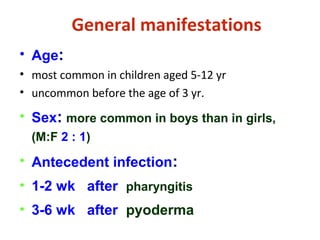
General manifestations
• Age:
• most common in children aged 5-12 yr
• uncommon before the age of 3 yr.
• Sex: more common in boys than in girls,
(M:F 2 : 1)
• Antecedent infection:
• 1-2 wk after pharyngitis
• 3-6 wk after pyoderma
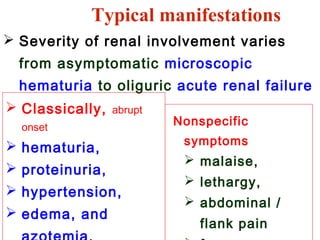
Typical manifestations
 Severity of renal involvement varies
from asymptomatic microscopic
hematuria to oliguric acute renal failure
Nonspecific
symptoms
 malaise,
 lethargy,
 abdominal /
flank pain
 Classically, abrupt
onset
 hematuria,
 proteinuria,
 hypertension,
 edema, and
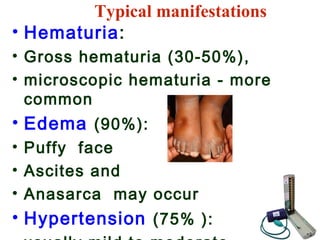
• Hematuria:
• Gross hematuria (30-50%),
• microscopic hematuria - more
common
• Edema (90%):
• Puffy face
• Ascites and
• Anasarca may occur
• Hypertension (75% ):
Typical manifestations
• Oliguria and anuria :
• transient oliguria.
• Anuria is infrequent
• Proteinuria
–Many patients have significant
proteinuria
–<5% - frank nephrotic syndrome.
Typical manifestations
Subclinical, microscopic
hematuria may be four times
more common as overt acute
PSGN
Attention
Clinical course
– Spontaneous improvement begins within 1 wk
– Edema-- resolves in 5-10 days
– Hypertension-- normalize by 4-6 wk after onset
– Proteinuria -- normalize by 4-6 wk
• Acute phase resolves within 6-8 wk.
• Microscopic hematuria may persist 1-2 yr
INVESTIGATIONS
22
• Urinalysis
– demonstrates red blood cells (RBCs),
– RBC casts
– Proteinuria
– ↑WBC
• CBC
– Mild normochromic anemia (due to hemodilution and
low-grade hemolysis)
23
Laboratory Findings
Laboratory Findings
• Activation of complements
– Serum C3 level, decrease (90%),
– return to normal within 4-8 wk
– Serum C4 levels -- typically normal
• Urea / creatinine ↑
• Blood chemistory
– Hyperkalemia
– hypocalcaemia
– hyponatremia
– Metabolic acidosis
Clinical diagnosis of APSGN likely
with:
1.Acute nephritic syndrome
2.Evidence of recent streptococcal
infection
– Positive throat culture
– Rising titer to streptococcal antigen(s)
3. Low C3 level 25
DIAGNOSIS
Antibodies to streptococcal
antigen(s)
• Anti-streptolysin O titer (ASOT) >333 TOD
Units
• COMMONLY elevated after a pharyngeal infection but
• RARELY increases after streptococcal skin infections.
• Anti deoxyribonuclease (DNase) B antibodies
(best single antibody titer to document cutaneous
streptococcal infection)
• Anti-hyaluronidase antibodies
• Anti-streptokinase antibodies
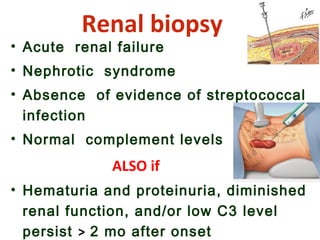
Renal biopsy
• Acute renal failure
• Nephrotic syndrome
• Absence of evidence of streptococcal
infection
• Normal complement levels
ALSO if
• Hematuria and proteinuria, diminished
renal function, and/or low C3 level
persist > 2 mo after onset
Differential Diagnosis
• IgA nephropathy
• Rapid progressive glomerulonephritis
(RPGN)
• Nephrotic syndrome (NS,nephritic
type)
• Exacerbation of chronic
glomerulonephritis
• Secondary glomerulonephriti
Complications
Acute renal dysfunction
Hypertension → 60% of patients
Hypertensive encephalopathy → 10%cases
Heart failure
Hyperkalemia
Hyperphosphatemia
Hypocalcemia
Acidosis
Seizures 29
• Treatment of APSGN is largely that of
supportive care.
• Usually, patients undergo a
spontaneous diuresis within 7 to 10
days after the onset of their illness.
• Management is directed at treating the
acute effects of renal insufficiency and
hypertension
Therapeutic Principle
Treatment
Management is directed at
•Treat renal insufficiency
•Treat hypertension
•Antibiotic therapy

Diet

Protein, sodium and water intake
-ARF

Treat renal insufficiency
Careful intake and output record
Daily weight measurement
Monitor & treat HTN
Water and sodium restriction
Protein restriction
Potassium and phosphate restriction
Adjust medication dosages
32
TREAT if any
Hyperkalemia
Hyponatremia
Seizures
Acidosis
Hypocalcemia
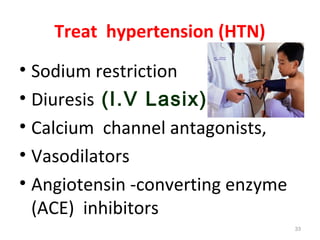
Treat hypertension (HTN)
• Sodium restriction
• Diuresis (I.V Lasix)
• Calcium channel antagonists,
• Vasodilators
• Angiotensin -converting enzyme
(ACE) inhibitors
33
Antibiotics
Systemic antibiotic therapy to limit
spread of nephritogenic organisms
10-day course of systemic antibiotic
therapy with Penicillin OR
Single I.M Inj Benzathin Penicillin
NOTE: Antibiotic therapy does not affect
natural history of glomerulonephritis
 
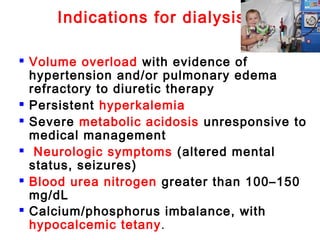
Indications for dialysis
 Volume overload with evidence of
hypertension and/or pulmonary edema
refractory to diuretic therapy
 Persistent hyperkalemia
 Severe metabolic acidosis unresponsive to
medical management
 Neurologic symptoms (altered mental
status, seizures)
 Blood urea nitrogen greater than 100–150
mg/dL
 Calcium/phosphorus imbalance, with
hypocalcemic tetany.
Prognosis
Complete recovery ≥95%
Infrequently, acute phase severe
chronic renal insufficiency
Recurrences -- extremely rare
Mortality ??? LOW
Mortality
Can be avoided by appropriate
management of:
•Acute renal failure
•Cardiac failure
•Hypertension 37
Prevention ??
• Early systemic antibiotic therapy for
streptococcal throat and skin infections
does not eliminate the risk of
glomerulonephritis
• Family members of patients with acute
glomerulonephritis should be cultured
for group-A β-hemolytic streptococci and
treated if culture positive 38
IgA nephropathy
(IgAN)
• Recurrent painless gross hematuria.
• Preceded by (usually 1-3 days ) infections
(URTI , Ac GE).
• HTN & renal insufficiency --- uncommon
• C3 level ----- normal
• ASO or anti DNase B ---- not elevated
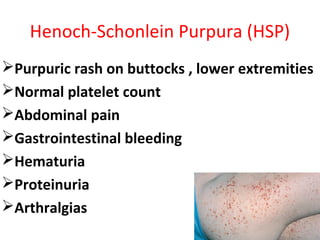
Henoch-Schonlein Purpura (HSP)
Purpuric rash on buttocks , lower extremities
Normal platelet count
Abdominal pain
Gastrointestinal bleeding
Hematuria
Proteinuria
Arthralgias
HUS
• Mostly <4yrs age
• Follows gastroenteritis by E.coli 0157.
• Micro-angiopathic hemolytic anemia
• Hematuria
• Oedema
• Oliguria
• Hypertension
• Variable proteinuria (usually < 3 g/day)
• Azotemia→ARF
THANK YOU !

NEPHRITIC SYNDROME / APSGN IN CHILDREN

  • 1.
    Acute Poststreptococcal Glomerulonephritis (APSGN) Dr. MuhammadSajjad Sabir MBBS, DCH, MCPS, FCPS Assistant Professor of Paediatrics
  • 2.
  • 3.
    Acute Nephritic Syndrome 1.Gross hematuria (sudden onset) 2. Edema 3. Hypertension (HTN) 4. Renal insufficiency (oliguria)
  • 4.
    Feature NEPHROTIC NEPHRITIC ONSETInsidious Abrupt OEDEMA ++++ ++ BLOOD PRESSURE Normal High JVP Normal Raised Proteinuria ++++ ++ Hematuria May/ may not +++ RBC Cast Absent Present Serum Albumen Low Normal 4
  • 5.
    Causes of NephriticSyndrome • IgA nephropathy • APGN • HUS • HSP • SLE nephritis • MPGN • RPGN
  • 6.
    Acute Poststreptococcal Glomerulonephritis (APSGN ) Classic example of the acute nephritic syndrome characterized by sudden onset of: Gross hematuria Edema Hypertension, and Renal insufficiency 2nd most common glomerular causes of gross hematuria in children (1st IgA nephropathy) 6
  • 7.
    • APSGN followsinfection of the throat or skin by certain “nephritogenic” strains of group A β-hemolytic streptococci – Throat (serotype 12) , cold weather months. – skin (serotype 49) , warm weather months. BUT • APSGN is most commonly sporadic • Epidemics of nephritis -reported Etiology and epidemiology
  • 8.
    PATHOLOGY • Kidneys →symmetricallyenlarged • Light microscopy, • All glomeruli appear enlarged & relatively bloodless • Diffuse mesangial cell proliferation • Increase mesangial matrix • Polymorphonuclear leukocytes in glomeruli • Crescents and interstitial inflammation • These changes are not specific for poststreptococcal glomerulonephritis 8
  • 9.
    (A) ultrastructural featuresof a normal glomerular capillary loop , (B)ultrastructural features of APSGN, Note the subepithelial hump like dense deposits and endocapillary hypercellularity A B
  • 10.
  • 11.
    PATHOLOGY   Immunofluorescence microscopy Lumpy-bumpy depositsof immunoglobulin complement on glomerular basement membrane (GBM) in the mesangium. Electron microscopy Electron-dense deposits, or "humps," on the epithelial side of the GBM
  • 12.
    EM glomerular capillary-APSGN showing subepithelial dense deposits and a neutrophil (N) marginated
  • 13.
    Immune complexes, antigens Activation of Compliments Recruitment of leukocytes GBMdamage, Blood ingredients leakage Hematuria Proteinuria RBC Casts Proliferation of MC and EC Blockage of renal capillaries and decreased GFR Edema hypertention heart failure encephalopathy renal failure Oliguria, sodium and water retention, hypervolemia Inflammation mediates, Cytokines, proliferative F. Infection of streptocacci PATHOGENESIS
  • 14.
    Although • Morphologic studies& • ↓(C3) level strongly suggest →mediated by immune complexes Questions still unsolved • Precise mechanisms→ UNKNOWN 14 PATHOGENESIS
  • 15.
  • 16.
    General manifestations • Age: •most common in children aged 5-12 yr • uncommon before the age of 3 yr. • Sex: more common in boys than in girls, (M:F 2 : 1) • Antecedent infection: • 1-2 wk after pharyngitis • 3-6 wk after pyoderma
  • 17.
    Typical manifestations  Severityof renal involvement varies from asymptomatic microscopic hematuria to oliguric acute renal failure Nonspecific symptoms  malaise,  lethargy,  abdominal / flank pain  Classically, abrupt onset  hematuria,  proteinuria,  hypertension,  edema, and
  • 18.
    • Hematuria: • Grosshematuria (30-50%), • microscopic hematuria - more common • Edema (90%): • Puffy face • Ascites and • Anasarca may occur • Hypertension (75% ): Typical manifestations
  • 19.
    • Oliguria andanuria : • transient oliguria. • Anuria is infrequent • Proteinuria –Many patients have significant proteinuria –<5% - frank nephrotic syndrome. Typical manifestations
  • 20.
    Subclinical, microscopic hematuria maybe four times more common as overt acute PSGN Attention
  • 21.
    Clinical course – Spontaneousimprovement begins within 1 wk – Edema-- resolves in 5-10 days – Hypertension-- normalize by 4-6 wk after onset – Proteinuria -- normalize by 4-6 wk • Acute phase resolves within 6-8 wk. • Microscopic hematuria may persist 1-2 yr
  • 22.
  • 23.
    • Urinalysis – demonstratesred blood cells (RBCs), – RBC casts – Proteinuria – ↑WBC • CBC – Mild normochromic anemia (due to hemodilution and low-grade hemolysis) 23 Laboratory Findings
  • 24.
    Laboratory Findings • Activationof complements – Serum C3 level, decrease (90%), – return to normal within 4-8 wk – Serum C4 levels -- typically normal • Urea / creatinine ↑ • Blood chemistory – Hyperkalemia – hypocalcaemia – hyponatremia – Metabolic acidosis
  • 25.
    Clinical diagnosis ofAPSGN likely with: 1.Acute nephritic syndrome 2.Evidence of recent streptococcal infection – Positive throat culture – Rising titer to streptococcal antigen(s) 3. Low C3 level 25 DIAGNOSIS
  • 26.
    Antibodies to streptococcal antigen(s) •Anti-streptolysin O titer (ASOT) >333 TOD Units • COMMONLY elevated after a pharyngeal infection but • RARELY increases after streptococcal skin infections. • Anti deoxyribonuclease (DNase) B antibodies (best single antibody titer to document cutaneous streptococcal infection) • Anti-hyaluronidase antibodies • Anti-streptokinase antibodies
  • 27.
    Renal biopsy • Acuterenal failure • Nephrotic syndrome • Absence of evidence of streptococcal infection • Normal complement levels ALSO if • Hematuria and proteinuria, diminished renal function, and/or low C3 level persist > 2 mo after onset
  • 28.
    Differential Diagnosis • IgAnephropathy • Rapid progressive glomerulonephritis (RPGN) • Nephrotic syndrome (NS,nephritic type) • Exacerbation of chronic glomerulonephritis • Secondary glomerulonephriti
  • 29.
    Complications Acute renal dysfunction Hypertension→ 60% of patients Hypertensive encephalopathy → 10%cases Heart failure Hyperkalemia Hyperphosphatemia Hypocalcemia Acidosis Seizures 29
  • 30.
    • Treatment ofAPSGN is largely that of supportive care. • Usually, patients undergo a spontaneous diuresis within 7 to 10 days after the onset of their illness. • Management is directed at treating the acute effects of renal insufficiency and hypertension Therapeutic Principle
  • 31.
    Treatment Management is directedat •Treat renal insufficiency •Treat hypertension •Antibiotic therapy  Diet  Protein, sodium and water intake -ARF 
  • 32.
    Treat renal insufficiency Carefulintake and output record Daily weight measurement Monitor & treat HTN Water and sodium restriction Protein restriction Potassium and phosphate restriction Adjust medication dosages 32 TREAT if any Hyperkalemia Hyponatremia Seizures Acidosis Hypocalcemia
  • 33.
    Treat hypertension (HTN) •Sodium restriction • Diuresis (I.V Lasix) • Calcium channel antagonists, • Vasodilators • Angiotensin -converting enzyme (ACE) inhibitors 33
  • 34.
    Antibiotics Systemic antibiotic therapyto limit spread of nephritogenic organisms 10-day course of systemic antibiotic therapy with Penicillin OR Single I.M Inj Benzathin Penicillin NOTE: Antibiotic therapy does not affect natural history of glomerulonephritis  
  • 35.
    Indications for dialysis Volume overload with evidence of hypertension and/or pulmonary edema refractory to diuretic therapy  Persistent hyperkalemia  Severe metabolic acidosis unresponsive to medical management  Neurologic symptoms (altered mental status, seizures)  Blood urea nitrogen greater than 100–150 mg/dL  Calcium/phosphorus imbalance, with hypocalcemic tetany.
  • 36.
    Prognosis Complete recovery ≥95% Infrequently,acute phase severe chronic renal insufficiency Recurrences -- extremely rare Mortality ??? LOW
  • 37.
    Mortality Can be avoidedby appropriate management of: •Acute renal failure •Cardiac failure •Hypertension 37
  • 38.
    Prevention ?? • Earlysystemic antibiotic therapy for streptococcal throat and skin infections does not eliminate the risk of glomerulonephritis • Family members of patients with acute glomerulonephritis should be cultured for group-A β-hemolytic streptococci and treated if culture positive 38
  • 39.
    IgA nephropathy (IgAN) • Recurrentpainless gross hematuria. • Preceded by (usually 1-3 days ) infections (URTI , Ac GE). • HTN & renal insufficiency --- uncommon • C3 level ----- normal • ASO or anti DNase B ---- not elevated
  • 40.
    Henoch-Schonlein Purpura (HSP) Purpuricrash on buttocks , lower extremities Normal platelet count Abdominal pain Gastrointestinal bleeding Hematuria Proteinuria Arthralgias
  • 41.
    HUS • Mostly <4yrsage • Follows gastroenteritis by E.coli 0157. • Micro-angiopathic hemolytic anemia • Hematuria • Oedema • Oliguria • Hypertension • Variable proteinuria (usually < 3 g/day) • Azotemia→ARF
  • 42.