CARDIOVASCULAR SYSTEM Heart auscultation Lecture 2/5
The Goals of Auscultation The intensity of S 1  in all areas The intensity of S 2  in all areas The characterization of any systolic sounds The characterization of any diastolic sounds
 
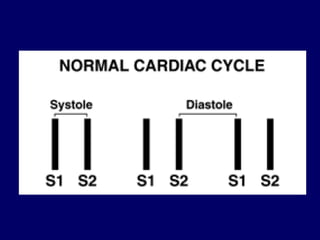
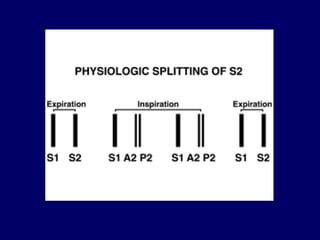
Normal heart sounds In younger patients physiologic splitting of S2. is possible  S2 is made up of 2 components, aortic (A2) and pulmonic (P2) valve closure.  On inspiration, venous return to the heart is augmented and pulmonic valve closure is delayed, allowing you to hear first A2 and then P2. On expiration, the two sounds occur closer together and are detected as a single S2.  The two components of S1 (mitral and tricuspid valve closure) occur so close together that splitting is not appreciated.
 
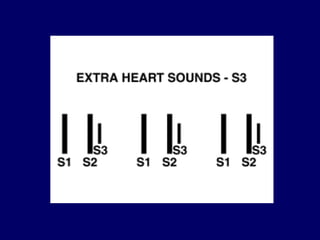
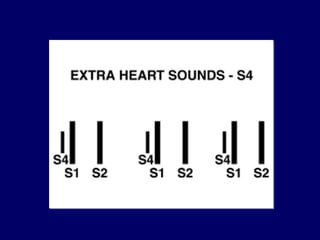
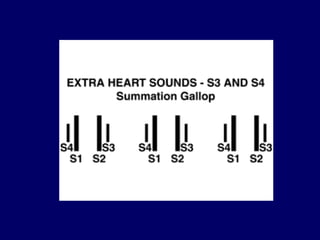
Extra heart sounds While present in normal subjects up to the ages of 20-30, they represent pathology in older patients.  An S3 is most commonly associated with left ventricular failure and is caused by blood from the left atrium slamming into an already overfilled ventricle during early diastolic filling.  The S4 is a sound created by blood trying to enter a stiff, non-compliant left ventricle during atrial contraction. It's most frequently associated with left ventricular hypertrophy that is the result of long standing hypertension.  Positioning the patient on their left side while you listen may improve the yield of this exam.  The presence of both an S3 and S4 simultaneously is referred to as a summation gallop.


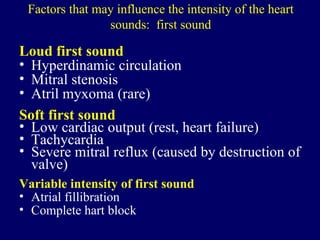
Factors that may influence the intensity of the heart sounds:  first sound Loud first sound Hyperdinamic circulation  Mitral stenosis Atril myxoma (rare) Soft first sound Low cardiac output (rest, heart failure) Tachycardia Severe mitral reflux (caused by destruction of valve) Variable intensity of first sound Atrial fillibration  Complete hart block
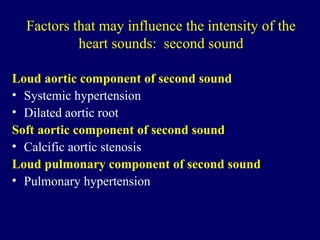
Factors that may influence the intensity of the heart sounds:  second sound Loud aortic component of second sound Systemic hypertension Dilated aortic root Soft aortic component of second sound Calcific aortic stenosis Loud pulmonary   component of second sound Pulmonary hypertension
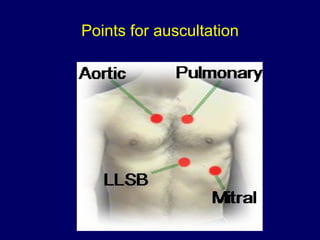
Points for auscultation
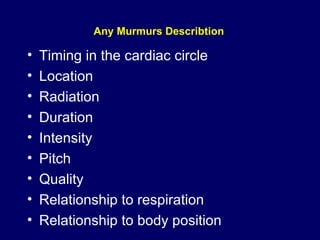
Any Murmurs Describtion   Timing in the cardiac circle Location Radiation Duration Intensity Pitch Quality Relationship to respiration Relationship to body position
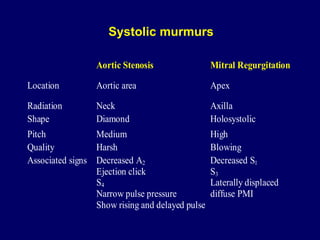
Systolic murmurs
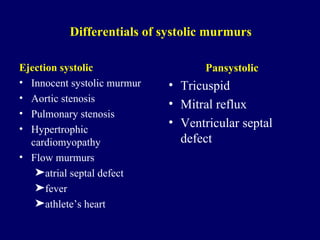
Differentials of systolic murmurs Ejection systolic Innocent systolic murmur Aortic stenosis Pulmonary stenosis Hypertrophic cardiomyopathy  Flow murmurs atrial septal defect fever athlete’s heart Pansystolic Tricuspid Mitral reflux Ventricular septal defect
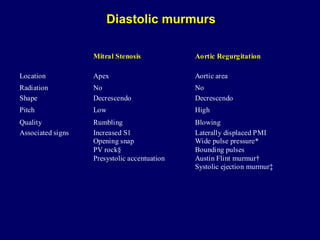
Diastolic murmurs
Grading the intensity of murmurs Grade 1 just audible with a good stethoscope in a quiet room Grade 2 quiet but readily audible with a stethoscope  Grade 3 easily heard with a stethoscope  Grade 4 a loud, obvious murmur Grade 5 very loud, heard not only over the precordium but elsewhere in the body
Behaviour of murmurs in respiration Louder immediately on inspiration Pulmonary stenosis Pulmonary valve flow murmurs Quieter immediately on inspiration (may become louder later)  Mitral regurgitation Aortic stenosis Louder during Valsalva manoeuvre   Hypertrophic obstructive cardiomyopathy  The murmur of mitral prolapse may become louder or softer during inspiration

heart auscultation

  • 1.
    CARDIOVASCULAR SYSTEM Heartauscultation Lecture 2/5
  • 2.
    The Goals ofAuscultation The intensity of S 1 in all areas The intensity of S 2 in all areas The characterization of any systolic sounds The characterization of any diastolic sounds
  • 3.
  • 4.
    Normal heart soundsIn younger patients physiologic splitting of S2. is possible S2 is made up of 2 components, aortic (A2) and pulmonic (P2) valve closure. On inspiration, venous return to the heart is augmented and pulmonic valve closure is delayed, allowing you to hear first A2 and then P2. On expiration, the two sounds occur closer together and are detected as a single S2. The two components of S1 (mitral and tricuspid valve closure) occur so close together that splitting is not appreciated.
  • 5.
  • 6.
    Extra heart soundsWhile present in normal subjects up to the ages of 20-30, they represent pathology in older patients. An S3 is most commonly associated with left ventricular failure and is caused by blood from the left atrium slamming into an already overfilled ventricle during early diastolic filling. The S4 is a sound created by blood trying to enter a stiff, non-compliant left ventricle during atrial contraction. It's most frequently associated with left ventricular hypertrophy that is the result of long standing hypertension. Positioning the patient on their left side while you listen may improve the yield of this exam. The presence of both an S3 and S4 simultaneously is referred to as a summation gallop.
  • 7.
  • 8.
  • 9.
  • 10.
    Factors that mayinfluence the intensity of the heart sounds: first sound Loud first sound Hyperdinamic circulation Mitral stenosis Atril myxoma (rare) Soft first sound Low cardiac output (rest, heart failure) Tachycardia Severe mitral reflux (caused by destruction of valve) Variable intensity of first sound Atrial fillibration Complete hart block
  • 11.
    Factors that mayinfluence the intensity of the heart sounds: second sound Loud aortic component of second sound Systemic hypertension Dilated aortic root Soft aortic component of second sound Calcific aortic stenosis Loud pulmonary component of second sound Pulmonary hypertension
  • 12.
  • 13.
    Any Murmurs Describtion Timing in the cardiac circle Location Radiation Duration Intensity Pitch Quality Relationship to respiration Relationship to body position
  • 14.
  • 15.
    Differentials of systolicmurmurs Ejection systolic Innocent systolic murmur Aortic stenosis Pulmonary stenosis Hypertrophic cardiomyopathy Flow murmurs atrial septal defect fever athlete’s heart Pansystolic Tricuspid Mitral reflux Ventricular septal defect
  • 16.
  • 17.
    Grading the intensityof murmurs Grade 1 just audible with a good stethoscope in a quiet room Grade 2 quiet but readily audible with a stethoscope Grade 3 easily heard with a stethoscope Grade 4 a loud, obvious murmur Grade 5 very loud, heard not only over the precordium but elsewhere in the body
  • 18.
    Behaviour of murmursin respiration Louder immediately on inspiration Pulmonary stenosis Pulmonary valve flow murmurs Quieter immediately on inspiration (may become louder later) Mitral regurgitation Aortic stenosis Louder during Valsalva manoeuvre Hypertrophic obstructive cardiomyopathy The murmur of mitral prolapse may become louder or softer during inspiration