Diastolic Murmurs
Dr Muhammed Aslam
Junior Resident
Pulmonary Medicine
ACME Pariyaram
Presented at Sahakarana Hrudayalaya
Diastolic Murmurs
• Always signify an abnormal cvs structurally or functionally
• Not graded by intensity but by their length
• Thrill additionally mentioned
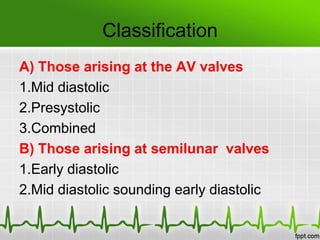
Classification
A) Those arising at the AV valves
1.Mid diastolic
2.Presystolic
3.Combined
B) Those arising at semilunar valves
1.Early diastolic
2.Mid diastolic sounding early diastolic
Diastolic murmurs at AV valves
Mechanism and Causes of
Diastolic Murmurs at Apex
A- Narrowing of mitral valve or left ventricular inflow
1.Mitral stenosis
2.Left atrial myxoma
3.Cor-triatrium
4.Constriction of AV groove as in constrictive
pericarditis
5.Hypertrophic cardiomyopathy (narrow inflow
cavity
Mechanism and Causes of Diastolic
Murmurs at Apex
B.Increased flow across AV valve
1.Left to right shunts (post tricuspid shunts)
(VSD,Ductus,systemic artero venous
fistula,RSOV in to right ventricle,aotopulmonary
window/fistula, Truncus Arteriosus)
2.Mitral Regurgitation (severe)
3.Hyperkinetics circulatory
states(anemia,thyrotoxicosis,pregnancy)
4.Chronic complete heart block
Mechanism and Causes of Diastolic
Murmurs at Apex
C. Mechanisms that interfere with mitral valve opening

Austin flint murmur with severe aortic regurgitation
D.Ventricular aneurysm with a narrow neck
E.Murmurs arising some where else but heard at apex

1.Aortic regurgitation
2.Tricuspid stenosis
3. Tricuspid flow murmur of ASD
4.Ebstien’s anomaly
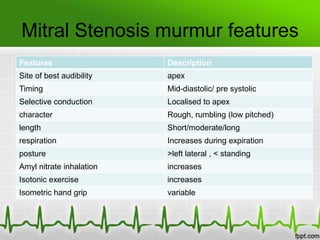
Mitral Stenosis murmur features
Features

Description

Site of best audibility

apex

Timing

Mid-diastolic/ pre systolic

Selective conduction

Localised to apex

character

Rough, rumbling (low pitched)

length

Short/moderate/long

respiration

Increases during expiration

posture

>left lateral , < standing

Amyl nitrate inhalation

increases

Isotonic exercise

increases

Isometric hand grip

variable
Mechanism of MDM in MS
• As the mitral valve become stenotic the
left atrial pressure increases with a
gradient between left atrium and left
ventricle in diastole. The opening snap
result from abrupt opening of the doming
mitrale valve. As the atrial contraction
contributes to increased gradient in pre
systole, there is pre systolic accentuation
of murmur
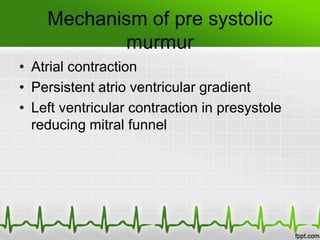
Mechanism of pre systolic
murmur
• Atrial contraction
• Persistent atrio ventricular gradient
• Left ventricular contraction in presystole
reducing mitral funnel
Absence of presystolic murmur in MS
•
•
•
•
•

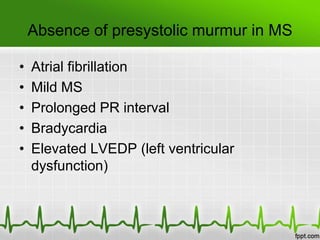
Atrial fibrillation
Mild MS
Prolonged PR interval
Bradycardia
Elevated LVEDP (left ventricular
dysfunction)
Severity of MS : Auscultatory
features
Severity of ms

S2-os interval in
second

features

mild

0.08-0.12

Short mdm/ or pre
systolic murmur or
murmur may appear with
exercise

moderate

0.06-0.08

MDM + pre systolic
murmur with a gap
between them.
Varying degree of MDM
in atrial fibrillation

sever

0.04-0.06

MDM + pre systolic
murmur with no gap.pre
systolic murmur with
atrial fibrillation
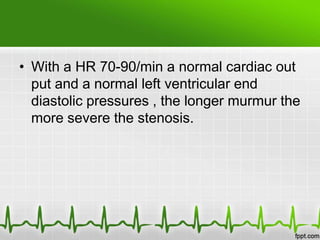
• With a HR 70-90/min a normal cardiac out
put and a normal left ventricular end
diastolic pressures , the longer murmur the
more severe the stenosis.
Mechanism influencing the
length of murmur in MS
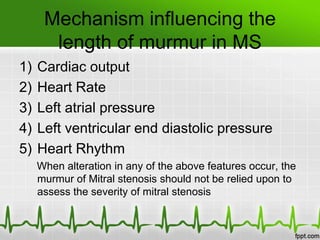
1)
2)
3)
4)
5)

Cardiac output
Heart Rate
Left atrial pressure
Left ventricular end diastolic pressure
Heart Rhythm
When alteration in any of the above features occur, the
murmur of Mitral stenosis should not be relied upon to
assess the severity of mitral stenosis
Character of murmur
• Rough, rumbling (low pitched)
• Non calcific valve – Very low frequency,
loud diastolic murmur with a thrill
• Severe calcific valve – high frequency,
less intensity , no thrill
• Heard with bell of diaphragm
Tricuspid diastolic murmurs
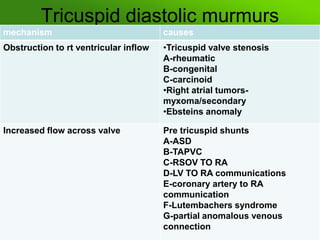
mechanism

causes

Obstruction to rt ventricular inflow

•Tricuspid valve stenosis
A-rheumatic
B-congenital
C-carcinoid
•Right atrial tumorsmyxoma/secondary
•Ebsteins anomaly

Increased flow across valve

Pre tricuspid shunts
A-ASD
B-TAPVC
C-RSOV TO RA
D-LV TO RA communications
E-coronary artery to RA
communication
F-Lutembachers syndrome
G-partial anomalous venous
connection
Tricuspid diastolic murmurs
mechanism

causes

Interference with opening of TV

Severe tricuspid regurgitation
A-functional
B-organic

Murmur produced somewhere else
but also heard at tricuspid area

•Severe TR with right sided Austin
Flint murmur
•MS
•Pulmonary regurgitation
•Aortic regurgitation

Murmurs mistaken for tricuspid
diastolic murmur

•Normal pressure pulmonary
incompetence
•Pericardial rub
•Right sided s4 may sound like pre
systolic murmur
The murmur of tricuspid stenosis
features

descriptions

Site of best audibility

Tricuspid area

timing

Pre systolic with or without Mid diastolic

length

Short/moderate/long

character

Rough/rumbling

Selective conduction

Localised to tricuspid area

Relation to physiological act
•Respiration
•Posture

•Increased during inspiration
•Increase in supine , passive leg raising

•Rapid deep breathing

•increases
• Length of murmur is directly related to the
severity of tricuspid stenosis
• Significant tricuspid stenosis with shorter
or no murmur : causes
1)Rheumatic TS with accompanying MS, severe PAH
,Increased Right ventricular end diastolic pressure
2) Diuretic therapy in TS
3) Atrial fibrillation ( absent pre systolic murmur)
4) Ebstein’s Anomaly of tricuspid valve
Other mid diastolic murmurs at
the AV valve
1)
•
•
•
•
•
•

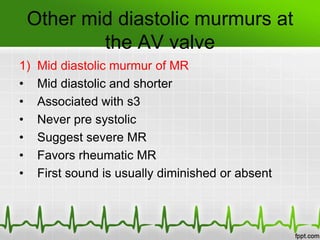
Mid diastolic murmur of MR
Mid diastolic and shorter
Associated with s3
Never pre systolic
Suggest severe MR
Favors rheumatic MR
First sound is usually diminished or absent
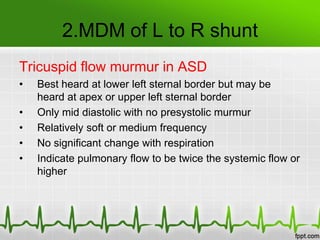
2.MDM of L to R shunt
Tricuspid flow murmur in ASD
•
•
•
•
•

Best heard at lower left sternal border but may be
heard at apex or upper left sternal border
Only mid diastolic with no presystolic murmur
Relatively soft or medium frequency
No significant change with respiration
Indicate pulmonary flow to be twice the systemic flow or
higher
Causes of Tricuspid flow
murmur
A)Left to right shunts(pre tricuspid)
1.ASD
2.PAVC
3.RSOV
4.Coronary cameral fistula in to rt atrium
5.Left ventricular right atrial communication
(Gerbodes defect)
Causes of Tricuspid flow
murmur
B) Admixture lesions ( Cyanotic heart
disease)
1.TAPVC
2.Single atrium
3.Hypoplastic left heart syndrome ( mitral atresia)

C)Severe tricuspid regurgitations
D)The right sided Austin-Flint murmur in
severe functional pulmonary regurgitation
Causes of mitral flow murmurs
A) Left to right shunts (post tricuspid shunts)
1.VSD
2.PDA
3.Aorto pulmonary window
4.Systemic arteriovenous fistula
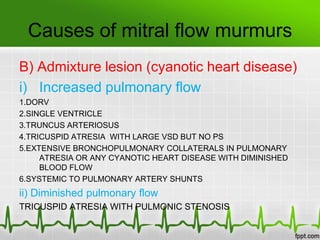
Causes of mitral flow murmurs
B) Admixture lesion (cyanotic heart disease)
i) Increased pulmonary flow
1.DORV
2.SINGLE VENTRICLE
3.TRUNCUS ARTERIOSUS
4.TRICUSPID ATRESIA WITH LARGE VSD BUT NO PS
5.EXTENSIVE BRONCHOPULMONARY COLLATERALS IN PULMONARY
ATRESIA OR ANY CYANOTIC HEART DISEASE WITH DIMINISHED
BLOOD FLOW
6.SYSTEMIC TO PULMONARY ARTERY SHUNTS

ii) Diminished pulmonary flow
TRICUSPID ATRESIA WITH PULMONIC STENOSIS
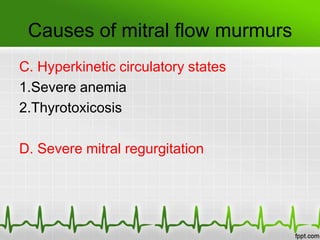
Causes of mitral flow murmurs
C. Hyperkinetic circulatory states
1.Severe anemia
2.Thyrotoxicosis
D. Severe mitral regurgitation
Austin Flint Murmur
•
•
•
•

In moderate to severe AR
Mid diastolic and/or presystolic
Low pitched best heard with bell
Heavy jet of aortic regurgitation impinging on the
anterior leaflet of mitral valve preventing adequate
opening of the valve and creating turbulence to flow
from left atrium to ventricle in diastole
• with premature closure of mitral valve as in free
severe AR or a/c AR the pre systolic murmur does
not occur.
Austin Flint Murmur
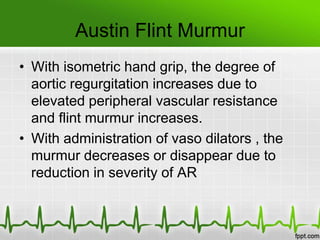
• With isometric hand grip, the degree of
aortic regurgitation increases due to
elevated peripheral vascular resistance
and flint murmur increases.
• With administration of vaso dilators , the
murmur decreases or disappear due to
reduction in severity of AR
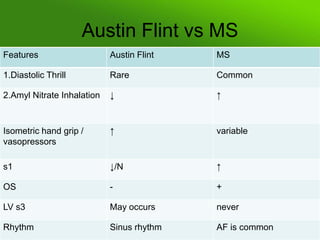
Austin Flint vs MS
Features

Austin Flint

MS

1.Diastolic Thrill

Rare

Common

2.Amyl Nitrate Inhalation

↓

↑

Isometric hand grip /
vasopressors

↑

variable

s1

↓/N

↑

OS

-

+

LV s3

May occurs

never

Rhythm

Sinus rhythm

AF is common
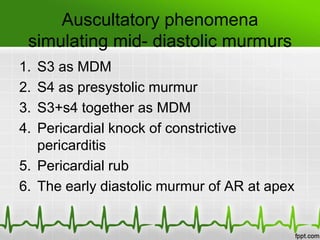
Auscultatory phenomena
simulating mid- diastolic murmurs
1.
2.
3.
4.

S3 as MDM
S4 as presystolic murmur
S3+s4 together as MDM
Pericardial knock of constrictive
pericarditis
5. Pericardial rub
6. The early diastolic murmur of AR at apex
Other Mid Diastolic Murmur
• Carey Coomb’s murmurs
– Acute rheumatic fever, mitral valve structures acutely inflamed with
some thickening and edema turbulence of flow during the rapid filling
phase + moderate MR [increased mitral inflow in diastole]
– Low pitched short MDM.
– Distinguished from MS MDM by the absence of opening snap before
the murmur
– good evidence of active carditis
Early diastolic murmur
AR murmur
• Timing - Early diastolic
• Site of best audibility – best heard along left sternal
border, but is also well heard at right 2nd space and
apex.
Left sternal border murmur of AR
causes

Right sternal border murmur of AR
causes

1.
2.
3.
4.

1.
2.
3.
4.
5.

Rheumatic heart disease
Congenital bicuspid valve
IE
AR in association with valvular
AS or subvalvular fixed AS
5. Prosthetic AR

Syphilis
Marfan syndrome
Ankylosing spondylitis
Rheumatoid arthritis
AR associated with TOF or VSD
AR murmur
• Character- high frequency / soft / blowing/
musical
• Thrill is rare
• Length of the murmur correlates with
severity
AR murmur
Causes of AR with short or no murmur
1. a/c AR
2. LVF
3. Tachycardia
4. Hypotension
5. Vasodilators
6. Pregnancy
Relation to physiological act
• Respiration and posture – best heard in
sitting ( or standing ) leaning forward , held
in expiration
• Isometric hand grip - ↑
• Vasopressor - ↑
• Vasodilator - ↓
• Squatting - ↑
maneuver

mechanisms

Sitting,leaning forward,held
expiration,diaphragm firmly
applied to chest

•Aorta nearer to chest
•Non interference with the noise
of breathing
•Improved quality of diaphragm
to appreciate the high frequency
murmur

Prone position

Aorta nearer to chest

Prompt squatting

Increased systemic vascular
resistance

Isometric hand grip

As above

vasopressors

•Increased systemic resistance
Auscultatory events or murmurs simulating AR
Auscultatory event /murmur

Differentiating feature

PR with PAH (Graham Steel murmur)

•Not audible at Rt side of sternum and
apex
•May ↑ with inspiration
•↓ with standing / inspiration

MDM of severe MS at apex and
occasionally along LSB

Low frequency , better heard with bell

MDM of severe MR when heard along
left sternal border

As above

MDM of TS

•↓ with sitting , standing , during
expiration
•↑ with inspiration , supine position
•Better heard with bell
•Prominent a wave with elevated JVP

Pericardial friction rub when high
frequency or musical

•Changes with posture / respiration
•Never heard to rt of sternum
Cole- Cecil murmur
• AR murmur in left axilla due to higher position of apex
Murmur of Pulmonary Regurgitation with PAH
(Graham – Steell murmur)
• Timing – early diastolic
• Length- very short to pan diastolic
Length of murmur reflects the duration of
pressure difference between pulmonary
artery and right ventricle in diastole
• Site of best audibility – pulmonary area
• Character – high pitched (PR with no PAH
is low frequency )
• Conduction – left sternal border 3 rd and 4
th spaces
Relation to physiological act
• Respiration – may incrs during inspirationmainly in PR with no PAH
• Posture – better heard in supine posture
,passive leg raising
• No influence for isometric hand grip/
vasopressors/amyl nitrite inhalation
PR with normal pressure
Feature

Description

Timing

Mid - diastolic

length

Short , never pan diastolic

Site of best audibility

Pulmonary area

character

Low frequency , rumbling

conduction

Localised to pulmonary area , may be
heard along left sternal border

Relation to physiological act
1. Posture

•

2. Respiration

•

Incrs during supine / passive leg
raising .Decrs with standing
Incrs with inspiration.Decrs with
exprn
Other diastolic murmurs
• Cabot– Locke Murmur- [Diastolic Flow murmur]
- in severe anemia
– The Cabot–Locke murmur is a diastolic murmur that sounds similar to
aortic insufficiency but does not have a decrescendo; it is heard best at
the left sternal border. [High flow thru coronary vessels, LMCA, LAD]
– The murmur resolves with treatment of anaemia.

• Dock’s murmur
– diastolic crescendo-decrescendo, with late accentuation, [consistent
with blood flow through the coronary] in a sharply localized area, 4 cm
left of the sternum in the 3LICS, detectable only when the patient was
sitting upright.
– Due to stenosis of LAD
Other diastolic murmurs
• Key–Hodgkin murmur
– EDM of AR; it has a raspy quality, [sound of a saw cutting through
wood]. Hodgkin correlated the murmur with retroversion of the aortic
valve leaflets in syphilitic disease.

• Rytand’s murmur
– Late diastolic murmur in complete heart block
THANK YOU !!!

Diastolic murmurs

  • 1.
    Diastolic Murmurs Dr MuhammedAslam Junior Resident Pulmonary Medicine ACME Pariyaram Presented at Sahakarana Hrudayalaya
  • 2.
    Diastolic Murmurs • Alwayssignify an abnormal cvs structurally or functionally • Not graded by intensity but by their length • Thrill additionally mentioned
  • 3.
    Classification A) Those arisingat the AV valves 1.Mid diastolic 2.Presystolic 3.Combined B) Those arising at semilunar valves 1.Early diastolic 2.Mid diastolic sounding early diastolic
  • 5.
  • 6.
    Mechanism and Causesof Diastolic Murmurs at Apex A- Narrowing of mitral valve or left ventricular inflow 1.Mitral stenosis 2.Left atrial myxoma 3.Cor-triatrium 4.Constriction of AV groove as in constrictive pericarditis 5.Hypertrophic cardiomyopathy (narrow inflow cavity
  • 7.
    Mechanism and Causesof Diastolic Murmurs at Apex B.Increased flow across AV valve 1.Left to right shunts (post tricuspid shunts) (VSD,Ductus,systemic artero venous fistula,RSOV in to right ventricle,aotopulmonary window/fistula, Truncus Arteriosus) 2.Mitral Regurgitation (severe) 3.Hyperkinetics circulatory states(anemia,thyrotoxicosis,pregnancy) 4.Chronic complete heart block
  • 8.
    Mechanism and Causesof Diastolic Murmurs at Apex C. Mechanisms that interfere with mitral valve opening Austin flint murmur with severe aortic regurgitation D.Ventricular aneurysm with a narrow neck E.Murmurs arising some where else but heard at apex 1.Aortic regurgitation 2.Tricuspid stenosis 3. Tricuspid flow murmur of ASD 4.Ebstien’s anomaly
  • 9.
    Mitral Stenosis murmurfeatures Features Description Site of best audibility apex Timing Mid-diastolic/ pre systolic Selective conduction Localised to apex character Rough, rumbling (low pitched) length Short/moderate/long respiration Increases during expiration posture >left lateral , < standing Amyl nitrate inhalation increases Isotonic exercise increases Isometric hand grip variable
  • 10.
    Mechanism of MDMin MS • As the mitral valve become stenotic the left atrial pressure increases with a gradient between left atrium and left ventricle in diastole. The opening snap result from abrupt opening of the doming mitrale valve. As the atrial contraction contributes to increased gradient in pre systole, there is pre systolic accentuation of murmur
  • 11.
    Mechanism of presystolic murmur • Atrial contraction • Persistent atrio ventricular gradient • Left ventricular contraction in presystole reducing mitral funnel
  • 12.
    Absence of presystolicmurmur in MS • • • • • Atrial fibrillation Mild MS Prolonged PR interval Bradycardia Elevated LVEDP (left ventricular dysfunction)
  • 13.
    Severity of MS: Auscultatory features Severity of ms S2-os interval in second features mild 0.08-0.12 Short mdm/ or pre systolic murmur or murmur may appear with exercise moderate 0.06-0.08 MDM + pre systolic murmur with a gap between them. Varying degree of MDM in atrial fibrillation sever 0.04-0.06 MDM + pre systolic murmur with no gap.pre systolic murmur with atrial fibrillation
  • 14.
    • With aHR 70-90/min a normal cardiac out put and a normal left ventricular end diastolic pressures , the longer murmur the more severe the stenosis.
  • 15.
    Mechanism influencing the lengthof murmur in MS 1) 2) 3) 4) 5) Cardiac output Heart Rate Left atrial pressure Left ventricular end diastolic pressure Heart Rhythm When alteration in any of the above features occur, the murmur of Mitral stenosis should not be relied upon to assess the severity of mitral stenosis
  • 16.
    Character of murmur •Rough, rumbling (low pitched) • Non calcific valve – Very low frequency, loud diastolic murmur with a thrill • Severe calcific valve – high frequency, less intensity , no thrill • Heard with bell of diaphragm
  • 17.
    Tricuspid diastolic murmurs mechanism causes Obstructionto rt ventricular inflow •Tricuspid valve stenosis A-rheumatic B-congenital C-carcinoid •Right atrial tumorsmyxoma/secondary •Ebsteins anomaly Increased flow across valve Pre tricuspid shunts A-ASD B-TAPVC C-RSOV TO RA D-LV TO RA communications E-coronary artery to RA communication F-Lutembachers syndrome G-partial anomalous venous connection
  • 18.
    Tricuspid diastolic murmurs mechanism causes Interferencewith opening of TV Severe tricuspid regurgitation A-functional B-organic Murmur produced somewhere else but also heard at tricuspid area •Severe TR with right sided Austin Flint murmur •MS •Pulmonary regurgitation •Aortic regurgitation Murmurs mistaken for tricuspid diastolic murmur •Normal pressure pulmonary incompetence •Pericardial rub •Right sided s4 may sound like pre systolic murmur
  • 19.
    The murmur oftricuspid stenosis features descriptions Site of best audibility Tricuspid area timing Pre systolic with or without Mid diastolic length Short/moderate/long character Rough/rumbling Selective conduction Localised to tricuspid area Relation to physiological act •Respiration •Posture •Increased during inspiration •Increase in supine , passive leg raising •Rapid deep breathing •increases
  • 20.
    • Length ofmurmur is directly related to the severity of tricuspid stenosis • Significant tricuspid stenosis with shorter or no murmur : causes 1)Rheumatic TS with accompanying MS, severe PAH ,Increased Right ventricular end diastolic pressure 2) Diuretic therapy in TS 3) Atrial fibrillation ( absent pre systolic murmur) 4) Ebstein’s Anomaly of tricuspid valve
  • 21.
    Other mid diastolicmurmurs at the AV valve 1) • • • • • • Mid diastolic murmur of MR Mid diastolic and shorter Associated with s3 Never pre systolic Suggest severe MR Favors rheumatic MR First sound is usually diminished or absent
  • 22.
    2.MDM of Lto R shunt Tricuspid flow murmur in ASD • • • • • Best heard at lower left sternal border but may be heard at apex or upper left sternal border Only mid diastolic with no presystolic murmur Relatively soft or medium frequency No significant change with respiration Indicate pulmonary flow to be twice the systemic flow or higher
  • 23.
    Causes of Tricuspidflow murmur A)Left to right shunts(pre tricuspid) 1.ASD 2.PAVC 3.RSOV 4.Coronary cameral fistula in to rt atrium 5.Left ventricular right atrial communication (Gerbodes defect)
  • 24.
    Causes of Tricuspidflow murmur B) Admixture lesions ( Cyanotic heart disease) 1.TAPVC 2.Single atrium 3.Hypoplastic left heart syndrome ( mitral atresia) C)Severe tricuspid regurgitations D)The right sided Austin-Flint murmur in severe functional pulmonary regurgitation
  • 25.
    Causes of mitralflow murmurs A) Left to right shunts (post tricuspid shunts) 1.VSD 2.PDA 3.Aorto pulmonary window 4.Systemic arteriovenous fistula
  • 26.
    Causes of mitralflow murmurs B) Admixture lesion (cyanotic heart disease) i) Increased pulmonary flow 1.DORV 2.SINGLE VENTRICLE 3.TRUNCUS ARTERIOSUS 4.TRICUSPID ATRESIA WITH LARGE VSD BUT NO PS 5.EXTENSIVE BRONCHOPULMONARY COLLATERALS IN PULMONARY ATRESIA OR ANY CYANOTIC HEART DISEASE WITH DIMINISHED BLOOD FLOW 6.SYSTEMIC TO PULMONARY ARTERY SHUNTS ii) Diminished pulmonary flow TRICUSPID ATRESIA WITH PULMONIC STENOSIS
  • 27.
    Causes of mitralflow murmurs C. Hyperkinetic circulatory states 1.Severe anemia 2.Thyrotoxicosis D. Severe mitral regurgitation
  • 28.
    Austin Flint Murmur • • • • Inmoderate to severe AR Mid diastolic and/or presystolic Low pitched best heard with bell Heavy jet of aortic regurgitation impinging on the anterior leaflet of mitral valve preventing adequate opening of the valve and creating turbulence to flow from left atrium to ventricle in diastole • with premature closure of mitral valve as in free severe AR or a/c AR the pre systolic murmur does not occur.
  • 29.
    Austin Flint Murmur •With isometric hand grip, the degree of aortic regurgitation increases due to elevated peripheral vascular resistance and flint murmur increases. • With administration of vaso dilators , the murmur decreases or disappear due to reduction in severity of AR
  • 30.
    Austin Flint vsMS Features Austin Flint MS 1.Diastolic Thrill Rare Common 2.Amyl Nitrate Inhalation ↓ ↑ Isometric hand grip / vasopressors ↑ variable s1 ↓/N ↑ OS - + LV s3 May occurs never Rhythm Sinus rhythm AF is common
  • 31.
    Auscultatory phenomena simulating mid-diastolic murmurs 1. 2. 3. 4. S3 as MDM S4 as presystolic murmur S3+s4 together as MDM Pericardial knock of constrictive pericarditis 5. Pericardial rub 6. The early diastolic murmur of AR at apex
  • 32.
    Other Mid DiastolicMurmur • Carey Coomb’s murmurs – Acute rheumatic fever, mitral valve structures acutely inflamed with some thickening and edema turbulence of flow during the rapid filling phase + moderate MR [increased mitral inflow in diastole] – Low pitched short MDM. – Distinguished from MS MDM by the absence of opening snap before the murmur – good evidence of active carditis
  • 33.
  • 34.
    AR murmur • Timing- Early diastolic • Site of best audibility – best heard along left sternal border, but is also well heard at right 2nd space and apex. Left sternal border murmur of AR causes Right sternal border murmur of AR causes 1. 2. 3. 4. 1. 2. 3. 4. 5. Rheumatic heart disease Congenital bicuspid valve IE AR in association with valvular AS or subvalvular fixed AS 5. Prosthetic AR Syphilis Marfan syndrome Ankylosing spondylitis Rheumatoid arthritis AR associated with TOF or VSD
  • 35.
    AR murmur • Character-high frequency / soft / blowing/ musical • Thrill is rare • Length of the murmur correlates with severity
  • 36.
    AR murmur Causes ofAR with short or no murmur 1. a/c AR 2. LVF 3. Tachycardia 4. Hypotension 5. Vasodilators 6. Pregnancy
  • 37.
    Relation to physiologicalact • Respiration and posture – best heard in sitting ( or standing ) leaning forward , held in expiration • Isometric hand grip - ↑ • Vasopressor - ↑ • Vasodilator - ↓ • Squatting - ↑
  • 38.
    maneuver mechanisms Sitting,leaning forward,held expiration,diaphragm firmly appliedto chest •Aorta nearer to chest •Non interference with the noise of breathing •Improved quality of diaphragm to appreciate the high frequency murmur Prone position Aorta nearer to chest Prompt squatting Increased systemic vascular resistance Isometric hand grip As above vasopressors •Increased systemic resistance
  • 39.
    Auscultatory events ormurmurs simulating AR Auscultatory event /murmur Differentiating feature PR with PAH (Graham Steel murmur) •Not audible at Rt side of sternum and apex •May ↑ with inspiration •↓ with standing / inspiration MDM of severe MS at apex and occasionally along LSB Low frequency , better heard with bell MDM of severe MR when heard along left sternal border As above MDM of TS •↓ with sitting , standing , during expiration •↑ with inspiration , supine position •Better heard with bell •Prominent a wave with elevated JVP Pericardial friction rub when high frequency or musical •Changes with posture / respiration •Never heard to rt of sternum
  • 40.
    Cole- Cecil murmur •AR murmur in left axilla due to higher position of apex
  • 41.
    Murmur of PulmonaryRegurgitation with PAH (Graham – Steell murmur) • Timing – early diastolic • Length- very short to pan diastolic Length of murmur reflects the duration of pressure difference between pulmonary artery and right ventricle in diastole
  • 42.
    • Site ofbest audibility – pulmonary area • Character – high pitched (PR with no PAH is low frequency ) • Conduction – left sternal border 3 rd and 4 th spaces
  • 43.
    Relation to physiologicalact • Respiration – may incrs during inspirationmainly in PR with no PAH • Posture – better heard in supine posture ,passive leg raising • No influence for isometric hand grip/ vasopressors/amyl nitrite inhalation
  • 44.
    PR with normalpressure Feature Description Timing Mid - diastolic length Short , never pan diastolic Site of best audibility Pulmonary area character Low frequency , rumbling conduction Localised to pulmonary area , may be heard along left sternal border Relation to physiological act 1. Posture • 2. Respiration • Incrs during supine / passive leg raising .Decrs with standing Incrs with inspiration.Decrs with exprn
  • 45.
    Other diastolic murmurs •Cabot– Locke Murmur- [Diastolic Flow murmur] - in severe anemia – The Cabot–Locke murmur is a diastolic murmur that sounds similar to aortic insufficiency but does not have a decrescendo; it is heard best at the left sternal border. [High flow thru coronary vessels, LMCA, LAD] – The murmur resolves with treatment of anaemia. • Dock’s murmur – diastolic crescendo-decrescendo, with late accentuation, [consistent with blood flow through the coronary] in a sharply localized area, 4 cm left of the sternum in the 3LICS, detectable only when the patient was sitting upright. – Due to stenosis of LAD
  • 46.
    Other diastolic murmurs •Key–Hodgkin murmur – EDM of AR; it has a raspy quality, [sound of a saw cutting through wood]. Hodgkin correlated the murmur with retroversion of the aortic valve leaflets in syphilitic disease. • Rytand’s murmur – Late diastolic murmur in complete heart block
  • 47.