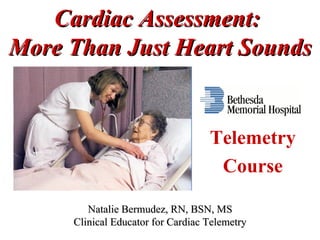
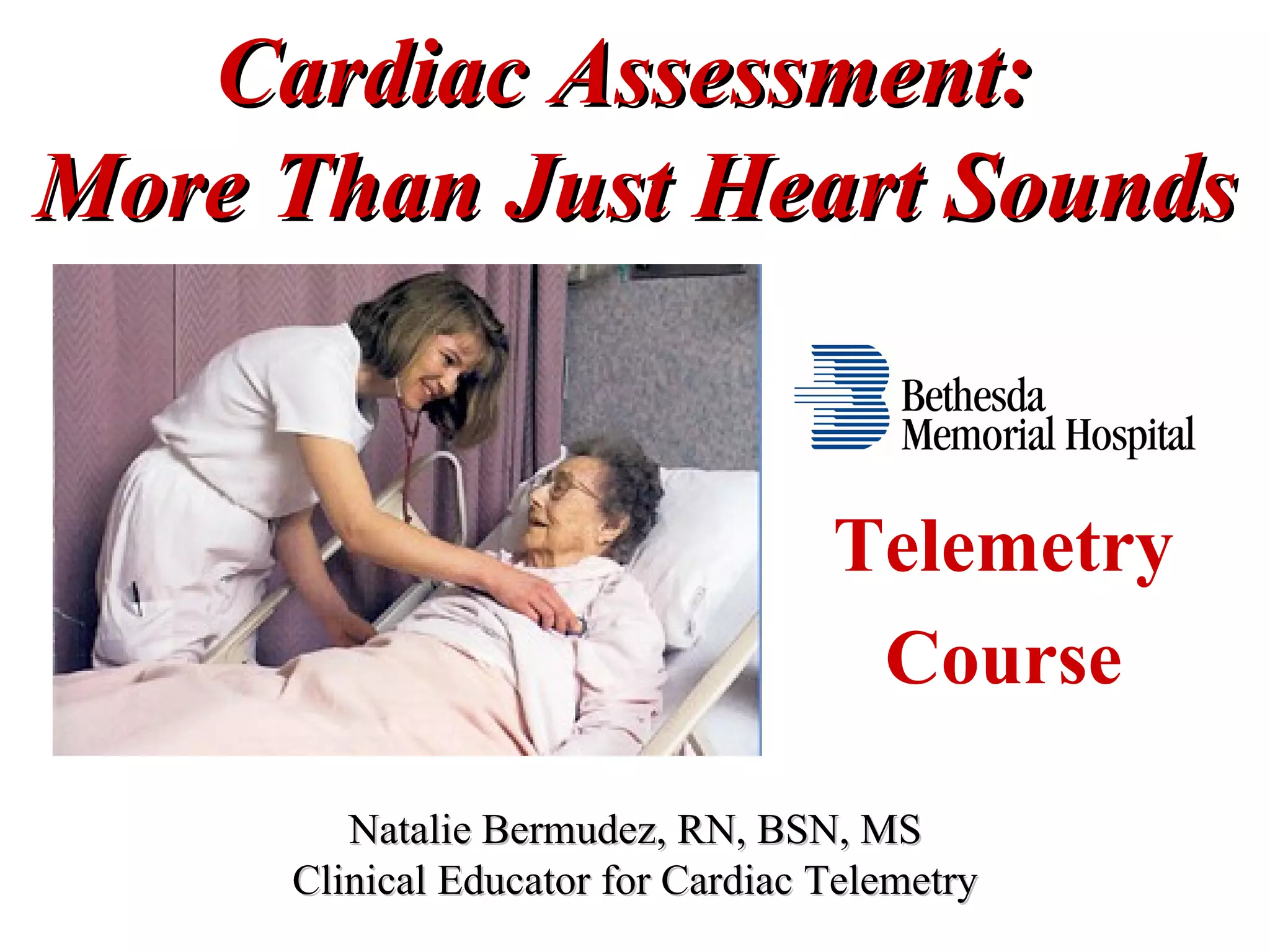
Cardiac Assessment:
More Than Just Heart Sounds


                                   Telemetry
                                    Course

        Natalie Bermudez, RN, BSN, MS
     Clinical Educator for Cardiac Telemetry
Importance of Assessment
• RNs are the 24/7 surveillance system
  for the patient (Linda Aiken)
• RNs are rescue workers (Suzanne
  Gordon)
• RNs are the integrators of all things
  (Maggie McClure)
• RNs are the coordinators of care
Essentials of Assessment
• Empathic listening
• Ability to interview patients of different
  ages, moods, and backgrounds
• Techniques for examining different
  body systems
• Clinical Reasoning (I.e. critical
  thinking)
  – Putting it all together!
Key Points of Assessment
• Listen to the patient, they will often
  help in leading to a diagnosis
• Focus on the patient, not the task; be
  observant
• Be a detective; dig for clues
• Don’t take anything for GRANTED!
  – Always check things out, especially “gut
    feelings”
Key Points of Assessment
• Be proactive; anticipate your patients
  needs
  – Act before your patients gets into trouble
• When possible, round with the
  physician
  – Discuss any abnormal findings, especially
    when you’re not sure of their significance
History
• Drives the physical assessment as well
  as the diagnostic studies and treatment
• Lays the groundwork for the nurse-
  patient relationship
• Provides key information
• Should not be bypassed
History of Present Illness
• Why is the patient seeking care?
• Have patient describe in his/her own words

Presenting Symptoms:
• Ask patient to describe symptoms
• Use a systematic approach to evaluating
  symptoms
  – OLDCARTS
  – NOPQRST
OLDCARTS
•   O = Onset
•   L = Location
•   D = Duration
•   C = Character
•   A = Aggravating/Alleviating factors
•   R = Radiation
•   T = Timing
•   S = Site
NOPQRST
•   N = Normal
•   O = Onset
•   P = Precipitating, Provoking, Palliative
•   Q = Quality or Quantity
•   R = Radiation or Region
•   S = Severity or other Symptoms
•   T = Time and Treatment
Cardiovascular Complaints
Chest Pain or Pressure
• Most common symptom in CV presentation
• Utilize the NOPQRST method of assessment
  •   N = Normal
  •   O = Onset
  •   P = Precipitation, Provoking, Palliation
  •   Q = Quality and Quantity
  •   R = Radiation and Region
  •   S = Severity and other Symptoms
  •   T = Time and Treatment
Chest Pain or Pressure
Onset
• Start suddenly or gradually – most angina starts at
  low intensity and builds
• Time of day that discomfort started - some MI’s
  occur in the morning after the patient rises and
  begins activity
• When did the discomfort 1st begin – today or a few
  days ago???
• MI may occur with activity or after a heavy meal
   •   Periods of increased myocardial demand
Chest Pain or Pressure
Precipitation, Provoking, Palliation
• Chest pain caused by CAD is often precipitated by
  exertion
   •   Other precipitants are exposure to cold or heavy meals

• Associated factors – does the discomfort change
  with inspiration or position change?
• What relieves the discomfort? –
   •   NTG, how many; if no relief, ask about storage of NTG

• Does the discomfort change with activity change,
  such as rest?
Chest Pain or Pressure
Quality and Quantity
• Angina or ischemic discomfort is often described as
  heaviness, pressure, tightness, or squeezing
• Stabbing, intermittent, knife-like descriptions are
  not likely to be due to cardiac ischemia
• Remember – Ask the patient to describe the
  discomfort
Chest Pain or Pressure
Radiation and Region
• Substernal region in the most common location for
  discomfort with cardiac origin
• Anginal or ischemic discomfort is likely to radiate to
  the jaw, either arm, or back
• However, discomfort is not always substernal even if
  it is of cardiac origin
• Region of discomfort is usually larger than a fingertip
  and often the size of a hand or closed fist
Chest Pain or Pressure
Severity and Other Symptoms
• Severity is subjective
• Ischemic pain can range from mild to severe
• Rate on a scale of 0 – 10
• Assess for other symptoms – nausea, vomiting,
  dyspnea, diaphoresis, etc.
Chest Pain or Pressure
Time and Treatment
• Length of time since onset of symptoms
• How long do the symptoms last?
• Treated in the past for the same symptoms?
Dyspnea
• Can be due to pulmonary or cardiac problems
• Symptoms occur with activity or rest?
• If with activity, what level?
• Decreased activity tolerance demonstrated by DOE
  might be anginal
• Onset gradual or sudden?
• Orthopnea - Difficulty breathing when flat
• PND – dyspnea that occurs 1-2 hours into sleep,
  relieved by sitting
• How many pillows does the patient use?
Cough and Hemoptysis
• Heart Failure or Pulmonary Embolus
• Signs of Left-Sided HF
• Wet or dry cough
• Frequency – chronic or new onset
• Occurs only with activity?
• Sputum (amount, color, and consistency)
• Hemoptysis – blood-streaked, frothy pink, frank
   •   May be present with mitral valve stenosis, pulmonary embolus,
       pulmonary hypertension, or tuberculosis
Palpitations
• Awareness of heartbeat
• May occur with fast or normal heart rate
• May be regular or irregular
• May occur with aortic or mitral regurgitation,
  pregnancy
• Tachydysrhythmias may result in palpitations
  • A-Fib or A-Flutter with RVR, SVT, VT
Syncope
• Distinguish between dizziness, fainting and
  syncope
• Room spinning or whirling indicates a
  vestibular disorder
• Fading off or blacking out is usually caused by
  insufficient blood supply to the brain
  • Hypotension or marked bradycardia or tachycardia
  • Usually occurs when systolic BP < 70 mmHg
  • Suspect orthostatic hypotension if occurs with position
    changes
  • Vasovagal stimulation
Physical Assessment
• Find a systematic approach that works for you
• Always begin your shift with a thorough
  physical assessment (baseline)
• Always complete assessment with respect for
  patient’s privacy
• Room should be quiet
• Perform assessment from patients right side
Physical Assessment
• Find a systematic approach that works for you
• Always begin your shift with a thorough
  physical assessment (baseline)
• Always complete assessment with respect for
  patient’s privacy
• Room should be quiet
• Perform assessment from patients right side
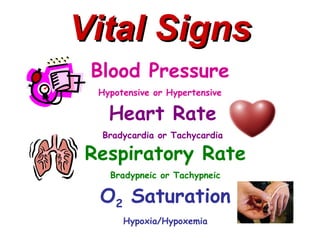
Vital Signs
 Blood Pressure
 Hypotensive or Hypertensive

   Heart Rate
  Bradycardia or Tachycardia

Respiratory Rate
   Bradypneic or Tachypneic

 O2 Saturation
      Hypoxia/Hypoxemia
Blood Pressure
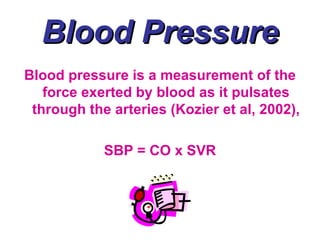
Blood pressure is a measurement of the
   force exerted by blood as it pulsates
 through the arteries (Kozier et al, 2002),

            SBP = CO x SVR
Blood Pressure
   Systolic blood pressure (SBP) is the
    pressure of the blood as a result of
       contraction of the ventricles

  Diastolic blood pressure (DBP) is the
  pressure when the ventricles are at rest

DBP is the lower pressure that is present at
         all times within the arteries
               (Kozier et al, 2002, p. 33)
Blood Pressure
Blood pressure is affected by factors such as
 CO [preload, contractility, afterload]; distension
 of the arteries; and the volume, velocity, and
   viscosity of the blood (Smeltzer et al, 2008, p. 799)

 Blood pressure is an indicator of adequate or
             inadequate perfusion

Inadequate perfusion may be a result of high or
             low blood pressures
Blood Pressure
Hypotension: SBP < 90 and/or DBP < 60

Hypertension: SBP > 140 and/or DBP > 90
Blood Pressure
• Technique for measuring blood pressure
  is important
  – Sitting up
  – Arm at the level of the heart with support
  – Place cuff over brachial artery
  – Use appropriate cuff size
     • Too small – falsely elevated BP
     • Too big – falsely decreased BP
Orthostatic Blood Pressure
• Technique for measuring orthostatic BP
  – Use the same arm
  – Wait at least 5 minutes between measurements
  – Lying, sitting, standing
• Orthostatic Hypotension if:
  – Fall of SBP > 20 mmHg
  – Fall of DBP > 10 mmHg
Mean Arterial Pressure
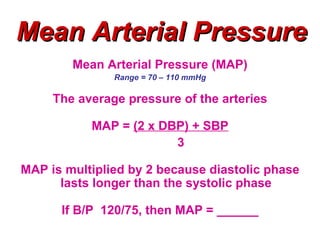
        Mean Arterial Pressure (MAP)
               Range = 70 – 110 mmHg

     The average pressure of the arteries

           MAP = (2 x DBP) + SBP
                        3

MAP is multiplied by 2 because diastolic phase
      lasts longer than the systolic phase

      If B/P 120/75, then MAP = ______
Mean Arterial Pressure
MAP is the average arterial pressure during a
                cardiac cycle

   MAP is considered to be the perfusion
    pressure seen by organs in the body

MAP that is > 60 mmHg is enough to sustain
     the organs of the average person

If MAP is < 60 mmHg, then the organs are not
    being adequately perfused and they will
               become ischemic
Noninvasive BP
    Measurement
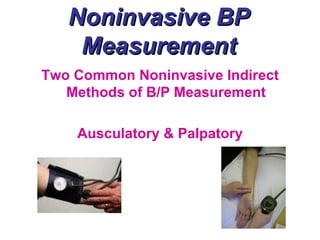
Two Common Noninvasive Indirect
   Methods of B/P Measurement

    Ausculatory & Palpatory
Ausculatory BP Measurement
External pressure is applied to a superficial
    artery (most commonly the brachial).

 The stethoscope, or a Doppler device,is
 placed over the artery and the pressure is
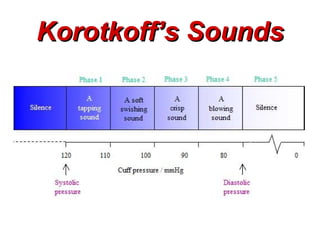
 assessed by listening for the 5 phases of
                  sounds

         a.k.a. Korotkoff’s sounds
Korotkoff’s Sounds
Palpatory BP Measurement
Used when Korotkoff’s sounds cannot be
   heard and electronic equipment to
  amplify the sound (i.e. doppler) is not
                available

   The pulses are palpated, instead of
               auscultated

     The first palpation is the SBP
     DBP is not able to be assessed
Invasive BP Measurement
      Common Invasive Methods of B/P
              Measurement:

          • Arterial B/P Monitoring
   • Pulmonary Artery Pressure Monitoring
        • Cardiac Output Monitoring
          • Cardiac Catheterization
    • Central Venous Pressure Monitoring
               (Donofrio et al, 2005)

 Cardiac Telemetry Patients are not monitored
                 invasively!!!!
Factors Affecting BP:
• Age: Increased r/t arterial wall rigidity
      • Sex: Male BP > Female B/P
        • Exercise: Increases B/P
• Medications: Some Increase, some decrease
         • Stress: Increases B/P
    • Race: African American males –
          increased after age 35
Factors Affecting BP:
• Obesity: Predisposed to hypertension

• Diurnal Variations: lowest in AM, peaks
      in late afternoon/early evening

• Fever/Heat/Cold: Increased with fever
   (increased metabolic rate), decreased
     w/ external heat (vasodilation), and
  increased with cold (vasoconstriction)
Heart Rate
Pulse is the term used to describe rate,
  rhythm, and volume of the heartbeat

  A pulse is produced by ventricular
  contraction which creates a wave of
       blood through the arteries
   The pulse reflects the heartbeat
          (Kozier et al, 2002, p. 23)
Characteristics of a Pulse

Pulse should be characterized as:
• Thready, weak, strong, or bounding
• Equal bilaterally or not
• Rhythm regular or irregular
Heart Rate & Blood
     Pressure
Blood pressure is directly affected by the
                heart rate

 Heart rate is directly affected by blood
                  pressure


   What does this mean…?
Heart Rate & Blood
      Pressure
• HR is Within Defined Parameters if 60–
  100
  – Bradycardia if HR < 60
  – Tachycardia if HR > 100
• Blood pressure affects HR and HR affects
  BP
  – If HR > 100, then BP decreases
  – If HR < 60, then BP decreases
  – If BP decreases then HR increases
Factors Affecting Heart Rate:
    Age: increased age, decreased HR
      • Sex: Male HR < Female HR
               • Exercise
  • Fever: Increased heart rate (peripheral
       vasodilation r/t elevated temp)
               • Medications
• Hypovolemia/Dehydration: Increased heart
                    rates
                  • Stress
     • Position: Higher when standing
Respiratory Rate
Respiratory rate is calculated by counting
  the number of inspirations/respirations
                 per minute

      Normal range is 15 – 20 bpm

        Depth & Rhythm (pattern)


              (Kozier et al, 2002)
Breathing Rates
Eupnea – normal RR that is quiet, rhythmic, and
                  effortless

  Tachypnea – rapid respirations, marked by
       shallow breaths (> 20 per minute)

   Bradypnea – abnormally slow breathing
              (< 8 per minute)

        Apnea – cessation of breathing

               (Kozier et al, 2002, p. 31)
Breathing Rates
Cheyne-Stoke – Fast, deep respirations of 30 –
 170 seconds punctuated by periods of apnea
           lasting 20 – 60 seconds

 Kussmaul’s – fast (over 20 per minute), deep
(resembling sighs), labored respirations without
                    a pause


             (Goldberg et al, 1997, p. 764)
Factors Affecting RR
    • Age: rate & depth decrease with age
      • Exercise: Increased rate & depth
              • Fever: Increased
  • Medications: Narcotics cause respiratory
                   depression
       • Stress: Increased rate & depth
• Homeostasis (acidosis/alkalosis): Increased
                or decreased rate

              (Kozier et al, 2002)
Oxygen Saturation
          Normal = 95% - 100%
      Below 70% is life threatening
 Pulse oximeter - measures arterial blood
            oxygen saturation
Can detect hypoxemia before clinical signs
         & symptoms are apparent

              (Kozier et al, 2002)
Pulse Oximeter
              2-Part Sensor
2. Two light-emitting diodes (LEDs) – one
            red and one infrared
 Transmit light through nails, tissue, venous blood, &
                      arterial blood
2. Photodetector (opposite side of LEDs)
Measures the amount of red and infrared light absorbed
  by oxygenated & deoxygenated hemoglobin in arterial
              blood and reports it as SaO2.


                  (Kozier et al, 2002)
Factors Affecting 02 Sat:
• Hemoglobin: regardless of low Hemoglobin
   levels, if the hemoglobin is fully saturated
          the SaO2 will still be “normal”

 • Circulation: Will be inaccurate if the area
  under the sensor has impaired circulation
• Activity: Shivering or excessive movement
     of the sensor site may interfere with
               accurate readings

              (Kozier et al, 2002, p. 39)
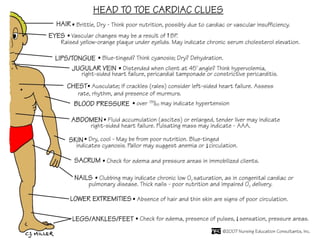
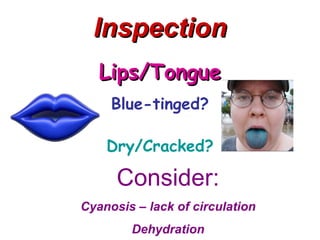
Inspection
   Lips/Tongue
     Blue-tinged?

    Dry/Cracked?

      Consider:
Cyanosis – lack of circulation
        Dehydration
Inspection
               Skin:
                              Hair
Cyanosis/Pale?            Distribution?
  Redness?                    Turgor?

            Consider:
      Cardiac or Vascular insufficiency
                Dehydration
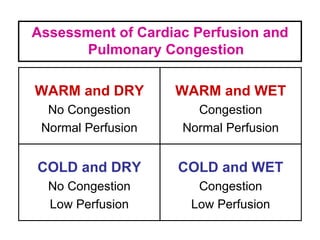
Assessment of Cardiac Perfusion and
       Pulmonary Congestion

WARM and DRY        WARM and WET
  No Congestion       Congestion
 Normal Perfusion   Normal Perfusion


COLD and DRY        COLD and WET
  No Congestion       Congestion
  Low Perfusion      Low Perfusion
Inspection
         Neck:
Jugular Vein Distension?
          Consider:
     Right-sided heart failure
          Hypervolemia
       Cardiac Tamponade
     Constrictive Pericarditis
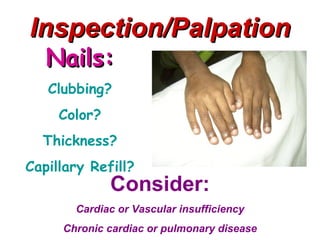
Inspection/Palpation
   Nails:
   Clubbing?
     Color?
  Thickness?
Capillary Refill?
              Consider:
       Cardiac or Vascular insufficiency
     Chronic cardiac or pulmonary disease
Capillary Refill
If greater than 3 seconds may indicate:
  •Dehydration
  •Shock
  •PVD
  •Hypothermia
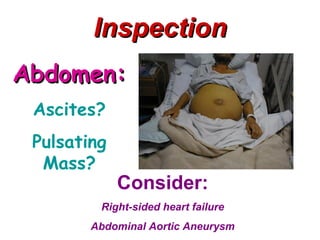
Inspection
Abdomen:
 Ascites?
 Pulsating
  Mass?
             Consider:
         Right-sided heart failure
        Abdominal Aortic Aneurysm
Inspection
Lower Extremities:
       Cyanosis/Pale?
           Redness?
    Hair Distribution?
            Turgor?
            Edema?
       Consider:
  Cardiac or Vascular insufficiency
      Left-sided Heart Failure
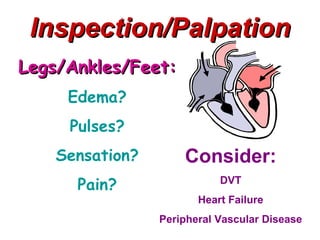
Inspection/Palpation
Legs/Ankles/Feet:
     Edema?
     Pulses?
    Sensation?       Consider:
      Pain?                 DVT
                        Heart Failure
                 Peripheral Vascular Disease
Palpation
Upper Extremities:
         Pulses?
       Sensation?
       Consider:
Peripheral Vascular Disease
           DVT
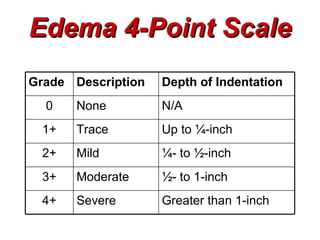
Edema 4-Point Scale
Grade Description   Depth of Indentation
  0    None         N/A
  1+   Trace        Up to ÂĽ-inch
  2+   Mild         ¼- to ½-inch
  3+   Moderate     ½- to 1-inch
  4+   Severe       Greater than 1-inch
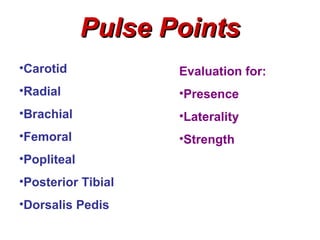
Pulse Points
•Carotid            Evaluation for:
•Radial             •Presence
•Brachial           •Laterality
•Femoral            •Strength
•Popliteal
•Posterior Tibial
•Dorsalis Pedis
Pulse 4-Point Scale
 Grade           Description
   0                Absent
  1+       Palpable, but thready and
            weak; easily obliterated
  2+     Normal, easily identified; not
               easily obliterated
  3+      Increased pulse; moderate
            pressure for obliteration
  4+         Full, bounding; cannot
                    obliterate
Terminology of Pulse
     Variations
•Pulsus Magnus – strong and bounding
•Pulsus Parvus – thready
•Pulsus Alternans – large amplitude followed by low
amplitude (with a regular rhythm)
•Pulsus Bisferiens – double-peaked systolic impulse
(cardiomyopathy)
•Water-Hammer pulse – rapid rising and collapsing
(aortic regurgitation)
General Points
When assessing heart sounds:
 •Need a quiet room
 •Stand to the right of the patient
 •Having patient roll slightly to the left accentuates S3, S4
 and mitral murmurs, especially mitral stenosis
 •Having patient lean forward accentuates aortic
 regurgitation
 •Right-sided heart sounds are better heard on inspiration
 •Left-sided heart sounds are better heard during
 expiration
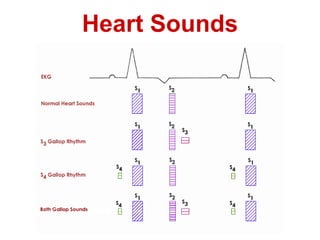
Heart Sounds
First Heart Sounds
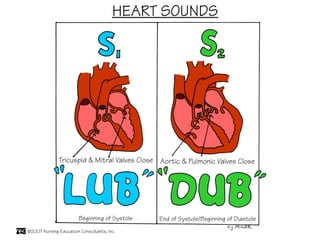
S1 = Lub
 •Closure of the mitral and tricuspid valves
 •Beginning of ventricular systole and atrial
 diastole
 •Palpate the carotid pulse to assist with ID
   •Occurs just before carotid pulse

 •Best heard in mitral area
Second Heart Sounds
S2 = Dub
 •Closure of the aortic and pulmonic valves
 •End of ventricular systole
 •Beginning of ventricular diastole
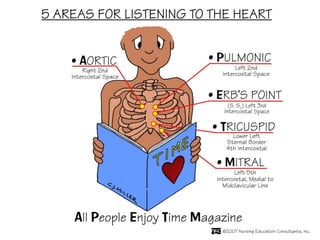
 •Best heard at pulmonic area and Erb’s
 point
Third Heart Sounds
S3 = Lub DubDa
 •Ventricular gallop
 •Caused by increased atrial or ventriuclar filling
 •May be normal in children and pregnancy
 •Best heard in left lateral decub position
 •Associated with R or L ventricular failure,
 ischemia, aortic regurg, mitral regurg, or systolic
 dysfunction
Fourth Heart Sounds
S4 = DaLub Dub
 •Atrial gallop
 •Occurs during late ventricular diastole
 •Caused by atrial contraction and propulsion of
 blood into a noncompliant, stiff ventricle
 •Best heard in left lateral decub position
 •Associated with restrictive cardiomyopathy,
 ischemia, and aortic stenosis
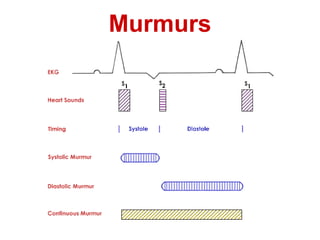
Murmurs
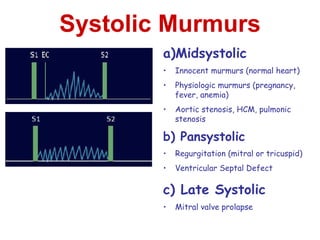
Systolic Murmurs
        a)Midsystolic
        •   Innocent murmurs (normal heart)
        •   Physiologic murmurs (pregnancy,
            fever, anemia)
        •   Aortic stenosis, HCM, pulmonic
            stenosis

        b) Pansystolic
        •   Regurgitation (mitral or tricuspid)
        •   Ventricular Septal Defect

        c) Late Systolic
        •   Mitral valve prolapse
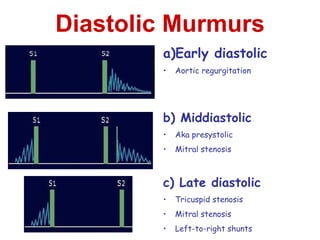
Diastolic Murmurs
        a)Early diastolic
        •   Aortic regurgitation


        b) Middiastolic
        •   Aka presystolic
        •   Mitral stenosis


        c) Late diastolic
        •   Tricuspid stenosis
        •   Mitral stenosis
        •   Left-to-right shunts
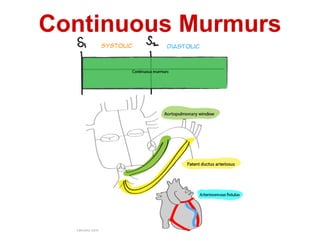
Continuous Murmurs
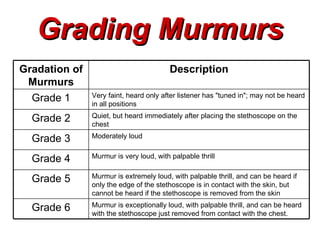
Grading Murmurs
Gradation of                            Description
 Murmurs
               Very faint, heard only after listener has "tuned in"; may not be heard
  Grade 1      in all positions
               Quiet, but heard immediately after placing the stethoscope on the
  Grade 2      chest
               Moderately loud
  Grade 3
               Murmur is very loud, with palpable thrill
  Grade 4
               Murmur is extremely loud, with palpable thrill, and can be heard if
  Grade 5      only the edge of the stethoscope is in contact with the skin, but
               cannot be heard if the stethoscope is removed from the skin
               Murmur is exceptionally loud, with palpable thrill, and can be heard
  Grade 6      with the stethoscope just removed from contact with the chest.
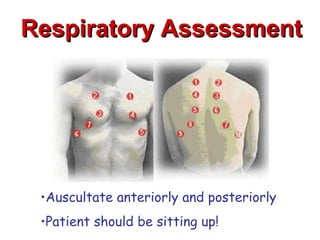
Respiratory Assessment


 •Auscultate anteriorly and posteriorly
 •Patient should be sitting up!
Normal Breath Sounds
Bronchial (upper)
  •Expiratory longer than inspiratory
  •Loud and higher in pitch

Bronchovesicular (middle)
  •Equal inspiratory and expiratory

Vesicular (lower)
  •Soft or low pitched
  •Heard through inspiration and 1/3 expiration
Adventitious Sounds
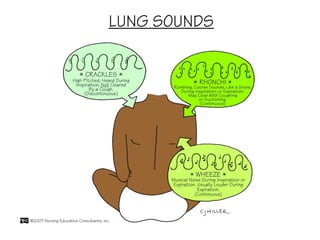
Crackles (Rales)
 •Discontinuous
 •Intermittent, non-musical, brief
 •Like dots in time
 •Crackles that do not clear with cough indicate
 abnormal lung tissue such as fluid (pulmonary
 edema)
 •If clears with cough, atelectasis or secretions
Adventitious Sounds

Wheezes
 •Continuous
 •Musical
 •High-pitched with hissing or shrill quality
 •Narrowing of airways
Adventitious Sounds

Rhonchi
 •Continuous
 •Relatively low-pitched
 •Snoring quality
 •Suggest secretions in large airways
Abdominal Assessment

Auscultation:
 •Normal sounds – clicks & gurgles
 •Occur at 5- to 15-second intervals
 •Absent = no sounds detected within 2 minutes
 •Hypoactive = less than normal
 •Hyperactive = more than normal
 •Listen for bruits
Abdominal Assessment

Palpation:
 •Soft, firm, or rigid
 •No masses or tenderness
 •Rebound pain (may suggest peritoneal
 inflammation or peritonitis)

Inspection:
 •Concave, flat, protuberant, distended???
Genitourinary Assessment
 •Intake and output
   •Indicates both renal and cardiac function

 •Foley catheter
   •Check for orders and insertion date
References
Bickley, L. S. (2007). Bates’ pocket guide to physical examination and history
   taking, (5th ed.). Philadelphia, PA: Lippincott, Wilkins, and Williams.

Davis, L. (2004). Cardiovascular nursing secrets: Your cardiovascular
   questions answered by exoerts you trust. St. Louis, MO: Elsevier Mosby.

Donofrio, J., Haworth, K., Schaeffer, L., & Thompson, G. (Eds.). (2005).
  Cardiovascular care made incredibly easy. Ambler, PA: Lippincott, Williams,
  and Wilkins.

Goldberg, K., Johnson, P., & Lear-Olimpi, M. (1997). Handbook of clinical skills.
   Springhouse, PA: Springhouse Corporation.

Kozier, B., Erb, G., Berman, A., & Snyder, S. (2002). Kozier’s and erb’s
   techniques in clinical nursing: Basic to intermediate skills, (5th ed.). Upper
   Saddle, NJ: Prentice Hall.

Moser, D. K., & Riegel, B. (2008). Cardiac nursing: A companion to braunwald’s
  heart disease. St. Louis, MO: Saunders Elsevier.

Smeltzer et al. (2008). Brunner and suddarth’s textbook of medical-surgical
   nursing, (11th ed.). Philadelphia, PA: Lippincott Williams and Wilkins.

Cardiac Assessment - BMH Tele

  • 1.
    Cardiac Assessment: More ThanJust Heart Sounds Telemetry Course Natalie Bermudez, RN, BSN, MS Clinical Educator for Cardiac Telemetry
  • 2.
    Importance of Assessment •RNs are the 24/7 surveillance system for the patient (Linda Aiken) • RNs are rescue workers (Suzanne Gordon) • RNs are the integrators of all things (Maggie McClure) • RNs are the coordinators of care
  • 3.
    Essentials of Assessment •Empathic listening • Ability to interview patients of different ages, moods, and backgrounds • Techniques for examining different body systems • Clinical Reasoning (I.e. critical thinking) – Putting it all together!
  • 4.
    Key Points ofAssessment • Listen to the patient, they will often help in leading to a diagnosis • Focus on the patient, not the task; be observant • Be a detective; dig for clues • Don’t take anything for GRANTED! – Always check things out, especially “gut feelings”
  • 5.
    Key Points ofAssessment • Be proactive; anticipate your patients needs – Act before your patients gets into trouble • When possible, round with the physician – Discuss any abnormal findings, especially when you’re not sure of their significance
  • 6.
    History • Drives thephysical assessment as well as the diagnostic studies and treatment • Lays the groundwork for the nurse- patient relationship • Provides key information • Should not be bypassed
  • 7.
    History of PresentIllness • Why is the patient seeking care? • Have patient describe in his/her own words Presenting Symptoms: • Ask patient to describe symptoms • Use a systematic approach to evaluating symptoms – OLDCARTS – NOPQRST
  • 8.
    OLDCARTS • O = Onset • L = Location • D = Duration • C = Character • A = Aggravating/Alleviating factors • R = Radiation • T = Timing • S = Site
  • 9.
    NOPQRST • N = Normal • O = Onset • P = Precipitating, Provoking, Palliative • Q = Quality or Quantity • R = Radiation or Region • S = Severity or other Symptoms • T = Time and Treatment
  • 10.
    Cardiovascular Complaints Chest Painor Pressure • Most common symptom in CV presentation • Utilize the NOPQRST method of assessment • N = Normal • O = Onset • P = Precipitation, Provoking, Palliation • Q = Quality and Quantity • R = Radiation and Region • S = Severity and other Symptoms • T = Time and Treatment
  • 11.
    Chest Pain orPressure Onset • Start suddenly or gradually – most angina starts at low intensity and builds • Time of day that discomfort started - some MI’s occur in the morning after the patient rises and begins activity • When did the discomfort 1st begin – today or a few days ago??? • MI may occur with activity or after a heavy meal • Periods of increased myocardial demand
  • 12.
    Chest Pain orPressure Precipitation, Provoking, Palliation • Chest pain caused by CAD is often precipitated by exertion • Other precipitants are exposure to cold or heavy meals • Associated factors – does the discomfort change with inspiration or position change? • What relieves the discomfort? – • NTG, how many; if no relief, ask about storage of NTG • Does the discomfort change with activity change, such as rest?
  • 13.
    Chest Pain orPressure Quality and Quantity • Angina or ischemic discomfort is often described as heaviness, pressure, tightness, or squeezing • Stabbing, intermittent, knife-like descriptions are not likely to be due to cardiac ischemia • Remember – Ask the patient to describe the discomfort
  • 14.
    Chest Pain orPressure Radiation and Region • Substernal region in the most common location for discomfort with cardiac origin • Anginal or ischemic discomfort is likely to radiate to the jaw, either arm, or back • However, discomfort is not always substernal even if it is of cardiac origin • Region of discomfort is usually larger than a fingertip and often the size of a hand or closed fist
  • 15.
    Chest Pain orPressure Severity and Other Symptoms • Severity is subjective • Ischemic pain can range from mild to severe • Rate on a scale of 0 – 10 • Assess for other symptoms – nausea, vomiting, dyspnea, diaphoresis, etc.
  • 16.
    Chest Pain orPressure Time and Treatment • Length of time since onset of symptoms • How long do the symptoms last? • Treated in the past for the same symptoms?
  • 17.
    Dyspnea • Can bedue to pulmonary or cardiac problems • Symptoms occur with activity or rest? • If with activity, what level? • Decreased activity tolerance demonstrated by DOE might be anginal • Onset gradual or sudden? • Orthopnea - Difficulty breathing when flat • PND – dyspnea that occurs 1-2 hours into sleep, relieved by sitting • How many pillows does the patient use?
  • 18.
    Cough and Hemoptysis •Heart Failure or Pulmonary Embolus • Signs of Left-Sided HF • Wet or dry cough • Frequency – chronic or new onset • Occurs only with activity? • Sputum (amount, color, and consistency) • Hemoptysis – blood-streaked, frothy pink, frank • May be present with mitral valve stenosis, pulmonary embolus, pulmonary hypertension, or tuberculosis
  • 19.
    Palpitations • Awareness ofheartbeat • May occur with fast or normal heart rate • May be regular or irregular • May occur with aortic or mitral regurgitation, pregnancy • Tachydysrhythmias may result in palpitations • A-Fib or A-Flutter with RVR, SVT, VT
  • 20.
    Syncope • Distinguish betweendizziness, fainting and syncope • Room spinning or whirling indicates a vestibular disorder • Fading off or blacking out is usually caused by insufficient blood supply to the brain • Hypotension or marked bradycardia or tachycardia • Usually occurs when systolic BP < 70 mmHg • Suspect orthostatic hypotension if occurs with position changes • Vasovagal stimulation
  • 21.
    Physical Assessment • Finda systematic approach that works for you • Always begin your shift with a thorough physical assessment (baseline) • Always complete assessment with respect for patient’s privacy • Room should be quiet • Perform assessment from patients right side
  • 22.
    Physical Assessment • Finda systematic approach that works for you • Always begin your shift with a thorough physical assessment (baseline) • Always complete assessment with respect for patient’s privacy • Room should be quiet • Perform assessment from patients right side
  • 23.
    Vital Signs BloodPressure Hypotensive or Hypertensive Heart Rate Bradycardia or Tachycardia Respiratory Rate Bradypneic or Tachypneic O2 Saturation Hypoxia/Hypoxemia
  • 24.
    Blood Pressure Blood pressureis a measurement of the force exerted by blood as it pulsates through the arteries (Kozier et al, 2002), SBP = CO x SVR
  • 25.
    Blood Pressure Systolic blood pressure (SBP) is the pressure of the blood as a result of contraction of the ventricles Diastolic blood pressure (DBP) is the pressure when the ventricles are at rest DBP is the lower pressure that is present at all times within the arteries (Kozier et al, 2002, p. 33)
  • 26.
    Blood Pressure Blood pressureis affected by factors such as CO [preload, contractility, afterload]; distension of the arteries; and the volume, velocity, and viscosity of the blood (Smeltzer et al, 2008, p. 799) Blood pressure is an indicator of adequate or inadequate perfusion Inadequate perfusion may be a result of high or low blood pressures
  • 27.
    Blood Pressure Hypotension: SBP< 90 and/or DBP < 60 Hypertension: SBP > 140 and/or DBP > 90
  • 28.
    Blood Pressure • Techniquefor measuring blood pressure is important – Sitting up – Arm at the level of the heart with support – Place cuff over brachial artery – Use appropriate cuff size • Too small – falsely elevated BP • Too big – falsely decreased BP
  • 29.
    Orthostatic Blood Pressure •Technique for measuring orthostatic BP – Use the same arm – Wait at least 5 minutes between measurements – Lying, sitting, standing • Orthostatic Hypotension if: – Fall of SBP > 20 mmHg – Fall of DBP > 10 mmHg
  • 30.
    Mean Arterial Pressure Mean Arterial Pressure (MAP) Range = 70 – 110 mmHg The average pressure of the arteries MAP = (2 x DBP) + SBP 3 MAP is multiplied by 2 because diastolic phase lasts longer than the systolic phase If B/P 120/75, then MAP = ______
  • 31.
    Mean Arterial Pressure MAPis the average arterial pressure during a cardiac cycle MAP is considered to be the perfusion pressure seen by organs in the body MAP that is > 60 mmHg is enough to sustain the organs of the average person If MAP is < 60 mmHg, then the organs are not being adequately perfused and they will become ischemic
  • 32.
    Noninvasive BP Measurement Two Common Noninvasive Indirect Methods of B/P Measurement Ausculatory & Palpatory
  • 33.
    Ausculatory BP Measurement Externalpressure is applied to a superficial artery (most commonly the brachial). The stethoscope, or a Doppler device,is placed over the artery and the pressure is assessed by listening for the 5 phases of sounds a.k.a. Korotkoff’s sounds
  • 34.
  • 35.
    Palpatory BP Measurement Usedwhen Korotkoff’s sounds cannot be heard and electronic equipment to amplify the sound (i.e. doppler) is not available The pulses are palpated, instead of auscultated The first palpation is the SBP DBP is not able to be assessed
  • 36.
    Invasive BP Measurement Common Invasive Methods of B/P Measurement: • Arterial B/P Monitoring • Pulmonary Artery Pressure Monitoring • Cardiac Output Monitoring • Cardiac Catheterization • Central Venous Pressure Monitoring (Donofrio et al, 2005) Cardiac Telemetry Patients are not monitored invasively!!!!
  • 37.
    Factors Affecting BP: •Age: Increased r/t arterial wall rigidity • Sex: Male BP > Female B/P • Exercise: Increases B/P • Medications: Some Increase, some decrease • Stress: Increases B/P • Race: African American males – increased after age 35
  • 38.
    Factors Affecting BP: •Obesity: Predisposed to hypertension • Diurnal Variations: lowest in AM, peaks in late afternoon/early evening • Fever/Heat/Cold: Increased with fever (increased metabolic rate), decreased w/ external heat (vasodilation), and increased with cold (vasoconstriction)
  • 39.
    Heart Rate Pulse isthe term used to describe rate, rhythm, and volume of the heartbeat A pulse is produced by ventricular contraction which creates a wave of blood through the arteries The pulse reflects the heartbeat (Kozier et al, 2002, p. 23)
  • 40.
    Characteristics of aPulse Pulse should be characterized as: • Thready, weak, strong, or bounding • Equal bilaterally or not • Rhythm regular or irregular
  • 41.
    Heart Rate &Blood Pressure Blood pressure is directly affected by the heart rate Heart rate is directly affected by blood pressure What does this mean…?
  • 42.
    Heart Rate &Blood Pressure • HR is Within Defined Parameters if 60– 100 – Bradycardia if HR < 60 – Tachycardia if HR > 100 • Blood pressure affects HR and HR affects BP – If HR > 100, then BP decreases – If HR < 60, then BP decreases – If BP decreases then HR increases
  • 43.
    Factors Affecting HeartRate: Age: increased age, decreased HR • Sex: Male HR < Female HR • Exercise • Fever: Increased heart rate (peripheral vasodilation r/t elevated temp) • Medications • Hypovolemia/Dehydration: Increased heart rates • Stress • Position: Higher when standing
  • 44.
    Respiratory Rate Respiratory rateis calculated by counting the number of inspirations/respirations per minute Normal range is 15 – 20 bpm Depth & Rhythm (pattern) (Kozier et al, 2002)
  • 45.
    Breathing Rates Eupnea –normal RR that is quiet, rhythmic, and effortless Tachypnea – rapid respirations, marked by shallow breaths (> 20 per minute) Bradypnea – abnormally slow breathing (< 8 per minute) Apnea – cessation of breathing (Kozier et al, 2002, p. 31)
  • 46.
    Breathing Rates Cheyne-Stoke –Fast, deep respirations of 30 – 170 seconds punctuated by periods of apnea lasting 20 – 60 seconds Kussmaul’s – fast (over 20 per minute), deep (resembling sighs), labored respirations without a pause (Goldberg et al, 1997, p. 764)
  • 47.
    Factors Affecting RR • Age: rate & depth decrease with age • Exercise: Increased rate & depth • Fever: Increased • Medications: Narcotics cause respiratory depression • Stress: Increased rate & depth • Homeostasis (acidosis/alkalosis): Increased or decreased rate (Kozier et al, 2002)
  • 48.
    Oxygen Saturation Normal = 95% - 100% Below 70% is life threatening Pulse oximeter - measures arterial blood oxygen saturation Can detect hypoxemia before clinical signs & symptoms are apparent (Kozier et al, 2002)
  • 49.
    Pulse Oximeter 2-Part Sensor 2. Two light-emitting diodes (LEDs) – one red and one infrared Transmit light through nails, tissue, venous blood, & arterial blood 2. Photodetector (opposite side of LEDs) Measures the amount of red and infrared light absorbed by oxygenated & deoxygenated hemoglobin in arterial blood and reports it as SaO2. (Kozier et al, 2002)
  • 50.
    Factors Affecting 02Sat: • Hemoglobin: regardless of low Hemoglobin levels, if the hemoglobin is fully saturated the SaO2 will still be “normal” • Circulation: Will be inaccurate if the area under the sensor has impaired circulation • Activity: Shivering or excessive movement of the sensor site may interfere with accurate readings (Kozier et al, 2002, p. 39)
  • 52.
    Inspection Lips/Tongue Blue-tinged? Dry/Cracked? Consider: Cyanosis – lack of circulation Dehydration
  • 53.
    Inspection Skin: Hair Cyanosis/Pale? Distribution? Redness? Turgor? Consider: Cardiac or Vascular insufficiency Dehydration
  • 54.
    Assessment of CardiacPerfusion and Pulmonary Congestion WARM and DRY WARM and WET No Congestion Congestion Normal Perfusion Normal Perfusion COLD and DRY COLD and WET No Congestion Congestion Low Perfusion Low Perfusion
  • 55.
    Inspection Neck: Jugular Vein Distension? Consider: Right-sided heart failure Hypervolemia Cardiac Tamponade Constrictive Pericarditis
  • 56.
    Inspection/Palpation Nails: Clubbing? Color? Thickness? Capillary Refill? Consider: Cardiac or Vascular insufficiency Chronic cardiac or pulmonary disease
  • 57.
    Capillary Refill If greaterthan 3 seconds may indicate: •Dehydration •Shock •PVD •Hypothermia
  • 58.
    Inspection Abdomen: Ascites? Pulsating Mass? Consider: Right-sided heart failure Abdominal Aortic Aneurysm
  • 59.
    Inspection Lower Extremities: Cyanosis/Pale? Redness? Hair Distribution? Turgor? Edema? Consider: Cardiac or Vascular insufficiency Left-sided Heart Failure
  • 60.
    Inspection/Palpation Legs/Ankles/Feet: Edema? Pulses? Sensation? Consider: Pain? DVT Heart Failure Peripheral Vascular Disease
  • 61.
    Palpation Upper Extremities: Pulses? Sensation? Consider: Peripheral Vascular Disease DVT
  • 62.
    Edema 4-Point Scale GradeDescription Depth of Indentation 0 None N/A 1+ Trace Up to ¼-inch 2+ Mild ¼- to ½-inch 3+ Moderate ½- to 1-inch 4+ Severe Greater than 1-inch
  • 63.
    Pulse Points •Carotid Evaluation for: •Radial •Presence •Brachial •Laterality •Femoral •Strength •Popliteal •Posterior Tibial •Dorsalis Pedis
  • 64.
    Pulse 4-Point Scale Grade Description 0 Absent 1+ Palpable, but thready and weak; easily obliterated 2+ Normal, easily identified; not easily obliterated 3+ Increased pulse; moderate pressure for obliteration 4+ Full, bounding; cannot obliterate
  • 65.
    Terminology of Pulse Variations •Pulsus Magnus – strong and bounding •Pulsus Parvus – thready •Pulsus Alternans – large amplitude followed by low amplitude (with a regular rhythm) •Pulsus Bisferiens – double-peaked systolic impulse (cardiomyopathy) •Water-Hammer pulse – rapid rising and collapsing (aortic regurgitation)
  • 67.
    General Points When assessingheart sounds: •Need a quiet room •Stand to the right of the patient •Having patient roll slightly to the left accentuates S3, S4 and mitral murmurs, especially mitral stenosis •Having patient lean forward accentuates aortic regurgitation •Right-sided heart sounds are better heard on inspiration •Left-sided heart sounds are better heard during expiration
  • 69.
  • 70.
    First Heart Sounds S1= Lub •Closure of the mitral and tricuspid valves •Beginning of ventricular systole and atrial diastole •Palpate the carotid pulse to assist with ID •Occurs just before carotid pulse •Best heard in mitral area
  • 71.
    Second Heart Sounds S2= Dub •Closure of the aortic and pulmonic valves •End of ventricular systole •Beginning of ventricular diastole •Best heard at pulmonic area and Erb’s point
  • 72.
    Third Heart Sounds S3= Lub DubDa •Ventricular gallop •Caused by increased atrial or ventriuclar filling •May be normal in children and pregnancy •Best heard in left lateral decub position •Associated with R or L ventricular failure, ischemia, aortic regurg, mitral regurg, or systolic dysfunction
  • 73.
    Fourth Heart Sounds S4= DaLub Dub •Atrial gallop •Occurs during late ventricular diastole •Caused by atrial contraction and propulsion of blood into a noncompliant, stiff ventricle •Best heard in left lateral decub position •Associated with restrictive cardiomyopathy, ischemia, and aortic stenosis
  • 74.
  • 75.
    Systolic Murmurs a)Midsystolic • Innocent murmurs (normal heart) • Physiologic murmurs (pregnancy, fever, anemia) • Aortic stenosis, HCM, pulmonic stenosis b) Pansystolic • Regurgitation (mitral or tricuspid) • Ventricular Septal Defect c) Late Systolic • Mitral valve prolapse
  • 76.
    Diastolic Murmurs a)Early diastolic • Aortic regurgitation b) Middiastolic • Aka presystolic • Mitral stenosis c) Late diastolic • Tricuspid stenosis • Mitral stenosis • Left-to-right shunts
  • 77.
  • 78.
    Grading Murmurs Gradation of Description Murmurs Very faint, heard only after listener has "tuned in"; may not be heard Grade 1 in all positions Quiet, but heard immediately after placing the stethoscope on the Grade 2 chest Moderately loud Grade 3 Murmur is very loud, with palpable thrill Grade 4 Murmur is extremely loud, with palpable thrill, and can be heard if Grade 5 only the edge of the stethoscope is in contact with the skin, but cannot be heard if the stethoscope is removed from the skin Murmur is exceptionally loud, with palpable thrill, and can be heard Grade 6 with the stethoscope just removed from contact with the chest.
  • 79.
    Respiratory Assessment •Auscultateanteriorly and posteriorly •Patient should be sitting up!
  • 80.
    Normal Breath Sounds Bronchial(upper) •Expiratory longer than inspiratory •Loud and higher in pitch Bronchovesicular (middle) •Equal inspiratory and expiratory Vesicular (lower) •Soft or low pitched •Heard through inspiration and 1/3 expiration
  • 81.
    Adventitious Sounds Crackles (Rales) •Discontinuous •Intermittent, non-musical, brief •Like dots in time •Crackles that do not clear with cough indicate abnormal lung tissue such as fluid (pulmonary edema) •If clears with cough, atelectasis or secretions
  • 82.
    Adventitious Sounds Wheezes •Continuous •Musical •High-pitched with hissing or shrill quality •Narrowing of airways
  • 83.
    Adventitious Sounds Rhonchi •Continuous •Relatively low-pitched •Snoring quality •Suggest secretions in large airways
  • 85.
    Abdominal Assessment Auscultation: •Normalsounds – clicks & gurgles •Occur at 5- to 15-second intervals •Absent = no sounds detected within 2 minutes •Hypoactive = less than normal •Hyperactive = more than normal •Listen for bruits
  • 86.
    Abdominal Assessment Palpation: •Soft,firm, or rigid •No masses or tenderness •Rebound pain (may suggest peritoneal inflammation or peritonitis) Inspection: •Concave, flat, protuberant, distended???
  • 87.
    Genitourinary Assessment •Intakeand output •Indicates both renal and cardiac function •Foley catheter •Check for orders and insertion date
  • 88.
    References Bickley, L. S.(2007). Bates’ pocket guide to physical examination and history taking, (5th ed.). Philadelphia, PA: Lippincott, Wilkins, and Williams. Davis, L. (2004). Cardiovascular nursing secrets: Your cardiovascular questions answered by exoerts you trust. St. Louis, MO: Elsevier Mosby. Donofrio, J., Haworth, K., Schaeffer, L., & Thompson, G. (Eds.). (2005). Cardiovascular care made incredibly easy. Ambler, PA: Lippincott, Williams, and Wilkins. Goldberg, K., Johnson, P., & Lear-Olimpi, M. (1997). Handbook of clinical skills. Springhouse, PA: Springhouse Corporation. Kozier, B., Erb, G., Berman, A., & Snyder, S. (2002). Kozier’s and erb’s techniques in clinical nursing: Basic to intermediate skills, (5th ed.). Upper Saddle, NJ: Prentice Hall. Moser, D. K., & Riegel, B. (2008). Cardiac nursing: A companion to braunwald’s heart disease. St. Louis, MO: Saunders Elsevier. Smeltzer et al. (2008). Brunner and suddarth’s textbook of medical-surgical nursing, (11th ed.). Philadelphia, PA: Lippincott Williams and Wilkins.

Editor's Notes

  • #2 Thorough cardiac assessment Head – to – Toe Fashion
  • #24 Blood pressure tells us about adequate perfusion B/P that is too low can cause poor perfusion SBP &lt; 90 is considered unstable if symptomatic Elevated B/P can cause problems such as stroke Different factors cause elevations in B/P Pulse Too low or too high can cause poor perfusion Different factors cause elevations in pulse rates RR -elevated RR’s can indicate compensation for a cardiac problem 02 sat -low O2 sat’s may reflect poor perfusion or other cardiac disorders
  • #52 Brief synopsis of a head – to – toe cardiac assessment tool Identifies key assessment findings that could indicate cardiac problems