MITRAL STENOSIS
K. Kavindya M. Fernando
JMJ 1
Mitral stenosis
• Mitral valve
– Consist of fibrous annulus,
– Anterior & posterior leaflets
– Chordae tendinae,
– Papillary muscle
JMJ 2
Mitral stenosis
• Commonest cause :rheumatic heart
disease
• Infections with group A beta hemolytic
streptococci
• More common in women
• Inflammation leads to commissural
fusion and a reduction in mitral valve
orifice area
JMJ 3
Pathophysiology
• Normal valve area: 4-6 cm2
• Mild mitral stenosis:
– MVA 1.5-2.5 cm2
– Minimal symptoms
• Moderate mitral stenosis
– MVA 1.0-1.5 cm2 usually does not produce
symptoms at rest
• Severe mitral stenosis
– MVA < 1.0 cm2
JMJ 4
To maintain sufficient cardiac
output
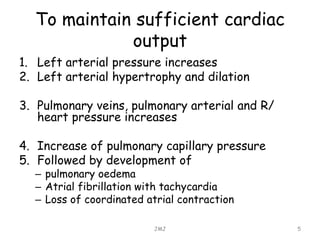
1. Left arterial pressure increases
2. Left arterial hypertrophy and dilation
3. Pulmonary veins, pulmonary arterial and R/
heart pressure increases
4. Increase of pulmonary capillary pressure
5. Followed by development of
– pulmonary oedema
– Atrial fibrillation with tachycardia
– Loss of coordinated atrial contraction
JMJ 5
To maintain sufficient cardiac
output
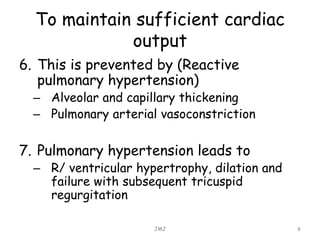
6. This is prevented by (Reactive
pulmonary hypertension)
– Alveolar and capillary thickening
– Pulmonary arterial vasoconstriction
7. Pulmonary hypertension leads to
– R/ ventricular hypertrophy, dilation and
failure with subsequent tricuspid
regurgitation
JMJ 6
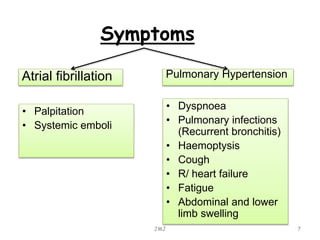
Symptoms
• Palpitation
• Systemic emboli
JMJ 7
• Dyspnoea
• Pulmonary infections
(Recurrent bronchitis)
• Haemoptysis
• Cough
• R/ heart failure
• Fatigue
• Abdominal and lower
limb swelling
Atrial fibrillation Pulmonary Hypertension
Signs
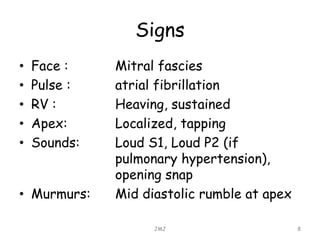
• Face : Mitral fascies
• Pulse : atrial fibrillation
• RV : Heaving, sustained
• Apex: Localized, tapping
• Sounds: Loud S1, Loud P2 (if
pulmonary hypertension),
opening snap
• Murmurs: Mid diastolic rumble at apex
JMJ 8
Mitral Stenosis: Physical
Exam
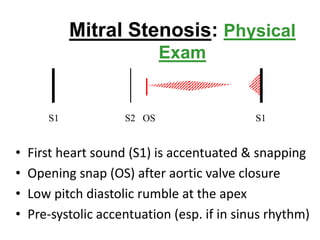
• First heart sound (S1) is accentuated & snapping
• Opening snap (OS) after aortic valve closure
• Low pitch diastolic rumble at the apex
• Pre-systolic accentuation (esp. if in sinus rhythm)
S1 S2 OS S1
Signs (Face)
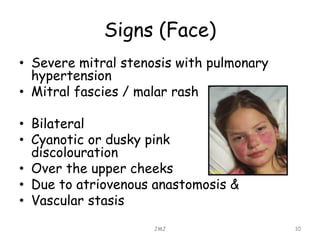
• Severe mitral stenosis with pulmonary
hypertension
• Mitral fascies / malar rash
• Bilateral
• Cyanotic or dusky pink
discolouration
• Over the upper cheeks
• Due to atriovenous anastomosis &
• Vascular stasis
JMJ 10
Signs (Pulse)
• Small volume pulse
• Usually regular in early stages,
• If the patient is in sinus rhythem
• In severe disease, may develop atrial
fibrillation
• Irregularly irregular pulse
JMJ 11
Signs (Jugular Veins)
• If R heart failure develops 
• obvious distension of jugular veins
• If pulmonary hypertension or tricuspid
stenosis is present 
• ‘a’ Wave will be prominent
JMJ 12
Signs (Palpation)
• Tapping impulse felt parasternally on
left side
• Palpable 1st heart sound
• Combined with left ventricular backward
displacement
• Produced by an enlarging left ventricle
• Sustained parasternal impulse
• Due to R ventricular hypertrophy
JMJ 13
Signs (Auscultation)
• Loud 1st heart sound
– If the mitral valve is pliable
– It will not occur in calcified mitral stenosis
• Opening snap
– Valve suddenly opens with the force of the
increased L arterial pressure
• Low pitched ‘rumbling’ mid diastolic murmur
– Best heard with bell held lightly
– At the apex with the patient lying on the left side
JMJ 14
Signs (Auscultation)
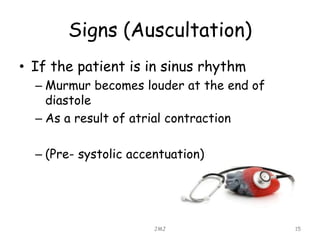
• If the patient is in sinus rhythm
– Murmur becomes louder at the end of
diastole
– As a result of atrial contraction
– (Pre- systolic accentuation)
JMJ 15
How to determine the severity of
mitral stenosis
• Presence of pulmonary hypertension 
– Recognized by R/ ventricular heave & loud
pulmonary component of 2nd heart sound
– And signs with R heart failure : Oedema,
hepatomegaly
– Graham Steell murmur
JMJ 16
How to determine the severity of
mitral stenosis
• Closeness of the opening snap to the 2nd
heart sound ∞ severe MS
• Length of mid-diastolic murmur ∞ severity
• As the valve cusps become immobile
– Loud 1st heart sound softens
– Opening snap diasppears
– When pulmonary hypertension occurs : P2
intensity increase, mid diastolic murmur
become quieter
JMJ 17
Investigations
• Chest X-ray
• Electrocardiogram
• Echocardiogram
• Cardiac magnetic resonance
• Cardiac catheterization
JMJ 18
Investigations –X-ray
• Small heart with an enlarged L/ atrium
• Pulmonary venous hypertension
• Calcified mitral valve– on penetrated or
lateral view
• Signs of pulmonary oedema or pulmonary
hypertension
JMJ 19
Investigations –ECG
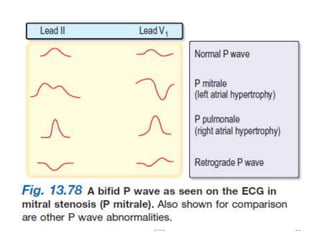
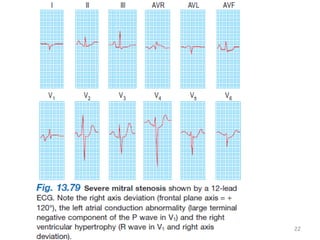
• Sinus rhythm in ECG shows a bifid P wave
– Owing to delayed L/atrial activation
• Atrial fibrillation may be present
• ECG features of R/ventricular hypertrophy
– Right axis deviation
– Perhaps tall R wave in lead V1
JMJ 20
Investigations –ECG
JMJ 21
Investigations –ECG
JMJ 22
Investigations –Echocardiogram
• Transthoracic echocardiography
– To determine L/ R/ atrial and ventricular
size
– The sevirity of MS
• Transoesophageal Echocardiography
(TOE)
– To detect the presence of L/ atrial
thrombus
JMJ 23
Treatment
• Need no treatment other than prompt therapy
of attacks of bronchitis
• Early symptoms like dyspnea - diuretics
• Onset of atrial fibrillation :digoxin,
anticoagulants (to prevent atrial thrombus and
systemic embolism)
• If pulmonary hypertension or symptoms of
pulmonary congestion : surgical therapy
JMJ 24
Treatment
• Operative therapies
– Trans-septal balloon valvotomy
– Closed valvotomy
– Open valvotomy
– Mitral valve replacement
JMJ 25
Treatment: Trans-septal balloon
valvotomy
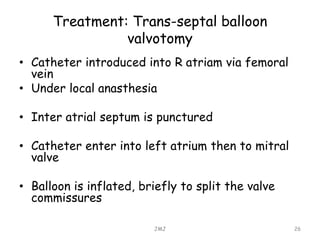
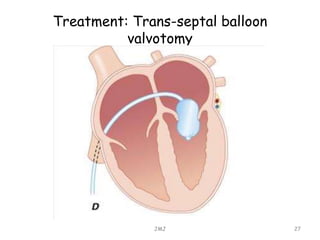
• Catheter introduced into R atriam via femoral
vein
• Under local anasthesia
• Inter atrial septum is punctured
• Catheter enter into left atrium then to mitral
valve
• Balloon is inflated, briefly to split the valve
commissures
JMJ 26
Treatment: Trans-septal balloon
valvotomy
JMJ 27
Treatment: Trans-septal balloon
valvotomy
• Complications
– Regurgitation may result
• Contraindications
– Heavy calcification
– More than mild mitral regurgitation &
thrombus in the L/atrium
• TOE is done before this procedure
JMJ 28
Treatment: Closed valvotomy
• For the patients with
– mobile,
– non calcified and
– non regurgitant mitral valves
• Fused cusps  forced apart by a dilator
(introduced through the apex of L/ ventricle)
• Cardiopulmonary bypass is not needed for this
operation
JMJ 29
Treatment: Open valvotomy
• Often preferred to closed valvotomy
• Cusps are carefully dissected apart
under direct vision
• Cardiopulmonary bypass is requied
JMJ 30
Treatment: Mitral valve replacement
• It is necessary if
– Mitral regurgitation is present
– Badly diseased or badly calcified stenotic
valve,
– Moderate or severe mitral stenosis &
thrombus in L atrium despite anticoagulation
• Artificial valve >20 yrs
• Anticoagulants are necessary
JMJ 31
JMJ 32
JMJ 33

Mitral stenosis

  • 1.
    MITRAL STENOSIS K. KavindyaM. Fernando JMJ 1
  • 2.
    Mitral stenosis • Mitralvalve – Consist of fibrous annulus, – Anterior & posterior leaflets – Chordae tendinae, – Papillary muscle JMJ 2
  • 3.
    Mitral stenosis • Commonestcause :rheumatic heart disease • Infections with group A beta hemolytic streptococci • More common in women • Inflammation leads to commissural fusion and a reduction in mitral valve orifice area JMJ 3
  • 4.
    Pathophysiology • Normal valvearea: 4-6 cm2 • Mild mitral stenosis: – MVA 1.5-2.5 cm2 – Minimal symptoms • Moderate mitral stenosis – MVA 1.0-1.5 cm2 usually does not produce symptoms at rest • Severe mitral stenosis – MVA < 1.0 cm2 JMJ 4
  • 5.
    To maintain sufficientcardiac output 1. Left arterial pressure increases 2. Left arterial hypertrophy and dilation 3. Pulmonary veins, pulmonary arterial and R/ heart pressure increases 4. Increase of pulmonary capillary pressure 5. Followed by development of – pulmonary oedema – Atrial fibrillation with tachycardia – Loss of coordinated atrial contraction JMJ 5
  • 6.
    To maintain sufficientcardiac output 6. This is prevented by (Reactive pulmonary hypertension) – Alveolar and capillary thickening – Pulmonary arterial vasoconstriction 7. Pulmonary hypertension leads to – R/ ventricular hypertrophy, dilation and failure with subsequent tricuspid regurgitation JMJ 6
  • 7.
    Symptoms • Palpitation • Systemicemboli JMJ 7 • Dyspnoea • Pulmonary infections (Recurrent bronchitis) • Haemoptysis • Cough • R/ heart failure • Fatigue • Abdominal and lower limb swelling Atrial fibrillation Pulmonary Hypertension
  • 8.
    Signs • Face :Mitral fascies • Pulse : atrial fibrillation • RV : Heaving, sustained • Apex: Localized, tapping • Sounds: Loud S1, Loud P2 (if pulmonary hypertension), opening snap • Murmurs: Mid diastolic rumble at apex JMJ 8
  • 9.
    Mitral Stenosis: Physical Exam •First heart sound (S1) is accentuated & snapping • Opening snap (OS) after aortic valve closure • Low pitch diastolic rumble at the apex • Pre-systolic accentuation (esp. if in sinus rhythm) S1 S2 OS S1
  • 10.
    Signs (Face) • Severemitral stenosis with pulmonary hypertension • Mitral fascies / malar rash • Bilateral • Cyanotic or dusky pink discolouration • Over the upper cheeks • Due to atriovenous anastomosis & • Vascular stasis JMJ 10
  • 11.
    Signs (Pulse) • Smallvolume pulse • Usually regular in early stages, • If the patient is in sinus rhythem • In severe disease, may develop atrial fibrillation • Irregularly irregular pulse JMJ 11
  • 12.
    Signs (Jugular Veins) •If R heart failure develops  • obvious distension of jugular veins • If pulmonary hypertension or tricuspid stenosis is present  • ‘a’ Wave will be prominent JMJ 12
  • 13.
    Signs (Palpation) • Tappingimpulse felt parasternally on left side • Palpable 1st heart sound • Combined with left ventricular backward displacement • Produced by an enlarging left ventricle • Sustained parasternal impulse • Due to R ventricular hypertrophy JMJ 13
  • 14.
    Signs (Auscultation) • Loud1st heart sound – If the mitral valve is pliable – It will not occur in calcified mitral stenosis • Opening snap – Valve suddenly opens with the force of the increased L arterial pressure • Low pitched ‘rumbling’ mid diastolic murmur – Best heard with bell held lightly – At the apex with the patient lying on the left side JMJ 14
  • 15.
    Signs (Auscultation) • Ifthe patient is in sinus rhythm – Murmur becomes louder at the end of diastole – As a result of atrial contraction – (Pre- systolic accentuation) JMJ 15
  • 16.
    How to determinethe severity of mitral stenosis • Presence of pulmonary hypertension  – Recognized by R/ ventricular heave & loud pulmonary component of 2nd heart sound – And signs with R heart failure : Oedema, hepatomegaly – Graham Steell murmur JMJ 16
  • 17.
    How to determinethe severity of mitral stenosis • Closeness of the opening snap to the 2nd heart sound ∞ severe MS • Length of mid-diastolic murmur ∞ severity • As the valve cusps become immobile – Loud 1st heart sound softens – Opening snap diasppears – When pulmonary hypertension occurs : P2 intensity increase, mid diastolic murmur become quieter JMJ 17
  • 18.
    Investigations • Chest X-ray •Electrocardiogram • Echocardiogram • Cardiac magnetic resonance • Cardiac catheterization JMJ 18
  • 19.
    Investigations –X-ray • Smallheart with an enlarged L/ atrium • Pulmonary venous hypertension • Calcified mitral valve– on penetrated or lateral view • Signs of pulmonary oedema or pulmonary hypertension JMJ 19
  • 20.
    Investigations –ECG • Sinusrhythm in ECG shows a bifid P wave – Owing to delayed L/atrial activation • Atrial fibrillation may be present • ECG features of R/ventricular hypertrophy – Right axis deviation – Perhaps tall R wave in lead V1 JMJ 20
  • 21.
  • 22.
  • 23.
    Investigations –Echocardiogram • Transthoracicechocardiography – To determine L/ R/ atrial and ventricular size – The sevirity of MS • Transoesophageal Echocardiography (TOE) – To detect the presence of L/ atrial thrombus JMJ 23
  • 24.
    Treatment • Need notreatment other than prompt therapy of attacks of bronchitis • Early symptoms like dyspnea - diuretics • Onset of atrial fibrillation :digoxin, anticoagulants (to prevent atrial thrombus and systemic embolism) • If pulmonary hypertension or symptoms of pulmonary congestion : surgical therapy JMJ 24
  • 25.
    Treatment • Operative therapies –Trans-septal balloon valvotomy – Closed valvotomy – Open valvotomy – Mitral valve replacement JMJ 25
  • 26.
    Treatment: Trans-septal balloon valvotomy •Catheter introduced into R atriam via femoral vein • Under local anasthesia • Inter atrial septum is punctured • Catheter enter into left atrium then to mitral valve • Balloon is inflated, briefly to split the valve commissures JMJ 26
  • 27.
  • 28.
    Treatment: Trans-septal balloon valvotomy •Complications – Regurgitation may result • Contraindications – Heavy calcification – More than mild mitral regurgitation & thrombus in the L/atrium • TOE is done before this procedure JMJ 28
  • 29.
    Treatment: Closed valvotomy •For the patients with – mobile, – non calcified and – non regurgitant mitral valves • Fused cusps  forced apart by a dilator (introduced through the apex of L/ ventricle) • Cardiopulmonary bypass is not needed for this operation JMJ 29
  • 30.
    Treatment: Open valvotomy •Often preferred to closed valvotomy • Cusps are carefully dissected apart under direct vision • Cardiopulmonary bypass is requied JMJ 30
  • 31.
    Treatment: Mitral valvereplacement • It is necessary if – Mitral regurgitation is present – Badly diseased or badly calcified stenotic valve, – Moderate or severe mitral stenosis & thrombus in L atrium despite anticoagulation • Artificial valve >20 yrs • Anticoagulants are necessary JMJ 31
  • 32.
  • 33.