INTERNAL
    MEDICINE:
    Secondary
   Hypertension
nianderthalNOTES
SECONDARY HYPERTENSION
DEFINITION:
-the elevation of blood pressure due to a specific
   underlying disorder

CAUSES (Include but not limited to):
-Renal Parenchymal Diseases
-Primary Aldosteronism
-Cushing’s Syndrome
-Pheochromocytoma
Renal Parenchymal Diseases
-RENAL DISEASE IS THE MOST COMMON CAUSE
  OF SECONDARY HYPERTENSION
-Hypertension is MORE SEVERE in GLOMERULAR
  DISEASES than in Interstitial Diseases
-Proteinuria >1000 mg/day and an active urine
  sediment are indicative of PRIMARY RENAL
  DISEASE
Renovascular Hypertension
-hypertension due to obstruction of a renal artery
-potentially curable form
-mechanism is related to activation of the renin-
  angiotensin system
-Females 8x > Males
-Patients at risk:
  1. Older arteriosclerotic patients with plaque on
  renal artery, frequently at its origin
  2. Patients with fibromuscular dysplasia
Renovascular Hypertension
-Histologic Variants of Fibromuscular Dysplasia:
  1. Medial Fibroplasia – MOST COMMON
  2. Perimedial Fibroplasia
  3. Medial Hyperplasia
  4. Intimal Fibroplasia
*Fibromuscular dysplasia lesion are bilateral and
  affect more distal portions of the renal artery
Renovascular Hypertension
-S/Sx:
   -abdominal or flank bruit that extends throughout
   systole into diastole
-Treatment:
   -Renal Vascular repair: pts with long-standing HTN,
   advanced renal insufficiency, DM are LESS LIKELY to
   benefit
   -ACE inhibitors/ARBs: decrease GFR in stenotic kidneys
   causing renal arteriolar vasodilation; cause progressive
   renal insufficiency in pts w/ bilateral renal artery
   stenosis or renal artery stenosis on a solitary kidney
   BUT insufficiency is REVERSIBLE IF DRUG is
   DISCONTINUED
Renovascular Hypertension
-Treatment:
   -Percutaneous Transluminal Renal Angioplasty (PTRA)
        -intial treatment of choice in pts w/ Fibromuscular
   Disease
-LAB/Imaging:
   -OIH scan / DTPA scan before and after a single dose of ACEi
   to assess renal blood flow and GFR, respectively
   -Doppler Ultrasound
   -Gadolinium-contrast magnetic resonance angiography –
   proximal > distal renal artery
   - Contrast Angiography – “GOLD STANDARD” for detecting
   Renal Artery Lesions; NEPHROTOXIC ( to patients with DM,
   w/ pre-existing Renal Insufficiency)
Renovascular Hypertension
-Prognosis:
  -Patients with fibromuscular disease have
  more favorable outcomes than patients with
  atherosclerotic lesions, owing to younger age,
  shorter duration of HTN and less systemic
  disease
Primary Aldosteronism
-DEFINITION: excess aldosterone production
-potentially curable form of HTN
-HTN is mild to moderate, but occasionally severe
-increased aldosterone production is INDEPENDENT
   of the renin-angiotensin system and the
   consequences are:
   1. sodium retention
   2. hypertension
   3. hypokalemia
   4. low PRA
Primary Aldosteronism
-Risk Factors:
  -30s-50s
  -pts taking diuretics
-S/Sx:
  -asymptomatic (most)
  -polyuria
  -polydipsia
  -paresthesias or muscle weakness
  -hypertension- mild-moderate, occasionally
  severe
Primary Aldosteronism
-LAB/Imaging:
   1. Serum potassium concentration
        -SIMPLEST SCREENING TEST
        -can be normal initially in some pts with aldosterone
   secreting adenoma
   2. Plasma Aldosterone to Plasma Renin Activity (PA/PRA) ratio
        -ambulatory pts in the morning
        - >20 PA/PRA ratio -90% have aldosterone secreting
   adenoma
        -affected by drugs:
                -Aldosterone antagonists – increases aldosterone
                -ARBs and ACEi – increases renin
Primary Aldosteronism
-LAB/Imaging:
  3. CT/MRI
      -should be carried out in all patients
  diagnoses with primary aldosteronism
  4. Adrenal Scintigraphy
      -if CT/MRI does not detect adenoma
Primary Aldosteronism
-Diagnosis:
  -confirmed by demonstrating FAILURE TO
  SUPPRESS plasma aldosterone to <277 pmol/L
  after IV infusion of 2L of isotonic saline over 4h
Primary Aldosteronism
-Etiology:
  -aldosterone producing adrenal adenoma
      -unilateral, <3cm in diameter
      -biosynthesis is more responsive to ACTH
      -Hypertension responsive post surgery
  -adrenocortical hyperplasia
      -bilateral
      -biosynthesis is more responsive to angiotensin
      -Hypertension NOT responsive post surgery
Primary Aldosteronism
-Etiology:
  -adrenal carcinoma
      -produce other adrenal steroids
  -ectopic malignancy
      -e.g. ovarian arrhenoblastoma
Primary Aldosteronism
-Treatment:
   1.Surgery
       -should be undertaken only after BP has been
   controlled and hypokalemia corrected
       -HYPOaldosteronism may occur 3 months post
   operation during this time Potassium should be
   monitored, and HYPERkalemia should be treated with
   potassium-wasting diuretics and fludrocortisone

  2. Aldosterone antagonists

  3. Potassium-sparing diuretics
Primary Aldosteronism
-Treatment:
  4. Glucocorticoids / Spironolactone
      -for rare, monogenic, autosomal dominant
  form of the disease characterized by moderate
  to severe HTN
Cushing’s Syndrome
-Hypertension occurs in 75-80% of patients

-MECHANISM:
  -stimulation of mineralocorticoid receptors by
  cortisol and increased secretion of adrenal
  steroids
  -can be seen in patients taking exogenous
  glucocorticoids
Cushing’s Syndrome
-Lab/Imaging:
  1. 24-h urine excretion rate of free cortisol

  2. Overnight Dexamethasone suppression tes

-Treatment:
   -appropriate therapy depends on etiology
Pheochromocytoma
-DEFINITION: catecholamine secreting tumors
  that are located in the adrenal medulla
  -autosomal dominant
  -can be associated with multiple endocrine
  neoplasias (MEN) type 2A and type 2B

-PARAGANGLIOMA: -tumor in extra-adrenal
  paraganglion tissue
Pheochromocytoma
-MECHANISM:
  -related to increased circulating
  catecholamines, and may secrete other
  vasoactive substances

 -RARITY: epinephrine is secreted predominantly
 and causes HYPOtension rather than
 HYPERtension
Pheochromocytoma
-Lab/Imaging:
  1. Catecholamine in Urine or Plasma

  2. Genetic screening
MISCELLANEOUS CAUSES OF
           HYPERTENSION
1. Obstructive Sleep Apnea
    -severity of HTN correlates with severity of
   sleep apnea
    -should be considered in drug-resistant
   patients and with history of snoring
   -Dx: confirmed by Polysomnography
   -Rx: Weight loss, Continuous Positive Airway
   Pressure (CPAP)
MISCELLANEOUS CAUSES OF
           HYPERTENSION
2. Coarctation of the Aorta
     -MOST COMMON CONGENITAL
    CARDIOVASCULAR CAUSE OF HYPERTENSION
     -occurs in 35% of pts with Turner’s Syndrome
    -Patients with less severe lesions may not be
    diagnosed until young adulthood
    -S/Sx: diminished and delayed femoral pulses,
    systolic pressure gradient between the right
    arms and legs
MISCELLANEOUS CAUSES OF
           HYPERTENSION
2. Coarctation of the Aorta
     -Dx: Chest X-ray and transesophageal
    echocardiogram
    -Tx: Surgical repair, Balloon angioplasty (with
    or without cardiovascular stent)

3. Thyroid diseases
    -Hypothyroidism: mild diastolic hypertension
    -Hyperthyroidism: systolic hypertension
MISCELLANEOUS CAUSES OF
          HYPERTENSION
4. Acromegaly

5. Hypercalcemia
    -MOST COMMON ETIOLOGY IS PRIMARY
   HYPERPARATHYROIDISM
MONOGENIC HYPERTENSION
-recognized by their characteristic phenotypes
   and Dx confirmed by genetic analysis
-inherited defects in adrenal steroid biosynthesis
   and metabolism result in
   MINERALOCORTICOID-INDUCED
   HYPERTENSION and HYPOKALEMIA
MONOGENIC HYPERTENSION
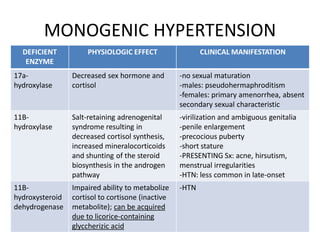
  DEFICIENT           PHYSIOLOGIC EFFECT                  CLINICAL MANIFESTATION
   ENZYME
17a-             Decreased sex hormone and         -no sexual maturation
hydroxylase      cortisol                          -males: pseudohermaphroditism
                                                   -females: primary amenorrhea, absent
                                                   secondary sexual characteristic
11B-             Salt-retaining adrenogenital      -virilization and ambiguous genitalia
hydroxylase      syndrome resulting in             -penile enlargement
                 decreased cortisol synthesis,     -precocious puberty
                 increased mineralocorticoids      -short stature
                 and shunting of the steroid       -PRESENTING Sx: acne, hirsutism,
                 biosynthesis in the androgen      menstrual irregularities
                 pathway                           -HTN: less common in late-onset
11B-             Impaired ability to metabolize    -HTN
hydroxysteroid   cortisol to cortisone (inactive
dehydrogenase    metabolite); can be acquired
                 due to licorice-containing
                 glyccherizic acid
MONOGENIC HYPERTENSION
-LIDDLE’S SYNDROME:
   -results from constitutive activation of
   amiloride sensitive epithelial sodium channels
   on the distal renal tubule resulting in EXCESS
   SODIUM REABSORPTION

-HYPERTENSION IN PREGNANCY
   -exacerbated due to activation of
   mineralocorticoid receptors by progesterone

INTERNAL MEDICINE - Secondary Hypertension

  • 1.
    INTERNAL MEDICINE: Secondary Hypertension nianderthalNOTES
  • 2.
    SECONDARY HYPERTENSION DEFINITION: -the elevationof blood pressure due to a specific underlying disorder CAUSES (Include but not limited to): -Renal Parenchymal Diseases -Primary Aldosteronism -Cushing’s Syndrome -Pheochromocytoma
  • 3.
    Renal Parenchymal Diseases -RENALDISEASE IS THE MOST COMMON CAUSE OF SECONDARY HYPERTENSION -Hypertension is MORE SEVERE in GLOMERULAR DISEASES than in Interstitial Diseases -Proteinuria >1000 mg/day and an active urine sediment are indicative of PRIMARY RENAL DISEASE
  • 4.
    Renovascular Hypertension -hypertension dueto obstruction of a renal artery -potentially curable form -mechanism is related to activation of the renin- angiotensin system -Females 8x > Males -Patients at risk: 1. Older arteriosclerotic patients with plaque on renal artery, frequently at its origin 2. Patients with fibromuscular dysplasia
  • 5.
    Renovascular Hypertension -Histologic Variantsof Fibromuscular Dysplasia: 1. Medial Fibroplasia – MOST COMMON 2. Perimedial Fibroplasia 3. Medial Hyperplasia 4. Intimal Fibroplasia *Fibromuscular dysplasia lesion are bilateral and affect more distal portions of the renal artery
  • 6.
    Renovascular Hypertension -S/Sx: -abdominal or flank bruit that extends throughout systole into diastole -Treatment: -Renal Vascular repair: pts with long-standing HTN, advanced renal insufficiency, DM are LESS LIKELY to benefit -ACE inhibitors/ARBs: decrease GFR in stenotic kidneys causing renal arteriolar vasodilation; cause progressive renal insufficiency in pts w/ bilateral renal artery stenosis or renal artery stenosis on a solitary kidney BUT insufficiency is REVERSIBLE IF DRUG is DISCONTINUED
  • 7.
    Renovascular Hypertension -Treatment: -Percutaneous Transluminal Renal Angioplasty (PTRA) -intial treatment of choice in pts w/ Fibromuscular Disease -LAB/Imaging: -OIH scan / DTPA scan before and after a single dose of ACEi to assess renal blood flow and GFR, respectively -Doppler Ultrasound -Gadolinium-contrast magnetic resonance angiography – proximal > distal renal artery - Contrast Angiography – “GOLD STANDARD” for detecting Renal Artery Lesions; NEPHROTOXIC ( to patients with DM, w/ pre-existing Renal Insufficiency)
  • 8.
    Renovascular Hypertension -Prognosis: -Patients with fibromuscular disease have more favorable outcomes than patients with atherosclerotic lesions, owing to younger age, shorter duration of HTN and less systemic disease
  • 9.
    Primary Aldosteronism -DEFINITION: excessaldosterone production -potentially curable form of HTN -HTN is mild to moderate, but occasionally severe -increased aldosterone production is INDEPENDENT of the renin-angiotensin system and the consequences are: 1. sodium retention 2. hypertension 3. hypokalemia 4. low PRA
  • 10.
    Primary Aldosteronism -Risk Factors: -30s-50s -pts taking diuretics -S/Sx: -asymptomatic (most) -polyuria -polydipsia -paresthesias or muscle weakness -hypertension- mild-moderate, occasionally severe
  • 11.
    Primary Aldosteronism -LAB/Imaging: 1. Serum potassium concentration -SIMPLEST SCREENING TEST -can be normal initially in some pts with aldosterone secreting adenoma 2. Plasma Aldosterone to Plasma Renin Activity (PA/PRA) ratio -ambulatory pts in the morning - >20 PA/PRA ratio -90% have aldosterone secreting adenoma -affected by drugs: -Aldosterone antagonists – increases aldosterone -ARBs and ACEi – increases renin
  • 12.
    Primary Aldosteronism -LAB/Imaging: 3. CT/MRI -should be carried out in all patients diagnoses with primary aldosteronism 4. Adrenal Scintigraphy -if CT/MRI does not detect adenoma
  • 13.
    Primary Aldosteronism -Diagnosis: -confirmed by demonstrating FAILURE TO SUPPRESS plasma aldosterone to <277 pmol/L after IV infusion of 2L of isotonic saline over 4h
  • 14.
    Primary Aldosteronism -Etiology: -aldosterone producing adrenal adenoma -unilateral, <3cm in diameter -biosynthesis is more responsive to ACTH -Hypertension responsive post surgery -adrenocortical hyperplasia -bilateral -biosynthesis is more responsive to angiotensin -Hypertension NOT responsive post surgery
  • 15.
    Primary Aldosteronism -Etiology: -adrenal carcinoma -produce other adrenal steroids -ectopic malignancy -e.g. ovarian arrhenoblastoma
  • 16.
    Primary Aldosteronism -Treatment: 1.Surgery -should be undertaken only after BP has been controlled and hypokalemia corrected -HYPOaldosteronism may occur 3 months post operation during this time Potassium should be monitored, and HYPERkalemia should be treated with potassium-wasting diuretics and fludrocortisone 2. Aldosterone antagonists 3. Potassium-sparing diuretics
  • 17.
    Primary Aldosteronism -Treatment: 4. Glucocorticoids / Spironolactone -for rare, monogenic, autosomal dominant form of the disease characterized by moderate to severe HTN
  • 18.
    Cushing’s Syndrome -Hypertension occursin 75-80% of patients -MECHANISM: -stimulation of mineralocorticoid receptors by cortisol and increased secretion of adrenal steroids -can be seen in patients taking exogenous glucocorticoids
  • 19.
    Cushing’s Syndrome -Lab/Imaging: 1. 24-h urine excretion rate of free cortisol 2. Overnight Dexamethasone suppression tes -Treatment: -appropriate therapy depends on etiology
  • 20.
    Pheochromocytoma -DEFINITION: catecholamine secretingtumors that are located in the adrenal medulla -autosomal dominant -can be associated with multiple endocrine neoplasias (MEN) type 2A and type 2B -PARAGANGLIOMA: -tumor in extra-adrenal paraganglion tissue
  • 21.
    Pheochromocytoma -MECHANISM: -relatedto increased circulating catecholamines, and may secrete other vasoactive substances -RARITY: epinephrine is secreted predominantly and causes HYPOtension rather than HYPERtension
  • 22.
    Pheochromocytoma -Lab/Imaging: 1.Catecholamine in Urine or Plasma 2. Genetic screening
  • 23.
    MISCELLANEOUS CAUSES OF HYPERTENSION 1. Obstructive Sleep Apnea -severity of HTN correlates with severity of sleep apnea -should be considered in drug-resistant patients and with history of snoring -Dx: confirmed by Polysomnography -Rx: Weight loss, Continuous Positive Airway Pressure (CPAP)
  • 24.
    MISCELLANEOUS CAUSES OF HYPERTENSION 2. Coarctation of the Aorta -MOST COMMON CONGENITAL CARDIOVASCULAR CAUSE OF HYPERTENSION -occurs in 35% of pts with Turner’s Syndrome -Patients with less severe lesions may not be diagnosed until young adulthood -S/Sx: diminished and delayed femoral pulses, systolic pressure gradient between the right arms and legs
  • 25.
    MISCELLANEOUS CAUSES OF HYPERTENSION 2. Coarctation of the Aorta -Dx: Chest X-ray and transesophageal echocardiogram -Tx: Surgical repair, Balloon angioplasty (with or without cardiovascular stent) 3. Thyroid diseases -Hypothyroidism: mild diastolic hypertension -Hyperthyroidism: systolic hypertension
  • 26.
    MISCELLANEOUS CAUSES OF HYPERTENSION 4. Acromegaly 5. Hypercalcemia -MOST COMMON ETIOLOGY IS PRIMARY HYPERPARATHYROIDISM
  • 27.
    MONOGENIC HYPERTENSION -recognized bytheir characteristic phenotypes and Dx confirmed by genetic analysis -inherited defects in adrenal steroid biosynthesis and metabolism result in MINERALOCORTICOID-INDUCED HYPERTENSION and HYPOKALEMIA
  • 28.
    MONOGENIC HYPERTENSION DEFICIENT PHYSIOLOGIC EFFECT CLINICAL MANIFESTATION ENZYME 17a- Decreased sex hormone and -no sexual maturation hydroxylase cortisol -males: pseudohermaphroditism -females: primary amenorrhea, absent secondary sexual characteristic 11B- Salt-retaining adrenogenital -virilization and ambiguous genitalia hydroxylase syndrome resulting in -penile enlargement decreased cortisol synthesis, -precocious puberty increased mineralocorticoids -short stature and shunting of the steroid -PRESENTING Sx: acne, hirsutism, biosynthesis in the androgen menstrual irregularities pathway -HTN: less common in late-onset 11B- Impaired ability to metabolize -HTN hydroxysteroid cortisol to cortisone (inactive dehydrogenase metabolite); can be acquired due to licorice-containing glyccherizic acid
  • 29.
    MONOGENIC HYPERTENSION -LIDDLE’S SYNDROME: -results from constitutive activation of amiloride sensitive epithelial sodium channels on the distal renal tubule resulting in EXCESS SODIUM REABSORPTION -HYPERTENSION IN PREGNANCY -exacerbated due to activation of mineralocorticoid receptors by progesterone