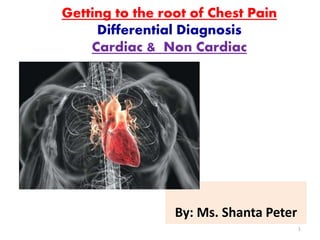
Getting to the root of Chest Pain
Differential Diagnosis
Cardiac & Non Cardiac
By: Ms. Shanta Peter
1
Chest Pain-- cardiac or Not
• Treat patient as though he is critical --- until
proved otherwise
History
• Risk factors, H/O IHD, previous Rxs , Previous chest pain
• Pain- Heart burn - burning sensation – chest pain with
pressure /tightness
Remember ---–
……………treat with cause… there are many causes
2
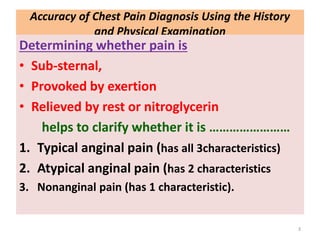
Accuracy of Chest Pain Diagnosis Using the History
and Physical Examination
Determining whether pain is
• Sub-sternal,
• Provoked by exertion
• Relieved by rest or nitroglycerin
helps to clarify whether it is ……………………
1. Typical anginal pain (has all 3characteristics)
2. Atypical anginal pain (has 2 characteristics
3. Nonanginal pain (has 1 characteristic).
3
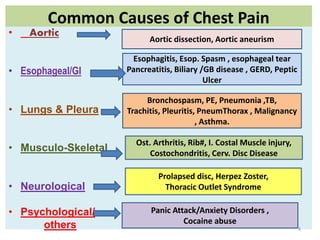
Common Causes of Chest Pain
• Aortic
• Esophageal/GI
• Lungs & Pleura
• Musculo-Skeletal
• Neurological
• Psychological/
others
Aortic dissection, Aortic aneurism
Esophagitis, Esop. Spasm , esophageal tear
Pancreatitis, Biliary /GB disease , GERD, Peptic
Ulcer
Bronchospasm, PE, Pneumonia ,TB,
Trachitis, Pleuritis, PneumThorax , Malignancy
, Asthma.
Ost. Arthritis, Rib#, I. Costal Muscle injury,
Costochondritis, Cerv. Disc Disease
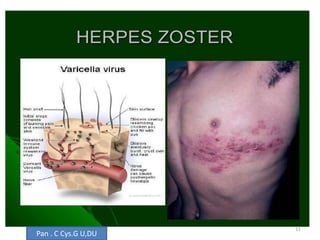
Prolapsed disc, Herpez Zoster,
Thoracic Outlet Syndrome
Panic Attack/Anxiety Disorders ,
Cocaine abuse
4
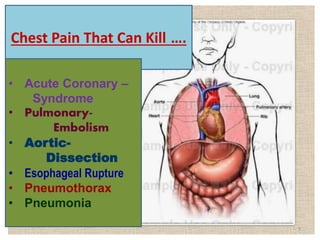
Chest Pain That Can Kill ….
• Acute Coronary –
Syndrome
• Pulmonary-
Embolism
• Aortic-
Dissection
• Esophageal Rupture
• Pneumothorax
• Pneumonia
5
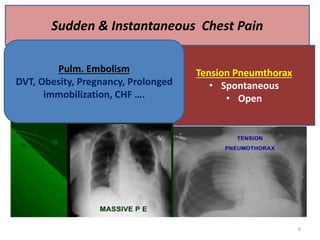
Sudden & Instantaneous Chest Pain
Tension Pneumthorax
• Spontaneous
• Open
Pulm. Embolism
DVT, Obesity, Pregnancy, Prolonged
immobilization, CHF ….
6
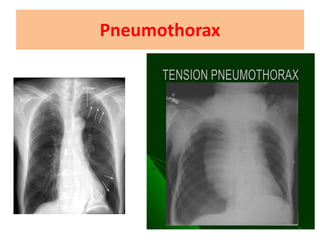
Pneumothorax
7
Pneumothorax
Sharp C. Pain. Dyspnea ,absence of breath- sound
in the affected side
• Radionuclide studies – Gated pool
• SPECT – Single proton emission computed Tomography
• PET – Positron Emission Tomography
Pulm. Embolism
Sudden pleuretic substernal pain with dyspnea ,
T cardia , fever or cough , diaphoresis – mimic MI/angina
• VQ Scan
• D DIMER
• Spiral CT-- best Diag –
(Pneumonia )
8
Pneumonia
• Infection of pulm. tissue – Interstitial spaces,
alveoli, bronchioles
• Chest pain – pleuritic , come sin suddenly
• Febrile – chills , cough with copious/blood
stained sputum
• Rales--- rhonchi wheezes
• Hypoxia
(Ca)
9
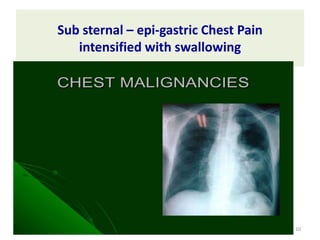
Sub sternal – epi-gastric Chest Pain
intensified with swallowing
10
11
Pan . C Cys.G U,DU
G Intestinal
Pancreatitis : Pain in the LUQ, substernal. Radiate to back
, difficulty in breathing, tachycardia, vomiting, worse in
supine , better while leaning forward
• Cholecystitis :
Pain in RUQ – precipitate by meal
• Gastric Ulcer
Pain Lt Epigastrium – radiation to back
• Duodinal Ulcer
Mid Epigastric pain – cramping- 2-4 hrs after
meal
(E rupture ) 12
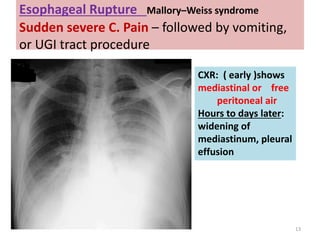
Esophageal Rupture Mallory–Weiss syndrome
Sudden severe C. Pain – followed by vomiting,
or UGI tract procedure
CXR: ( early )shows
mediastinal or free
peritoneal air
Hours to days later:
widening of
mediastinum, pleural
effusion
13
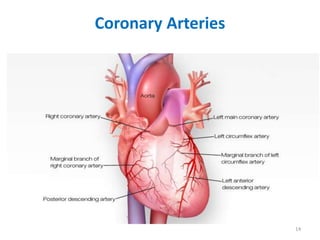
Coronary Arteries
14
15
16
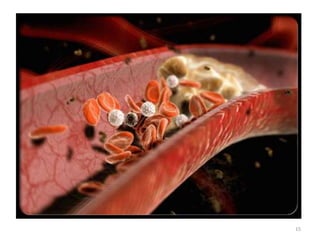
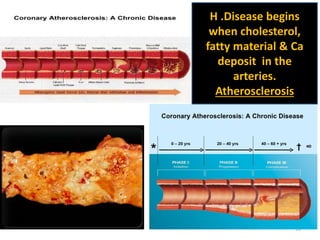
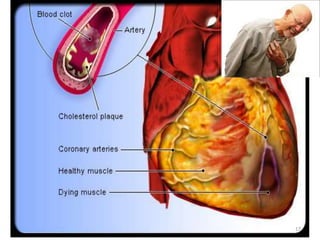
H .Disease begins
when cholesterol,
fatty material & Ca
deposit in the
arteries.
Atherosclerosis
17
18
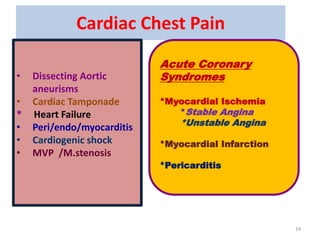
Cardiac Chest Pain
• Dissecting Aortic
aneurisms
• Cardiac Tamponade
* Heart Failure
• Peri/endo/myocarditis
• Cardiogenic shock
• MVP /M.stenosis
Acute Coronary
Syndromes
*Myocardial Ischemia
*Stable Angina
*Unstable Angina
*Myocardial Infarction
*Pericarditis
19
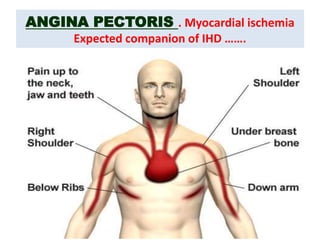
ANGINA PECTORIS . Myocardial ischemia
Expected companion of IHD …….
20
Accuracy of Chest Pain Diagnosis Using the History
and Physical Examination
Determining whether pain is
• Sub-sternal,
• Provoked by exertion
• Relieved by rest or nitroglycerin
helps to clarify whether it is ……………………
1. Typical anginal pain (has all 3characteristics)
2. Atypical anginal pain (has 2 characteristics
3. Non-anginal pain (has 1 characteristic).
21
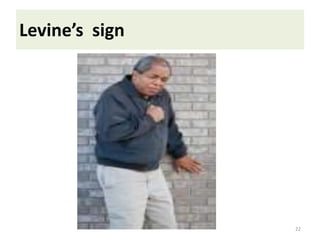
Levine’s sign
22
23
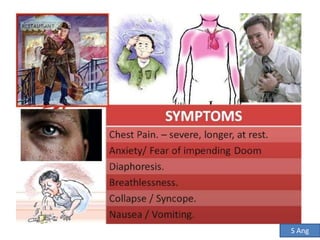
S Ang
24
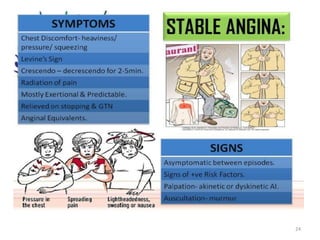
Angina ..Myocardial ischemia
A. Stable Angina(Exertional Angina)Stable pattern
of onset ……………… relieved by Rest/GTN
B. Unstable Angina(PreinfarctionAngina)unpredictable,
NOT relieved by GTN
C. Variant Angina ( Prinzmetal- vasospastic) ,
without relation to effort, Occur at REST-
between midnight & early morning
ST Elevation ---
25
D. Intractable Angina –
Chronic, incapacitating, unresponsive to
treatment
E. Pre-infarction Angina( Last more than 15 mts)
F. Post infarction Angina ( after MI ,residual
ischemia)
26
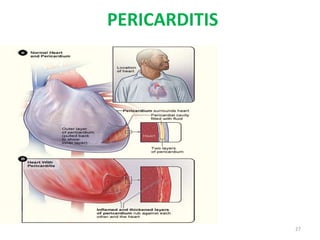
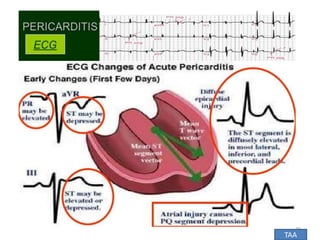
PERICARDITIS
27
Pericarditis
• Sharp Pre-cordial pain, deep and diffuse
• Worse in supine position- relieved while
leaning fore ward
• Aggravated during inspiration coughing
• H/O viral infection , MI…….
28
29
TAA
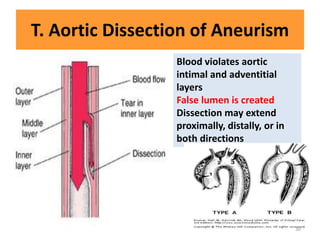
T. Aortic Dissection of Aneurism
Blood violates aortic
intimal and adventitial
layers
False lumen is created
Dissection may extend
proximally, distally, or in
both directions
30
T.A Aneurism dissection
• Constant and boring chest pain
• Deep diffuse – in supine position
• Cough, dyspnea, stridor
• Aphonia ( loss of voice) --
31
H Attack signs in Women
1. Pain or discomfort in one or both arms, the back,
neck, jaw or stomach.
2. Shortness of breath with or without chest
discomfort.
3. breaking out in a cold sweat, nausea or
lightheadedness.
4. As with men, women’s most common heart attack
symptom is chest pain or Chest dis comfort, other
common symptoms, particularly shortness of
breath, nausea/vomiting and back or jaw pain.
32
Complications
Cardiac arrest ----------------------
33
34
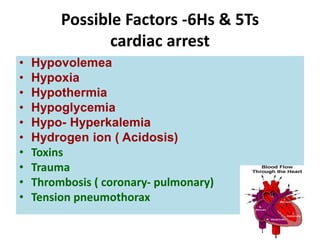
Possible Factors -6Hs & 5Ts
cardiac arrest
• Hypovolemea
• Hypoxia
• Hypothermia
• Hypoglycemia
• Hypo- Hyperkalemia
• Hydrogen ion ( Acidosis)
• Toxins
• Trauma
• Thrombosis ( coronary- pulmonary)
• Tension pneumothorax
21 yrs old young male – was lifting weights –in
the GIM .
He had sudden onset of sharp chest pain,
and SOB …
Brought him to ER …
HR 122. RR 34, BP 70/? Sat 88%
Decreased breath sounds on left side of the
chest .. ???????
35
• Mr. Mohd in CCU with Ext Ant MI,
complicated with vent arrhythmia
treatments are continuing. No more chest
pain
• Today is the 4th day , he is febrile 38- 39C
since 3rd day , ESR and WBC is high, He
suddenly complaining of severe sharp
precordial pain, cannot breath-in or cannot
lie down. He is bending down his chest and
crying
36
• Ms .A 61yrs,had severe Asthmatic attack ,as
the O2 sat was 89% . Put on Mech Ventilator
Mode : PEEP .
• 3rd day sedations stopped and started to
wean her. Suddenly she screamed of severe
chest pain and dyspnea
What will be the possible condition ?
37
• OPD – Endoscopy room
Ms K had gastroscopy ? D.Ulcer , she is in the
recovery room after the procedure. BP and
other vital signs stable. She is coming out of the
sedation . Suddenly she is complaining of pain
holding her chest , breathless.
???????
38

Chest Pain- Differential Diagnosis

  • 1.
    Getting to theroot of Chest Pain Differential Diagnosis Cardiac & Non Cardiac By: Ms. Shanta Peter 1
  • 2.
    Chest Pain-- cardiacor Not • Treat patient as though he is critical --- until proved otherwise History • Risk factors, H/O IHD, previous Rxs , Previous chest pain • Pain- Heart burn - burning sensation – chest pain with pressure /tightness Remember ---– ……………treat with cause… there are many causes 2
  • 3.
    Accuracy of ChestPain Diagnosis Using the History and Physical Examination Determining whether pain is • Sub-sternal, • Provoked by exertion • Relieved by rest or nitroglycerin helps to clarify whether it is …………………… 1. Typical anginal pain (has all 3characteristics) 2. Atypical anginal pain (has 2 characteristics 3. Nonanginal pain (has 1 characteristic). 3
  • 4.
    Common Causes ofChest Pain • Aortic • Esophageal/GI • Lungs & Pleura • Musculo-Skeletal • Neurological • Psychological/ others Aortic dissection, Aortic aneurism Esophagitis, Esop. Spasm , esophageal tear Pancreatitis, Biliary /GB disease , GERD, Peptic Ulcer Bronchospasm, PE, Pneumonia ,TB, Trachitis, Pleuritis, PneumThorax , Malignancy , Asthma. Ost. Arthritis, Rib#, I. Costal Muscle injury, Costochondritis, Cerv. Disc Disease Prolapsed disc, Herpez Zoster, Thoracic Outlet Syndrome Panic Attack/Anxiety Disorders , Cocaine abuse 4
  • 5.
    Chest Pain ThatCan Kill …. • Acute Coronary – Syndrome • Pulmonary- Embolism • Aortic- Dissection • Esophageal Rupture • Pneumothorax • Pneumonia 5
  • 6.
    Sudden & InstantaneousChest Pain Tension Pneumthorax • Spontaneous • Open Pulm. Embolism DVT, Obesity, Pregnancy, Prolonged immobilization, CHF …. 6
  • 7.
  • 8.
    Pneumothorax Sharp C. Pain.Dyspnea ,absence of breath- sound in the affected side • Radionuclide studies – Gated pool • SPECT – Single proton emission computed Tomography • PET – Positron Emission Tomography Pulm. Embolism Sudden pleuretic substernal pain with dyspnea , T cardia , fever or cough , diaphoresis – mimic MI/angina • VQ Scan • D DIMER • Spiral CT-- best Diag – (Pneumonia ) 8
  • 9.
    Pneumonia • Infection ofpulm. tissue – Interstitial spaces, alveoli, bronchioles • Chest pain – pleuritic , come sin suddenly • Febrile – chills , cough with copious/blood stained sputum • Rales--- rhonchi wheezes • Hypoxia (Ca) 9
  • 10.
    Sub sternal –epi-gastric Chest Pain intensified with swallowing 10
  • 11.
    11 Pan . CCys.G U,DU
  • 12.
    G Intestinal Pancreatitis :Pain in the LUQ, substernal. Radiate to back , difficulty in breathing, tachycardia, vomiting, worse in supine , better while leaning forward • Cholecystitis : Pain in RUQ – precipitate by meal • Gastric Ulcer Pain Lt Epigastrium – radiation to back • Duodinal Ulcer Mid Epigastric pain – cramping- 2-4 hrs after meal (E rupture ) 12
  • 13.
    Esophageal Rupture Mallory–Weisssyndrome Sudden severe C. Pain – followed by vomiting, or UGI tract procedure CXR: ( early )shows mediastinal or free peritoneal air Hours to days later: widening of mediastinum, pleural effusion 13
  • 14.
  • 15.
  • 16.
    16 H .Disease begins whencholesterol, fatty material & Ca deposit in the arteries. Atherosclerosis
  • 17.
  • 18.
  • 19.
    Cardiac Chest Pain •Dissecting Aortic aneurisms • Cardiac Tamponade * Heart Failure • Peri/endo/myocarditis • Cardiogenic shock • MVP /M.stenosis Acute Coronary Syndromes *Myocardial Ischemia *Stable Angina *Unstable Angina *Myocardial Infarction *Pericarditis 19
  • 20.
    ANGINA PECTORIS .Myocardial ischemia Expected companion of IHD ……. 20
  • 21.
    Accuracy of ChestPain Diagnosis Using the History and Physical Examination Determining whether pain is • Sub-sternal, • Provoked by exertion • Relieved by rest or nitroglycerin helps to clarify whether it is …………………… 1. Typical anginal pain (has all 3characteristics) 2. Atypical anginal pain (has 2 characteristics 3. Non-anginal pain (has 1 characteristic). 21
  • 22.
  • 23.
  • 24.
  • 25.
    Angina ..Myocardial ischemia A.Stable Angina(Exertional Angina)Stable pattern of onset ……………… relieved by Rest/GTN B. Unstable Angina(PreinfarctionAngina)unpredictable, NOT relieved by GTN C. Variant Angina ( Prinzmetal- vasospastic) , without relation to effort, Occur at REST- between midnight & early morning ST Elevation --- 25
  • 26.
    D. Intractable Angina– Chronic, incapacitating, unresponsive to treatment E. Pre-infarction Angina( Last more than 15 mts) F. Post infarction Angina ( after MI ,residual ischemia) 26
  • 27.
  • 28.
    Pericarditis • Sharp Pre-cordialpain, deep and diffuse • Worse in supine position- relieved while leaning fore ward • Aggravated during inspiration coughing • H/O viral infection , MI……. 28
  • 29.
  • 30.
    T. Aortic Dissectionof Aneurism Blood violates aortic intimal and adventitial layers False lumen is created Dissection may extend proximally, distally, or in both directions 30
  • 31.
    T.A Aneurism dissection •Constant and boring chest pain • Deep diffuse – in supine position • Cough, dyspnea, stridor • Aphonia ( loss of voice) -- 31
  • 32.
    H Attack signsin Women 1. Pain or discomfort in one or both arms, the back, neck, jaw or stomach. 2. Shortness of breath with or without chest discomfort. 3. breaking out in a cold sweat, nausea or lightheadedness. 4. As with men, women’s most common heart attack symptom is chest pain or Chest dis comfort, other common symptoms, particularly shortness of breath, nausea/vomiting and back or jaw pain. 32
  • 33.
  • 34.
    34 Possible Factors -6Hs& 5Ts cardiac arrest • Hypovolemea • Hypoxia • Hypothermia • Hypoglycemia • Hypo- Hyperkalemia • Hydrogen ion ( Acidosis) • Toxins • Trauma • Thrombosis ( coronary- pulmonary) • Tension pneumothorax
  • 35.
    21 yrs oldyoung male – was lifting weights –in the GIM . He had sudden onset of sharp chest pain, and SOB … Brought him to ER … HR 122. RR 34, BP 70/? Sat 88% Decreased breath sounds on left side of the chest .. ??????? 35
  • 36.
    • Mr. Mohdin CCU with Ext Ant MI, complicated with vent arrhythmia treatments are continuing. No more chest pain • Today is the 4th day , he is febrile 38- 39C since 3rd day , ESR and WBC is high, He suddenly complaining of severe sharp precordial pain, cannot breath-in or cannot lie down. He is bending down his chest and crying 36
  • 37.
    • Ms .A61yrs,had severe Asthmatic attack ,as the O2 sat was 89% . Put on Mech Ventilator Mode : PEEP . • 3rd day sedations stopped and started to wean her. Suddenly she screamed of severe chest pain and dyspnea What will be the possible condition ? 37
  • 38.
    • OPD –Endoscopy room Ms K had gastroscopy ? D.Ulcer , she is in the recovery room after the procedure. BP and other vital signs stable. She is coming out of the sedation . Suddenly she is complaining of pain holding her chest , breathless. ??????? 38