Atrial Fibrillation
Presented by:
Anish Dhakal
28th
May, 2019
Introduction
• Most common sustained cardiac arrhythmia
• A complex arrhythmia characterised by
– abnormal automatic firing and the
– presence of multiple re-entry circuits
• Disorganized atrial depolarisation without effective
atrial contraction
• The prevalence rises with increasing age
– 1% & 9% of those aged 60-64 years and over 80
years
• Responsible for 15% strokes
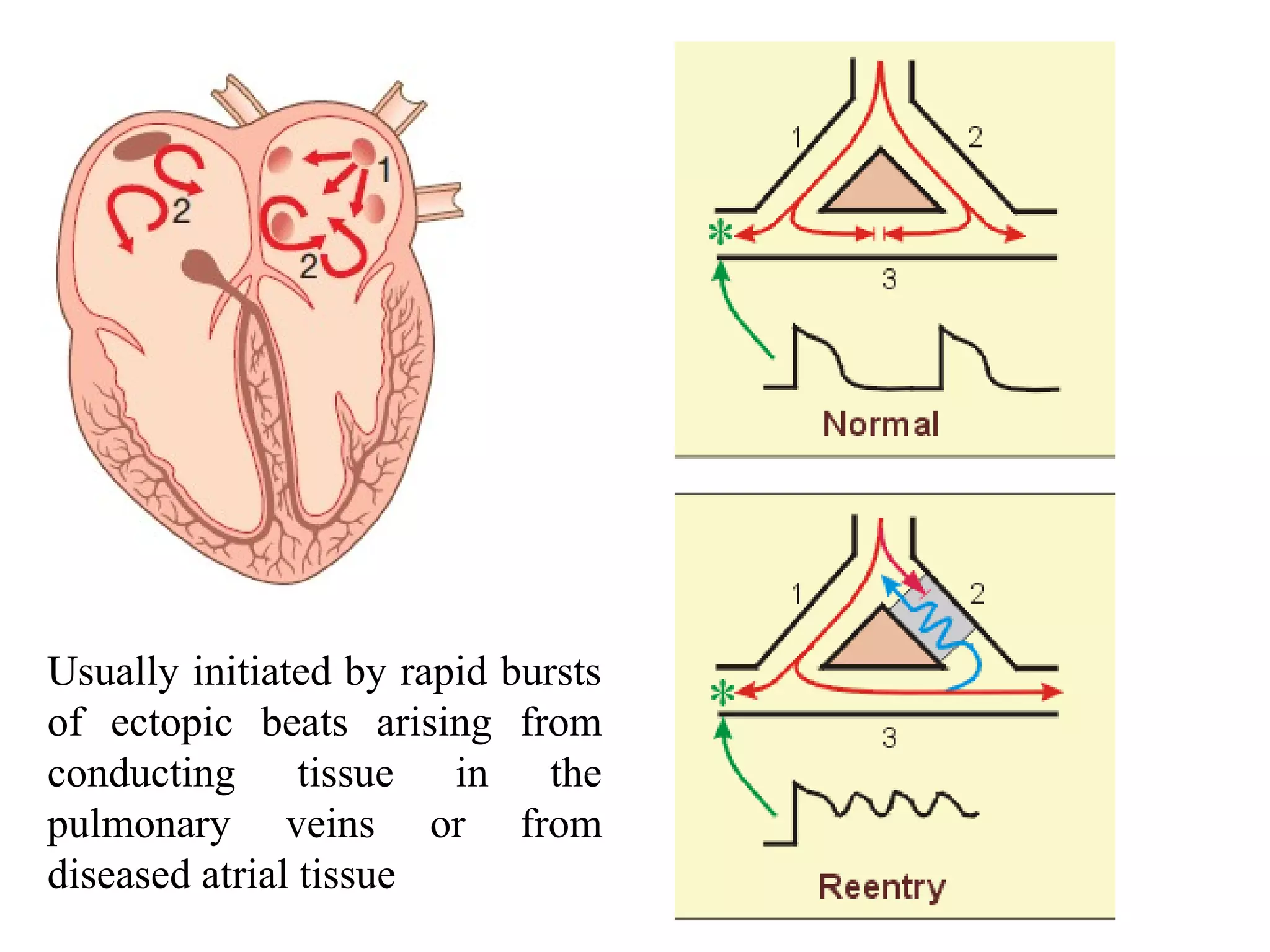
Usually initiated by rapid bursts
of ectopic beats arising from
conducting tissue in the
pulmonary veins or from
diseased atrial tissue
Pathophysiology
• Electrophysiological changes occur in the atria
within a few hours of the onset of AF that tend to
maintain fibrillation: electrical remodelling
• When AF persists for a period of months, structural
remodelling occurs with atrial fibrosis and dilatation
that further predispose to AF
• Thus early treatment of AF will prevent this and
reinitiating of the arrhythmia
About 50% of all patients with paroxysmal AF and 20% of patients
with persistent or permanent AF have structurally normal hearts
Types of AF
Paroxysmal (intermittent)
• Recurrent AF (≥2 episodes)
• Terminates spontaneously in less than seven
days, usually less than 24 hours
• It will become permanent as the underlying
disease process that predisposes to AF
progresses
Persistent
• Fails to self-terminate within seven days
• Episodes often require pharmacologic or
electrical cardioversion to restore sinus rhythm
• Persistent AF can have later episodes of
paroxysmal AF as AF is generally considered
a progressive disease
Permanent
• Lasts for more than one year and
cardioversion either has not been attempted
or has failed
• It also describes patients where a decision has
been made to no longer pursue a rhythm
control strategy
Signs and Symptoms
• Asymptomatic
• Incidental finding (30% of cases)
• Palpitation, breathlessness and fatigue.
• Patient with poor ventricular function or valve
disease, it may precipitate or aggravate cardiac
failure because of Loss of atrial function and heart
rate control.
• Fall BP may cause lightheadedness and chest pain.
ECG changes
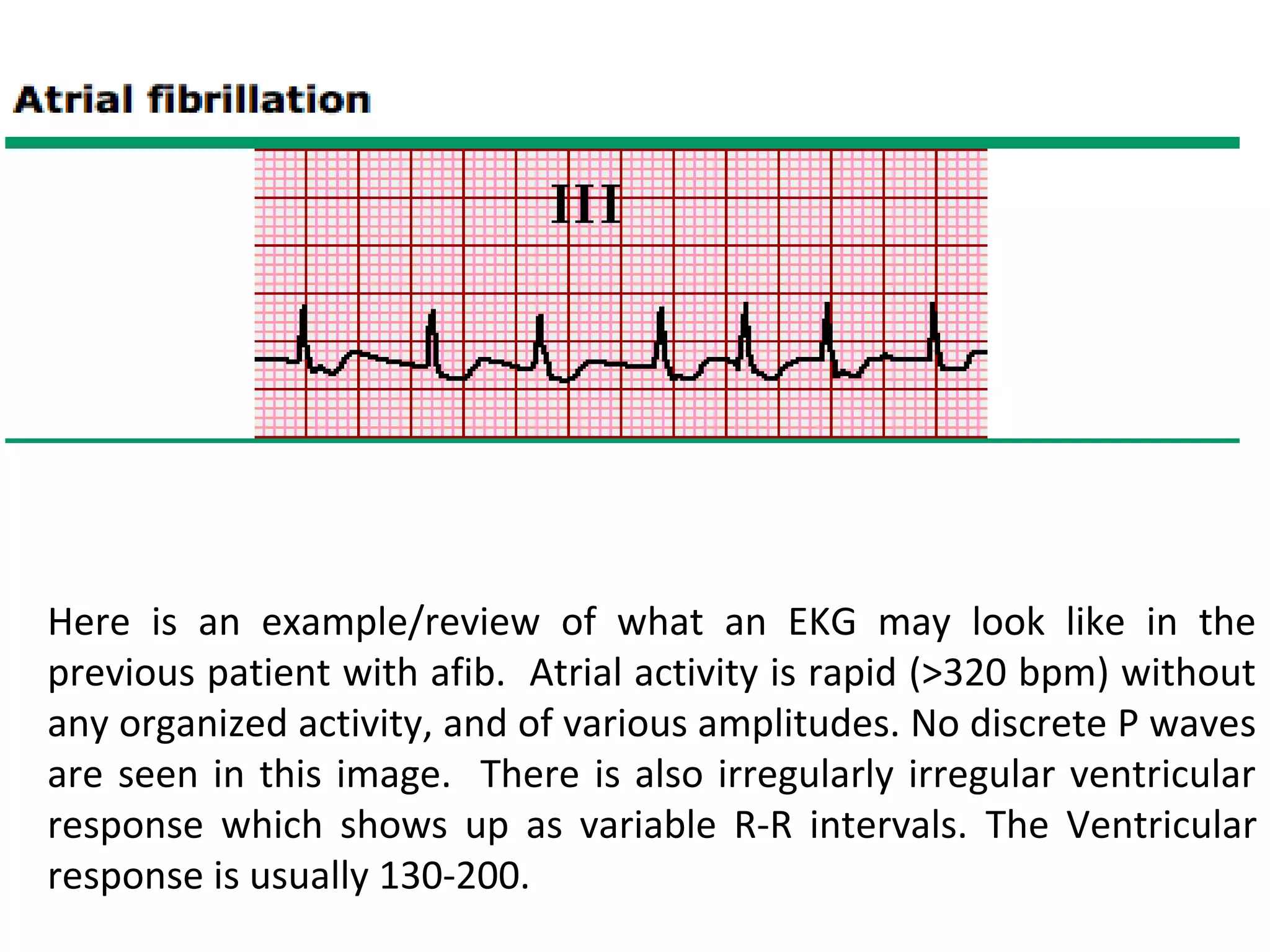
The QRS complexes are irregular and there are no P
waves.
A. There is usually a fast ventricular rate, e.g. between
120 and 160/min, at the onset of atrial fibrillation.
B. In chronic atrial fibrillation, the ventricular rate
may be much slower, due to the effects of medication
and AV nodal fatigue
Here is an example/review of what an EKG may look like in the
previous patient with afib. Atrial activity is rapid (>320 bpm) without
any organized activity, and of various amplitudes. No discrete P waves
are seen in this image. There is also irregularly irregular ventricular
response which shows up as variable R-R intervals. The Ventricular
response is usually 130-200.
Management of AF
Diagnosis
History, Physical Ex,Labs
- Underlying heart disease, thyroid, alcohol
ECG
CXR
- Pneumonia
Echocardiogram
Approach
• When AF complicates an acute illness (e.g. chest
infection, pulmonary embolism), effective
treatment of the primary disorder will often
restore sinus rhythm
• Otherwise, the main objectives are
– restoration of sinus rhythm (when possible),
– prevention of recurrent AF,
– optimisation of the heart rate during periods of AF,
– reduction of the risk of thromboembolism, and
– treatment of underlying disease
Paroxysmal AF
• Occasional attacks that are well tolerated do not
necessarily require treatment
• β-blockers as first-line therapy if troublesome,
and if associated with IHD, HTN and CCF
- Beta-blockers reduce the ectopic firing that normally
initiates AF
• Class IC drugs, such as propafenone or
flecainide, also effective (C/I: CAD or Left
Ventricular dysfunction)
Catheter ablation
• When anti-arrhythmic drug therapy is ineffective
or causes side-effects
• Used to disconnect the pulmonary veins from
the LA electrically, preventing ectopic triggering
of AF
• Lines of conduction block can be created within
the atria to prevent re-entry
• Prevents AF in approximately 70% of patients
although a repeat procedure is sometimes required
• Associated with a risk of cardiac tamponade or
embolic stroke
Persistent and Permanent AF
There are two options:-
•Rhythm control
- Attempting to restore and maintain sinus rhythm
•Rate control
- Accepting that AF will be permanent and using treatments to
control the ventricular rate and to prevent embolic complications
Rhythm control
• Attempts successful if AF present for < 3
months, the patient is young and there is no
important structural heart disease
• Pharmacologic or by electro cardioversion
• Electrical cardioversion successful in 75%,
but relapse frequent
• Immediate DC cardioversion after iv heparin
if AF present for < 48 hrs.
Cont…
• Infusing IV flecainide (2 mg/kg over 30 minutes,
maximum dose 150 mg) is a safe alternative to
electrical cardioversion if no underlying structural
heart disease
• In other situations, DC cardioversion should be
deferred until
- On warfarin, with an INR > 2.0 for a minimum of 4 weeks, and
- Any underlying problems, such as HTN or alcohol excess, have been
eliminated
• Anticoagulation should be maintained for at least 3
months following successful cardioversion
Rate control
• If sinus rhythm cannot be restored , treatment
should be directed at maintaining an
appropriate heart rate
• Digoxin, β-blockers or rate-limiting CCB such
as verapamil, diltiazem
- reduce the ventricular rate by increasing the degree of AV
block
- β-blockers or rate-limiting CCB often more effective than
digoxin in controlling HR during exercise and have additional
benefits in pt’s with HTN and structural heart disease
Cont..
•Combination therapy (e.g. digoxin + atenolol) is
often advisable
•Cather ablation and permanent pacemaker is
useful in poorly controlled symptoms “pace and
ablate” strategy
RATE CONTROL
Atrial FibrillationAtrial Fibrillation
SBP
90-110
SBP 100
to 120
SBP 100
to 120
SBP
>120
SBP
>120
DIGOXIN
Load: 0.5mg IV6
hrs later; 0.25mg
IV6 hrs later;
0.25 mg IV
Maintenance:
0.125 mg daily
DIGOXIN
Load: 0.5mg IV6
hrs later; 0.25mg
IV6 hrs later;
0.25 mg IV
Maintenance:
0.125 mg daily
B-Blocker
Initial: Metoprolol 5mg
IVP q5min x3doses
Prn: metoprolol 5mg IV
q6hr prn
Maintenance: Metoprolol
25 mg po BID (max 100mg
BID)
B-Blocker
Initial: Metoprolol 5mg
IVP q5min x3doses
Prn: metoprolol 5mg IV
q6hr prn
Maintenance: Metoprolol
25 mg po BID (max 100mg
BID)
Ca2+ Blockers
Initial and prn:
Diltiazem 10mg IVP
q6hrs
Maintenance:
Diltiazem 30mg PO
q6hs
References:
• Davidson’s Principle and Practice of
medicine, 23rd
edition
• Harrison’s Principles of Internal Medicine, 20th
edition
• Uptodate
THANK YOU
AF Association Global AF Aware Week | 18 - 24
November 2019

Atrial Fibrillation by Dr. Aryan

  • 1.
  • 2.
    Introduction • Most commonsustained cardiac arrhythmia • A complex arrhythmia characterised by – abnormal automatic firing and the – presence of multiple re-entry circuits • Disorganized atrial depolarisation without effective atrial contraction • The prevalence rises with increasing age – 1% & 9% of those aged 60-64 years and over 80 years • Responsible for 15% strokes
  • 3.
    Usually initiated byrapid bursts of ectopic beats arising from conducting tissue in the pulmonary veins or from diseased atrial tissue
  • 4.
    Pathophysiology • Electrophysiological changesoccur in the atria within a few hours of the onset of AF that tend to maintain fibrillation: electrical remodelling • When AF persists for a period of months, structural remodelling occurs with atrial fibrosis and dilatation that further predispose to AF • Thus early treatment of AF will prevent this and reinitiating of the arrhythmia
  • 8.
    About 50% ofall patients with paroxysmal AF and 20% of patients with persistent or permanent AF have structurally normal hearts
  • 9.
  • 10.
    Paroxysmal (intermittent) • RecurrentAF (≥2 episodes) • Terminates spontaneously in less than seven days, usually less than 24 hours • It will become permanent as the underlying disease process that predisposes to AF progresses
  • 11.
    Persistent • Fails toself-terminate within seven days • Episodes often require pharmacologic or electrical cardioversion to restore sinus rhythm • Persistent AF can have later episodes of paroxysmal AF as AF is generally considered a progressive disease
  • 12.
    Permanent • Lasts formore than one year and cardioversion either has not been attempted or has failed • It also describes patients where a decision has been made to no longer pursue a rhythm control strategy
  • 13.
    Signs and Symptoms •Asymptomatic • Incidental finding (30% of cases) • Palpitation, breathlessness and fatigue. • Patient with poor ventricular function or valve disease, it may precipitate or aggravate cardiac failure because of Loss of atrial function and heart rate control. • Fall BP may cause lightheadedness and chest pain.
  • 14.
  • 15.
    The QRS complexesare irregular and there are no P waves. A. There is usually a fast ventricular rate, e.g. between 120 and 160/min, at the onset of atrial fibrillation. B. In chronic atrial fibrillation, the ventricular rate may be much slower, due to the effects of medication and AV nodal fatigue
  • 16.
    Here is anexample/review of what an EKG may look like in the previous patient with afib. Atrial activity is rapid (>320 bpm) without any organized activity, and of various amplitudes. No discrete P waves are seen in this image. There is also irregularly irregular ventricular response which shows up as variable R-R intervals. The Ventricular response is usually 130-200.
  • 17.
  • 18.
    Diagnosis History, Physical Ex,Labs -Underlying heart disease, thyroid, alcohol ECG CXR - Pneumonia Echocardiogram
  • 19.
    Approach • When AFcomplicates an acute illness (e.g. chest infection, pulmonary embolism), effective treatment of the primary disorder will often restore sinus rhythm • Otherwise, the main objectives are – restoration of sinus rhythm (when possible), – prevention of recurrent AF, – optimisation of the heart rate during periods of AF, – reduction of the risk of thromboembolism, and – treatment of underlying disease
  • 20.
    Paroxysmal AF • Occasionalattacks that are well tolerated do not necessarily require treatment • β-blockers as first-line therapy if troublesome, and if associated with IHD, HTN and CCF - Beta-blockers reduce the ectopic firing that normally initiates AF • Class IC drugs, such as propafenone or flecainide, also effective (C/I: CAD or Left Ventricular dysfunction)
  • 21.
    Catheter ablation • Whenanti-arrhythmic drug therapy is ineffective or causes side-effects • Used to disconnect the pulmonary veins from the LA electrically, preventing ectopic triggering of AF • Lines of conduction block can be created within the atria to prevent re-entry • Prevents AF in approximately 70% of patients although a repeat procedure is sometimes required • Associated with a risk of cardiac tamponade or embolic stroke
  • 22.
    Persistent and PermanentAF There are two options:- •Rhythm control - Attempting to restore and maintain sinus rhythm •Rate control - Accepting that AF will be permanent and using treatments to control the ventricular rate and to prevent embolic complications
  • 23.
    Rhythm control • Attemptssuccessful if AF present for < 3 months, the patient is young and there is no important structural heart disease • Pharmacologic or by electro cardioversion • Electrical cardioversion successful in 75%, but relapse frequent • Immediate DC cardioversion after iv heparin if AF present for < 48 hrs.
  • 24.
    Cont… • Infusing IVflecainide (2 mg/kg over 30 minutes, maximum dose 150 mg) is a safe alternative to electrical cardioversion if no underlying structural heart disease • In other situations, DC cardioversion should be deferred until - On warfarin, with an INR > 2.0 for a minimum of 4 weeks, and - Any underlying problems, such as HTN or alcohol excess, have been eliminated • Anticoagulation should be maintained for at least 3 months following successful cardioversion
  • 25.
    Rate control • Ifsinus rhythm cannot be restored , treatment should be directed at maintaining an appropriate heart rate • Digoxin, β-blockers or rate-limiting CCB such as verapamil, diltiazem - reduce the ventricular rate by increasing the degree of AV block - β-blockers or rate-limiting CCB often more effective than digoxin in controlling HR during exercise and have additional benefits in pt’s with HTN and structural heart disease
  • 26.
    Cont.. •Combination therapy (e.g.digoxin + atenolol) is often advisable •Cather ablation and permanent pacemaker is useful in poorly controlled symptoms “pace and ablate” strategy
  • 27.
    RATE CONTROL Atrial FibrillationAtrialFibrillation SBP 90-110 SBP 100 to 120 SBP 100 to 120 SBP >120 SBP >120 DIGOXIN Load: 0.5mg IV6 hrs later; 0.25mg IV6 hrs later; 0.25 mg IV Maintenance: 0.125 mg daily DIGOXIN Load: 0.5mg IV6 hrs later; 0.25mg IV6 hrs later; 0.25 mg IV Maintenance: 0.125 mg daily B-Blocker Initial: Metoprolol 5mg IVP q5min x3doses Prn: metoprolol 5mg IV q6hr prn Maintenance: Metoprolol 25 mg po BID (max 100mg BID) B-Blocker Initial: Metoprolol 5mg IVP q5min x3doses Prn: metoprolol 5mg IV q6hr prn Maintenance: Metoprolol 25 mg po BID (max 100mg BID) Ca2+ Blockers Initial and prn: Diltiazem 10mg IVP q6hrs Maintenance: Diltiazem 30mg PO q6hs
  • 32.
    References: • Davidson’s Principleand Practice of medicine, 23rd edition • Harrison’s Principles of Internal Medicine, 20th edition • Uptodate
  • 33.
    THANK YOU AF AssociationGlobal AF Aware Week | 18 - 24 November 2019

Editor's Notes

  • #17 Here is an example/review of what an EKG may look like in the previous patient with afib. Atrial activity is rapid (&amp;gt;320 bpm) without any organized activity, and of various amplitudes. No discrete P waves are seen in this image. There is also irregularly irregular ventricular response which shows up as variable R-R intervals. The Ventricular response is usually 130-200.
  • #28 Pick rate controlling agent based on systolic BP. Each of these agents will drop BP to varying degrees; CA blockers&amp;gt;B blockers&amp;gt;digoxin Also this slide shows how we start an oral maintenance early on and in addition to using prn pushes because the goal is to get the patient on maintenance meds early on in order to adequately control the arrhythmia and not just chase the rate constantly with prn doses. Note: for digoxin if renal impairment cut doses in half. Note: for metoprolol try to initially get rate under control with IVPs q5min x3 doses total but monitor BP while doing it. Start a PO maintenance dose also because by the time the PO kicks in the IV will wear off. Also titrate up the maintenance dose based on the amount of extra prn IVPs that are needed to control HR at goal. Note: with dilatiazem start an initial IVP along with a maintenance PO because by the time the PO kicks in the IV will wear off. Titrate up the maintenance po dose based upon any extra prn IVPsthat are given to control rate. Once rate is stable and controlled at goal then convert short acting diltiazem into long acting daily dose.