INERT GAS CONDENSATION
A NANOPARTICLES PREPARATION METHOD………………
PRESENTED BY
D.V.ANANDA RAO
M150405ME
M.Tech
MATERIALS SCIENCE AND TECHNOLOGY
CONTENTS
 INTRODUCTION
 CLASSIFICATION
 PROCESS
 PROCESS PARAMETERS
 APPLICATIONS
 ADVANTAGES
 LIMITATIONS
INTRODUCTION
Nanoscience refers to the science of very minute
particles having their dimensions of the order of 10-9 m
Making of materials in NANO range is called NANO
fabrication
To synthesize nanostructured materials two approaches
are there
1)Bottom-up approach
2)Top-down approach
 Top-down approach:
Under this process of fabrication, bulk materials are broken
into nano-sized particles
Eg. Ball millling
plasma arching
 Bottom-Up approach:
Refers to the building up of a material from the bottom
i.e., atom by atom
molecule by molecule
cluster by cluster
Eg. Inert Gas Condensation
vapour deposition methods
Inert gas condensation
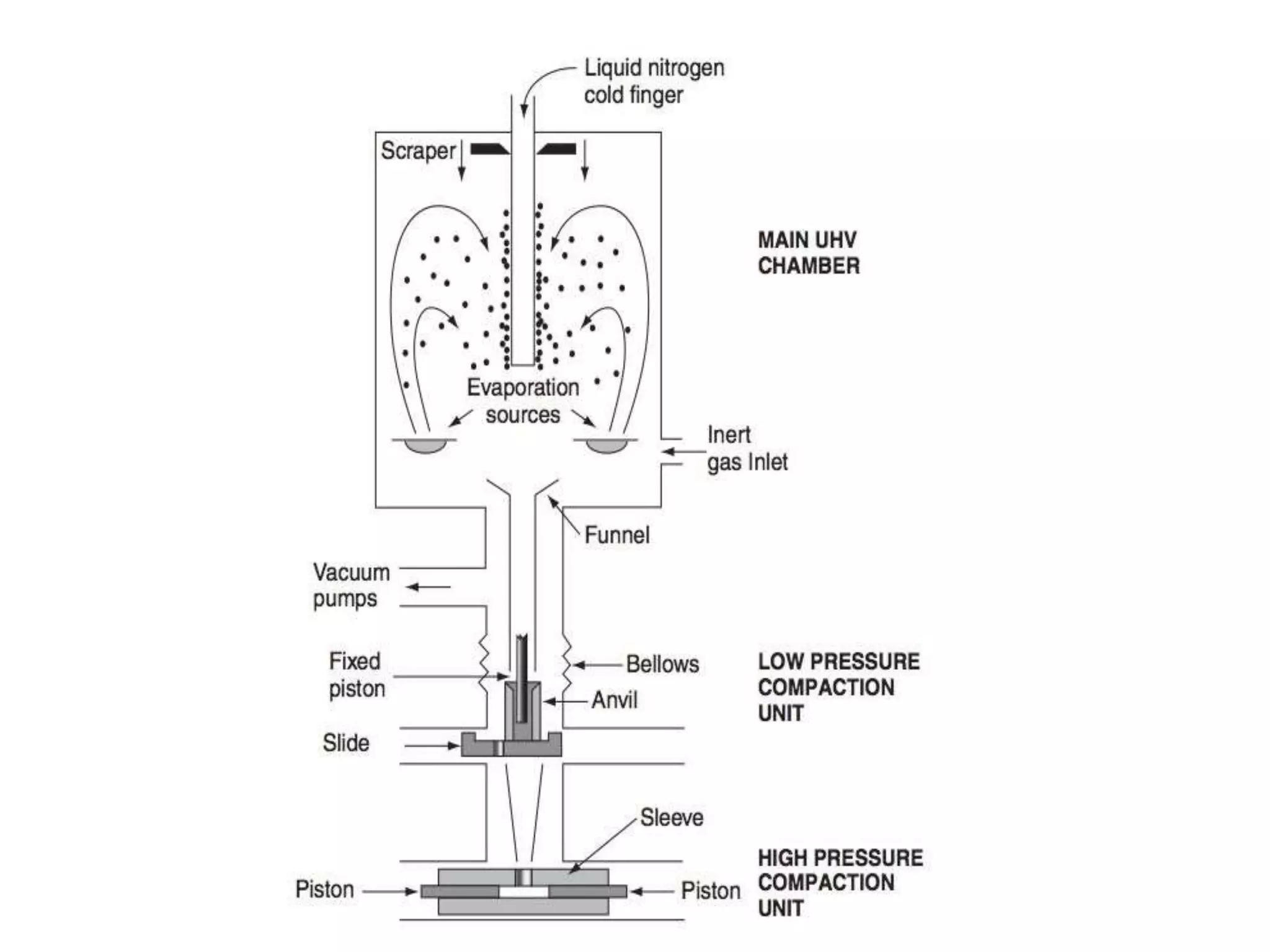
• Inert-gas condensation (IGC) is a bottom-up approach to
synthesizing nanostructured materials, which involves
two basic steps
 The first step is the evaporation of the material
 The second step involves a rapid controlled condensation
to produce the required particle size
 In this unit, the chamber is evacuated to a pressure of
about 2 × 10⁻⁶ Torr by an oil diffusion pump. A crucible
containing the metal to be evaporated is slowly heated
EVAPORATION TECHNIQUES
 Thermal Evaporation
 Laser Vaporization
 Sputtering
 Electrical Arc Discharge
 Plasma Heating
 The evaporated metal atoms collide with the inert-gas
atoms inside the chamber, lose their kinetic energy, and
condense in the form of small, discrete crystals of loose
powder, on the nitrogen cooled cold finger unit
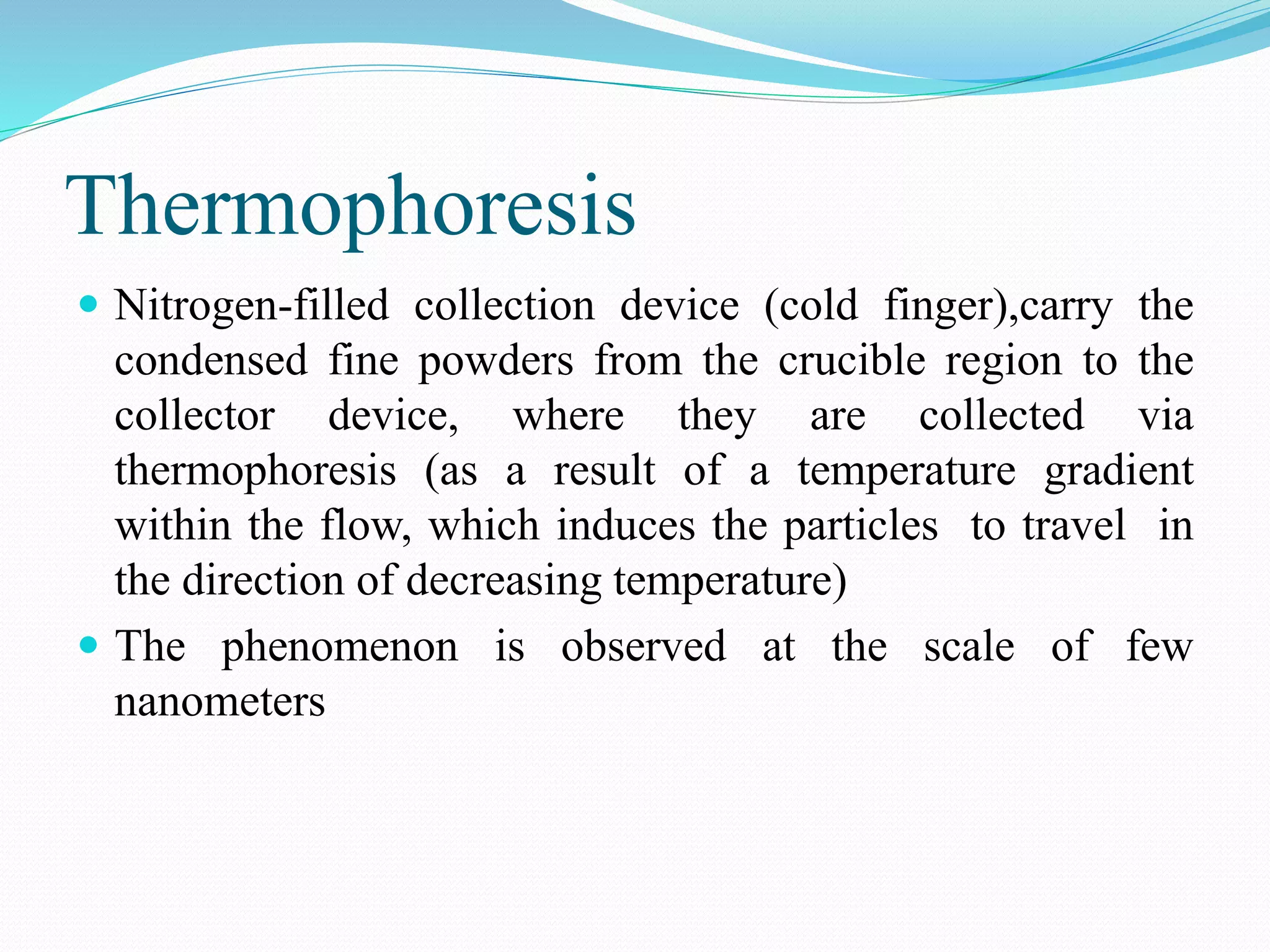
Thermophoresis
 Nitrogen-filled collection device (cold finger),carry the
condensed fine powders from the crucible region to the
collector device, where they are collected via
thermophoresis (as a result of a temperature gradient
within the flow, which induces the particles to travel in
the direction of decreasing temperature)
 The phenomenon is observed at the scale of few
nanometers
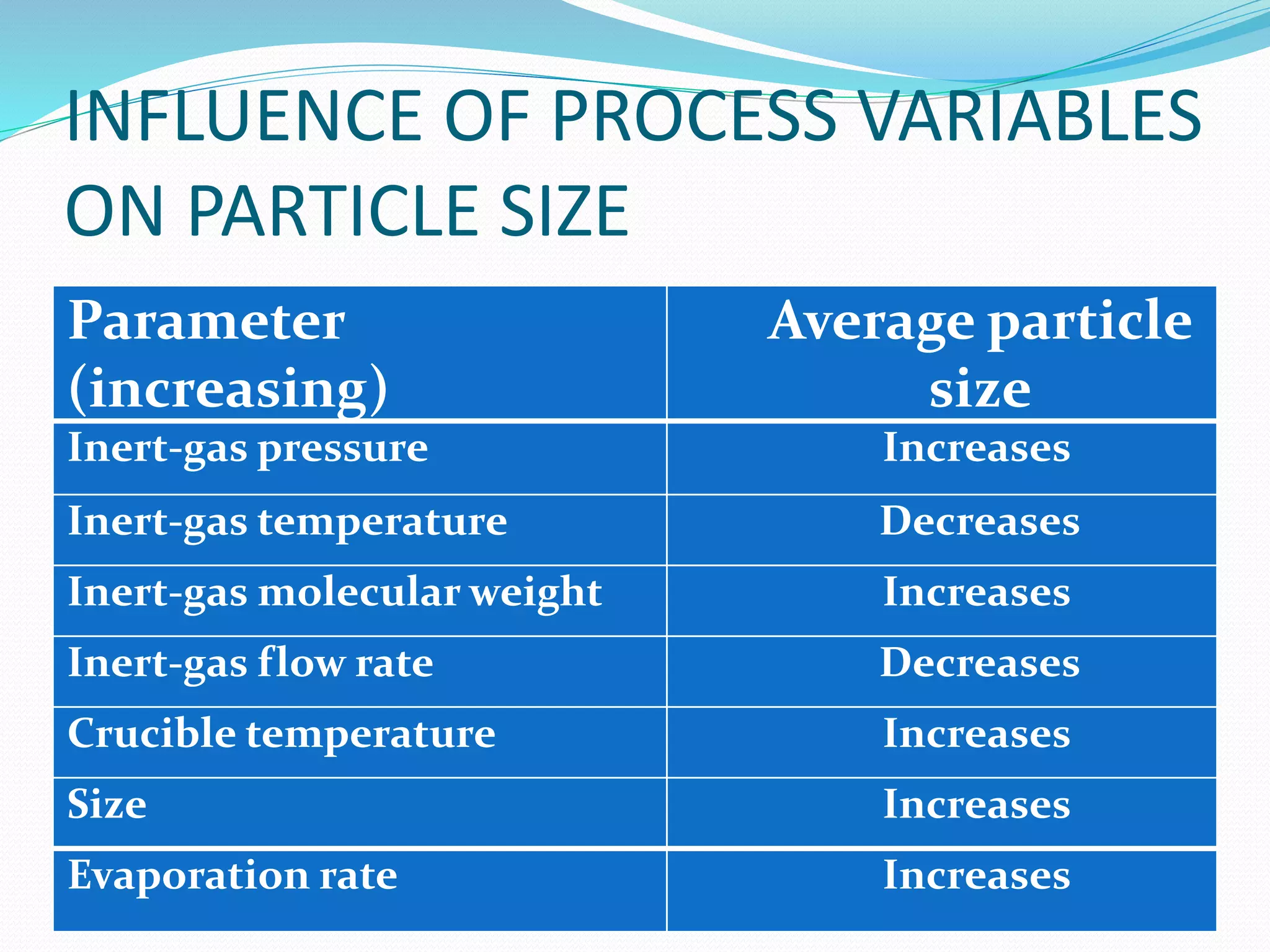
INFLUENCE OF PROCESS VARIABLES
ON PARTICLE SIZE
Parameter
(increasing)
Average particle
size
Inert-gas pressure Increases
Inert-gas temperature Decreases
Inert-gas molecular weight Increases
Inert-gas flow rate Decreases
Crucible temperature Increases
Size Increases
Evaporation rate Increases
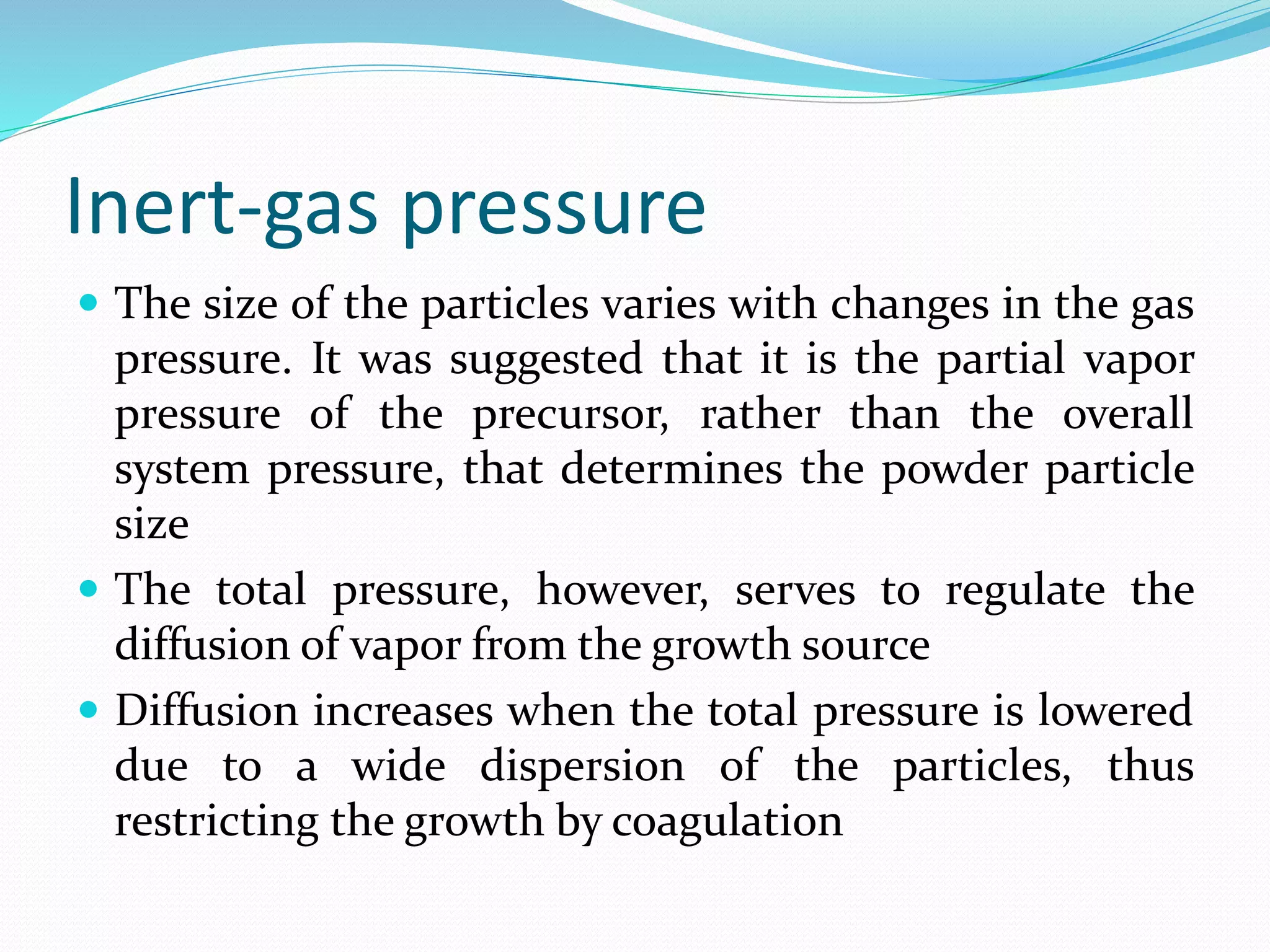
Inert-gas pressure
 The size of the particles varies with changes in the gas
pressure. It was suggested that it is the partial vapor
pressure of the precursor, rather than the overall
system pressure, that determines the powder particle
size
 The total pressure, however, serves to regulate the
diffusion of vapor from the growth source
 Diffusion increases when the total pressure is lowered
due to a wide dispersion of the particles, thus
restricting the growth by coagulation
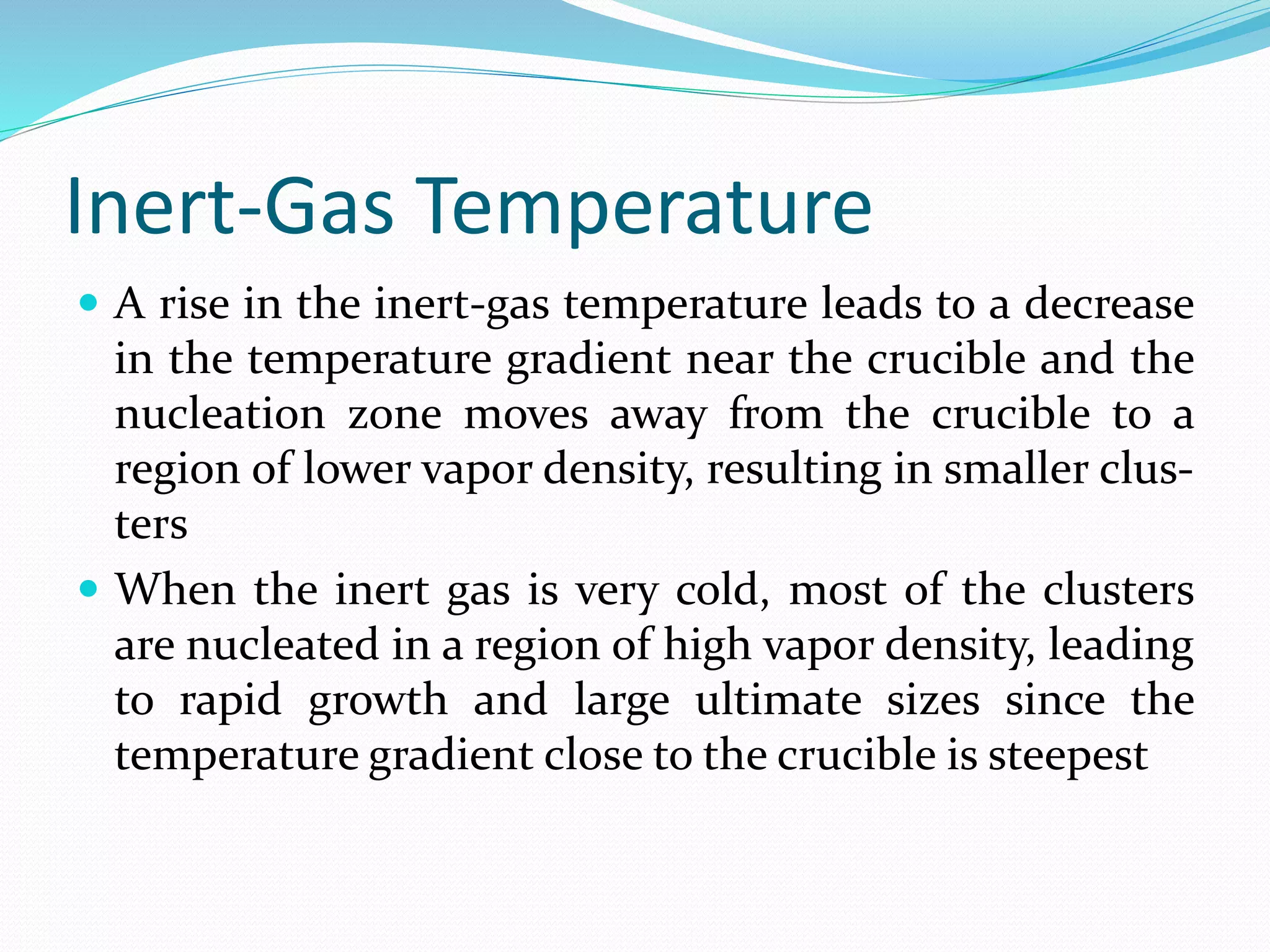
Inert-Gas Temperature
 A rise in the inert-gas temperature leads to a decrease
in the temperature gradient near the crucible and the
nucleation zone moves away from the crucible to a
region of lower vapor density, resulting in smaller clus-
ters
 When the inert gas is very cold, most of the clusters
are nucleated in a region of high vapor density, leading
to rapid growth and large ultimate sizes since the
temperature gradient close to the crucible is steepest
Inert-Gas Type
 An inert gas is generally used because the frequent
collisions of the metal vapor atoms with the gas atoms
decrease the diffusion rate of atoms away from the
source region
 These collisions cool the metal atoms; consequently
the diffusion rate is reduced and this allows
achievement of supersaturation. The inert gases (Ar,
He, Ne, and Xe) limit diffusion by shortening the
mean free path
 Heavier gas atoms are most effective in limiting the
mean free path and confining the metal vapor
Inert-Gas Flow Rate
 Increasing the inert-gas flow rate reduces the length of
time that the clusters spend in the growth region of
high vapor density and consequently leads to a
decrease in the particle size
 They have less time to grow and so are smaller. It also
increases the effectiveness of cooling, so that the
temperature gradient is larger near the crucible and
more clusters are nucleated
Chamber Size and Distance
 IGC operation in a large chamber leads to the
deposition of nanostructured particles on a large area
of the cold finger. The deposition of particles on a large
area of the cold finger is preferable for easy collection
of particles. Sufficient free space is required not only
for convection in the IGC chamber but also for the
collection of nanophase particles
 if the condensation chamber is very large, then growth
may stop when the vapor is exhausted even before the
exit is reached
Evaporation Rate
 Evaporation rate is the mass evaporated per unit area
in unit time. The production rate is determined mostly
by the evaporation rate. High evaporation rates have
resulted in larger particles. The evaporation rate (Wg)
in a gas atmosphere is given by
𝑊
𝑔=(𝑃𝑠-P)
𝑀
2𝜋𝑅𝑇
1/2
APPLICATIONS
 Suitable to produce metal nanoparticles
 Controlled sintering after particle formation used to
prepare composite nanoparticles
(pbS/Al;Si/ln;Ge/ln;Al/ln;Al/pb)
 The types of nanostructured materials prepared by the IGC
method include metals (e.g., Cu, Fe, Ni, Pd, and W), ionic
compounds (e.g., Fe𝐹2, Ca𝐹2, 𝐹2𝑂3, and Ti𝑂2), and also
covalent substances (e.g., Si)
ADVANTAGES
 Reactive condensation is possible, usually by adding 𝑂2 to
the inert gas in order to produce nanosized ceramic particles
 A wide range of materials including metals, alloys, inter-
metallic compounds, ceramics, semiconductors, and com-
posites can be synthesized by this technique. It is possible to
produce virtually any material that can be vaporized.
 IGC is a very flexible technique in terms of the range of
cluster sizes that can be made. It is possible to control the
size and size distribution of the clusters/nanoparticles over a
large range by altering process parameters such as tem-
perature and pressure. Thus, particles of well-defined or
predetermined size can be synthesized with enhanced
properties.
LIMITATIONS
 Chamber to be kept under high vacuum during deposition,
substantial pumping of a large flow of an inert gas is nec-
essary. The pumps make up most of the cost and bulk of
the apparatus
 Agglomeration of particles is a problem in consolidated
nanopowders. The van der Waals forces caused by a tem-
porally varying charge distribution in each individual
nanopowder particle can cause rapid agglomeration into
branched bodies. These entities are difficult to break up on
compaction and sintering, and thus lead to inter
agglomerate voids and residual porosity in the sample.
INERT GAS CONDENSATION.pptx

INERT GAS CONDENSATION.pptx

  • 1.
    INERT GAS CONDENSATION ANANOPARTICLES PREPARATION METHOD……………… PRESENTED BY D.V.ANANDA RAO M150405ME M.Tech MATERIALS SCIENCE AND TECHNOLOGY
  • 2.
    CONTENTS  INTRODUCTION  CLASSIFICATION PROCESS  PROCESS PARAMETERS  APPLICATIONS  ADVANTAGES  LIMITATIONS
  • 3.
    INTRODUCTION Nanoscience refers tothe science of very minute particles having their dimensions of the order of 10-9 m Making of materials in NANO range is called NANO fabrication To synthesize nanostructured materials two approaches are there 1)Bottom-up approach 2)Top-down approach
  • 5.
     Top-down approach: Underthis process of fabrication, bulk materials are broken into nano-sized particles Eg. Ball millling plasma arching  Bottom-Up approach: Refers to the building up of a material from the bottom i.e., atom by atom molecule by molecule cluster by cluster Eg. Inert Gas Condensation vapour deposition methods
  • 6.
    Inert gas condensation •Inert-gas condensation (IGC) is a bottom-up approach to synthesizing nanostructured materials, which involves two basic steps  The first step is the evaporation of the material  The second step involves a rapid controlled condensation to produce the required particle size  In this unit, the chamber is evacuated to a pressure of about 2 × 10⁻⁶ Torr by an oil diffusion pump. A crucible containing the metal to be evaporated is slowly heated
  • 8.
    EVAPORATION TECHNIQUES  ThermalEvaporation  Laser Vaporization  Sputtering  Electrical Arc Discharge  Plasma Heating
  • 9.
     The evaporatedmetal atoms collide with the inert-gas atoms inside the chamber, lose their kinetic energy, and condense in the form of small, discrete crystals of loose powder, on the nitrogen cooled cold finger unit
  • 10.
    Thermophoresis  Nitrogen-filled collectiondevice (cold finger),carry the condensed fine powders from the crucible region to the collector device, where they are collected via thermophoresis (as a result of a temperature gradient within the flow, which induces the particles to travel in the direction of decreasing temperature)  The phenomenon is observed at the scale of few nanometers
  • 11.
    INFLUENCE OF PROCESSVARIABLES ON PARTICLE SIZE Parameter (increasing) Average particle size Inert-gas pressure Increases Inert-gas temperature Decreases Inert-gas molecular weight Increases Inert-gas flow rate Decreases Crucible temperature Increases Size Increases Evaporation rate Increases
  • 12.
    Inert-gas pressure  Thesize of the particles varies with changes in the gas pressure. It was suggested that it is the partial vapor pressure of the precursor, rather than the overall system pressure, that determines the powder particle size  The total pressure, however, serves to regulate the diffusion of vapor from the growth source  Diffusion increases when the total pressure is lowered due to a wide dispersion of the particles, thus restricting the growth by coagulation
  • 13.
    Inert-Gas Temperature  Arise in the inert-gas temperature leads to a decrease in the temperature gradient near the crucible and the nucleation zone moves away from the crucible to a region of lower vapor density, resulting in smaller clus- ters  When the inert gas is very cold, most of the clusters are nucleated in a region of high vapor density, leading to rapid growth and large ultimate sizes since the temperature gradient close to the crucible is steepest
  • 14.
    Inert-Gas Type  Aninert gas is generally used because the frequent collisions of the metal vapor atoms with the gas atoms decrease the diffusion rate of atoms away from the source region  These collisions cool the metal atoms; consequently the diffusion rate is reduced and this allows achievement of supersaturation. The inert gases (Ar, He, Ne, and Xe) limit diffusion by shortening the mean free path  Heavier gas atoms are most effective in limiting the mean free path and confining the metal vapor
  • 15.
    Inert-Gas Flow Rate Increasing the inert-gas flow rate reduces the length of time that the clusters spend in the growth region of high vapor density and consequently leads to a decrease in the particle size  They have less time to grow and so are smaller. It also increases the effectiveness of cooling, so that the temperature gradient is larger near the crucible and more clusters are nucleated
  • 16.
    Chamber Size andDistance  IGC operation in a large chamber leads to the deposition of nanostructured particles on a large area of the cold finger. The deposition of particles on a large area of the cold finger is preferable for easy collection of particles. Sufficient free space is required not only for convection in the IGC chamber but also for the collection of nanophase particles  if the condensation chamber is very large, then growth may stop when the vapor is exhausted even before the exit is reached
  • 17.
    Evaporation Rate  Evaporationrate is the mass evaporated per unit area in unit time. The production rate is determined mostly by the evaporation rate. High evaporation rates have resulted in larger particles. The evaporation rate (Wg) in a gas atmosphere is given by 𝑊 𝑔=(𝑃𝑠-P) 𝑀 2𝜋𝑅𝑇 1/2
  • 18.
    APPLICATIONS  Suitable toproduce metal nanoparticles  Controlled sintering after particle formation used to prepare composite nanoparticles (pbS/Al;Si/ln;Ge/ln;Al/ln;Al/pb)  The types of nanostructured materials prepared by the IGC method include metals (e.g., Cu, Fe, Ni, Pd, and W), ionic compounds (e.g., Fe𝐹2, Ca𝐹2, 𝐹2𝑂3, and Ti𝑂2), and also covalent substances (e.g., Si)
  • 19.
    ADVANTAGES  Reactive condensationis possible, usually by adding 𝑂2 to the inert gas in order to produce nanosized ceramic particles  A wide range of materials including metals, alloys, inter- metallic compounds, ceramics, semiconductors, and com- posites can be synthesized by this technique. It is possible to produce virtually any material that can be vaporized.  IGC is a very flexible technique in terms of the range of cluster sizes that can be made. It is possible to control the size and size distribution of the clusters/nanoparticles over a large range by altering process parameters such as tem- perature and pressure. Thus, particles of well-defined or predetermined size can be synthesized with enhanced properties.
  • 20.
    LIMITATIONS  Chamber tobe kept under high vacuum during deposition, substantial pumping of a large flow of an inert gas is nec- essary. The pumps make up most of the cost and bulk of the apparatus  Agglomeration of particles is a problem in consolidated nanopowders. The van der Waals forces caused by a tem- porally varying charge distribution in each individual nanopowder particle can cause rapid agglomeration into branched bodies. These entities are difficult to break up on compaction and sintering, and thus lead to inter agglomerate voids and residual porosity in the sample.