METAL ION TRANSPORT
-Jaiswal Priyanka Balister
MSc - I
Types of Ion transport
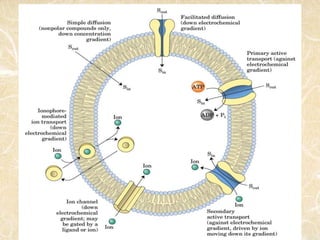
• Ion transport can be either active transport or passive transport.
• Active transport is the pumping of molecules or ions through a
membrane against their concentration gradient
• It requires :
- A transmembrane protein (Ion Pump).
- Energy in the form of ATP.
• Passive transport can be either channel mediated or carrier
mediated. It does not require energy for the transport of ions.
Passive Transport
• Passive transport of metal ions may occur in two
ways:
1. the cation may be encapsulated within a
macrocyclic ion carrying ligand (ionophores)
having organic groups outside – Carrier
mediated.
2. The metal ions may pass through an ion
permeable channel extending through the
membrane.
Ionophores
• Ionophores are naturally occuring ligands having the ability
to encapsulate metal ion and at the same time provide a
group of organic groups outside the complex.
• These compounds resemble crown ethers and cryptates by
having several oxygen or nitrogen atoms spaced along a
chain or ring that can wrap around a metal ion.
• Examples: valinomycin, nonactin, gramicidin, etc.
• The transport kinetics of lipid-soluble ionophores has been
studied by the planar lipid bilayer technique.
• They are obtained mostly from marine organisms and fungi.
How Ionophores work?
• Some ionophores increase the passive diffusion across a lipid
bilayer by providing a hydrophilic pocket that binds a solute and
sequesters it away from the hydrophobic lipid interior.
• These ionophores generally show specificity of transport
because the pocket binds some ions better than others.
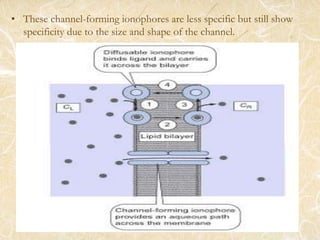
• For these types of ionophores, the ionophore-ligand complex is
believed to diffuse across the lipid bilayer, carrying the ligand
with the ionophore.
• Other ionophores form an aqueous channel across the lipid
layers.
• These channel-forming ionophores are less specific but still show
specificity due to the size and shape of the channel.
Valinomycin
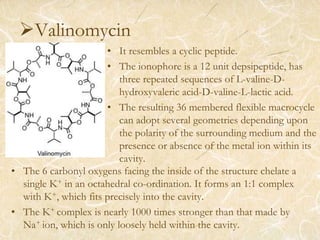
• It resembles a cyclic peptide.
• The ionophore is a 12 unit depsipeptide, has
three repeated sequences of L-valine-D-
hydroxyvaleric acid-D-valine-L-lactic acid.
• The resulting 36 membered flexible macrocycle
can adopt several geometries depending upon
the polarity of the surrounding medium and the
presence or absence of the metal ion within its
cavity.
• The 6 carbonyl oxygens facing the inside of the structure chelate a
single K+ in an octahedral co-ordination. It forms an 1:1 complex
with K+, which fits precisely into the cavity.
• The K+ complex is nearly 1000 times stronger than that made by
Na+ ion, which is only loosely held within the cavity.
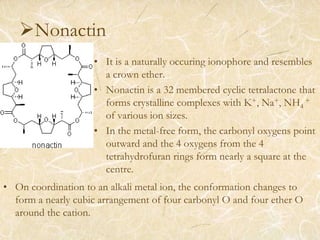
Nonactin
• On coordination to an alkali metal ion, the conformation changes to
form a nearly cubic arrangement of four carbonyl O and four ether O
around the cation.
• It is a naturally occuring ionophore and resembles
a crown ether.
• Nonactin is a 32 membered cyclic tetralactone that
forms crystalline complexes with K+, Na+, NH4
+
of various ion sizes.
• In the metal-free form, the carbonyl oxygens point
outward and the 4 oxygens from the 4
tetrahydrofuran rings form nearly a square at the
centre.
Ionophores as Antibiotics
• Ionophores can carry both K+ and Na+ ions through the
nonpolar cell membranes in either directions.
• This may disrupt the balance in the cells- a situation that
may be fatal for single celled species, viz. bacteria.
• The ionophores thus possess the potentiality of antibiotics
(transport antibiotics). But they are therapeutically useless
as they cannot distinguish microbial cells from the host
animal cells.
• Some limited veterinary applications are reported.
References
1. General & Inorganic Chemistry, Vol 2, R.Sarkar.
2. Inorganic Chemistry, 5th Ed., Atkins, Overton, Rourke,
Weller, Armstrong.
3. Quantitative Human Physiology: An Introduction, Joseph
Feher.
4. Cell Physiology Sourcebook: Essentials of Membrane
Biophysics, Nicholas Sperelakis.

Metal ion transport

  • 1.
    METAL ION TRANSPORT -JaiswalPriyanka Balister MSc - I
  • 2.
    Types of Iontransport • Ion transport can be either active transport or passive transport. • Active transport is the pumping of molecules or ions through a membrane against their concentration gradient • It requires : - A transmembrane protein (Ion Pump). - Energy in the form of ATP. • Passive transport can be either channel mediated or carrier mediated. It does not require energy for the transport of ions.
  • 4.
    Passive Transport • Passivetransport of metal ions may occur in two ways: 1. the cation may be encapsulated within a macrocyclic ion carrying ligand (ionophores) having organic groups outside – Carrier mediated. 2. The metal ions may pass through an ion permeable channel extending through the membrane.
  • 5.
    Ionophores • Ionophores arenaturally occuring ligands having the ability to encapsulate metal ion and at the same time provide a group of organic groups outside the complex. • These compounds resemble crown ethers and cryptates by having several oxygen or nitrogen atoms spaced along a chain or ring that can wrap around a metal ion. • Examples: valinomycin, nonactin, gramicidin, etc. • The transport kinetics of lipid-soluble ionophores has been studied by the planar lipid bilayer technique. • They are obtained mostly from marine organisms and fungi.
  • 6.
    How Ionophores work? •Some ionophores increase the passive diffusion across a lipid bilayer by providing a hydrophilic pocket that binds a solute and sequesters it away from the hydrophobic lipid interior. • These ionophores generally show specificity of transport because the pocket binds some ions better than others. • For these types of ionophores, the ionophore-ligand complex is believed to diffuse across the lipid bilayer, carrying the ligand with the ionophore. • Other ionophores form an aqueous channel across the lipid layers.
  • 7.
    • These channel-formingionophores are less specific but still show specificity due to the size and shape of the channel.
  • 8.
    Valinomycin • It resemblesa cyclic peptide. • The ionophore is a 12 unit depsipeptide, has three repeated sequences of L-valine-D- hydroxyvaleric acid-D-valine-L-lactic acid. • The resulting 36 membered flexible macrocycle can adopt several geometries depending upon the polarity of the surrounding medium and the presence or absence of the metal ion within its cavity. • The 6 carbonyl oxygens facing the inside of the structure chelate a single K+ in an octahedral co-ordination. It forms an 1:1 complex with K+, which fits precisely into the cavity. • The K+ complex is nearly 1000 times stronger than that made by Na+ ion, which is only loosely held within the cavity.
  • 9.
    Nonactin • On coordinationto an alkali metal ion, the conformation changes to form a nearly cubic arrangement of four carbonyl O and four ether O around the cation. • It is a naturally occuring ionophore and resembles a crown ether. • Nonactin is a 32 membered cyclic tetralactone that forms crystalline complexes with K+, Na+, NH4 + of various ion sizes. • In the metal-free form, the carbonyl oxygens point outward and the 4 oxygens from the 4 tetrahydrofuran rings form nearly a square at the centre.
  • 10.
    Ionophores as Antibiotics •Ionophores can carry both K+ and Na+ ions through the nonpolar cell membranes in either directions. • This may disrupt the balance in the cells- a situation that may be fatal for single celled species, viz. bacteria. • The ionophores thus possess the potentiality of antibiotics (transport antibiotics). But they are therapeutically useless as they cannot distinguish microbial cells from the host animal cells. • Some limited veterinary applications are reported.
  • 11.
    References 1. General &Inorganic Chemistry, Vol 2, R.Sarkar. 2. Inorganic Chemistry, 5th Ed., Atkins, Overton, Rourke, Weller, Armstrong. 3. Quantitative Human Physiology: An Introduction, Joseph Feher. 4. Cell Physiology Sourcebook: Essentials of Membrane Biophysics, Nicholas Sperelakis.