CRYSTALLIZATION IN FINAL
STAGES OF PURIFICATION
Presented by Breena
CRYSTALLIZATION
 Crystallization is a separation and purification method
widely used for final purification of components
 The principle of crystallization is based on the limited
solubility of a compound in a solvent at a certain
temperature, pressure, etc. A change of these conditions
to a state where the solubility is lower will lead to the
formation of a crystalline solid
 Crystallization consists of two stages:
• formation of nuclei
• growth of crystals
CRYSTAL
 A crystal is a solid in which the constituent atoms,
molecules, or ions are packed in a regularly ordered,
repeating pattern extending in all three spatial
dimension
 The formation of such a highly ordered structure
prohibits foreign molecules from being incorporated into
the lattice, a solid product of high purity is obtained
SHAPES OF CRYSTALS
EXAMPLES
Crystal Angle of axes Length of axes Examples
Cubic (regular) α = β = γ = 90º x =y =z NaCl
Tetragonal α = β = γ = 90º x =y ≠z NiSO4
Orthorhombic α = β = γ = 90º x ≠y ≠z KMNO4
Monoclinic α = β = γ ≠ 90º x ≠y ≠z Sucrose
Triclinic
(asymmetric)
α ≠β ≠ γ ≠ 90º x ≠y ≠z CuSO4
Trigonal
(rhombohedral)
α = β = γ ≠90º x =y =z NaNO3
Hexagonal Z at 90º to base - AgNO3
TYPES OF
CRYSTALLIZATION
Crystallization processes can be distinguished by the
manner in which the supersaturation is created. The
most frequently applied types of crystallization are
 Evaporative crystallization
 Cooling crystallization from solution or the melt
 Reactive crystallization or precipitation
The choice for a certain method depends on the
properties of the compound to be crystallized, the feed
and the thermodynamics of the system
Continue…
 For compounds with a low solubility the standard option
is reactive crystallization or precipitation
 For compounds with a solubility higher than 200 g/kg, a
choice has to be made between evaporative and cooling
crystallization
 Evaporative crystallization is typically the preferred
option when the solubility is hardly dependent on T,
which implies that cooling the saturated solution will not
result in a significant amount of crystals
EVAPORATIVE CRYSTALLIZATION
 In evaporative crystallization, the crystallization is
resulting from the evaporation of the solvent. So, this
process creates a vapor and a suspension of crystals in
mother liquor
 The mother liquor contain the equilibrium concentration
of product
 The residual amount of product can be harvested by
recycling the mother liquor to the feed
 The high concentration of impurities can influence the
crystallization or the product purity
COOLING CRYSTALLIZATION
 Cooling crystallization is attractive when the solubility of
the product increases significantly with increasing
temperature
 the feed is cooled in a heat exchanger, which can be
situated inside the crystallizer or an external loop
 Crystallization can take place when the liquid is cooled
to a temperature below the equilibrium solubility
Melt Crystallization
 Melt crystallization can be regarded as a special form of
cooling crystallization process
 The main difference with cooling crystallization from
solution is the absence of solvents, which implies that
most melt crystallization processes are operated close
to the melting point of the pure product. The feed for a
melt crystallization process is an impure melt
PRECIPITATION
 In precipitation the supersaturation is created by the
mixing of two streams. The most common forms of
precipitation are
 Reactive crystallization is the process in which the
solid phase is formed due to a reaction between
components that were originally present in the two feed
streams
 pH shift crystallization often makes use of the change
in the chemical state/charge of ionic species with pH
Well known examples of ions that change state with pH
are for instance carbonate and phosphate
Continue…
 Anti-solvent (or extractive) crystallization The anti-
solvent is typically well-mixable with the solvent, the
crystallizing product has a lower solubility in the anti-
solvent and for economic and environmental reasons it
should be possible to recover the anti-solvent
FRACTIONAL CRYSTALLIZATION
 Fractional crystallization is a term that is used to
describe a process where repeated crystallization steps
are used to increase the purity of the product and/or to
increase the yield of the process
 Applications can be found in metal (metal refining), oil &
gas (e.g. oil dewaxing), food (e.g. palm oil fractionation)
 This second crystallization stage will operate at a higher
temperature than the first stage due to the higher purity
of the feed in the second stage
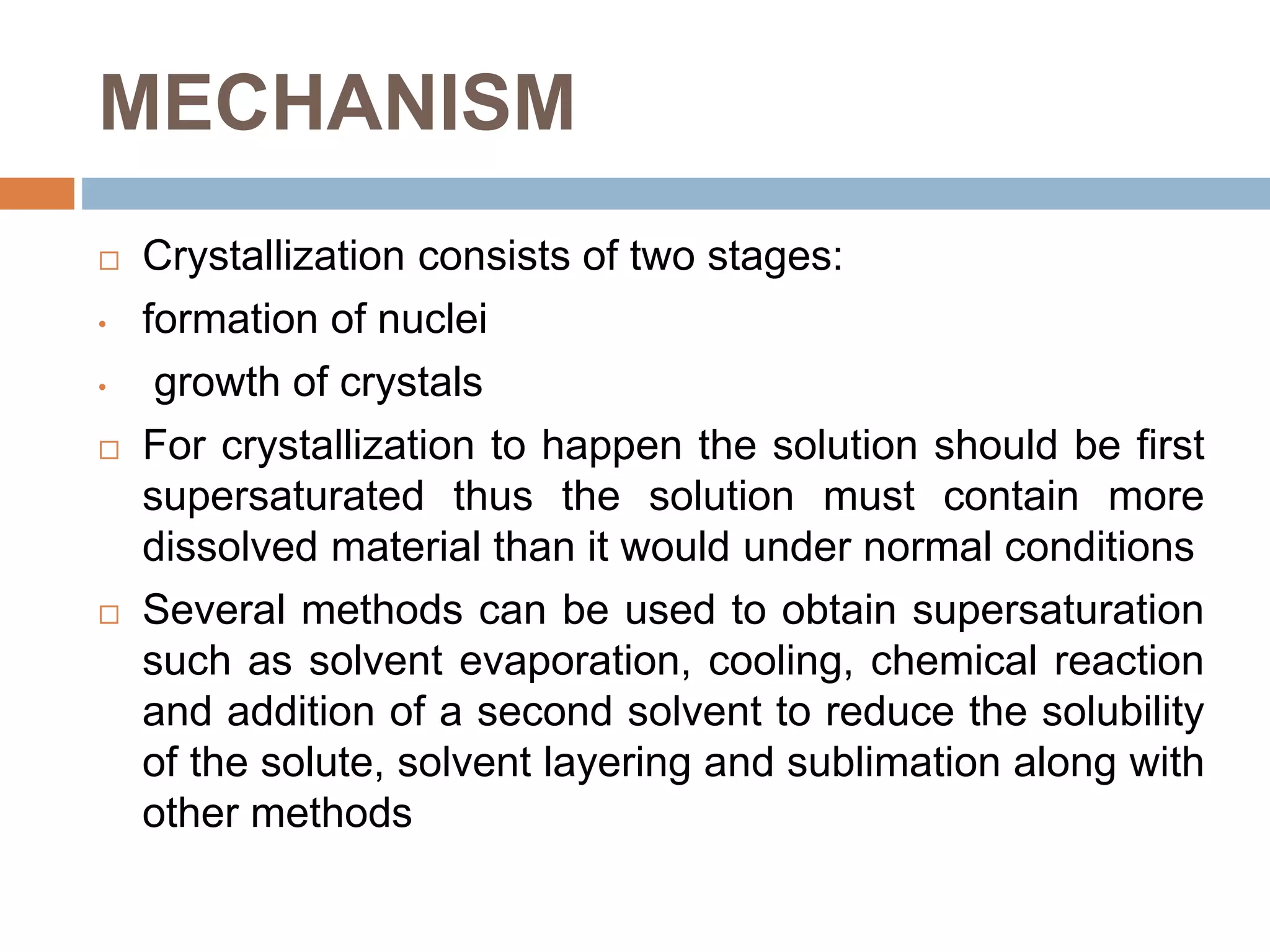
MECHANISM
 Crystallization consists of two stages:
• formation of nuclei
• growth of crystals
 For crystallization to happen the solution should be first
supersaturated thus the solution must contain more
dissolved material than it would under normal conditions
 Several methods can be used to obtain supersaturation
such as solvent evaporation, cooling, chemical reaction
and addition of a second solvent to reduce the solubility
of the solute, solvent layering and sublimation along with
other methods
FORMTION OF NUCLEI
Continue…
 The first step of crystallization is formation of nucleation
where crystals are formed when particles gather into
clusters. The clusters become stable nuclei after
achieving the critical cluster size. There are two different
nucleation formations – primary and secondary
 Primary nucleation is
 spontaneous and homogeneous in the absence of
foreign particles
 Heterogeneous in the presence of foreign particles then
the formation is induced by foreign particles and occurs
lower supersaturation concentration compared to
homogeneous primary nucleation
Continue…
 Secondary nucleation appears when crystals already
exist in the solution and it is caused by collision of
crystals. This type of nucleation formation is typical
mechanism in industrial crystallization because of low
supersaturation concentration
CRYSTAL GROWTH
 Nucleus size increases after the critical cluster size is
achieved
 Crystal growth increases its own dimension in thin
layers
 Crystal growth rate is affected by various physical
factors, such as surface tension of solution, pressure,
temperature and other factors
EXAMPLE
 Crystallization is typical downstream processing method
for high quality products with high purity requirements
 is widely used in organic acid production
 One of the most common organic acids is citric acid
which is used in several industries such as
pharmaceutical, food and beverage industries
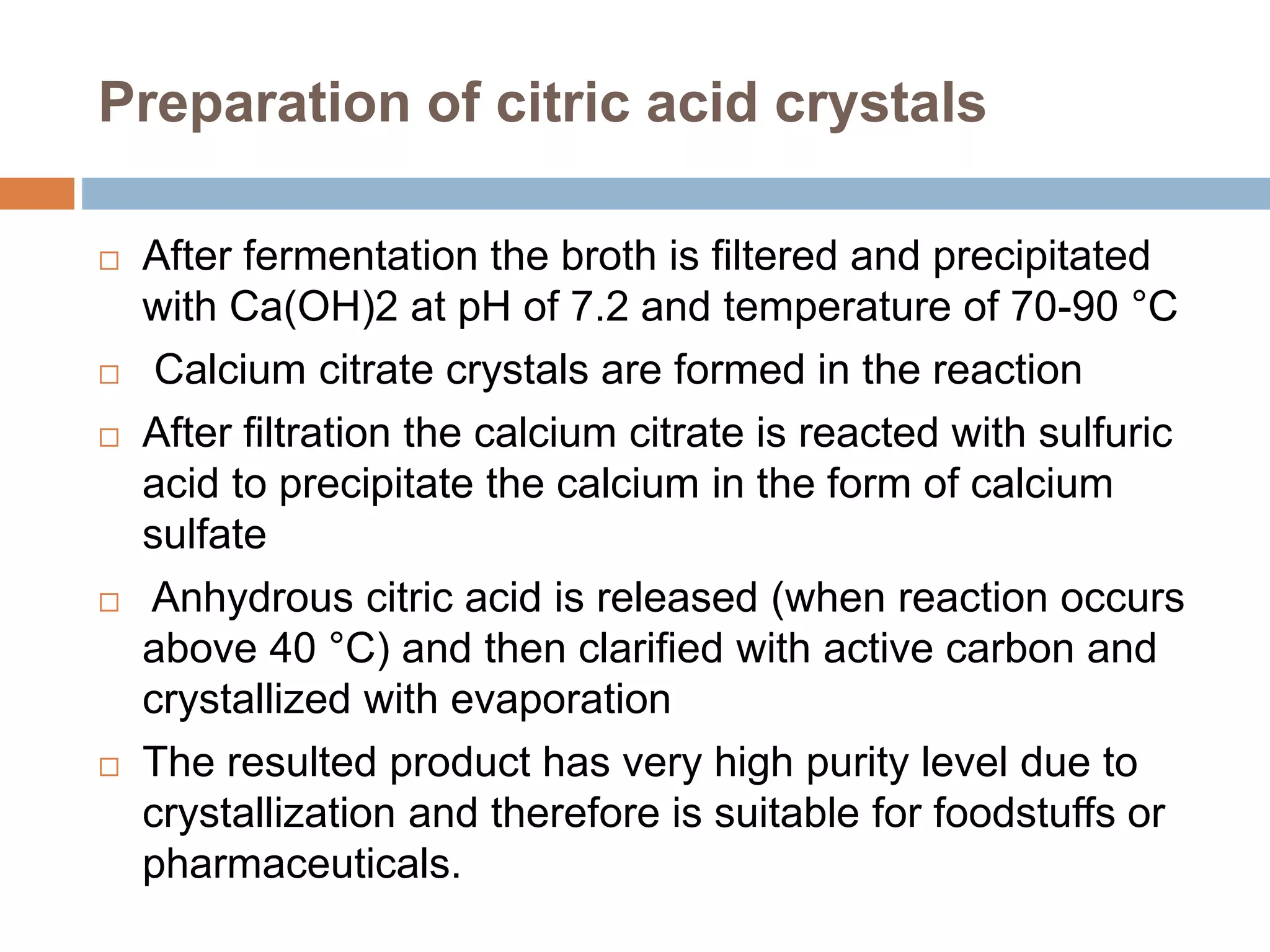
Preparation of citric acid crystals
 After fermentation the broth is filtered and precipitated
with Ca(OH)2 at pH of 7.2 and temperature of 70-90 °C
 Calcium citrate crystals are formed in the reaction
 After filtration the calcium citrate is reacted with sulfuric
acid to precipitate the calcium in the form of calcium
sulfate
 Anhydrous citric acid is released (when reaction occurs
above 40 °C) and then clarified with active carbon and
crystallized with evaporation
 The resulted product has very high purity level due to
crystallization and therefore is suitable for foodstuffs or
pharmaceuticals.
Preparation of Citric acid crystals
Purification of benzoic acid by
crystallization
Advantages & Disadvantages
 has an advantage compared to other solid liquid
separation operations such as distillation since
crystallization is a rather energy efficient unit operation
and the yielded product has very high purity level and
therefore wide scale of end use opportunities
 Its main disadvantage is that it is a slow process and
crystals can degrade by the gain in moisture or loss of
solvent
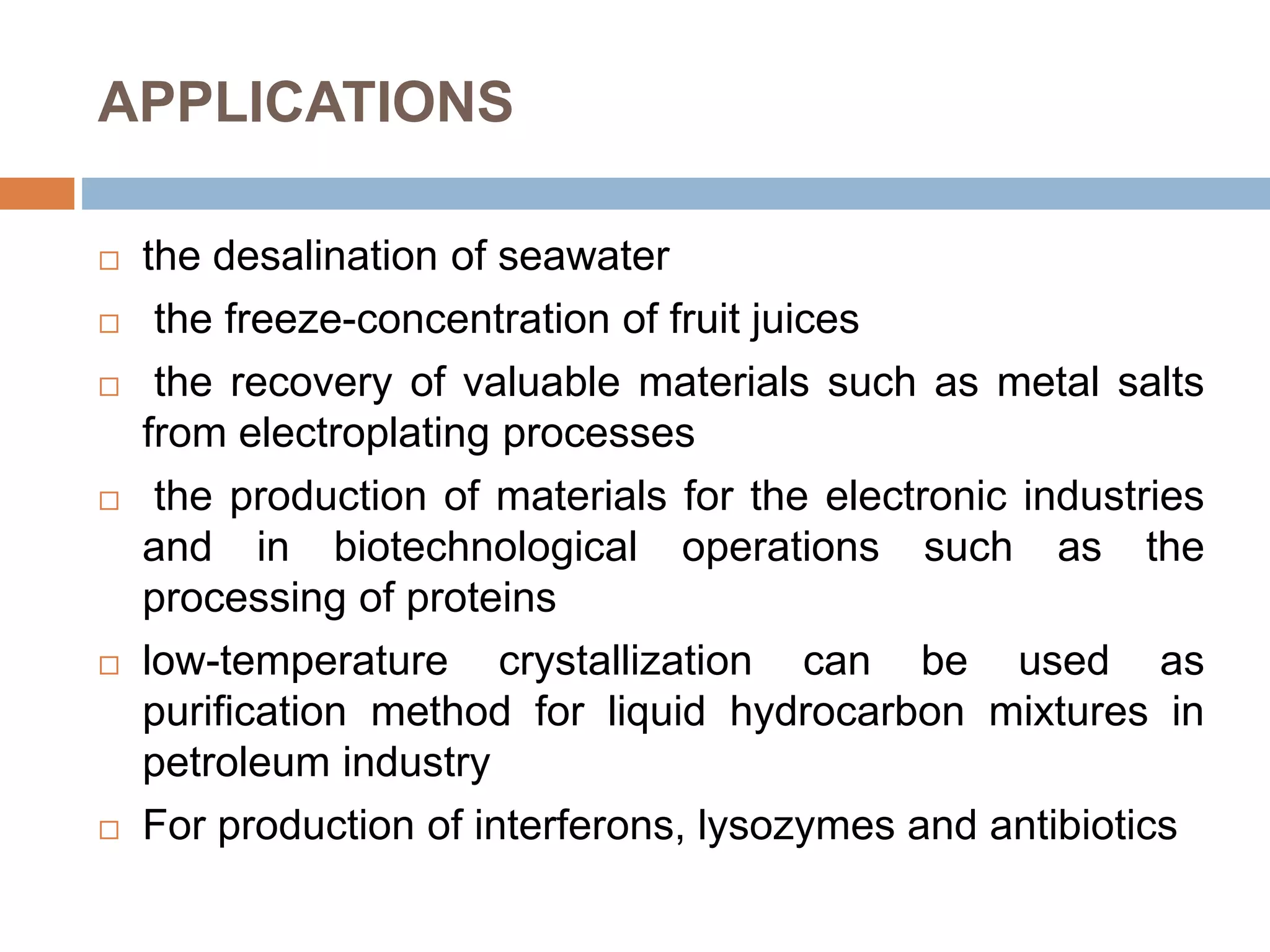
APPLICATIONS
 the desalination of seawater
 the freeze-concentration of fruit juices
 the recovery of valuable materials such as metal salts
from electroplating processes
 the production of materials for the electronic industries
and in biotechnological operations such as the
processing of proteins
 low-temperature crystallization can be used as
purification method for liquid hydrocarbon mixtures in
petroleum industry
 For production of interferons, lysozymes and antibiotics
Continue…
THANK YOU FOR YOUR
ATTENTION

Crystallization.pptx

  • 1.
    CRYSTALLIZATION IN FINAL STAGESOF PURIFICATION Presented by Breena
  • 2.
    CRYSTALLIZATION  Crystallization isa separation and purification method widely used for final purification of components  The principle of crystallization is based on the limited solubility of a compound in a solvent at a certain temperature, pressure, etc. A change of these conditions to a state where the solubility is lower will lead to the formation of a crystalline solid  Crystallization consists of two stages: • formation of nuclei • growth of crystals
  • 3.
    CRYSTAL  A crystalis a solid in which the constituent atoms, molecules, or ions are packed in a regularly ordered, repeating pattern extending in all three spatial dimension  The formation of such a highly ordered structure prohibits foreign molecules from being incorporated into the lattice, a solid product of high purity is obtained
  • 4.
  • 5.
    EXAMPLES Crystal Angle ofaxes Length of axes Examples Cubic (regular) α = β = γ = 90º x =y =z NaCl Tetragonal α = β = γ = 90º x =y ≠z NiSO4 Orthorhombic α = β = γ = 90º x ≠y ≠z KMNO4 Monoclinic α = β = γ ≠ 90º x ≠y ≠z Sucrose Triclinic (asymmetric) α ≠β ≠ γ ≠ 90º x ≠y ≠z CuSO4 Trigonal (rhombohedral) α = β = γ ≠90º x =y =z NaNO3 Hexagonal Z at 90º to base - AgNO3
  • 6.
    TYPES OF CRYSTALLIZATION Crystallization processescan be distinguished by the manner in which the supersaturation is created. The most frequently applied types of crystallization are  Evaporative crystallization  Cooling crystallization from solution or the melt  Reactive crystallization or precipitation The choice for a certain method depends on the properties of the compound to be crystallized, the feed and the thermodynamics of the system
  • 7.
    Continue…  For compoundswith a low solubility the standard option is reactive crystallization or precipitation  For compounds with a solubility higher than 200 g/kg, a choice has to be made between evaporative and cooling crystallization  Evaporative crystallization is typically the preferred option when the solubility is hardly dependent on T, which implies that cooling the saturated solution will not result in a significant amount of crystals
  • 8.
    EVAPORATIVE CRYSTALLIZATION  Inevaporative crystallization, the crystallization is resulting from the evaporation of the solvent. So, this process creates a vapor and a suspension of crystals in mother liquor  The mother liquor contain the equilibrium concentration of product  The residual amount of product can be harvested by recycling the mother liquor to the feed  The high concentration of impurities can influence the crystallization or the product purity
  • 9.
    COOLING CRYSTALLIZATION  Coolingcrystallization is attractive when the solubility of the product increases significantly with increasing temperature  the feed is cooled in a heat exchanger, which can be situated inside the crystallizer or an external loop  Crystallization can take place when the liquid is cooled to a temperature below the equilibrium solubility
  • 10.
    Melt Crystallization  Meltcrystallization can be regarded as a special form of cooling crystallization process  The main difference with cooling crystallization from solution is the absence of solvents, which implies that most melt crystallization processes are operated close to the melting point of the pure product. The feed for a melt crystallization process is an impure melt
  • 11.
    PRECIPITATION  In precipitationthe supersaturation is created by the mixing of two streams. The most common forms of precipitation are  Reactive crystallization is the process in which the solid phase is formed due to a reaction between components that were originally present in the two feed streams  pH shift crystallization often makes use of the change in the chemical state/charge of ionic species with pH Well known examples of ions that change state with pH are for instance carbonate and phosphate
  • 12.
    Continue…  Anti-solvent (orextractive) crystallization The anti- solvent is typically well-mixable with the solvent, the crystallizing product has a lower solubility in the anti- solvent and for economic and environmental reasons it should be possible to recover the anti-solvent
  • 13.
    FRACTIONAL CRYSTALLIZATION  Fractionalcrystallization is a term that is used to describe a process where repeated crystallization steps are used to increase the purity of the product and/or to increase the yield of the process  Applications can be found in metal (metal refining), oil & gas (e.g. oil dewaxing), food (e.g. palm oil fractionation)  This second crystallization stage will operate at a higher temperature than the first stage due to the higher purity of the feed in the second stage
  • 14.
    MECHANISM  Crystallization consistsof two stages: • formation of nuclei • growth of crystals  For crystallization to happen the solution should be first supersaturated thus the solution must contain more dissolved material than it would under normal conditions  Several methods can be used to obtain supersaturation such as solvent evaporation, cooling, chemical reaction and addition of a second solvent to reduce the solubility of the solute, solvent layering and sublimation along with other methods
  • 15.
  • 16.
    Continue…  The firststep of crystallization is formation of nucleation where crystals are formed when particles gather into clusters. The clusters become stable nuclei after achieving the critical cluster size. There are two different nucleation formations – primary and secondary  Primary nucleation is  spontaneous and homogeneous in the absence of foreign particles  Heterogeneous in the presence of foreign particles then the formation is induced by foreign particles and occurs lower supersaturation concentration compared to homogeneous primary nucleation
  • 17.
    Continue…  Secondary nucleationappears when crystals already exist in the solution and it is caused by collision of crystals. This type of nucleation formation is typical mechanism in industrial crystallization because of low supersaturation concentration
  • 18.
    CRYSTAL GROWTH  Nucleussize increases after the critical cluster size is achieved  Crystal growth increases its own dimension in thin layers  Crystal growth rate is affected by various physical factors, such as surface tension of solution, pressure, temperature and other factors
  • 19.
    EXAMPLE  Crystallization istypical downstream processing method for high quality products with high purity requirements  is widely used in organic acid production  One of the most common organic acids is citric acid which is used in several industries such as pharmaceutical, food and beverage industries
  • 20.
    Preparation of citricacid crystals  After fermentation the broth is filtered and precipitated with Ca(OH)2 at pH of 7.2 and temperature of 70-90 °C  Calcium citrate crystals are formed in the reaction  After filtration the calcium citrate is reacted with sulfuric acid to precipitate the calcium in the form of calcium sulfate  Anhydrous citric acid is released (when reaction occurs above 40 °C) and then clarified with active carbon and crystallized with evaporation  The resulted product has very high purity level due to crystallization and therefore is suitable for foodstuffs or pharmaceuticals.
  • 21.
    Preparation of Citricacid crystals
  • 22.
    Purification of benzoicacid by crystallization
  • 23.
    Advantages & Disadvantages has an advantage compared to other solid liquid separation operations such as distillation since crystallization is a rather energy efficient unit operation and the yielded product has very high purity level and therefore wide scale of end use opportunities  Its main disadvantage is that it is a slow process and crystals can degrade by the gain in moisture or loss of solvent
  • 24.
    APPLICATIONS  the desalinationof seawater  the freeze-concentration of fruit juices  the recovery of valuable materials such as metal salts from electroplating processes  the production of materials for the electronic industries and in biotechnological operations such as the processing of proteins  low-temperature crystallization can be used as purification method for liquid hydrocarbon mixtures in petroleum industry  For production of interferons, lysozymes and antibiotics
  • 25.
  • 26.
    THANK YOU FORYOUR ATTENTION