B.Ed. 2015-16
Psychology of Learners and Learning
UNIT – II
GROWTH AND DEVELOPMENT OF
THE LEARNER
M.Vijayalakshmi
Assistant Professor
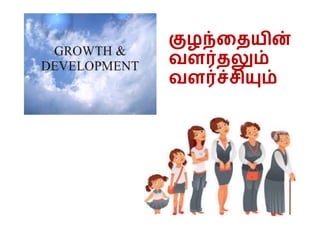
குழந்தையின்
வளர்ைலும்
வளர்ச்சியும்
Growth and Development: Meaning, factors
influencing Growth and Development –
Stages of development and its characteristics
– Adolescence problem and remedies –
Dimensions of development: Physical,
Cognitive, Social, Emotional and Moral –
Theories of development – Piaget’s cognitive
development – Freud’s psycho sexual
development – Erikson’s psycho – social
development.
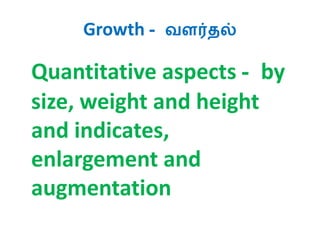
Growth - வளர்ைல்
Quantitative aspects - by
size, weight and height
and indicates,
enlargement and
augmentation
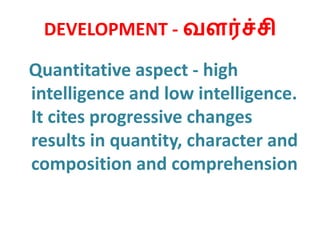
DEVELOPMENT - வளர்ச்சி
Quantitative aspect - high
intelligence and low intelligence.
It cites progressive changes
results in quantity, character and
composition and comprehension
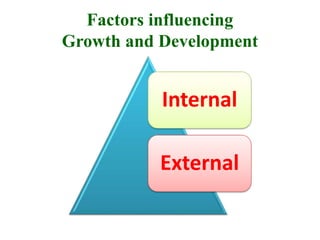
Factors influencing
Growth and Development
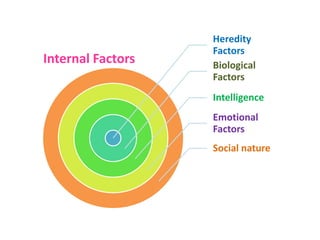
Internal
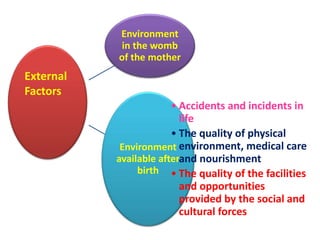
External
Heredity
Factors
Biological
Factors
Intelligence
Emotional
Factors
Social nature
Internal Factors
Environment
in the womb
of the mother
Environment
available after
birth
• Accidents and incidents in
life
• The quality of physical
environment, medical care
and nourishment
• The quality of the facilities
and opportunities
provided by the social and
cultural forces
External
Factors
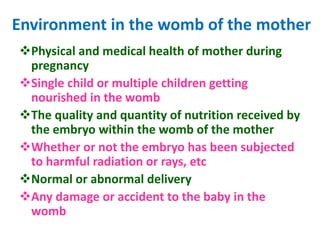
Environment in the womb of the mother
Physical and medical health of mother during
pregnancy
Single child or multiple children getting
nourished in the womb
The quality and quantity of nutrition received by
the embryo within the womb of the mother
Whether or not the embryo has been subjected
to harmful radiation or rays, etc
Normal or abnormal delivery
Any damage or accident to the baby in the
womb
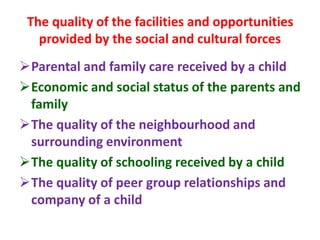
The quality of the facilities and opportunities
provided by the social and cultural forces
Parental and family care received by a child
Economic and social status of the parents and
family
The quality of the neighbourhood and
surrounding environment
The quality of schooling received by a child
The quality of peer group relationships and
company of a child
The quality of treatment made available to a
child and his family with regard to his caste,
religion, nationality or citizenship
The quality of educational and vocational
facilities and opportunities available to a
child
The quality of the government, laws and
organization of the society to which a child
belongs
The quality of the power and status enjoyed
by the country to which a child belongs
Principles of
Growth and Development
Principle of continuity
Principle of individual differences
Rate of growth and development is not
uniform
Uniformity of pattern
Development proceeds from general to
specific responses
Principles of
Growth and Development
Principle of integration
Principle of inter-relation
Development is predictable
Growth and development are a joint product
of both heredity and environment
Growth proceeds from head to trunk, centre
to extremities
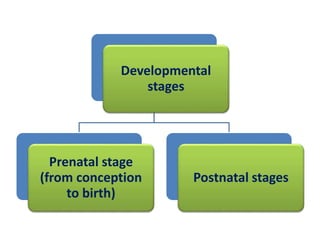
Developmental
stages
Prenatal stage
(from conception
to birth)
Postnatal stages
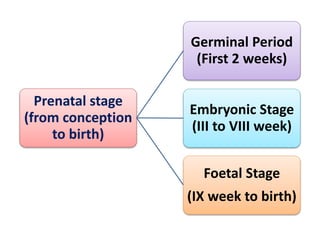
Prenatal stage
(from conception
to birth)
Germinal Period
(First 2 weeks)
Embryonic Stage
(III to VIII week)
Foetal Stage
(IX week to birth)
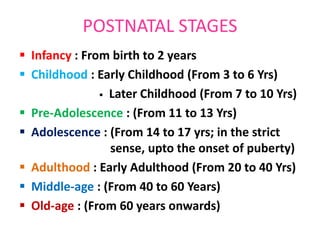
POSTNATAL STAGES
 Infancy : From birth to 2 years
 Childhood : Early Childhood (From 3 to 6 Yrs)
 Later Childhood (From 7 to 10 Yrs)
 Pre-Adolescence : (From 11 to 13 Yrs)
 Adolescence : (From 14 to 17 yrs; in the strict
sense, upto the onset of puberty)
 Adulthood : Early Adulthood (From 20 to 40 Yrs)
 Middle-age : (From 40 to 60 Years)
 Old-age : (From 60 years onwards)
Adolescence
• Latin verb ‘adolescere’ which means ‘to
grow’
• Begins with the onset of puberty and
lasts till the beginning of adulthood
(12+ to 18/20)
• Stanely Hall called this period as “Period
of Storm and Stress”
Special characteristics of Adolescents
Rapid perplexing physical changes
Heightend Self-consciousness
Intensification of sex-urge
Craving for independence
Peer - group relationship
Idealism vs. Realism
Vocational choice and Need of self-support
Aspiring for Leadership
Problems of Adolescents
Identity Crisis
Generation Gap
Negative and Non-conformist Attitude
Domination of Sexual Urge
Hesitation and Confusion in Selecting a Vocation
Emotional Swings
Aspiring for Autonomy
Peer Group Dominance
Remedies to overcome the
problems of the Adolescence
oTo have the proper knowledge of
adolescent’s psychology
oProviding suitable environment for
proper growth
oRendering proper sex education
oProper dealing with adolescents
oTraining of emotions and satisfaction of
emotional needs
oTo take care of the special interests of
the adolescents
oProviding Religious and Moral Education
oProvision for Vocational Education
oArranging Guidance Service
Theories of Development
Freud’s Psycho-sexual Development Theory
of Personality
Erikson’s Theory of Psycho-social
Development in Children
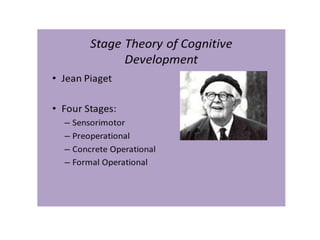
Jean Piaget’s Theory of Cognitive
Development in Children
Jean Piaget’s Theory of Moral Development
in Children
Lawrence Kohlberg’s Theory of Moral
Development in Children
Jean Piaget’s
Theory of Cognitive Development
in Children
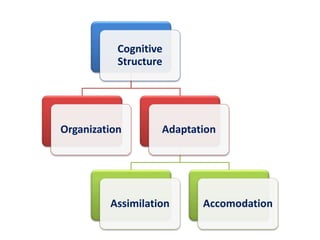
Cognitive
Structure
Organization Adaptation
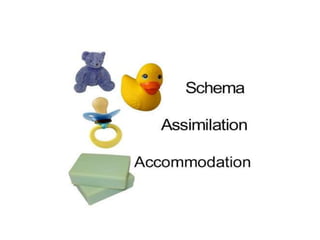
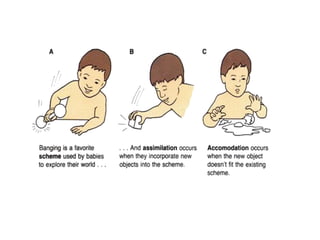
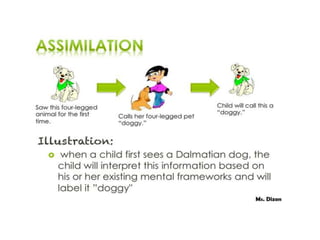
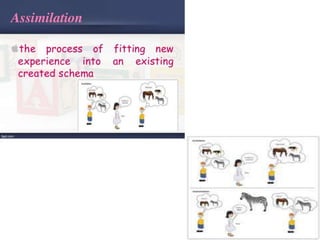
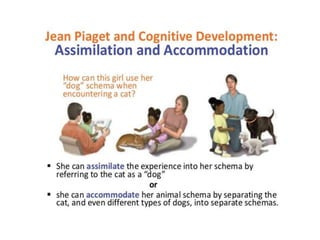
Assimilation Accomodation
Jean Piaget’s Theory of Cognitive
Development in Children
• Ego-centrism
• Animism
• Realism
• Centering
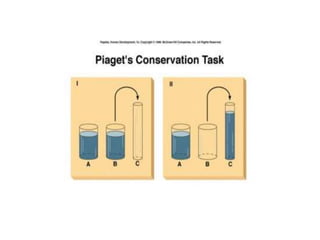
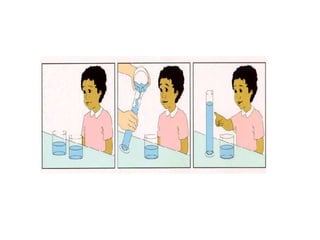
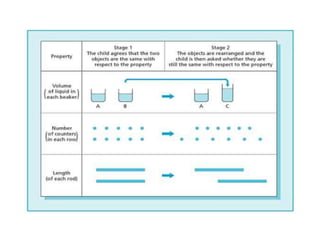
• Conservation task
• Cannot understand reversibility
• Consider their parents as omnipresent and
omnipotent
• Inability to play any game, following the rules
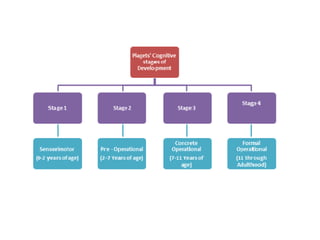
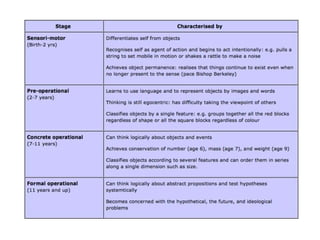
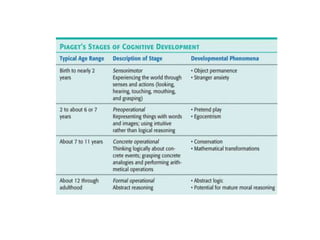
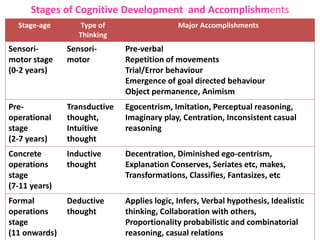
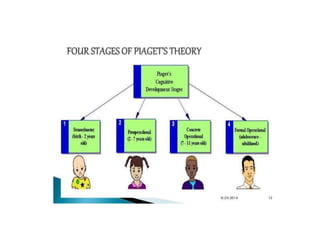
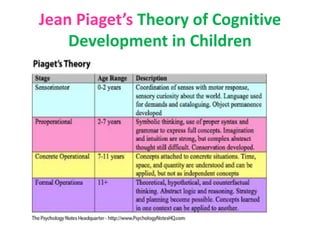
Stages of Cognitive Development and Accomplishments
Stage-age Type of
Thinking
Major Accomplishments
Sensori-
motor stage
(0-2 years)
Sensori-
motor
Pre-verbal
Repetition of movements
Trial/Error behaviour
Emergence of goal directed behaviour
Object permanence, Animism
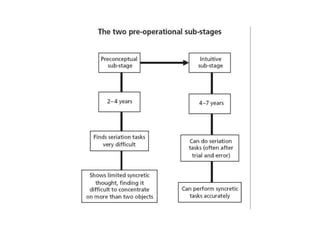
Pre-
operational
stage
(2-7 years)
Transductive
thought,
Intuitive
thought
Egocentrism, Imitation, Perceptual reasoning,
Imaginary play, Centration, Inconsistent casual
reasoning
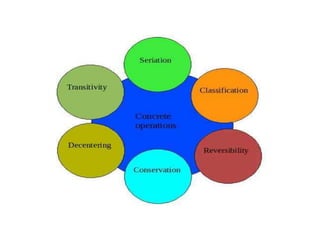
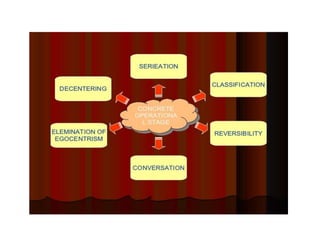
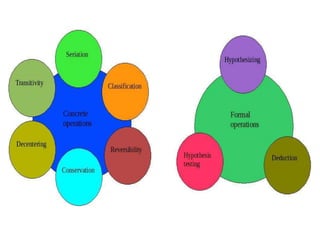
Concrete
operations
stage
(7-11 years)
Inductive
thought
Decentration, Diminished ego-centrism,
Explanation Conserves, Seriates etc, makes,
Transformations, Classifies, Fantasizes, etc
Formal
operations
stage
(11 onwards)
Deductive
thought
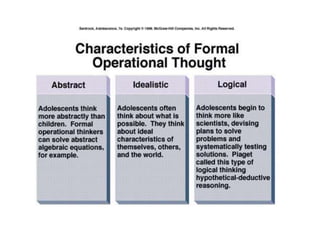
Applies logic, Infers, Verbal hypothesis, Idealistic
thinking, Collaboration with others,
Proportionality probabilistic and combinatorial
reasoning, casual relations
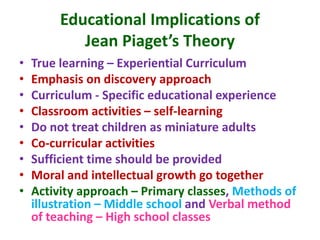
Educational Implications of
Jean Piaget’s Theory
• True learning – Experiential Curriculum
• Emphasis on discovery approach
• Curriculum - Specific educational experience
• Classroom activities – self-learning
• Do not treat children as miniature adults
• Co-curricular activities
• Sufficient time should be provided
• Moral and intellectual growth go together
• Activity approach – Primary classes, Methods of
illustration – Middle school and Verbal method
of teaching – High school classes
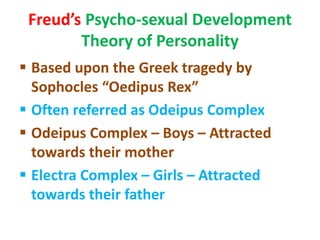
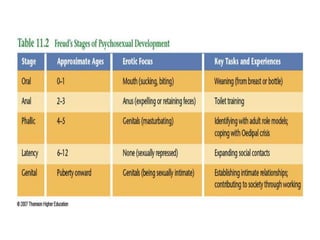
Freud’s Psycho-sexual Development
Theory of Personality
 Based upon the Greek tragedy by
Sophocles “Oedipus Rex”
 Often referred as Odeipus Complex
 Odeipus Complex – Boys – Attracted
towards their mother
 Electra Complex – Girls – Attracted
towards their father
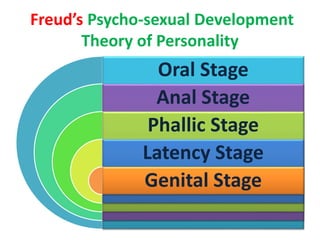
Freud’s Psycho-sexual Development
Theory of Personality
Oral Stage
Anal Stage
Phallic Stage
Latency Stage
Genital Stage
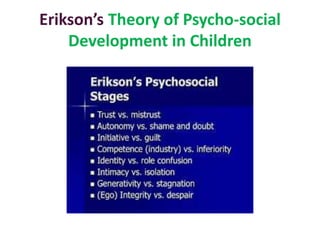
Erikson’s Theory of Psycho-social
Development in Children
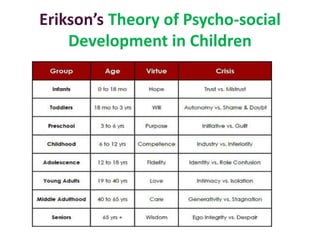
Erikson’s Theory of Psycho-social
Development in Children
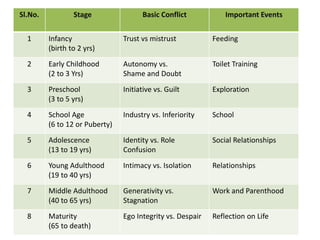
Sl.No. Stage Basic Conflict Important Events
1 Infancy
(birth to 2 yrs)
Trust vs mistrust Feeding
2 Early Childhood
(2 to 3 Yrs)
Autonomy vs.
Shame and Doubt
Toilet Training
3 Preschool
(3 to 5 yrs)
Initiative vs. Guilt Exploration
4 School Age
(6 to 12 or Puberty)
Industry vs. Inferiority School
5 Adolescence
(13 to 19 yrs)
Identity vs. Role
Confusion
Social Relationships
6 Young Adulthood
(19 to 40 yrs)
Intimacy vs. Isolation Relationships
7 Middle Adulthood
(40 to 65 yrs)
Generativity vs.
Stagnation
Work and Parenthood
8 Maturity
(65 to death)
Ego Integrity vs. Despair Reflection on Life
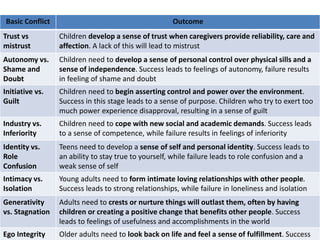
Basic Conflict Outcome
Trust vs
mistrust
Children develop a sense of trust when caregivers provide reliability, care and
affection. A lack of this will lead to mistrust
Autonomy vs.
Shame and
Doubt
Children need to develop a sense of personal control over physical sills and a
sense of independence. Success leads to feelings of autonomy, failure results
in feeling of shame and doubt
Initiative vs.
Guilt
Children need to begin asserting control and power over the environment.
Success in this stage leads to a sense of purpose. Children who try to exert too
much power experience disapproval, resulting in a sense of guilt
Industry vs.
Inferiority
Children need to cope with new social and academic demands. Success leads
to a sense of competence, while failure results in feelings of inferiority
Identity vs.
Role
Confusion
Teens need to develop a sense of self and personal identity. Success leads to
an ability to stay true to yourself, while failure leads to role confusion and a
weak sense of self
Intimacy vs.
Isolation
Young adults need to form intimate loving relationships with other people.
Success leads to strong relationships, while failure in loneliness and isolation
Generativity
vs. Stagnation
Adults need to crests or nurture things will outlast them, often by having
children or creating a positive change that benefits other people. Success
leads to feelings of usefulness and accomplishments in the world
Ego Integrity Older adults need to look back on life and feel a sense of fulfillment. Success
Growth and Development of the Learner

Growth and Development of the Learner

  • 1.
    B.Ed. 2015-16 Psychology ofLearners and Learning UNIT – II GROWTH AND DEVELOPMENT OF THE LEARNER M.Vijayalakshmi Assistant Professor
  • 2.
  • 3.
    Growth and Development:Meaning, factors influencing Growth and Development – Stages of development and its characteristics – Adolescence problem and remedies – Dimensions of development: Physical, Cognitive, Social, Emotional and Moral – Theories of development – Piaget’s cognitive development – Freud’s psycho sexual development – Erikson’s psycho – social development.
  • 4.
    Growth - வளர்ைல் Quantitativeaspects - by size, weight and height and indicates, enlargement and augmentation
  • 5.
    DEVELOPMENT - வளர்ச்சி Quantitativeaspect - high intelligence and low intelligence. It cites progressive changes results in quantity, character and composition and comprehension
  • 7.
    Factors influencing Growth andDevelopment Internal External
  • 8.
  • 9.
    Environment in the womb ofthe mother Environment available after birth • Accidents and incidents in life • The quality of physical environment, medical care and nourishment • The quality of the facilities and opportunities provided by the social and cultural forces External Factors
  • 10.
    Environment in thewomb of the mother Physical and medical health of mother during pregnancy Single child or multiple children getting nourished in the womb The quality and quantity of nutrition received by the embryo within the womb of the mother Whether or not the embryo has been subjected to harmful radiation or rays, etc Normal or abnormal delivery Any damage or accident to the baby in the womb
  • 11.
    The quality ofthe facilities and opportunities provided by the social and cultural forces Parental and family care received by a child Economic and social status of the parents and family The quality of the neighbourhood and surrounding environment The quality of schooling received by a child The quality of peer group relationships and company of a child
  • 12.
    The quality oftreatment made available to a child and his family with regard to his caste, religion, nationality or citizenship The quality of educational and vocational facilities and opportunities available to a child The quality of the government, laws and organization of the society to which a child belongs The quality of the power and status enjoyed by the country to which a child belongs
  • 14.
    Principles of Growth andDevelopment Principle of continuity Principle of individual differences Rate of growth and development is not uniform Uniformity of pattern Development proceeds from general to specific responses
  • 15.
    Principles of Growth andDevelopment Principle of integration Principle of inter-relation Development is predictable Growth and development are a joint product of both heredity and environment Growth proceeds from head to trunk, centre to extremities
  • 17.
  • 18.
    Prenatal stage (from conception tobirth) Germinal Period (First 2 weeks) Embryonic Stage (III to VIII week) Foetal Stage (IX week to birth)
  • 19.
    POSTNATAL STAGES  Infancy: From birth to 2 years  Childhood : Early Childhood (From 3 to 6 Yrs)  Later Childhood (From 7 to 10 Yrs)  Pre-Adolescence : (From 11 to 13 Yrs)  Adolescence : (From 14 to 17 yrs; in the strict sense, upto the onset of puberty)  Adulthood : Early Adulthood (From 20 to 40 Yrs)  Middle-age : (From 40 to 60 Years)  Old-age : (From 60 years onwards)
  • 21.
    Adolescence • Latin verb‘adolescere’ which means ‘to grow’ • Begins with the onset of puberty and lasts till the beginning of adulthood (12+ to 18/20) • Stanely Hall called this period as “Period of Storm and Stress”
  • 22.
    Special characteristics ofAdolescents Rapid perplexing physical changes Heightend Self-consciousness Intensification of sex-urge Craving for independence Peer - group relationship Idealism vs. Realism Vocational choice and Need of self-support Aspiring for Leadership
  • 23.
    Problems of Adolescents IdentityCrisis Generation Gap Negative and Non-conformist Attitude Domination of Sexual Urge Hesitation and Confusion in Selecting a Vocation Emotional Swings Aspiring for Autonomy Peer Group Dominance
  • 24.
    Remedies to overcomethe problems of the Adolescence oTo have the proper knowledge of adolescent’s psychology oProviding suitable environment for proper growth oRendering proper sex education oProper dealing with adolescents
  • 25.
    oTraining of emotionsand satisfaction of emotional needs oTo take care of the special interests of the adolescents oProviding Religious and Moral Education oProvision for Vocational Education oArranging Guidance Service
  • 26.
    Theories of Development Freud’sPsycho-sexual Development Theory of Personality Erikson’s Theory of Psycho-social Development in Children Jean Piaget’s Theory of Cognitive Development in Children Jean Piaget’s Theory of Moral Development in Children Lawrence Kohlberg’s Theory of Moral Development in Children
  • 27.
    Jean Piaget’s Theory ofCognitive Development in Children
  • 28.
  • 38.
    Jean Piaget’s Theoryof Cognitive Development in Children
  • 46.
    • Ego-centrism • Animism •Realism • Centering • Conservation task • Cannot understand reversibility • Consider their parents as omnipresent and omnipotent • Inability to play any game, following the rules
  • 52.
    Stages of CognitiveDevelopment and Accomplishments Stage-age Type of Thinking Major Accomplishments Sensori- motor stage (0-2 years) Sensori- motor Pre-verbal Repetition of movements Trial/Error behaviour Emergence of goal directed behaviour Object permanence, Animism Pre- operational stage (2-7 years) Transductive thought, Intuitive thought Egocentrism, Imitation, Perceptual reasoning, Imaginary play, Centration, Inconsistent casual reasoning Concrete operations stage (7-11 years) Inductive thought Decentration, Diminished ego-centrism, Explanation Conserves, Seriates etc, makes, Transformations, Classifies, Fantasizes, etc Formal operations stage (11 onwards) Deductive thought Applies logic, Infers, Verbal hypothesis, Idealistic thinking, Collaboration with others, Proportionality probabilistic and combinatorial reasoning, casual relations
  • 53.
    Educational Implications of JeanPiaget’s Theory • True learning – Experiential Curriculum • Emphasis on discovery approach • Curriculum - Specific educational experience • Classroom activities – self-learning • Do not treat children as miniature adults • Co-curricular activities • Sufficient time should be provided • Moral and intellectual growth go together • Activity approach – Primary classes, Methods of illustration – Middle school and Verbal method of teaching – High school classes
  • 54.
    Freud’s Psycho-sexual Development Theoryof Personality  Based upon the Greek tragedy by Sophocles “Oedipus Rex”  Often referred as Odeipus Complex  Odeipus Complex – Boys – Attracted towards their mother  Electra Complex – Girls – Attracted towards their father
  • 55.
    Freud’s Psycho-sexual Development Theoryof Personality Oral Stage Anal Stage Phallic Stage Latency Stage Genital Stage
  • 57.
    Erikson’s Theory ofPsycho-social Development in Children
  • 58.
    Erikson’s Theory ofPsycho-social Development in Children
  • 59.
    Sl.No. Stage BasicConflict Important Events 1 Infancy (birth to 2 yrs) Trust vs mistrust Feeding 2 Early Childhood (2 to 3 Yrs) Autonomy vs. Shame and Doubt Toilet Training 3 Preschool (3 to 5 yrs) Initiative vs. Guilt Exploration 4 School Age (6 to 12 or Puberty) Industry vs. Inferiority School 5 Adolescence (13 to 19 yrs) Identity vs. Role Confusion Social Relationships 6 Young Adulthood (19 to 40 yrs) Intimacy vs. Isolation Relationships 7 Middle Adulthood (40 to 65 yrs) Generativity vs. Stagnation Work and Parenthood 8 Maturity (65 to death) Ego Integrity vs. Despair Reflection on Life
  • 60.
    Basic Conflict Outcome Trustvs mistrust Children develop a sense of trust when caregivers provide reliability, care and affection. A lack of this will lead to mistrust Autonomy vs. Shame and Doubt Children need to develop a sense of personal control over physical sills and a sense of independence. Success leads to feelings of autonomy, failure results in feeling of shame and doubt Initiative vs. Guilt Children need to begin asserting control and power over the environment. Success in this stage leads to a sense of purpose. Children who try to exert too much power experience disapproval, resulting in a sense of guilt Industry vs. Inferiority Children need to cope with new social and academic demands. Success leads to a sense of competence, while failure results in feelings of inferiority Identity vs. Role Confusion Teens need to develop a sense of self and personal identity. Success leads to an ability to stay true to yourself, while failure leads to role confusion and a weak sense of self Intimacy vs. Isolation Young adults need to form intimate loving relationships with other people. Success leads to strong relationships, while failure in loneliness and isolation Generativity vs. Stagnation Adults need to crests or nurture things will outlast them, often by having children or creating a positive change that benefits other people. Success leads to feelings of usefulness and accomplishments in the world Ego Integrity Older adults need to look back on life and feel a sense of fulfillment. Success