
V.SURESH KUMAR
Assistant Professor in Mathematics
Rajalakshmi College of Education
Thoothukudi
Refers to increase in size, length, height & weight
The term ‘Growth’ is used in the physical sense.
One of the components of developmental process.
Development in its quantitative aspects is termed
as growth.
“Growth usually refers to an increase in size &
number” – Proffit 1986.
“Self multiplication of living substance” –
J.S.Huxley.
“Growth refers to increase in size” – Todd 1931.
Hereditary factor is the causes.
Physical factors play a dominant role.
Expansion in height and weight is its apparent
result.
It is quantitative, additive and augmentative.
Growth stops at a particular point of life.
Rate of growth in distinct and unique.
It is a progressive series of changes that occur in an
orderly predictable pattern as a result of maturation and
experience.
It is a qualitative and integral change occurring at
physical and mental levels improving the efficiency or
functional ability.
It means whole sequence of life from conception to
death.
“Development is a progress towards
maturity” – Todd 1931.
“Development is increase in complexity” –
Proffit 1986.
Development occurs with the help of both the
processes – learning and maturation.
The genetic raw material that an individual has
causes maturation.
Behavioral changes occur due to learning or
interacting with the environment by doing different
activities.
Learning & maturation are complementary
processes.
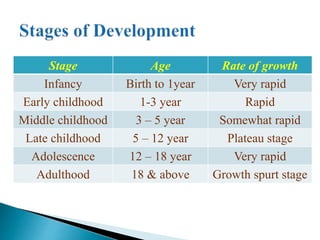
Stage Age Rate of growth
Infancy Birth to 1year Very rapid
Early childhood 1-3 year Rapid
Middle childhood 3 – 5 year Somewhat rapid
Late childhood 5 – 12 year Plateau stage
Adolescence 12 – 18 year Very rapid
Adulthood 18 & above Growth spurt stage
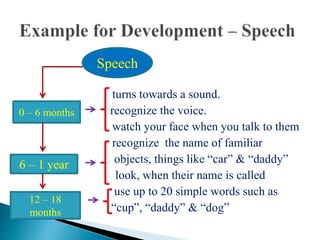
turns towards a sound.
recognize the voice.
watch your face when you talk to them
recognize the name of familiar
objects, things like “car” & “daddy”
look, when their name is called
use up to 20 simple words such as
“cup”, “daddy” & “dog”
Speech
0 – 6 months
6 – 1 year
12 – 18
months
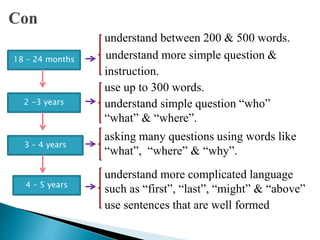
understand between 200 & 500 words.
understand more simple question &
instruction.
use up to 300 words.
understand simple question “who”
“what” & “where”.
asking many questions using words like
“what”, “where” & “why”.
understand more complicated language
such as “first”, “last”, “might” & “above”
use sentences that are well formed
18 – 24 months
2 -3 years
3 – 4 years
4 – 5 years
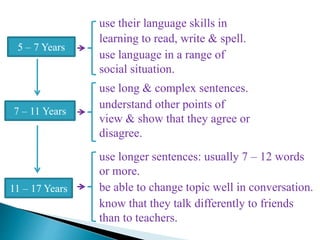
use their language skills in
learning to read, write & spell.
use language in a range of
social situation.
use long & complex sentences.
understand other points of
view & show that they agree or
disagree.
use longer sentences: usually 7 – 12 words
or more.
be able to change topic well in conversation.
know that they talk differently to friends
than to teachers.
5 – 7 Years
7 – 11 Years
11 – 17 Years
What is principle?
“ A fundamental, primary or general law or
truth from which others are derived”
Growth is a personal matter.
Growth comes from within.
Growth has certain characteristics common
at particular stages.
Growth is gradual & orderly but uneven.
The process of growth is influenced by
heredity & environment.
Growth is sequential
Example: infancy becomes mobile by lifting
first his head, then his abdomen, he sit, crawls, stands
alone & then walks in that order. The sequence orderly, but
the timing may be varied.
Growth is unique: some function that result from
growth are unique to the species like crewing standing &
walking. These are called phylogenetic function. While
function that are unique to the individual are called
ontogenetic functions.
Example: skating & bicycling which are
acquired through practice & not because one is a member
of the species.
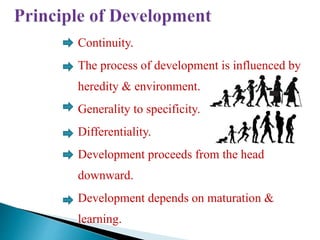
Continuity.
The process of development is influenced by
heredity & environment.
Generality to specificity.
Differentiality.
Development proceeds from the head
downward.
Development depends on maturation &
learning.
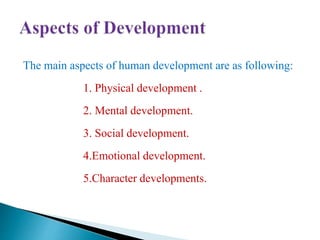
The main aspects of human development are as following:
1. Physical development .
2. Mental development.
3. Social development.
4.Emotional development.
5.Character developments.
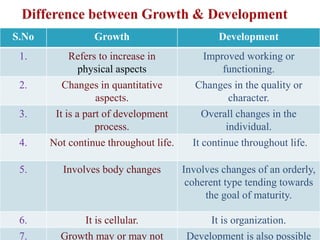
S.No Growth Development
1. Refers to increase in
physical aspects
Improved working or
functioning.
2. Changes in quantitative
aspects.
Changes in the quality or
character.
3. It is a part of development
process.
Overall changes in the
individual.
4. Not continue throughout life. It continue throughout life.
5. Involves body changes Involves changes of an orderly,
coherent type tending towards
the goal of maturity.
6. It is cellular. It is organization.
7. Growth may or may not Development is also possible
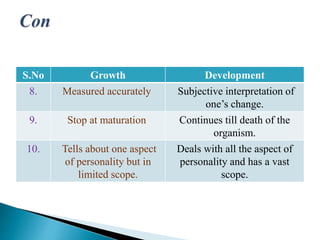
S.No Growth Development
8. Measured accurately Subjective interpretation of
one’s change.
9. Stop at maturation Continues till death of the
organism.
10. Tells about one aspect
of personality but in
limited scope.
Deals with all the aspect of
personality and has a vast
scope.
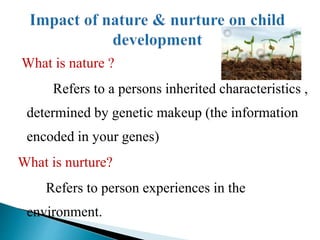
What is nature ?
Refers to a persons inherited characteristics ,
determined by genetic makeup (the information
encoded in your genes)
What is nurture?
Refers to person experiences in the
environment.
It responsible for the growth of a person from the
fetus level until development into a normal adult.
Response for their sex, skin color, color of their
eyes & hair.
Help in physical development.
Impart some positive or negative traits to an
individual.
Nature has some degree of influence in human
development.
Improving knowledge by practicing to adapt to
all creations in these circumstances or environment.
It builds upon the talents provided by nature.
Development of intelligent , knowledgeable or
athletic adult only through the exposure that nurture
gives a person.
Nurture strongly influences early human
development.
Growth & development

Growth & development

  • 1.
    V.SURESH KUMAR Assistant Professorin Mathematics Rajalakshmi College of Education Thoothukudi
  • 2.
    Refers to increasein size, length, height & weight The term ‘Growth’ is used in the physical sense. One of the components of developmental process. Development in its quantitative aspects is termed as growth.
  • 3.
    “Growth usually refersto an increase in size & number” – Proffit 1986. “Self multiplication of living substance” – J.S.Huxley. “Growth refers to increase in size” – Todd 1931.
  • 4.
    Hereditary factor isthe causes. Physical factors play a dominant role. Expansion in height and weight is its apparent result. It is quantitative, additive and augmentative. Growth stops at a particular point of life. Rate of growth in distinct and unique.
  • 7.
    It is aprogressive series of changes that occur in an orderly predictable pattern as a result of maturation and experience. It is a qualitative and integral change occurring at physical and mental levels improving the efficiency or functional ability. It means whole sequence of life from conception to death.
  • 8.
    “Development is aprogress towards maturity” – Todd 1931. “Development is increase in complexity” – Proffit 1986.
  • 9.
    Development occurs withthe help of both the processes – learning and maturation. The genetic raw material that an individual has causes maturation. Behavioral changes occur due to learning or interacting with the environment by doing different activities. Learning & maturation are complementary processes.
  • 10.
    Stage Age Rateof growth Infancy Birth to 1year Very rapid Early childhood 1-3 year Rapid Middle childhood 3 – 5 year Somewhat rapid Late childhood 5 – 12 year Plateau stage Adolescence 12 – 18 year Very rapid Adulthood 18 & above Growth spurt stage
  • 11.
    turns towards asound. recognize the voice. watch your face when you talk to them recognize the name of familiar objects, things like “car” & “daddy” look, when their name is called use up to 20 simple words such as “cup”, “daddy” & “dog” Speech 0 – 6 months 6 – 1 year 12 – 18 months
  • 12.
    understand between 200& 500 words. understand more simple question & instruction. use up to 300 words. understand simple question “who” “what” & “where”. asking many questions using words like “what”, “where” & “why”. understand more complicated language such as “first”, “last”, “might” & “above” use sentences that are well formed 18 – 24 months 2 -3 years 3 – 4 years 4 – 5 years
  • 13.
    use their languageskills in learning to read, write & spell. use language in a range of social situation. use long & complex sentences. understand other points of view & show that they agree or disagree. use longer sentences: usually 7 – 12 words or more. be able to change topic well in conversation. know that they talk differently to friends than to teachers. 5 – 7 Years 7 – 11 Years 11 – 17 Years
  • 14.
    What is principle? “A fundamental, primary or general law or truth from which others are derived”
  • 15.
    Growth is apersonal matter. Growth comes from within. Growth has certain characteristics common at particular stages. Growth is gradual & orderly but uneven. The process of growth is influenced by heredity & environment.
  • 16.
    Growth is sequential Example:infancy becomes mobile by lifting first his head, then his abdomen, he sit, crawls, stands alone & then walks in that order. The sequence orderly, but the timing may be varied. Growth is unique: some function that result from growth are unique to the species like crewing standing & walking. These are called phylogenetic function. While function that are unique to the individual are called ontogenetic functions. Example: skating & bicycling which are acquired through practice & not because one is a member of the species.
  • 17.
    Continuity. The process ofdevelopment is influenced by heredity & environment. Generality to specificity. Differentiality. Development proceeds from the head downward. Development depends on maturation & learning.
  • 18.
    The main aspectsof human development are as following: 1. Physical development . 2. Mental development. 3. Social development. 4.Emotional development. 5.Character developments.
  • 19.
    S.No Growth Development 1.Refers to increase in physical aspects Improved working or functioning. 2. Changes in quantitative aspects. Changes in the quality or character. 3. It is a part of development process. Overall changes in the individual. 4. Not continue throughout life. It continue throughout life. 5. Involves body changes Involves changes of an orderly, coherent type tending towards the goal of maturity. 6. It is cellular. It is organization. 7. Growth may or may not Development is also possible
  • 20.
    S.No Growth Development 8.Measured accurately Subjective interpretation of one’s change. 9. Stop at maturation Continues till death of the organism. 10. Tells about one aspect of personality but in limited scope. Deals with all the aspect of personality and has a vast scope.
  • 21.
    What is nature? Refers to a persons inherited characteristics , determined by genetic makeup (the information encoded in your genes) What is nurture? Refers to person experiences in the environment.
  • 22.
    It responsible forthe growth of a person from the fetus level until development into a normal adult. Response for their sex, skin color, color of their eyes & hair. Help in physical development. Impart some positive or negative traits to an individual. Nature has some degree of influence in human development.
  • 23.
    Improving knowledge bypracticing to adapt to all creations in these circumstances or environment. It builds upon the talents provided by nature. Development of intelligent , knowledgeable or athletic adult only through the exposure that nurture gives a person. Nurture strongly influences early human development.