MATURATION AND LEARNING
OP FOUSIYA
ATCW
fousimohd76@gmail.com 1
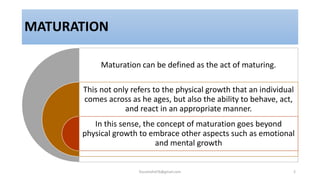
MATURATION
Maturation can be defined as the act of maturing.
This not only refers to the physical growth that an individual
comes across as he ages, but also the ability to behave, act,
and react in an appropriate manner.
In this sense, the concept of maturation goes beyond
physical growth to embrace other aspects such as emotional
and mental growth
fousimohd76@gmail.com 2
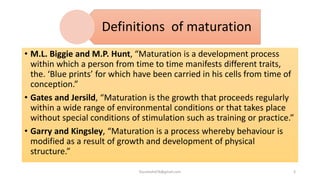
Definitions of maturation
• M.L. Biggie and M.P. Hunt, “Maturation is a development process
within which a person from time to time manifests different traits,
the. ‘Blue prints’ for which have been carried in his cells from time of
conception.”
• Gates and Jersild, “Maturation is the growth that proceeds regularly
within a wide range of environmental conditions or that takes place
without special conditions of stimulation such as training or practice.”
• Garry and Kingsley, “Maturation is a process whereby behaviour is
modified as a result of growth and development of physical
structure.”
fousimohd76@gmail.com 3
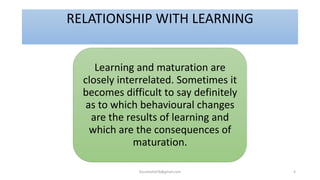
RELATIONSHIP WITH LEARNING
Learning and maturation are
closely interrelated. Sometimes it
becomes difficult to say definitely
as to which behavioural changes
are the results of learning and
which are the consequences of
maturation.
fousimohd76@gmail.com 4
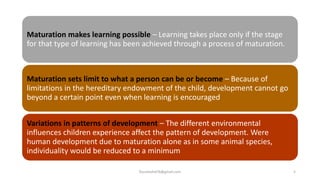
Maturation makes learning possible – Learning takes place only if the stage
for that type of learning has been achieved through a process of maturation.
Maturation sets limit to what a person can be or become – Because of
limitations in the hereditary endowment of the child, development cannot go
beyond a certain point even when learning is encouraged
Variations in patterns of development – The different environmental
influences children experience affect the pattern of development. Were
human development due to maturation alone as in some animal species,
individuality would be reduced to a minimum
fousimohd76@gmail.com 5
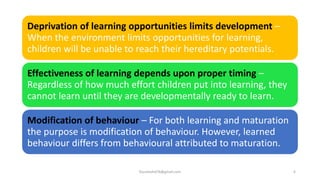
Deprivation of learning opportunities limits development –
When the environment limits opportunities for learning,
children will be unable to reach their hereditary potentials.
Effectiveness of learning depends upon proper timing –
Regardless of how much effort children put into learning, they
cannot learn until they are developmentally ready to learn.
Modification of behaviour – For both learning and maturation
the purpose is modification of behaviour. However, learned
behaviour differs from behavioural attributed to maturation.
fousimohd76@gmail.com 6
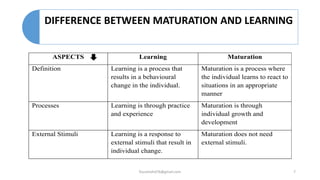
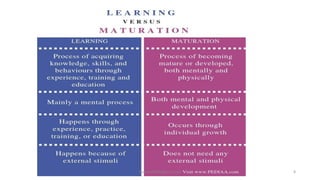
DIFFERENCE BETWEEN MATURATION AND LEARNING
ASPECTS Learning Maturation
Definition Learning is a process that
results in a behavioural
change in the individual.
Maturation is a process where
the individual learns to react to
situations in an appropriate
manner
Processes Learning is through practice
and experience
Maturation is through
individual growth and
development
External Stimuli Learning is a response to
external stimuli that result in
individual change.
Maturation does not need
external stimuli.
fousimohd76@gmail.com 7
fousimohd76@gmail.com 8
EDUCATIONAL IMPLICATION OF MATURATION
• An understanding of stages and levels of maturation helps the
teachers to know what and when to begin training. If too much is
expected from a child at a given age, children are likely to develop
feelings of inadequacy. On the other hand, if too little is expected of
them then they are deprived of incentives to develop their potential.
• If learning precedes maturation there is more wastage of time and
energy. Knowledge of maturation and developmental stages of a child
also suggest whether the child is mature and old enough to profit by
teaching. In case a concept is taught before the appropriate age the
teaching will go waste.
fousimohd76@gmail.com 9
The understanding of complexity of changes that
take place as a result of learning and maturation
would make a teacher and his/her teaching
effective
Maturation levels have implications on the
curriculum selection. Curriculum should be chosen
according to the level of learning and maturation.
For example, demonstration method for six to
twelfth, play way method for little children, lecture
method for graduates and post graduates.
fousimohd76@gmail.com 10

Learning and maturation

  • 1.
    MATURATION AND LEARNING OPFOUSIYA ATCW fousimohd76@gmail.com 1
  • 2.
    MATURATION Maturation can bedefined as the act of maturing. This not only refers to the physical growth that an individual comes across as he ages, but also the ability to behave, act, and react in an appropriate manner. In this sense, the concept of maturation goes beyond physical growth to embrace other aspects such as emotional and mental growth fousimohd76@gmail.com 2
  • 3.
    Definitions of maturation •M.L. Biggie and M.P. Hunt, “Maturation is a development process within which a person from time to time manifests different traits, the. ‘Blue prints’ for which have been carried in his cells from time of conception.” • Gates and Jersild, “Maturation is the growth that proceeds regularly within a wide range of environmental conditions or that takes place without special conditions of stimulation such as training or practice.” • Garry and Kingsley, “Maturation is a process whereby behaviour is modified as a result of growth and development of physical structure.” fousimohd76@gmail.com 3
  • 4.
    RELATIONSHIP WITH LEARNING Learningand maturation are closely interrelated. Sometimes it becomes difficult to say definitely as to which behavioural changes are the results of learning and which are the consequences of maturation. fousimohd76@gmail.com 4
  • 5.
    Maturation makes learningpossible – Learning takes place only if the stage for that type of learning has been achieved through a process of maturation. Maturation sets limit to what a person can be or become – Because of limitations in the hereditary endowment of the child, development cannot go beyond a certain point even when learning is encouraged Variations in patterns of development – The different environmental influences children experience affect the pattern of development. Were human development due to maturation alone as in some animal species, individuality would be reduced to a minimum fousimohd76@gmail.com 5
  • 6.
    Deprivation of learningopportunities limits development – When the environment limits opportunities for learning, children will be unable to reach their hereditary potentials. Effectiveness of learning depends upon proper timing – Regardless of how much effort children put into learning, they cannot learn until they are developmentally ready to learn. Modification of behaviour – For both learning and maturation the purpose is modification of behaviour. However, learned behaviour differs from behavioural attributed to maturation. fousimohd76@gmail.com 6
  • 7.
    DIFFERENCE BETWEEN MATURATIONAND LEARNING ASPECTS Learning Maturation Definition Learning is a process that results in a behavioural change in the individual. Maturation is a process where the individual learns to react to situations in an appropriate manner Processes Learning is through practice and experience Maturation is through individual growth and development External Stimuli Learning is a response to external stimuli that result in individual change. Maturation does not need external stimuli. fousimohd76@gmail.com 7
  • 8.
  • 9.
    EDUCATIONAL IMPLICATION OFMATURATION • An understanding of stages and levels of maturation helps the teachers to know what and when to begin training. If too much is expected from a child at a given age, children are likely to develop feelings of inadequacy. On the other hand, if too little is expected of them then they are deprived of incentives to develop their potential. • If learning precedes maturation there is more wastage of time and energy. Knowledge of maturation and developmental stages of a child also suggest whether the child is mature and old enough to profit by teaching. In case a concept is taught before the appropriate age the teaching will go waste. fousimohd76@gmail.com 9
  • 10.
    The understanding ofcomplexity of changes that take place as a result of learning and maturation would make a teacher and his/her teaching effective Maturation levels have implications on the curriculum selection. Curriculum should be chosen according to the level of learning and maturation. For example, demonstration method for six to twelfth, play way method for little children, lecture method for graduates and post graduates. fousimohd76@gmail.com 10