The Child and
Adolescent Learner and
Learning Principles
Two areas of the Philippine Professional
Standards for Teachers ( PPST )
1. Learning Environments
2. Diversity of learners
- are places where people learn. They can include physical
spaces such as classrooms, schools, or workplaces; virtual
spaces such as digital platforms; or blended spaces that
combine both physical and digital elements.
-The term “diverse learners” covers a broad range of abilities,
communities, backgrounds, and learning styles.
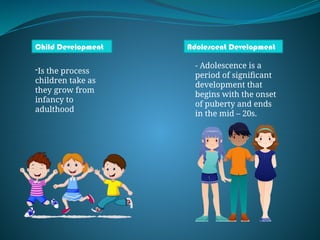
Child Development
- Adolescence is a
period of significant
development that
begins with the onset
of puberty and ends
in the mid – 20s.
Adolescent Development
-Is the process
children take as
they grow from
infancy to
adulthood
Nature and Principles of Development
- it is imperative that we understand our students’ background
(personal, social, cultural) to be able to engineer our teaching
strategies to maximize lerning. By knowing their needs, we can
address their concerns and seek for appropriate support
Development
- is the pattern of biological, cognitive, and socioemotional
changes that begins at conception and continues throughout
the lifespan.
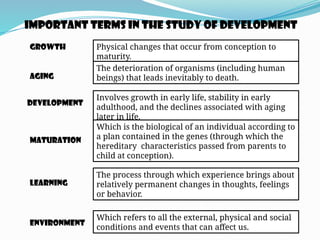
Important Terms in the Study of Development
Growth Physical changes that occur from conception to
maturity.
aging
The deterioration of organisms (including human
beings) that leads inevitably to death.
development
Involves growth in early life, stability in early
adulthood, and the declines associated with aging
later in life.
maturation
Which is the biological of an individual according to
a plan contained in the genes (through which the
hereditary characteristics passed from parents to
child at conception).
learning
The process through which experience brings about
relatively permanent changes in thoughts, feelings
or behavior.
environment
Which refers to all the external, physical and social
conditions and events that can affect us.
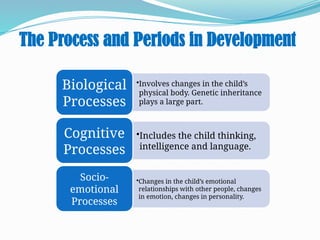
The Process and Periods in Development
•Involves changes in the child’s
physical body. Genetic inheritance
plays a large part.
Biological
Processes
•Includes the child thinking,
intelligence and language.
Cognitive
Processes
•Changes in the child’s emotional
relationships with other people, changes
in emotion, changes in personality.
Socio-
emotional
Processes
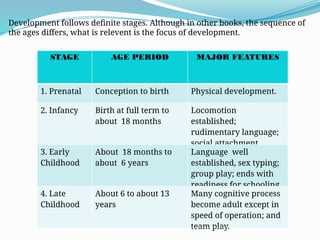
Development follows definite stages. Although in other books, the sequence of
the ages differs, what is relevent is the focus of development.
STAGE AGE PERIOD MAJOR FEATURES
1. Prenatal Conception to birth Physical development.
2. Infancy Birth at full term to
about 18 months
Locomotion
established;
rudimentary language;
social attachment.
3. Early
Childhood
About 18 months to
about 6 years
Language well
established, sex typing;
group play; ends with
readiness for schooling.
4. Late
Childhood
About 6 to about 13
years
Many cognitive process
become adult except in
speed of operation; and
team play.
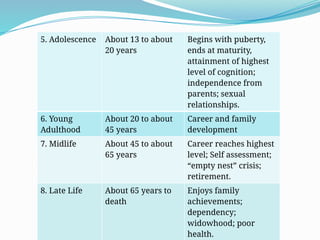
5. Adolescence About 13 to about
20 years
Begins with puberty,
ends at maturity,
attainment of highest
level of cognition;
independence from
parents; sexual
relationships.
6. Young
Adulthood
About 20 to about
45 years
Career and family
development
7. Midlife About 45 to about
65 years
Career reaches highest
level; Self assessment;
“empty nest” crisis;
retirement.
8. Late Life About 65 years to
death
Enjoys family
achievements;
dependency;
widowhood; poor
health.
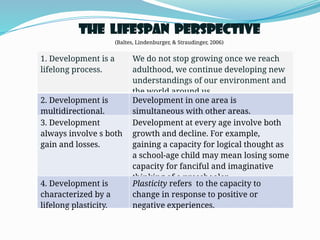
The Lifespan Perspective
(Baltes, Lindenburger, & Straudinger, 2006)
1. Development is a
lifelong process.
We do not stop growing once we reach
adulthood, we continue developing new
understandings of our environment and
the world around us.
2. Development is
multidirectional.
Development in one area is
simultaneous with other areas.
3. Development
always involve s both
gain and losses.
Development at every age involve both
growth and decline. For example,
gaining a capacity for logical thought as
a school-age child may mean losing some
capacity for fanciful and imaginative
thinking of a preschooler.
4. Development is
characterized by a
lifelong plasticity.
Plasticity refers to the capacity to
change in response to positive or
negative experiences.
5. Development
is shaped by its
historical/cultur
al context.
A person’s development is affected by the
culture and the history of the society he
or she grew up in.
6. Development
is multiply
influenced.
Human development is the product of
ongoing interactions between a changing
person and his or her changing world.
7.
Understanding
development
requires
multiple
discipline.
Human Development is best understood
by having knowledge of the
psychological perspectives, biological
underpinning and sociological context.
Basic Issues in Human Development
1. Assumptions About Human Nature
a. Original Sin:
Thomas Hobbes (1588-1679) portrayed children as
inherently selfish and bad, believing that it was society's task
to control their selfish and aggressive impulses and to teach
them to behave in positive ways.
b. Inherently Good:
Jean-Jacques Rousseau (1712-1778) argued that
children were innately good, that they were born with an
intuitive understanding of right and wrong , and that they
would develop in positive directions as long as society did not
interfere with their natural tendencies.
c. Tabula Rasa:
John Locke (1632-1704) maintained that an infant is
a tabula rasa, or a blank slate waiting to be written on by his
or her own experiences. Lock believed that children were
neither innately good nor bad; they could develop in any
number or direction depending on their own experiences.
2. Nature and Nurture
Nature refers to the behavior and characteristics
manifested because of the influence of biological forces
(heredity and biologically-based dispositions.)
Nurture refers to the influences brought about by the
exposure to the environment (includes learning
experiences, child-rearing methods, social changes
and culture.)
3. Activity and
Passivity
Some theorists believe that children are curious, active
creatures who in a very real sense orchestrate their own
environment. Other theorists view humans as passive
beings who are largely products of forces beyond their
control-usually environmental influences (but possibly
strong biological forces).
4. Continuity and
Discontinuity
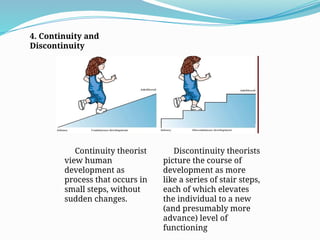
Continuity theorist
view human
development as
process that occurs in
small steps, without
sudden changes.
Discontinuity theorists
picture the course of
development as more
like a series of stair steps,
each of which elevates
the individual to a new
(and presumably more
advance) level of
functioning
Quantitative changes are changes in degree and indicate
continuity (a person becomes taller, knows more vocabulary
words, or interacts with friends more or less frequently).
Qualitative changes are changes in kind and suggest
discontinuity – changes that make the individual fundamentally
different in some way than he or she was before (a nonverbal
infant into a speaking toddler , or a prepubertal child into a
sexually mature adolescent.
5. Universality and Context-specificity
The extent to which developmental changes are common to
everyone (universal) or different from person to person
(context specific).

ProfEd1-Report (2) cognitive development

  • 1.
    The Child and AdolescentLearner and Learning Principles
  • 2.
    Two areas ofthe Philippine Professional Standards for Teachers ( PPST ) 1. Learning Environments 2. Diversity of learners - are places where people learn. They can include physical spaces such as classrooms, schools, or workplaces; virtual spaces such as digital platforms; or blended spaces that combine both physical and digital elements. -The term “diverse learners” covers a broad range of abilities, communities, backgrounds, and learning styles.
  • 3.
    Child Development - Adolescenceis a period of significant development that begins with the onset of puberty and ends in the mid – 20s. Adolescent Development -Is the process children take as they grow from infancy to adulthood
  • 4.
    Nature and Principlesof Development - it is imperative that we understand our students’ background (personal, social, cultural) to be able to engineer our teaching strategies to maximize lerning. By knowing their needs, we can address their concerns and seek for appropriate support Development - is the pattern of biological, cognitive, and socioemotional changes that begins at conception and continues throughout the lifespan.
  • 5.
    Important Terms inthe Study of Development Growth Physical changes that occur from conception to maturity. aging The deterioration of organisms (including human beings) that leads inevitably to death. development Involves growth in early life, stability in early adulthood, and the declines associated with aging later in life. maturation Which is the biological of an individual according to a plan contained in the genes (through which the hereditary characteristics passed from parents to child at conception). learning The process through which experience brings about relatively permanent changes in thoughts, feelings or behavior. environment Which refers to all the external, physical and social conditions and events that can affect us.
  • 6.
    The Process andPeriods in Development •Involves changes in the child’s physical body. Genetic inheritance plays a large part. Biological Processes •Includes the child thinking, intelligence and language. Cognitive Processes •Changes in the child’s emotional relationships with other people, changes in emotion, changes in personality. Socio- emotional Processes
  • 7.
    Development follows definitestages. Although in other books, the sequence of the ages differs, what is relevent is the focus of development. STAGE AGE PERIOD MAJOR FEATURES 1. Prenatal Conception to birth Physical development. 2. Infancy Birth at full term to about 18 months Locomotion established; rudimentary language; social attachment. 3. Early Childhood About 18 months to about 6 years Language well established, sex typing; group play; ends with readiness for schooling. 4. Late Childhood About 6 to about 13 years Many cognitive process become adult except in speed of operation; and team play.
  • 8.
    5. Adolescence About13 to about 20 years Begins with puberty, ends at maturity, attainment of highest level of cognition; independence from parents; sexual relationships. 6. Young Adulthood About 20 to about 45 years Career and family development 7. Midlife About 45 to about 65 years Career reaches highest level; Self assessment; “empty nest” crisis; retirement. 8. Late Life About 65 years to death Enjoys family achievements; dependency; widowhood; poor health.
  • 9.
    The Lifespan Perspective (Baltes,Lindenburger, & Straudinger, 2006) 1. Development is a lifelong process. We do not stop growing once we reach adulthood, we continue developing new understandings of our environment and the world around us. 2. Development is multidirectional. Development in one area is simultaneous with other areas. 3. Development always involve s both gain and losses. Development at every age involve both growth and decline. For example, gaining a capacity for logical thought as a school-age child may mean losing some capacity for fanciful and imaginative thinking of a preschooler. 4. Development is characterized by a lifelong plasticity. Plasticity refers to the capacity to change in response to positive or negative experiences.
  • 10.
    5. Development is shapedby its historical/cultur al context. A person’s development is affected by the culture and the history of the society he or she grew up in. 6. Development is multiply influenced. Human development is the product of ongoing interactions between a changing person and his or her changing world. 7. Understanding development requires multiple discipline. Human Development is best understood by having knowledge of the psychological perspectives, biological underpinning and sociological context.
  • 11.
    Basic Issues inHuman Development 1. Assumptions About Human Nature a. Original Sin: Thomas Hobbes (1588-1679) portrayed children as inherently selfish and bad, believing that it was society's task to control their selfish and aggressive impulses and to teach them to behave in positive ways. b. Inherently Good: Jean-Jacques Rousseau (1712-1778) argued that children were innately good, that they were born with an intuitive understanding of right and wrong , and that they would develop in positive directions as long as society did not interfere with their natural tendencies. c. Tabula Rasa: John Locke (1632-1704) maintained that an infant is a tabula rasa, or a blank slate waiting to be written on by his or her own experiences. Lock believed that children were neither innately good nor bad; they could develop in any number or direction depending on their own experiences.
  • 12.
    2. Nature andNurture Nature refers to the behavior and characteristics manifested because of the influence of biological forces (heredity and biologically-based dispositions.) Nurture refers to the influences brought about by the exposure to the environment (includes learning experiences, child-rearing methods, social changes and culture.) 3. Activity and Passivity Some theorists believe that children are curious, active creatures who in a very real sense orchestrate their own environment. Other theorists view humans as passive beings who are largely products of forces beyond their control-usually environmental influences (but possibly strong biological forces).
  • 13.
    4. Continuity and Discontinuity Continuitytheorist view human development as process that occurs in small steps, without sudden changes. Discontinuity theorists picture the course of development as more like a series of stair steps, each of which elevates the individual to a new (and presumably more advance) level of functioning
  • 14.
    Quantitative changes arechanges in degree and indicate continuity (a person becomes taller, knows more vocabulary words, or interacts with friends more or less frequently). Qualitative changes are changes in kind and suggest discontinuity – changes that make the individual fundamentally different in some way than he or she was before (a nonverbal infant into a speaking toddler , or a prepubertal child into a sexually mature adolescent. 5. Universality and Context-specificity The extent to which developmental changes are common to everyone (universal) or different from person to person (context specific).