INTELLIGENCE
M. Vijayalakshmi
M.Sc., M.Phil. (Life Sciences), M.Ed., M.Phil. (Education), NET (Education), PGDBI
Assistant Professor (Former),
Sri Ramakrishna Mission Vidyalaya College of Education (Autonomous),
Coimbatore – 641020.
INTELLIGENCE
• Mental property that includes many related cognitive
abilities – capacities to reasoning, planning, problems
solving, abstract thinking, comprehending ideas, using
language and learning
• Think rationally, act purposefully and deal effectively
MEANING AND DEFINITION
• Latin verb – ‘intelligere’ means ‘to understand’
• American Psychological Association (1995) – Intelligence
are attempts tomclarify and organize the complex set of
phenomena
• Albert Binet – Intelligence is a capacity to think well, to
judge well and to be self critical
• Charles Spearman – Intelligence is a rational thinking
FACTOR THEORIES
• Unitary Theory
• Oligarchic Theory
•Multi-Factor Theory
TWO-FACTOR THEORY
• g-factor – General intelligence
• s-factor - Specific intelligence
• gFluid intelligence (without
experience) and
• gCrystal intelligence (With
experience)
Two-Factor
Theory
g-factor –
General
intelligence
gFluid
intelligence
gCrystal
intelligence
s-factor -
Specific
intelligence
THEORY OF PRIMARY MENTAL ABILITIES
• Word fluency
• Verbal comprehension
• Spatial visualization
• Number facility
• Associative Memory
• Reasoning
• Perceptual Speed
Theory of
Primary
Mental
Abilities
Word
fluency
Verbal
comprehension
Spatial
visualization
Number
facility
Associative
Memory
Reasoning
Perceptual
Speed
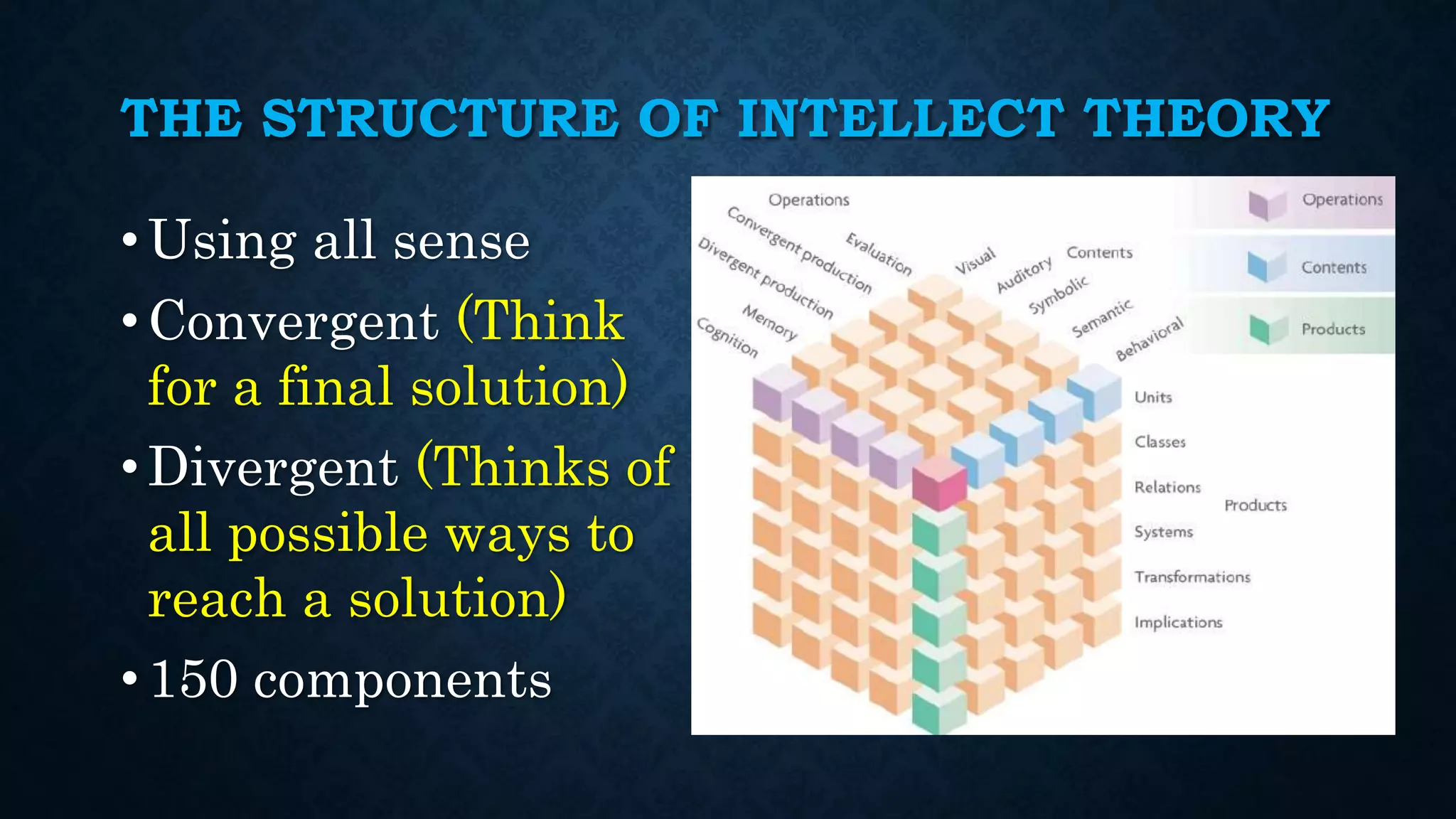
THE STRUCTURE OF INTELLECT THEORY
• Using all sense
• Convergent (Think
for a final solution)
• Divergent (Thinks of
all possible ways to
reach a solution)
• 150 components
PROCESS THEORIES
•Multiple Intelligence
•Triarchic Theory of Intelligence
MULTIPLE INTELLIGENCE
THEORY OF MULTIPLE INTELLIGENCE
•Howard Gardner - Seven intelligences
•Multiple Intelligence – Talent in all the
areas
•Gardner first outlined his theory in his
1983 book Frames of Mind
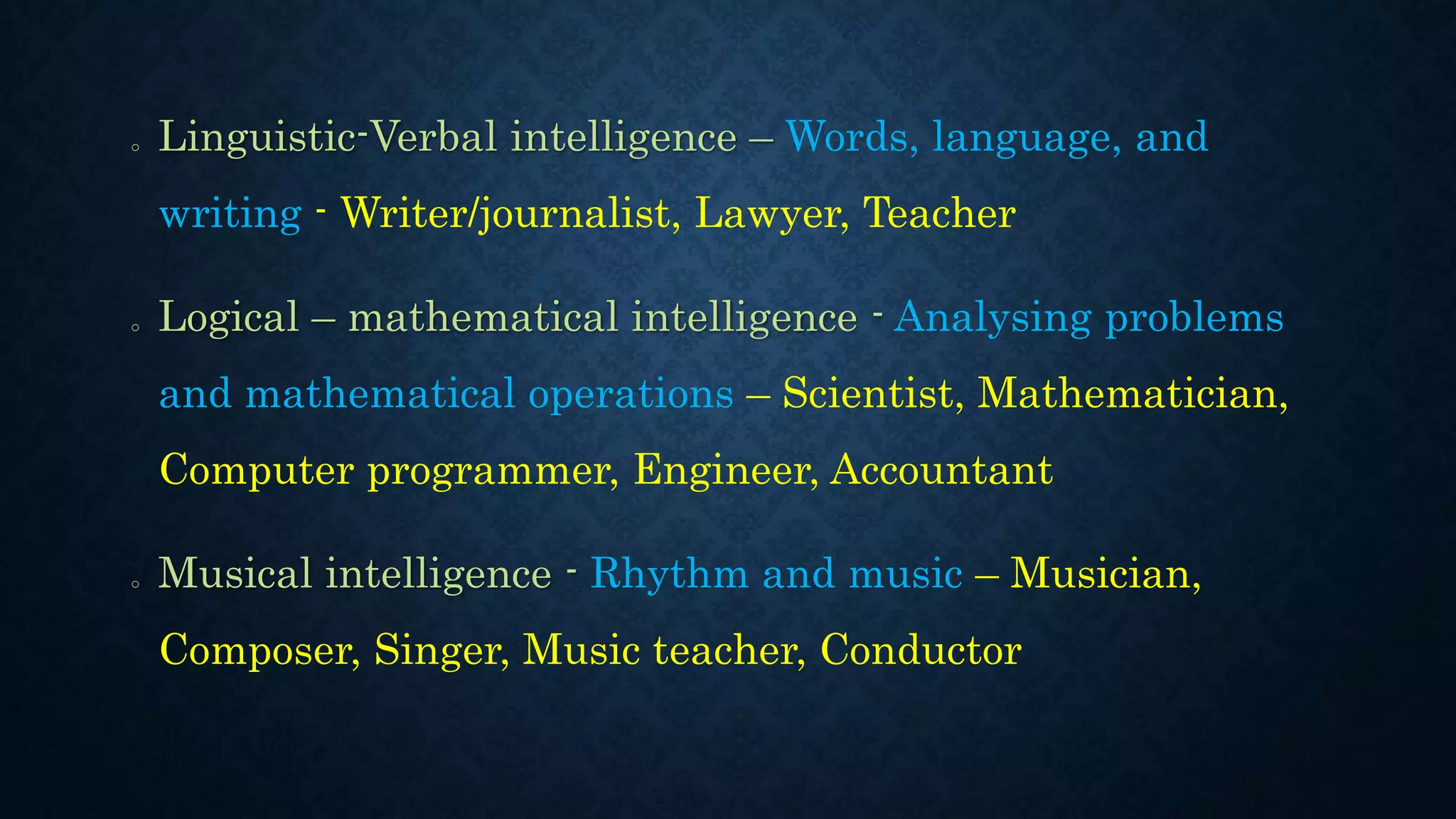
o Linguistic-Verbal intelligence – Words, language, and
writing - Writer/journalist, Lawyer, Teacher
o Logical – mathematical intelligence - Analysing problems
and mathematical operations – Scientist, Mathematician,
Computer programmer, Engineer, Accountant
o Musical intelligence - Rhythm and music – Musician,
Composer, Singer, Music teacher, Conductor
o Visual-Spatial intelligence - Visual and spatial judgment -
Architect, Artist, Engineer
o Bodily kinesthetic intelligence - Physical movement, motor
control – Dancer, Builder, Sculptor, Actor
o Interpersonal intelligence - Understanding and relating to
other people – Psychologist, Philosopher, Counsellor,
Salesperson, Politician
o Intrapersonal intelligence - Introspection and self-
reflection – Philosopher, Writer, Theorist, Scientist
o Naturalistic Intelligence - Finding patterns and
relationships to nature – Biologist, Conservationist,
Gardener, Farmer
o Ninth - “Existentialist intelligence”
TRIARCHIC THEORY OF INTELLIGENCE
• Sternberg – Theory of Practical Intelligence
• Information processing approach – Triarchic
Theory of Intelligence
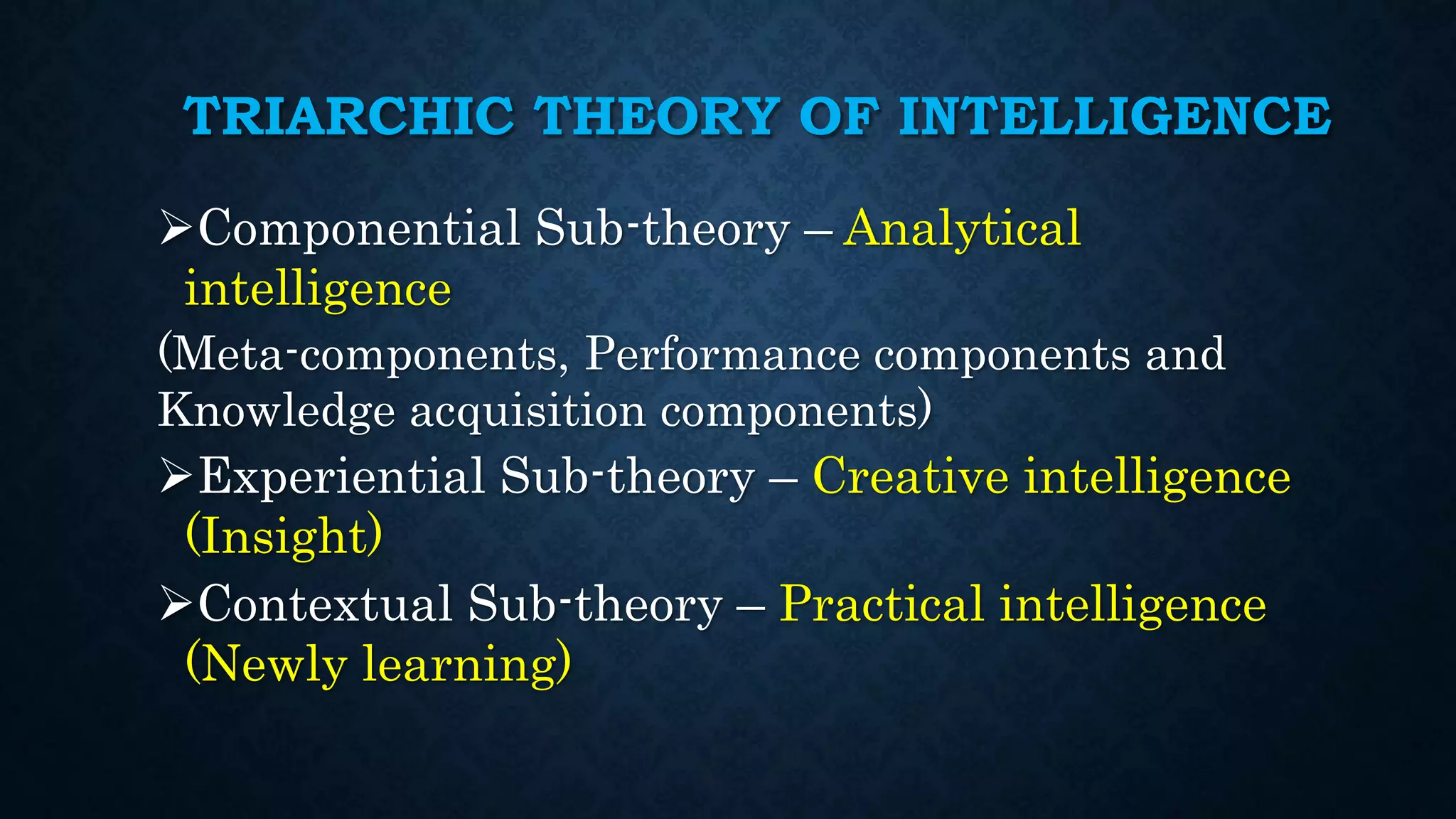
TRIARCHIC THEORY OF INTELLIGENCE
Componential Sub-theory – Analytical
intelligence
(Meta-components, Performance components and
Knowledge acquisition components)
Experiential Sub-theory – Creative intelligence
(Insight)
Contextual Sub-theory – Practical intelligence
(Newly learning)
ASSESSMENT
OF
INTELLIGENCE
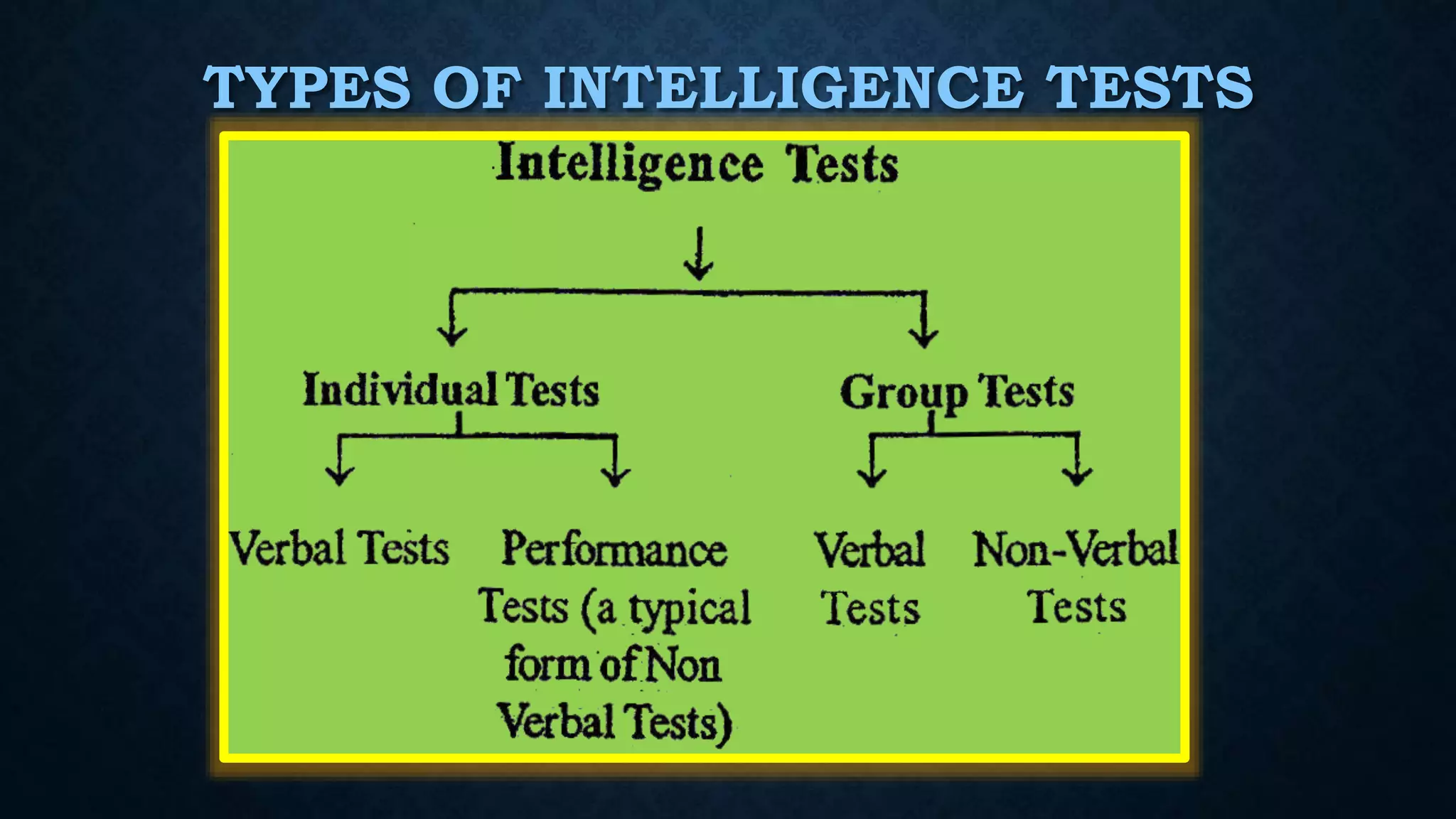
TYPES OF INTELLIGENCE TESTS
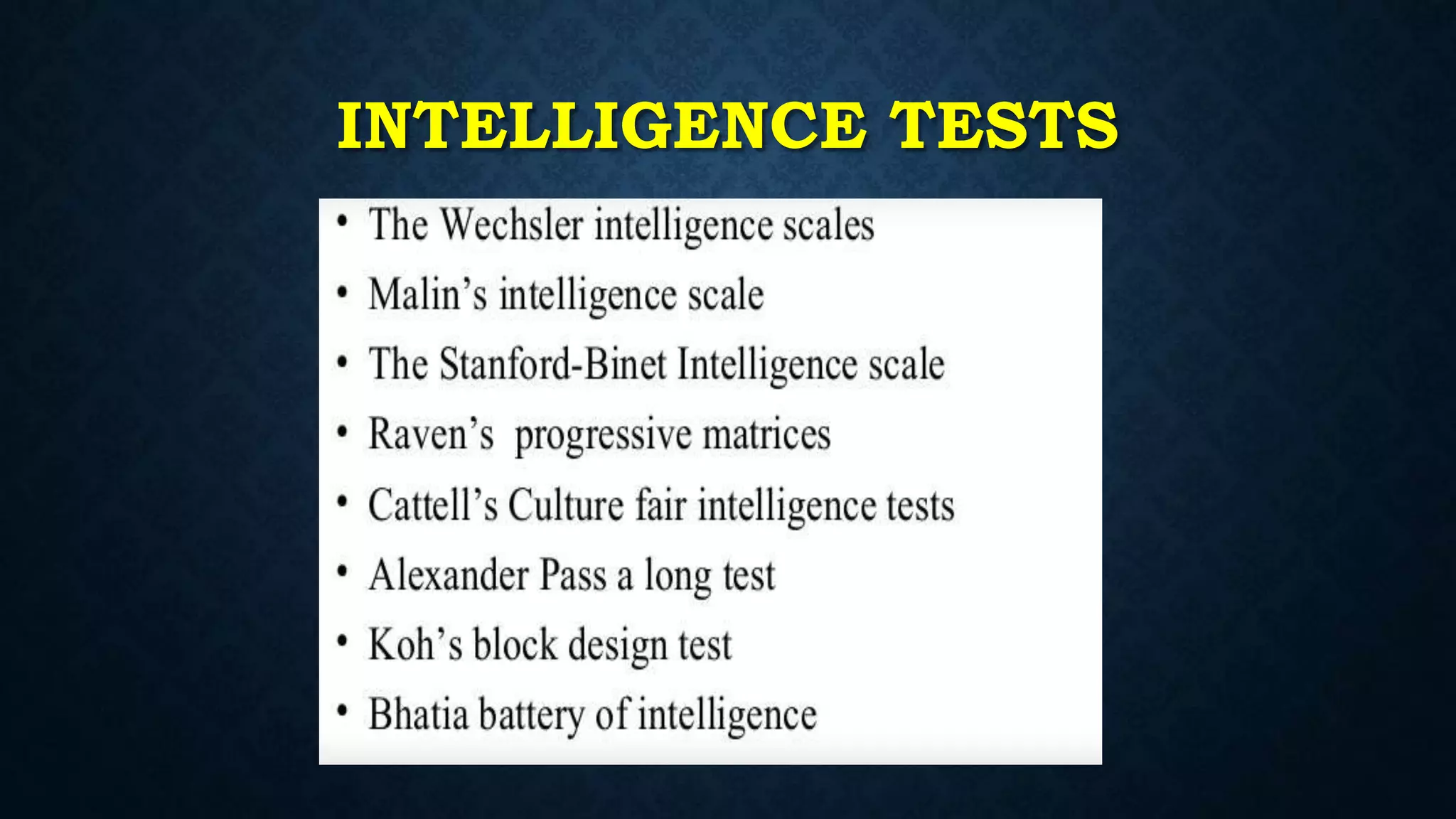
INTELLIGENCE TESTS
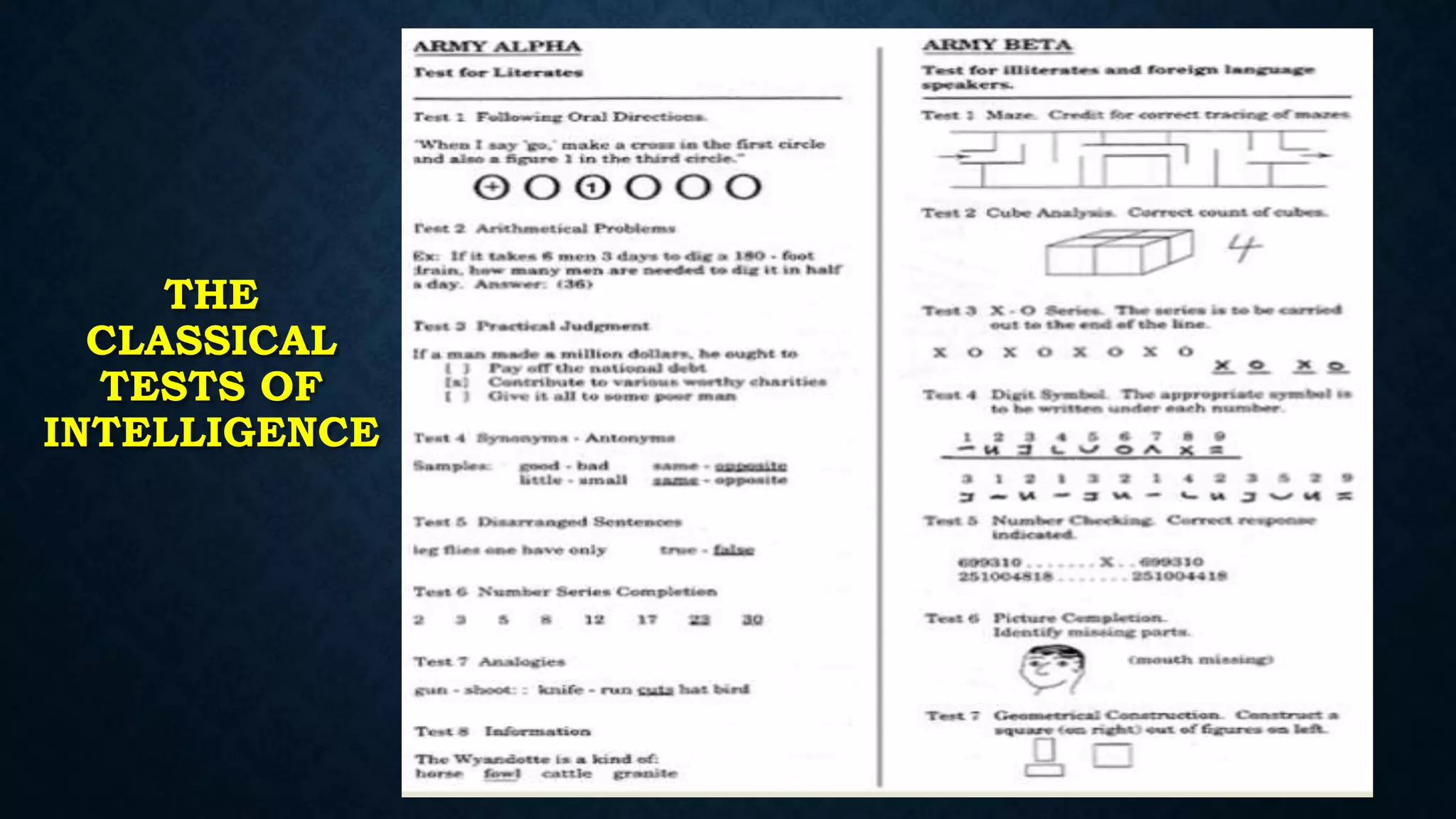
THE
CLASSICAL
TESTS OF
INTELLIGENCE
WECHSLER’S TEST OF INTELLIGENCE
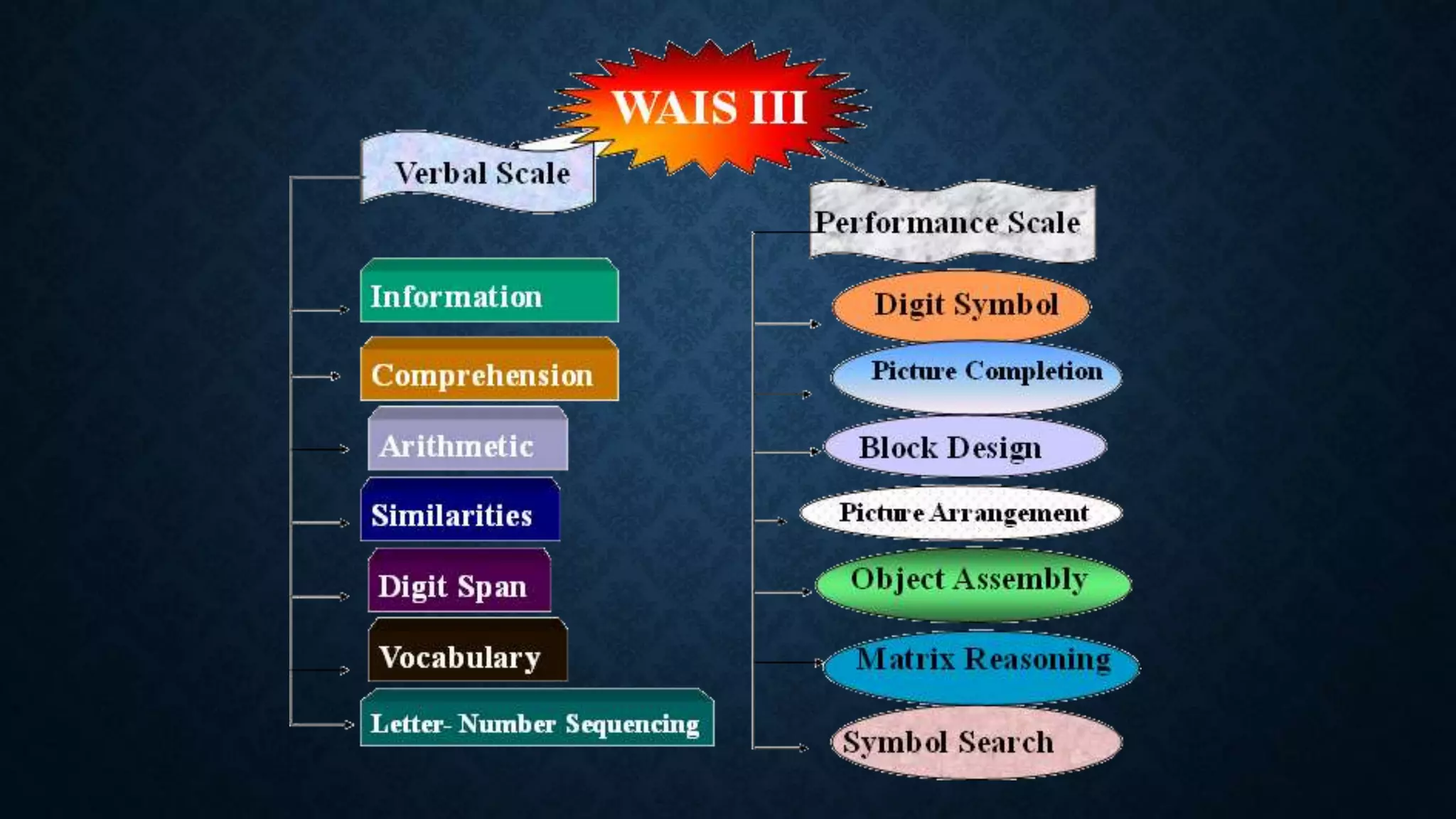
• Adult Intelligence Scale (WAIS) - 14 subsets
(7 verbal and 7 nonverbal)
• Wechsler Intelligence Scale for Children (WISC) – 7 –
16 yrs
• Wechsler Preschool and Primary Scale of
Intelligence (WPPSI) – 2 ½ - 7 yrs
• Wechsler Adult Intelligence Scale, Revised as a
Neuropsychological Instrument (WAIS-R NI) – 7
subsets
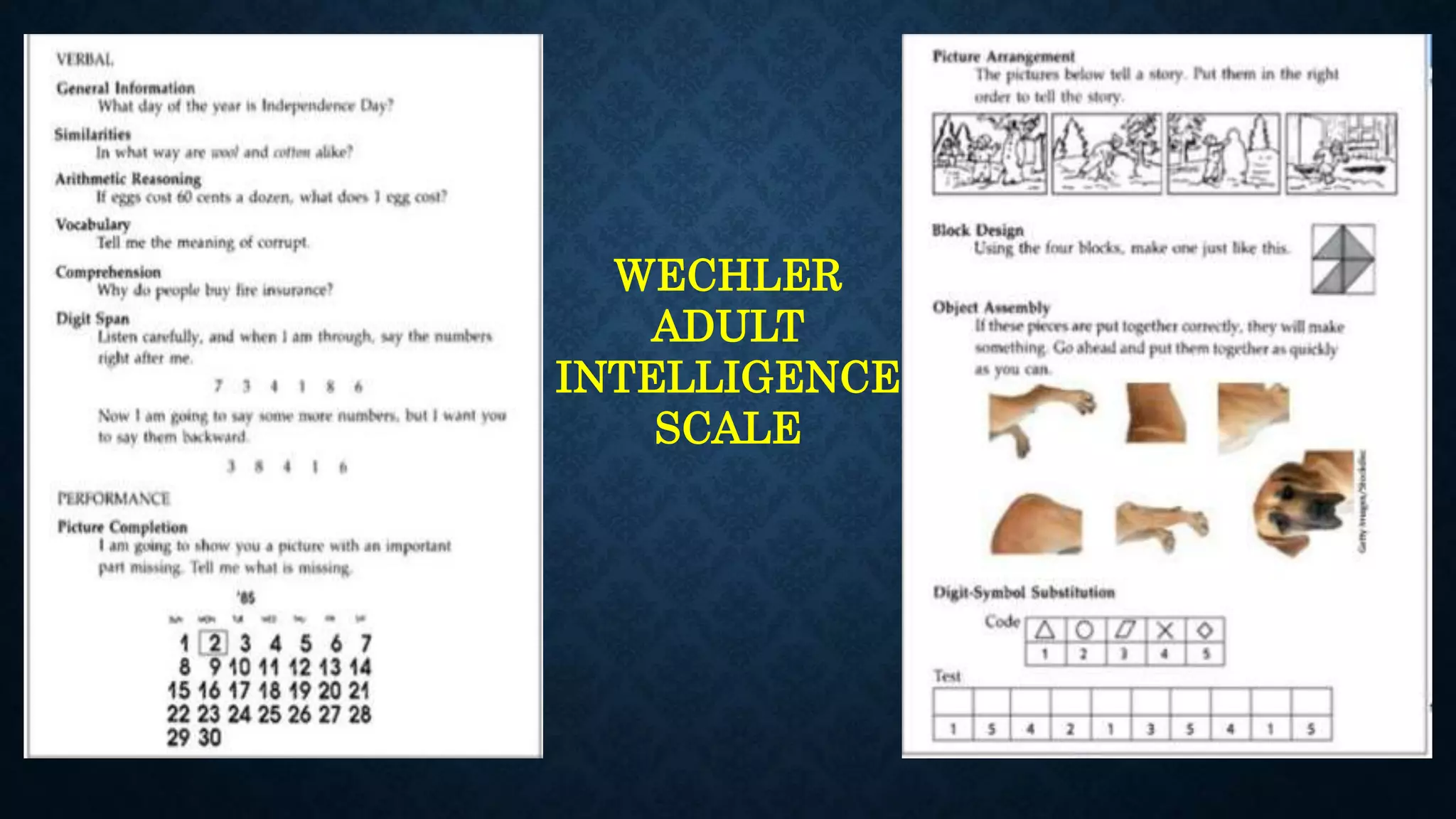
WECHLER
ADULT
INTELLIGENCE
SCALE
RAVEN’S PROGRESSIVE MATRICES
•Standard Progressive Matrices
•Coloured Progressive Matrices
•Advanced Progressive Matrices
•Standard Progressive Matrices Plus
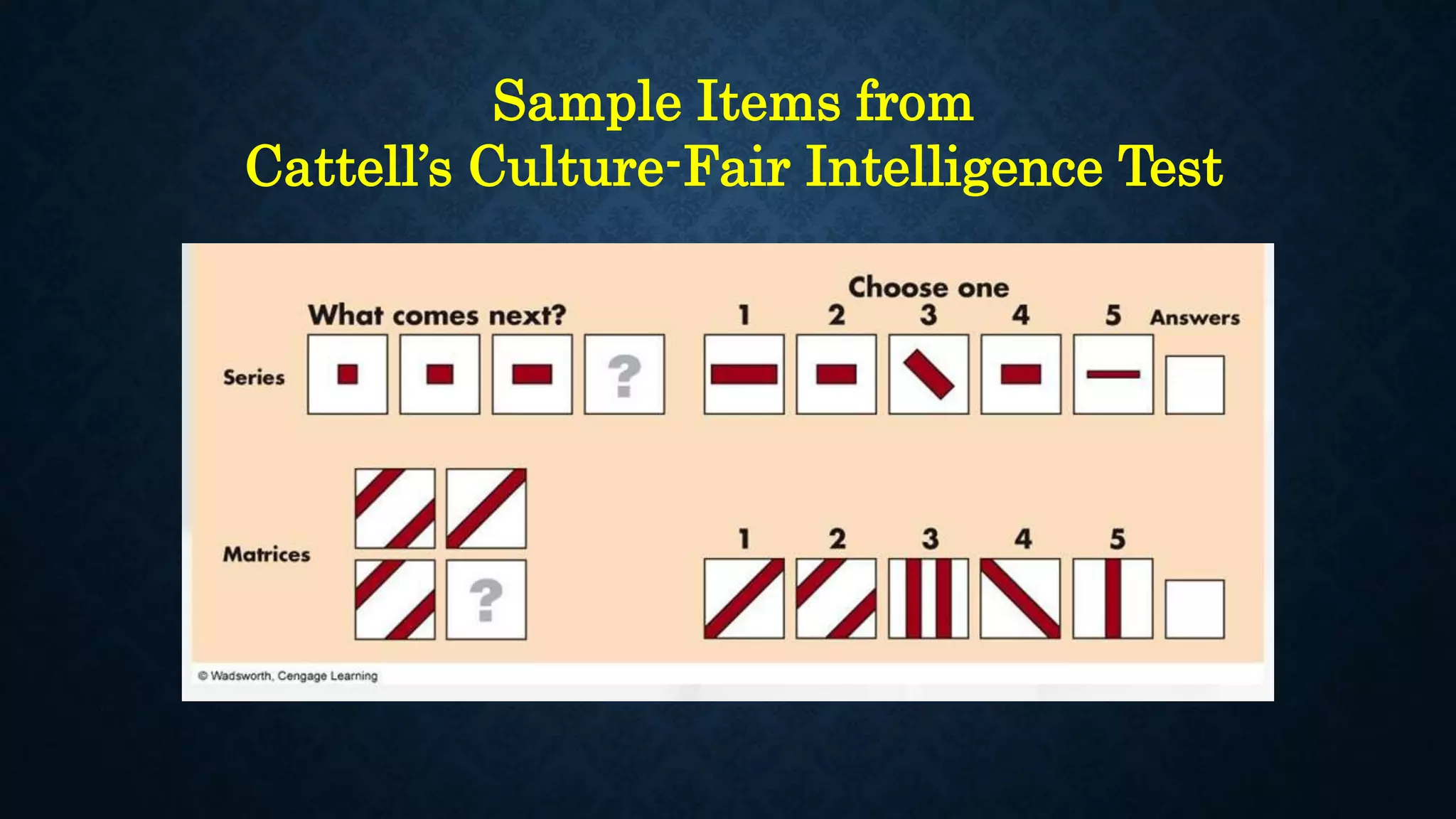
CULTURE-FAIR INTELLIGENCE TESTS
• Cattell’s Culture Fair Intelligence Test (CFIT) –
Without knowledge
• Sternberg Multidimensional Abilities Test (STAT)
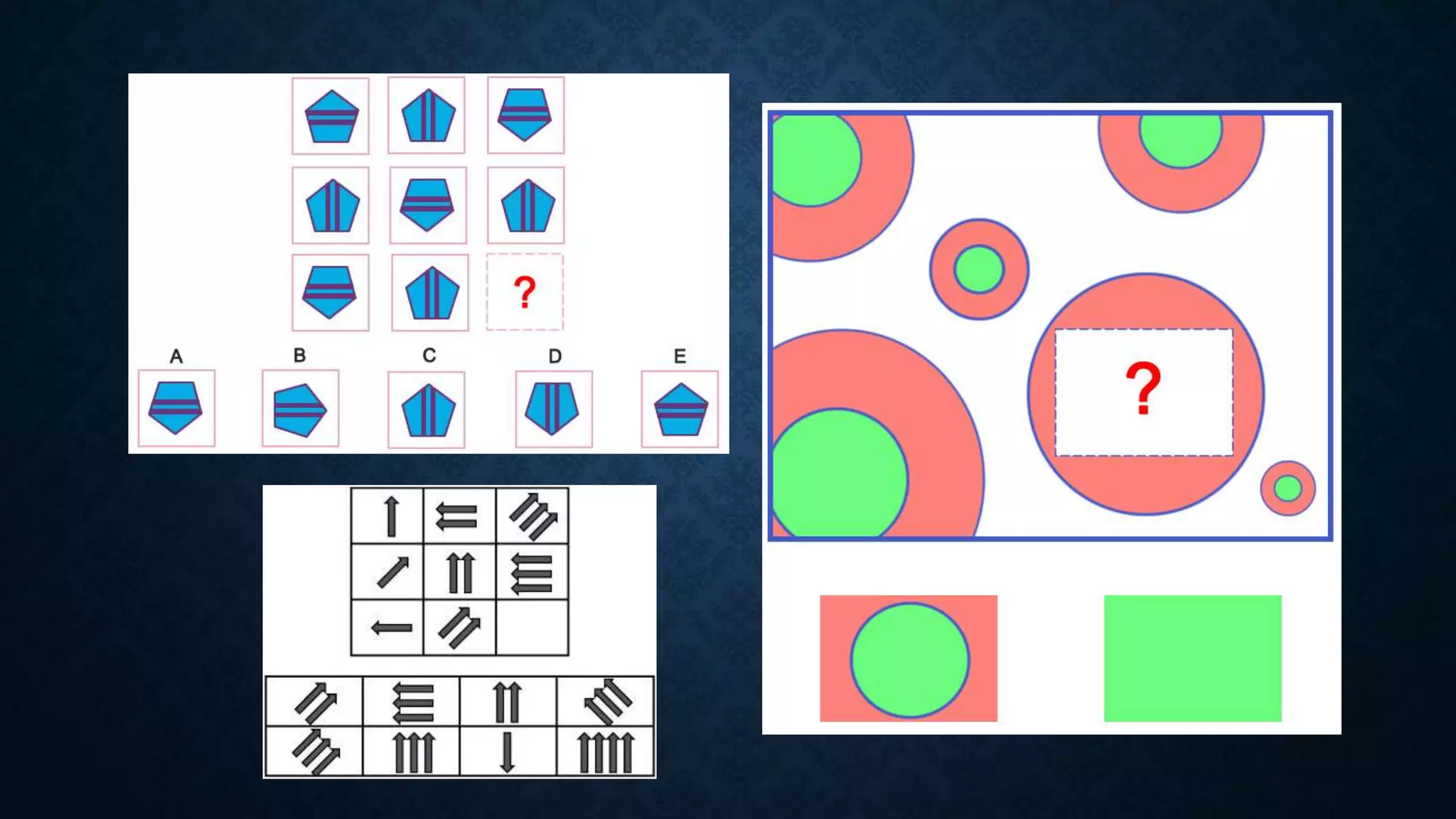
Sample Items from
Cattell’s Culture-Fair Intelligence Test
Extremes of
Intelligence
Mental
Retardation
Intellectual
Giftedness
MENTAL RETARDATION
(DEVELOPMENTAL DISABILITY)
• Mild Mental Retardation - IQ score - 50 to 75
• Moderate Mental Retardation - IQ score - 35 - 55
• Severe Mental Retardation - IQ score - 20 - 40
• Profound Mental Retardation - IQ score - 20 - 25
INTELLECTUAL GIFTEDNESS
Definitions of Giftedness
• Motivation, High self-esteem, self concept, creativity
• Joseph Renzuli – Three ring definition of giftedness
Above average ability
High levels of task commitment
High levels of creativity
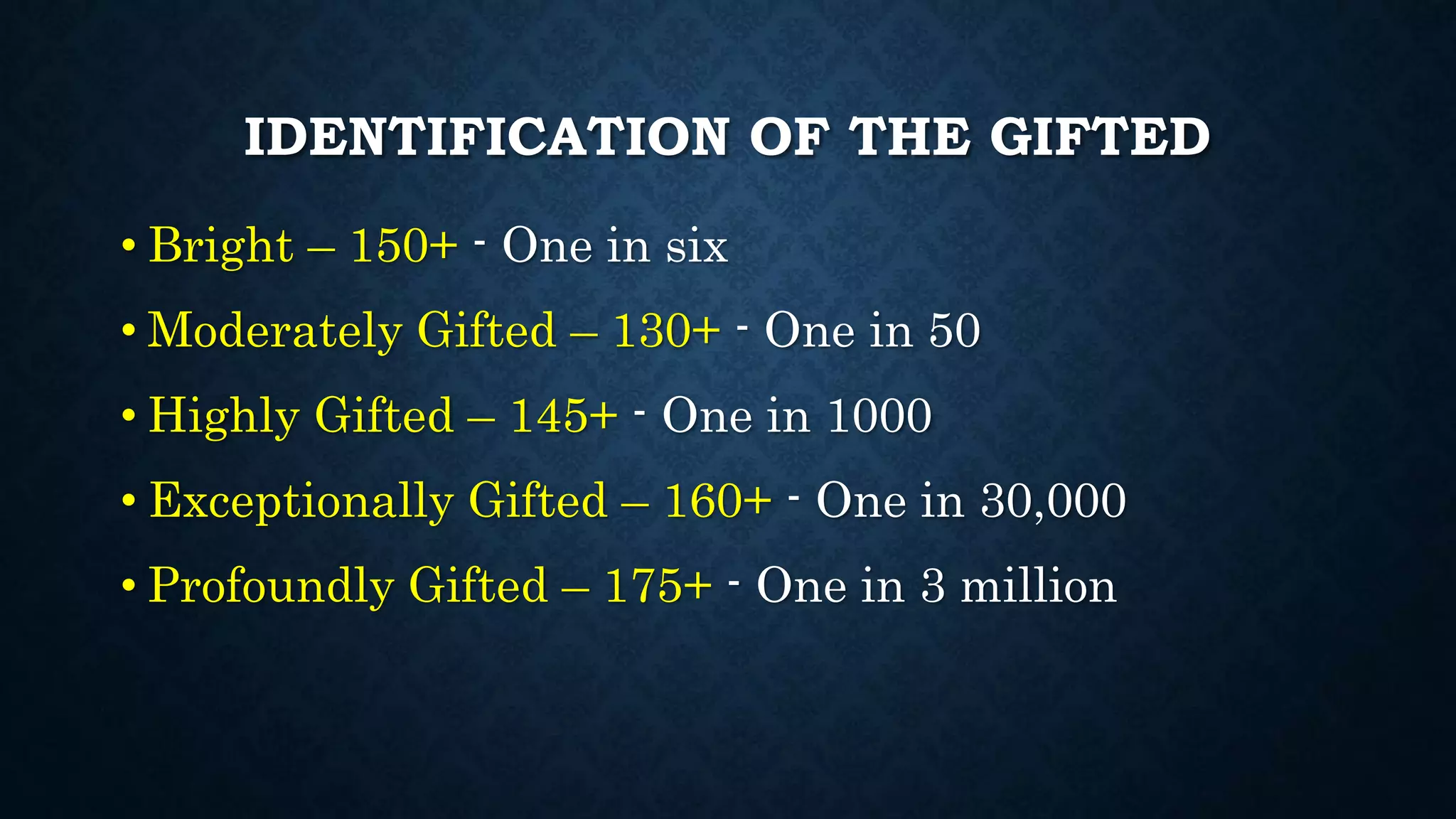
IDENTIFICATION OF THE GIFTED
• Bright – 150+ - One in six
• Moderately Gifted – 130+ - One in 50
• Highly Gifted – 145+ - One in 1000
• Exceptionally Gifted – 160+ - One in 30,000
• Profoundly Gifted – 175+ - One in 3 million
SAVANTISM
• People who perform exceptionally in one field
of learning
• Term Introduced in 1978
TRIARCHIC THEORY OF GIFTEDNESS
• Knowledge acquisition component (Learn more new
information)
• Sternberg
Component Subtheory – Analytical giftedness
Expereential Subtheory – Synthetic giftedness
Contextual Subtheory – Practical giftedness
CHARACTERISTICS OF GIFTEDNESS
• Characteristics of gifted children - high sensitivity, excessive
amounts of energy, boredom and a short attention span
• Characteristics of gifted adolescents – Risk taking, Impatient,
Perfectionist, Competing expectation
• Characteristics of gifted adults - impulsivity, curiosity, high need
for independence, high energy level, introversion, intuitiveness,
emotional sensitivity
GENETIC AND ENVIRONMENTAL
INFLUENCES ON INTELLIGENCE
•Genetic Relationships and Intelligence
•Environmental Influences
• Head Start Programs - Low socio economic
status
• Kibbutzim - Israeli farm
Intelligence

Intelligence

  • 1.
    INTELLIGENCE M. Vijayalakshmi M.Sc., M.Phil.(Life Sciences), M.Ed., M.Phil. (Education), NET (Education), PGDBI Assistant Professor (Former), Sri Ramakrishna Mission Vidyalaya College of Education (Autonomous), Coimbatore – 641020.
  • 2.
    INTELLIGENCE • Mental propertythat includes many related cognitive abilities – capacities to reasoning, planning, problems solving, abstract thinking, comprehending ideas, using language and learning • Think rationally, act purposefully and deal effectively
  • 3.
    MEANING AND DEFINITION •Latin verb – ‘intelligere’ means ‘to understand’ • American Psychological Association (1995) – Intelligence are attempts tomclarify and organize the complex set of phenomena • Albert Binet – Intelligence is a capacity to think well, to judge well and to be self critical • Charles Spearman – Intelligence is a rational thinking
  • 4.
    FACTOR THEORIES • UnitaryTheory • Oligarchic Theory •Multi-Factor Theory
  • 5.
    TWO-FACTOR THEORY • g-factor– General intelligence • s-factor - Specific intelligence • gFluid intelligence (without experience) and • gCrystal intelligence (With experience) Two-Factor Theory g-factor – General intelligence gFluid intelligence gCrystal intelligence s-factor - Specific intelligence
  • 6.
    THEORY OF PRIMARYMENTAL ABILITIES • Word fluency • Verbal comprehension • Spatial visualization • Number facility • Associative Memory • Reasoning • Perceptual Speed Theory of Primary Mental Abilities Word fluency Verbal comprehension Spatial visualization Number facility Associative Memory Reasoning Perceptual Speed
  • 7.
    THE STRUCTURE OFINTELLECT THEORY • Using all sense • Convergent (Think for a final solution) • Divergent (Thinks of all possible ways to reach a solution) • 150 components
  • 8.
  • 9.
  • 10.
    THEORY OF MULTIPLEINTELLIGENCE •Howard Gardner - Seven intelligences •Multiple Intelligence – Talent in all the areas •Gardner first outlined his theory in his 1983 book Frames of Mind
  • 11.
    o Linguistic-Verbal intelligence– Words, language, and writing - Writer/journalist, Lawyer, Teacher o Logical – mathematical intelligence - Analysing problems and mathematical operations – Scientist, Mathematician, Computer programmer, Engineer, Accountant o Musical intelligence - Rhythm and music – Musician, Composer, Singer, Music teacher, Conductor
  • 12.
    o Visual-Spatial intelligence- Visual and spatial judgment - Architect, Artist, Engineer o Bodily kinesthetic intelligence - Physical movement, motor control – Dancer, Builder, Sculptor, Actor o Interpersonal intelligence - Understanding and relating to other people – Psychologist, Philosopher, Counsellor, Salesperson, Politician
  • 13.
    o Intrapersonal intelligence- Introspection and self- reflection – Philosopher, Writer, Theorist, Scientist o Naturalistic Intelligence - Finding patterns and relationships to nature – Biologist, Conservationist, Gardener, Farmer o Ninth - “Existentialist intelligence”
  • 14.
    TRIARCHIC THEORY OFINTELLIGENCE • Sternberg – Theory of Practical Intelligence • Information processing approach – Triarchic Theory of Intelligence
  • 15.
    TRIARCHIC THEORY OFINTELLIGENCE Componential Sub-theory – Analytical intelligence (Meta-components, Performance components and Knowledge acquisition components) Experiential Sub-theory – Creative intelligence (Insight) Contextual Sub-theory – Practical intelligence (Newly learning)
  • 16.
  • 17.
  • 18.
  • 19.
  • 20.
    WECHSLER’S TEST OFINTELLIGENCE • Adult Intelligence Scale (WAIS) - 14 subsets (7 verbal and 7 nonverbal) • Wechsler Intelligence Scale for Children (WISC) – 7 – 16 yrs • Wechsler Preschool and Primary Scale of Intelligence (WPPSI) – 2 ½ - 7 yrs • Wechsler Adult Intelligence Scale, Revised as a Neuropsychological Instrument (WAIS-R NI) – 7 subsets
  • 22.
  • 24.
    RAVEN’S PROGRESSIVE MATRICES •StandardProgressive Matrices •Coloured Progressive Matrices •Advanced Progressive Matrices •Standard Progressive Matrices Plus
  • 27.
    CULTURE-FAIR INTELLIGENCE TESTS •Cattell’s Culture Fair Intelligence Test (CFIT) – Without knowledge • Sternberg Multidimensional Abilities Test (STAT)
  • 28.
    Sample Items from Cattell’sCulture-Fair Intelligence Test
  • 29.
  • 30.
    MENTAL RETARDATION (DEVELOPMENTAL DISABILITY) •Mild Mental Retardation - IQ score - 50 to 75 • Moderate Mental Retardation - IQ score - 35 - 55 • Severe Mental Retardation - IQ score - 20 - 40 • Profound Mental Retardation - IQ score - 20 - 25
  • 31.
    INTELLECTUAL GIFTEDNESS Definitions ofGiftedness • Motivation, High self-esteem, self concept, creativity • Joseph Renzuli – Three ring definition of giftedness Above average ability High levels of task commitment High levels of creativity
  • 32.
    IDENTIFICATION OF THEGIFTED • Bright – 150+ - One in six • Moderately Gifted – 130+ - One in 50 • Highly Gifted – 145+ - One in 1000 • Exceptionally Gifted – 160+ - One in 30,000 • Profoundly Gifted – 175+ - One in 3 million
  • 33.
    SAVANTISM • People whoperform exceptionally in one field of learning • Term Introduced in 1978
  • 34.
    TRIARCHIC THEORY OFGIFTEDNESS • Knowledge acquisition component (Learn more new information) • Sternberg Component Subtheory – Analytical giftedness Expereential Subtheory – Synthetic giftedness Contextual Subtheory – Practical giftedness
  • 35.
    CHARACTERISTICS OF GIFTEDNESS •Characteristics of gifted children - high sensitivity, excessive amounts of energy, boredom and a short attention span • Characteristics of gifted adolescents – Risk taking, Impatient, Perfectionist, Competing expectation • Characteristics of gifted adults - impulsivity, curiosity, high need for independence, high energy level, introversion, intuitiveness, emotional sensitivity
  • 36.
    GENETIC AND ENVIRONMENTAL INFLUENCESON INTELLIGENCE •Genetic Relationships and Intelligence •Environmental Influences • Head Start Programs - Low socio economic status • Kibbutzim - Israeli farm