
John Dewey (1859-1952):
Educational Thoughts and Contribution
Dr.M.Deivam
Assistant Professor
Department of Education
The Gandhigram Rural Institute
(Deemed to be University)
Gandhigram, Dindigul District,
Tamil Nadu – 624 302
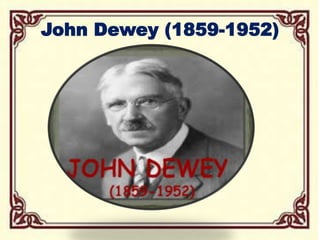
John Dewey (1859-1952)
Life history
• John Dewey was born in Vermont in England in
1859. His father was an ordinary shop-keeper.
• He was brought up in rural environment.
• He disliked traditional methods of schooling. He
had always something new and different to say
at the time of discussions.
• In 1879, he graduated from Vermont University.
He got his Ph.D. degree in philosophy at johns
Hopkins University.
• He joined the University at Michigan as a
lecturer in philosophy.
Cont.,
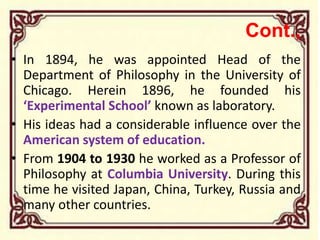
• In 1894, he was appointed Head of the
Department of Philosophy in the University of
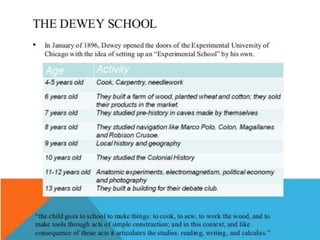
Chicago. Herein 1896, he founded his
‘Experimental School’ known as laboratory.
• His ideas had a considerable influence over the
American system of education.
• From 1904 to 1930 he worked as a Professor of
Philosophy at Columbia University. During this
time he visited Japan, China, Turkey, Russia and
many other countries.
Cont.,
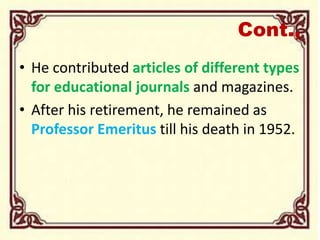
• He contributed articles of different types
for educational journals and magazines.
• After his retirement, he remained as
Professor Emeritus till his death in 1952.
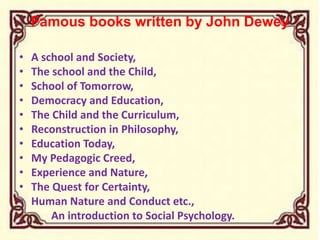
Famous books written by John Dewey
• A school and Society,
• The school and the Child,
• School of Tomorrow,
• Democracy and Education,
• The Child and the Curriculum,
• Reconstruction in Philosophy,
• Education Today,
• My Pedagogic Creed,
• Experience and Nature,
• The Quest for Certainty,
• Human Nature and Conduct etc.,
An introduction to Social Psychology.
Aims of Education
• To develop an ability to understand and analyse
the problems;
• To develop skills for intelligent application of
knowledge and insight into solving problems
• To arouse interest through planned experiences;
• To help in the adjustment to changing needs and
ideals of society
• School should give moral education through
social related activities.
• School should be the reflection of society. It
should change according to the situation.
John Dewey general philosophy
• Everything is tentative or provisional; Nothing is
ultimate (Onthology)
• Truths also change. What is truth today may not be true
tomorrow (Epistomology)
• There is no eternal or absolute values. All values change
with time and space. (Axiology)
• Man’s life is a series of experiments and purposeful
actions.
• Knowledge is always a means, never an end in itself. It is
purely instrumental.
• Knowledge and thinking are related with action;
• Dewey holds that barriers of creed, religion, language,
race, colour and nationality have divided humanity and
separated man from man.
Pragmatism
• Founded by Charles S. Peirce(1839-1914), William
James(1842-1910) and John Dewey(1859-1952)
• The term ‘pragmatic’ coined and used by Peirce but
linked pragmatism with education by Dewey.
Fundamental principles of pragmatism
• No ultimate value, formation of value during the
course of activity
• Emphasis on experiment in life for practical
implication
• Emphasis on the principle of practical utility
• Reality always in the making process
Functions of Education
• Education is a process of growth
• Education is life and life is education
• Education leads towards social efficiency
• Experience is the basis of his philosophy
Teaching methods
• Knowledge and thinking joined with action. Mind is
thinking when problem based.
• Learning by doing
• Hands on problem solving
• Experimenting
• Projects
• Direct Experience and Activity Method ( the
functions of school is to provide an environment and
improvise activities for learning through the use of
their senses)
• Children’s interest (Dewey also emphasised self-
education, self-learning, paly-way technique and
motivation)
Curriculum
• No fixed curriculum
• He believed that curriculum should reflect the
social life of the child and his activities in
societies.
• Curriculum should bring the disciplines together
to focus on solving problems in an
interdisciplinary.
• He emphasised life related subjects like
handcraft, science, Economics etc.,
• The curriculum should be constructed keeping in
view the innate tendencies, interest, and
capabilities of the child.
Discipline
• Social discipline: Man to think and behave
according to social norms.
• Democratic environment is its freedom
• Self-discipline is the true discipline
• Discipline is to be enforced through social
acceptance or rejection. (Eg. An indiscipline
child will not be allowed by his peers to
participate in games or projects)
Role of Teacher
• Teacher to be the servant of the society whose
duty is to lay foundation of a good social life.
• He is the provider of settings, conducive to
learning
• Guide
• Stimulus
• Facilitator
Contributions to Educational Practices
• Given a progressive outlook to education
• Living and doing itself is education
• Preparation for life through life experiences
• Social efficiency
• Child centered education
• Core curriculum, integrated curriculum and
activity curriculum
• Democracy in education
• Experimental school
Limitation
• The project method advocated by Dewey is highly
expensive and time consuming.
• As the teacher’s function is all expansive, it is very
difficult to get such type of talented teachers
• Knowledge attained by students in the project
method is very slow
• Dewey’s pragmatic approach is severely criticised as it
gave all importance to human purposes in life and
neglected completely the eternal values.
“Education is not preparation for life;
education is life itself. Education, therefore, is
a process of living and not a preparation for
future living.”
- John Dewey
John dewey (1859 1952) Educational Thoughts and Contribution

John dewey (1859 1952) Educational Thoughts and Contribution

  • 1.
    John Dewey (1859-1952): EducationalThoughts and Contribution Dr.M.Deivam Assistant Professor Department of Education The Gandhigram Rural Institute (Deemed to be University) Gandhigram, Dindigul District, Tamil Nadu – 624 302
  • 2.
  • 3.
    Life history • JohnDewey was born in Vermont in England in 1859. His father was an ordinary shop-keeper. • He was brought up in rural environment. • He disliked traditional methods of schooling. He had always something new and different to say at the time of discussions. • In 1879, he graduated from Vermont University. He got his Ph.D. degree in philosophy at johns Hopkins University. • He joined the University at Michigan as a lecturer in philosophy.
  • 4.
    Cont., • In 1894,he was appointed Head of the Department of Philosophy in the University of Chicago. Herein 1896, he founded his ‘Experimental School’ known as laboratory. • His ideas had a considerable influence over the American system of education. • From 1904 to 1930 he worked as a Professor of Philosophy at Columbia University. During this time he visited Japan, China, Turkey, Russia and many other countries.
  • 5.
    Cont., • He contributedarticles of different types for educational journals and magazines. • After his retirement, he remained as Professor Emeritus till his death in 1952.
  • 6.
    Famous books writtenby John Dewey • A school and Society, • The school and the Child, • School of Tomorrow, • Democracy and Education, • The Child and the Curriculum, • Reconstruction in Philosophy, • Education Today, • My Pedagogic Creed, • Experience and Nature, • The Quest for Certainty, • Human Nature and Conduct etc., An introduction to Social Psychology.
  • 8.
    Aims of Education •To develop an ability to understand and analyse the problems; • To develop skills for intelligent application of knowledge and insight into solving problems • To arouse interest through planned experiences; • To help in the adjustment to changing needs and ideals of society • School should give moral education through social related activities. • School should be the reflection of society. It should change according to the situation.
  • 9.
    John Dewey generalphilosophy • Everything is tentative or provisional; Nothing is ultimate (Onthology) • Truths also change. What is truth today may not be true tomorrow (Epistomology) • There is no eternal or absolute values. All values change with time and space. (Axiology) • Man’s life is a series of experiments and purposeful actions. • Knowledge is always a means, never an end in itself. It is purely instrumental. • Knowledge and thinking are related with action; • Dewey holds that barriers of creed, religion, language, race, colour and nationality have divided humanity and separated man from man.
  • 10.
    Pragmatism • Founded byCharles S. Peirce(1839-1914), William James(1842-1910) and John Dewey(1859-1952) • The term ‘pragmatic’ coined and used by Peirce but linked pragmatism with education by Dewey. Fundamental principles of pragmatism • No ultimate value, formation of value during the course of activity • Emphasis on experiment in life for practical implication • Emphasis on the principle of practical utility • Reality always in the making process
  • 11.
    Functions of Education •Education is a process of growth • Education is life and life is education • Education leads towards social efficiency • Experience is the basis of his philosophy
  • 12.
    Teaching methods • Knowledgeand thinking joined with action. Mind is thinking when problem based. • Learning by doing • Hands on problem solving • Experimenting • Projects • Direct Experience and Activity Method ( the functions of school is to provide an environment and improvise activities for learning through the use of their senses) • Children’s interest (Dewey also emphasised self- education, self-learning, paly-way technique and motivation)
  • 13.
    Curriculum • No fixedcurriculum • He believed that curriculum should reflect the social life of the child and his activities in societies. • Curriculum should bring the disciplines together to focus on solving problems in an interdisciplinary. • He emphasised life related subjects like handcraft, science, Economics etc., • The curriculum should be constructed keeping in view the innate tendencies, interest, and capabilities of the child.
  • 14.
    Discipline • Social discipline:Man to think and behave according to social norms. • Democratic environment is its freedom • Self-discipline is the true discipline • Discipline is to be enforced through social acceptance or rejection. (Eg. An indiscipline child will not be allowed by his peers to participate in games or projects)
  • 15.
    Role of Teacher •Teacher to be the servant of the society whose duty is to lay foundation of a good social life. • He is the provider of settings, conducive to learning • Guide • Stimulus • Facilitator
  • 16.
    Contributions to EducationalPractices • Given a progressive outlook to education • Living and doing itself is education • Preparation for life through life experiences • Social efficiency • Child centered education • Core curriculum, integrated curriculum and activity curriculum • Democracy in education • Experimental school
  • 17.
    Limitation • The projectmethod advocated by Dewey is highly expensive and time consuming. • As the teacher’s function is all expansive, it is very difficult to get such type of talented teachers • Knowledge attained by students in the project method is very slow • Dewey’s pragmatic approach is severely criticised as it gave all importance to human purposes in life and neglected completely the eternal values.
  • 18.
    “Education is notpreparation for life; education is life itself. Education, therefore, is a process of living and not a preparation for future living.” - John Dewey