M. Vijayalakshmi
M.Sc., M.Phil. (Life Sciences), M.Ed., M.Phil. (Education), NET (Education), PGDBI
Assistant Professor (Former),
Sri Ramakrishna Mission Vidyalaya College of Education (Autonomous),
Coimbatore – 641020.
Definition of Hypothesis
•A Hypothesis is a shrewd guess to inference that is
formulated and provisionally adopted to explain
observed facts or conditions and to guide in further
investigations.
CarterV. Good
Characteristics of a Good Hypothesis
• Reasonable
• Agreement with observed facts
• Verifiable
• Unambiguous
• Comprehensive
• Related to the theory
• Simple and to the point
• Related to the available
technique
• Empirically testable
• Specific
• Conceptually clear
Importance of Hypothesis
• Provides direction
• Sensitises the researcher
• Focuses research
• Helps to design our tools
• Places a specific goals before us
• Serves as a framework
• Provides the platform of known facts
• Serves the function of linking together related facts and information
Source of Hypothesis
•General culture
•Scientific theory
•Personal experience
•Analogies
•Using the review of related literature as the background
to formulate hypothesis
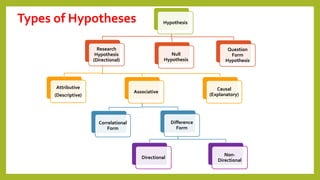
Types of Hypotheses Hypothesis
Research
Hypothesis
(Directional)
Attributive
(Descriptive)
Associative
Correlational
Form
Difference
Form
Directional
Non-
Directional
Causal
(Explanatory)
Null
Hypothesis
Question
Form
Hypothesis
Research Hypothesis
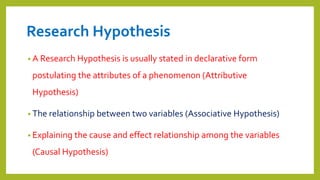
• A Research Hypothesis is usually stated in declarative form
postulating the attributes of a phenomenon (Attributive
Hypothesis)
• The relationship between two variables (Associative Hypothesis)
• Explaining the cause and effect relationship among the variables
(Causal Hypothesis)
Attribute Hypothesis or Descriptive Hypothesis
• State the existence size, form or distribution of some variables.
• Examples
• There is no living organism in the moon
• There is drop out of students in high schools
Associative Hypothesis
• Hypotheses, that talk about relationship between variables are
known as associative hypotheses.
• The relationship may be expressed in two forms:
• 1. Association or Correlation
• Ex: I.Q. and achievement are positively related
• 2. Difference Form
• Ex: Girls achieve better than boys in verbal ability tests
Causal Hypothesis (or Explanatory Hypothesis)
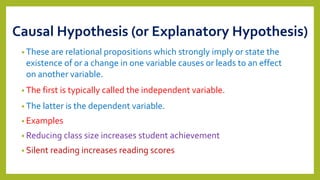
• These are relational propositions which strongly imply or state the
existence of or a change in one variable causes or leads to an effect
on another variable.
• The first is typically called the independent variable.
• The latter is the dependent variable.
• Examples
• Reducing class size increases student achievement
• Silent reading increases reading scores
Null Hypothesis
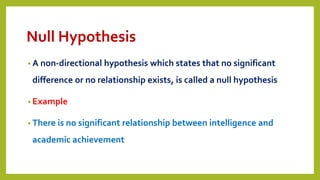
• A non-directional hypothesis which states that no significant
difference or no relationship exists, is called a null hypothesis
• Example
• There is no significant relationship between intelligence and
academic achievement
Question Form Hypothesis
• Whenever we are not sure of the relationship existing between
the variables, we usually resort to frame our hypothesis in the
null form. It is more popular hypothesis.
• Otherwise pose the hypothesis in the form of a question.
• Example
• Does intelligence affect academic achievement?
Difficulties in the formulation of hypotheses
• Lack of knowledge and clarity of the theoretical frame work of the
area in which the investigator chooses the work
• Lack of ability to make use of the theoretical frame work logically
• Lack of acquaintance with available research technique resulting
in failure to be able to phrase the hypothesis properly
• Vagueness of the statement
THANKYOU

Hypothesis

  • 1.
    M. Vijayalakshmi M.Sc., M.Phil.(Life Sciences), M.Ed., M.Phil. (Education), NET (Education), PGDBI Assistant Professor (Former), Sri Ramakrishna Mission Vidyalaya College of Education (Autonomous), Coimbatore – 641020.
  • 2.
    Definition of Hypothesis •AHypothesis is a shrewd guess to inference that is formulated and provisionally adopted to explain observed facts or conditions and to guide in further investigations. CarterV. Good
  • 3.
    Characteristics of aGood Hypothesis • Reasonable • Agreement with observed facts • Verifiable • Unambiguous • Comprehensive • Related to the theory • Simple and to the point • Related to the available technique • Empirically testable • Specific • Conceptually clear
  • 4.
    Importance of Hypothesis •Provides direction • Sensitises the researcher • Focuses research • Helps to design our tools • Places a specific goals before us • Serves as a framework • Provides the platform of known facts • Serves the function of linking together related facts and information
  • 5.
    Source of Hypothesis •Generalculture •Scientific theory •Personal experience •Analogies •Using the review of related literature as the background to formulate hypothesis
  • 6.
    Types of HypothesesHypothesis Research Hypothesis (Directional) Attributive (Descriptive) Associative Correlational Form Difference Form Directional Non- Directional Causal (Explanatory) Null Hypothesis Question Form Hypothesis
  • 7.
    Research Hypothesis • AResearch Hypothesis is usually stated in declarative form postulating the attributes of a phenomenon (Attributive Hypothesis) • The relationship between two variables (Associative Hypothesis) • Explaining the cause and effect relationship among the variables (Causal Hypothesis)
  • 8.
    Attribute Hypothesis orDescriptive Hypothesis • State the existence size, form or distribution of some variables. • Examples • There is no living organism in the moon • There is drop out of students in high schools
  • 9.
    Associative Hypothesis • Hypotheses,that talk about relationship between variables are known as associative hypotheses. • The relationship may be expressed in two forms: • 1. Association or Correlation • Ex: I.Q. and achievement are positively related • 2. Difference Form • Ex: Girls achieve better than boys in verbal ability tests
  • 10.
    Causal Hypothesis (orExplanatory Hypothesis) • These are relational propositions which strongly imply or state the existence of or a change in one variable causes or leads to an effect on another variable. • The first is typically called the independent variable. • The latter is the dependent variable. • Examples • Reducing class size increases student achievement • Silent reading increases reading scores
  • 11.
    Null Hypothesis • Anon-directional hypothesis which states that no significant difference or no relationship exists, is called a null hypothesis • Example • There is no significant relationship between intelligence and academic achievement
  • 12.
    Question Form Hypothesis •Whenever we are not sure of the relationship existing between the variables, we usually resort to frame our hypothesis in the null form. It is more popular hypothesis. • Otherwise pose the hypothesis in the form of a question. • Example • Does intelligence affect academic achievement?
  • 13.
    Difficulties in theformulation of hypotheses • Lack of knowledge and clarity of the theoretical frame work of the area in which the investigator chooses the work • Lack of ability to make use of the theoretical frame work logically • Lack of acquaintance with available research technique resulting in failure to be able to phrase the hypothesis properly • Vagueness of the statement
  • 14.