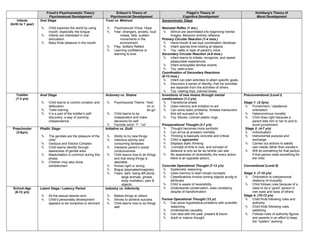
Freud’s Psychoanalytic Theory                   Erikson’s Theory of                            Piaget’s Theory of                                Kohlberg’s Theory of
                          Psychosexual Development                  Psychosocial Development                        Cognitive Development                                 Moral Development
     Infants        Oral Stage                                   Trust vs. Mistrust                     Sensorimotor Stage
(birth to 1 year)
                        Child explores the world by using            Psychosocial Virtue: Hope        Neonatal Reflex (1 mo.)
                         mouth, especially the tongue                 Fear: strangers, anxiety, loud     Stimuli are assimilated into beginning mental
                        Infants are interested in oral                    noises, falls, sudden              images. Behavior entirely reflexive
                         stimulation                                       movements in the             Primary Circular Reaction (1-4 mos.)
                        Baby finds pleasure in the mouth                  environment                    Hand-mouth & ear-eye coordination develops.
                                                                      Play: Solitary Reflect             Infant spends time looking at objects
                                                                      Learning confidence or             Toy: rattle or tape of parent’s voice
                                                                       learning to love                 Secondary Circular Reaction (4-8 mos.)
                                                                                                          Infant learns to initiate, recognize, and repeat
                                                                                                              pleasurable experiences
                                                                                                          Infant anticipates familiar events
                                                                                                          Toy: peel-a-boo
                                                                                                        Coordination of Secondary Reactions
                                                                                                        (8-12 mos.)
                                                                                                          Infant can plan activities to attain specific goals.
                                                                                                          Discovers a sense of identity, that his activities
                                                                                                              are separate from the activities of others.
                                                                                                          Toy: nesting toys; colored boxes
    Toddler         Anal Stage                                   Autonmy vs. Shame                      Inventions of new means through mental                    Preconventional (Level I)
    (1-3 y/o)                                                                                           combinations (1-2 y/o)
                        Child learns to control urination and         Psychosocial Theme: “hold         Transitional phase                                     Stage 1: (2-3y/o)
                         defecation                                                          on or        Uses memory and imitation to act                         Punishment / obedience
                        Toilet training                                                     let go”      Can solve basic problems, foresee maneuvers                 orientation
                        It is a part of the toddler’s self-       Child learns to be                        that will succeed or fail                             Heteronomous morality
                         discovery, a way of exerting                   independent and make              Toy: Blocks, colored plastic rings                       Child does right because a
                         independence                                   decisions for self                                                                             parent tells him or her to and to
                                                                   Favorite word: “I”, “no”            Preoperational Thought (2-7 y/o)                               avoid punishment
 Preschooler        Phallic Stage                                Initiative vs. Guilt                     Thought becomes more symbolic                           Stage 2: (4-7 y/o)
   (3-6y/o)                                                                                               Can arrive at answers mentally                           Individualism
                        The genitals are the pleasure of the        Ability to try new things           Thinking is basically concrete and critical              Instrumental purpose and
                         child                                       Intensive activity and              Child is egocentric                                         exchange
                        Oedipus and Electra Complex                  consuming fantasies                 Displays static thinking                                 Carries out actions to satisfy
                        Child learns identity through             Interjects parent’s social            .Concept of time is now, and concept of                     own needs rather than society’s
                         awareness of genital area                    consciousness                          distance is only as far as he/she can see              Will do something for that person
                        Masturbation is common during this        Child learns how to do things         No awareness of reversibility (for every action             if that person does something for
                         phase                                        and that doing things is               there is an opposite action)                              the child
                        Children may also show                       desirable
                         exhibitionism                             Knows right or wrong                Concrete Operational Thought (7-12 y/o)                   Conventional (Level II)
                                                                   Bogus playmates/imaginary             Systematic reasoning
                                                                   Fears: dark, being left alone,        Uses memory to learn broad concepts                    Stage 3: (7-10 y/o)
                                                                            large animals, ghosts,        Classifications involve sorting objects accdg to         Orientation to interpersonal
                                                                            body mutilation, pain &         attributes                                                 relations of mutuality
                                                                            objects                       Child is aware of reversibility                          Child follows rules because of a
  School-Age        Latent Stage / Latency Period                Industry vs. Inferiority                 Understands conservation, sees constancy                    need to be a “good” person in
   (6-12 y/o)                                                                                               despite of transformation                                  own eyes and eyes of others
                        All the sexual desires arch                  Makes things w/ others                                                                     Stage 4: (10-12 y/o)
                        Child’s personality development              Strives to achieve success       Formal Operational Thought (12 yr)                          Child finds following rules and
                         appears to be nonactive or dormant           Child learns how to do things      Can solve hypothetical problems with scientific             authority
                                                                       well                                 reasoning                                               Child finds following rules
                                                                                                          Understands causality                                       satisfying
                                                                                                          Can deal with the past, present & future                 Follows rules of authority figures
                                                                                                          Adult or mature thought                                     and parents in an effort to keep
                                                                                                                                                                       the “system” working
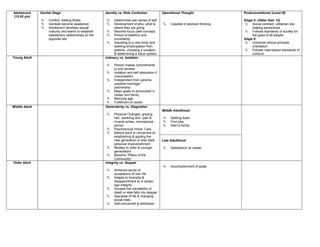
Adolescent     Genital Stage                            Identity vs. Role Confusion             Operational Thought                 Postconventional (Level III)
(13-20 y/o)
                   Conflict: Setting Rules                  Determines own sense of self                                          Stage 5: (Older than 12)
                   Genitals become awakened                 Development of who, what &            Capable of abstract thinking     Social contract, utilitarian law-
                   Adolescent develops sexual                where they are going                                                       making persectives
                    maturity and learns to establish      Become focus (self-concept)                                                Follows standards of society for
                    satisfactory relationships w/ the     Period of rebellion and                                                       the good of all people
                    opposite sex                              uncertainty                                                           Stage 6:
                                                          Adjusting to a new body and                                                Universal ethical principle
                                                              seeking emancipation from                                                  orientation
                                                              parents, choosing a vocation                                            Follows internalized standards of
                                                              & determining a value system                                               conduct.
Young Adult                                             Intimacy vs. Isolation

                                                           Person makes commitments
                                                            to one another
                                                          Isolation and self absorption if
                                                            unsuccessful
                                                          Independent from parents,
                                                            possible marriage /
                                                            partnership
                                                          Major goals to accomplish in
                                                            career and family
                                                          Marrying age
                                                          Fulfillment of career
Middle Adult                                            Generativity vs. Stagnation
                                                                                                Middle Adulthood:
                                                             Physical Changes: graying
                                                              hair, wrinkling skin, pain &          Settling down
                                                              muscle aches, menopausal              Find jobs
                                                              period                                Start a family
                                                          Psychosocial Virtue: Care
                                                          Mature adult is concerned w/
                                                              establishing & guiding the
                                                              new generation or else feels      Late Adulthood
                                                              personal impoverishment
                                                          Relates to older & younger               Satisfaction w/ career
                                                              generations
                                                          Become “Pillars of the
                                                              Community”
Older Adult                                             Integrity vs. Despair
                                                                                                    Accomplishment of goals
                                                            Achieves sense of
                                                             acceptance of own life
                                                            Adapts to triumphs &
                                                             disappointment w/ a certain
                                                             ego integrity
                                                            Accepts the inevitability of
                                                             death or else falls into despair
                                                            Appraisal of life & changing
                                                             social roles
                                                            Self-concerned & withdrawn
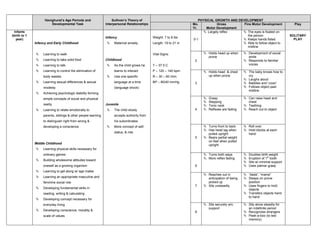
Havighurst’s Age Periods and                   Sullivan’s Theory of                                PHYSICAL GROWTH AND DEVELOPMENT
                        Developmental Task                     Interpersonal Relationships                         Mo.            Gross       Fine Motor Development               Play
                                                                                                                   Yr.     Motor Development
  Infants                                                                                                                  Largely reflex    The eyes is fixated on
(birth to 1                                                                                                                                     the person                       SOLITARY
                                                               Infancy                       Weight: 7 to 8 lbs
   year)                                                                                                           0-1                        Keeps hands fisted                  PLAY
              Infancy and Early Childhood                          Maternal anxiety         Length: 19 to 21 in                              Able to follow object to
                                                                                                                                                midline

                  Learning to walk                                                          Vital Signs:                 Holds head up when       Development of social
                                                                                                                           prone                     smile
                  Learning to take solid food                 Childhood                                            2                               Responds to familiar
                  Learning to talk                                As the child grows he    T – 37.5 C                                              voices

                  Learning to control the elimination of           learns to interact       P – 120 – 140 bpm            Holds head & chest       The baby knows how to
                   body wastes                                     Use one specific         R – 30 – 60 /min              up when prone             cry
                                                                                                                                                    Laughs aloud
                  Learning sexual differences & sexual             language at a time       BP – 80/40 mmHg        3                               Babbles and “coos”
                   modesty                                          (language shock)                                                                Follows object past
                                                                                                                                                     midline
                  Achieving psychologic stability forming
                   simple concepts of social and physical                                                                   Grasp                  Can raise head and
                                                                                                                            Stepping                chest
                   reality                                     Juvenile                                                     Tonic neck             Teething
                  Learning to relate emotionally to               The child slowly                                4       Reflexes are fading    Reach out to object
                   parents, siblings & other people learning        accepts authority from
                   to distinguish right from wrong &                his subordinates
                   developing a conscience                         More concept of self,                                 Turns front to back      Roll over
                                                                                                                          Has head lag when        Hold blocks at each
                                                                    status, & role                                         pulled upright            hand
                                                                                                                    5     Bears partial weight
                                                                                                                           on feet when pulled
              Middle Childhood                                                                                             upright
                  Learning physical skills necessary for
                   ordinary games                                                                                         Turns both ways            Doubles birth weight
                                                                                                                          Moro reflex fading         Eruption of 1st tooth
                  Building wholesome attitudes toward
                                                                                                                                                      Sits w/ minimal support
                   oneself as a growing organism                                                                    6                                 Uses palmar grasp
                  Learning to get along w/ age mates
                                                                                                                          Reaches out in           “dada”, “mama”
                  Learning an appropriate masculine and                                                                   anticipation of being    Sleeps on prone
                   feminine social role                                                                                    picked up                 position
                                                                                                                    7     Sits unsteadily          Uses fingers to hold
                  Developing fundamental skills in                                                                                                  objects
                   reading, writing & calculating                                                                                                   Transfers objects hand
                                                                                                                                                     to hand
                  Developing concept necessary for
                   everyday living                                                                                        Sits securely w/o        Sits alone steadily for
                                                                                                                           support                   an indefinite period
                  Developing conscience, morality &
                                                                                                                    8                               Recognizes strangers
                   scale of values                                                                                                                  Peek-a-boo (to test
                                                                                                                                                     memory)
   Achieving personal independence                                        Creeps or crawls          Can hold own bottle
                                                                                                                    Starts to crawl
                 Developing attitudes toward social
                                                                                  9                                 Understands simple
                  groups & institutions                                                                              gestures

                                                                                         Pulls self to standing    From crawling to
                                                                                                                     standing
                                                                                  10                                Responds when called
                                                                                                                     by his/her name

                                                                                         From crawling to          Walks with assistance
                                                                                  11      standing

                                                                                         Stands alone              Triples birth weight
                                                                                  12     Some infants take 1st     Can say 2 syllable
                                                                                          step                       words
                                                                                                                    Can walk w/ help

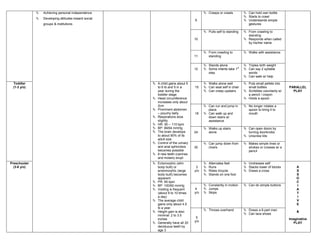
 Toddler                                                A child gains about 5           Walks alone well          Puts small pellets into
 (1-3 y/o)                                               to 6 lb and 5 in a       15     Can seat self in chair     small bottles              PARALLEL
                                                         year during the                 Can creep upstairs        Scribbles voluntarily w/     PLAY
                                                         toddler stage                                               a pencil / crayon
                                                        Head circumference                                         Holds a spoon
                                                         increases only about
                                                         2cm                             Can run and jump in       No longer rotates a
                                                        Prominent abdomen                place                      spoon to bring it to
                                                         – pouchy belly           18     Can walk up and            mouth
                                                        Respirations slow                down stairs w/
                                                         slightly                         assistance
                                                        HR: 90 – 110 bpm
                                                        BP: 99/64 mmHg                  Walks up stairs           Can open doors by
                                                        The brain develops       24      alone                      turning doorknobs
                                                         to about 90% of its                                        Unscrew lids
                                                         adult size
                                                        Control of the urinary          Can jump down from        Makes simple lines or
                                                         and anal sphincters      30      chairs                     strokes or crosses w/ a
                                                         becomes possible                                            pencil
                                                        8 new teeth (canines
                                                         and molars) erupt
Preschooler                                             Ectomorphic (slim                 Alternates feet         Undresses self
  (3-6 y/o)                                              body built) or            3       Runs                    Stacks tower of blocks         A
                                                         endomorphic (large       y/o      Rides tricycle          Draws a cross                  S
                                                         body built) becomes               Stands on one foot                                      S
                                                         apparent                                                                                   O
                                                        PR: 85 bpm                                                                                 C
                                                        BP: 100/60 mmHg                 Constantly in motion      Can do simple buttons          I
                                                        Voiding is frequent      4      Jumps                                                     A
                                                         (about 9 to 10 times     y/o    Skips                                                     T
                                                         a day)                                                                                     I
                                                        The average child                                                                          V
                                                         gains only about 4.5                                                                       E
                                                         lb a year.
                                                        Height gain is also             Throws overhand           Draws a 6-part man             &
                                                         minimal: 2 to 3.5                                          Can lace shoes
                                                         inches                    5                                                            Imaginative
                                                        Generally have all 20    y/o                                                             PLAY
                                                         deciduous teeth by
                                                         age 3
School-Age                                                  Average weight gain      6     A year of constant motion
 (6-12 y/o)                                                  is 3 to lb              y/o    Skipping is a new skill
                                                            Increase in height is          First molars erupt
                                                             1 to 2 inches
                                                            By age 10 brain          7     Central incisors erupt                                A
                                                             growth is complete      y/o    Difference b/w sexes become apparent in play          S
                                                            Posture becomes                Spends time in quiet play                             S
                                                             more erect                                                                            O
                                                            PR: 70 – 80 bpm          8     Coordination definitely improved                      C
                                                            BP: 112/60 mmHg         y/o    Playing with gang becomes important                   I
                                                            Development of                 Eyes become fully developed                           A
                                                             Secondary Sex                                                                         T
                                                                                      9
                                                             Characteristics                                                                       I
                                                                                     y/o    All activities done w/ gang
                                                            Sexual Maturation:                                                                    V
                                                                                     10
                                                             Girls (12 – 18 y/o);                                                                  E
                                                                                     y/o    Coordination improves
                                                             boys (14 - 20 y/o)
                                                            Deciduous teeth are     11                                                           PLAY
                                                             lost and permanent      y/o    Active, but awkward and ungainly
                                                             teeth erupt             12
                                                                                     y/o    Coordination improves

Adolescent       Developing intellectual skills and        Onset of puberty                              SEXUAL MATURATION
(13-20 y/o)                                                 Cessation of body        Yr            BOYS                      GIRLS
                  concepts necessary for civic
                                                             growth                           Growth spurt         Pubic hair thick & curly,
                  competence                                Most girls are 1 to 2             continuing            triangular in distribution
                 Desiring and achieving socially
                                                             inches taller than               Pubic hair           Breasts, areola & papilla
                                                             boys                              abundant & curly      form secondary mound
                  responsible behavior                      Boys grow about 4 to    13       Testes, penis, &     Menstruation is ovulatory,
                                                             12 inches in ht and     to        scrotum enlarging     making pregnancy
                 Acquiring a set of values & an ethical
                                                             gain 15 to 65 lb        15        further               possible
                  system as a guide to behavior             Girls grow 2 to 8                Axillary hair
                                                             inches and gain 15                present
                 Achieving emotional independence from
                                                             to 55 lb                         Facial hair fine &
                  parents & other adults achieving          PR: 70 bpm                        downy
                                                            RR: 20 breaths/min               Voice changes
                  assurance of economic independence
                                                            BP: 120/70 mmHg                   happening w/
                 Selecting and preparing for an            Gain 2nd molars by                annoying freq.
                                                             age 13 and 3rd                   Genitalia adult      Pubic hair curly &
                  occupation
                                                             molars b/w 18 and                Pubic hair            abundant (adult); may
                 Preparing for marriage and family life     21 y/o                            abundant & curly      extend onto medial aspect
                 Achieving a new and more mature                                    15       Scrotum dark &        of thighs
                                                                                     to        heavily rugated      Breast tissue adult &
                  relations w/ age mates of both sexes                               16       Facial and body       nipples protrude
                 Achieving masculine or feminine social                                       hair present         Areolas no longer project
                                                                                              Sperm production      as separate ridges from
                  role                                                                         mature                breasts
                 Accepting ones physique & using the                                                               May have some degree of
                                                                                                                     facial acne
                  body effectively                                                            Pubic hair curly &
                                                                                               abundant (adult);       END OF SKELETAL
                                                                                               may extend along             GROWTH
                                                                                     16        medial aspect of
                                                                                     to        thighs
                                                                                     17       Testes, scrotum &
                                                                                               penis adult in size
                                                                                              May have some
                                                                                               degree of facial
                                                                                               acne
                                                                                              Gynecomastia
17
                                                                                                        to   END OF SKELETAL
                                                                                                        18       GROWTH

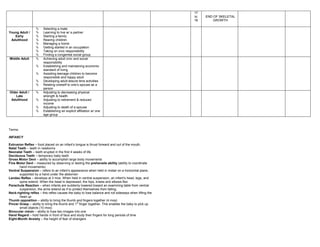
                       Selecting a mate
Young Adult /          Learning to live w/ a partner
   Early               Starting a family
 Adulthood             Rearing children
                       Managing a home
                       Getting started in an occupation
                       Taking on civic responsibility
                       Finding a congenital social group
Middle Adult           Achieving adult civic and social
                        responsibility
                       Establishing and maintaining economic
                        standard of living
                       Assisting teenage children to become
                        responsible and happy adult
                       Developing adult-leisure time activities
                       Relating oneself to one’s spouse as a
                        person
Older Adult /          Adjusting to decreasing physical
    Late                strength & health
 Adulthood             Adjusting to retirement & reduced
                        income
                       Adjusting to death of a spouse
                       Establishing an explicit affiliation w/ one
                        age group


Terms:

INFANCY

Extrusion Reflex – food placed on an infant’s tongue is thrust forward and out of the mouth.
Natal Teeth – teeth in newborns
Neonatal Teeth – teeth erupted in the first 4 weeks of life
Deciduous Teeth – temporary baby teeth
Gross Motor Devt – ability to accomplish large body movements
Fine Motor Devt – measured by observing or testing the prehensile ability (ability to coordinate
       hand movements)
Ventral Suspension – refers to an infant’s appearance when held in midair on a horizontal plane,
       supported by a hand under the abdomen
Landau Reflex – develops at 3 mos. When held in ventral suspension, an infant’s head, legs, and
       spine extend. When the head is depressed, the hips, knees and elbows flex
Parachute Reaction – when infants are suddenly lowered toward an examining table from ventral
       suspension, the arms extend as if to protect themselves from falling.
Neck-righting reflex – this reflex causes the baby to lose balance and roll sideways when lifting the
       head up
Thumb opposition – ability to bring the thumb and fingers together (4 mos)
Pincer Grasp – ability to bring the thumb and 1st finger together. This enables the baby to pick up
       small objects (10 mos)
Binocular vision – ability to fuse two images into one
Hand Regard – hold hands in front of face and study their fingers for long periods of time
Eight-Month Anxiety – the height of fear of strangers

Growth and Development Stages

  • 1.
    Freud’s Psychoanalytic Theory Erikson’s Theory of Piaget’s Theory of Kohlberg’s Theory of Psychosexual Development Psychosocial Development Cognitive Development Moral Development Infants Oral Stage Trust vs. Mistrust Sensorimotor Stage (birth to 1 year)  Child explores the world by using  Psychosocial Virtue: Hope Neonatal Reflex (1 mo.) mouth, especially the tongue  Fear: strangers, anxiety, loud  Stimuli are assimilated into beginning mental  Infants are interested in oral noises, falls, sudden images. Behavior entirely reflexive stimulation movements in the Primary Circular Reaction (1-4 mos.)  Baby finds pleasure in the mouth environment  Hand-mouth & ear-eye coordination develops.  Play: Solitary Reflect  Infant spends time looking at objects  Learning confidence or  Toy: rattle or tape of parent’s voice learning to love Secondary Circular Reaction (4-8 mos.)  Infant learns to initiate, recognize, and repeat pleasurable experiences  Infant anticipates familiar events  Toy: peel-a-boo Coordination of Secondary Reactions (8-12 mos.)  Infant can plan activities to attain specific goals.  Discovers a sense of identity, that his activities are separate from the activities of others.  Toy: nesting toys; colored boxes Toddler Anal Stage Autonmy vs. Shame Inventions of new means through mental Preconventional (Level I) (1-3 y/o) combinations (1-2 y/o)  Child learns to control urination and  Psychosocial Theme: “hold  Transitional phase Stage 1: (2-3y/o) defecation on or  Uses memory and imitation to act  Punishment / obedience  Toilet training let go”  Can solve basic problems, foresee maneuvers orientation  It is a part of the toddler’s self-  Child learns to be that will succeed or fail  Heteronomous morality discovery, a way of exerting independent and make  Toy: Blocks, colored plastic rings  Child does right because a independence decisions for self parent tells him or her to and to  Favorite word: “I”, “no” Preoperational Thought (2-7 y/o) avoid punishment Preschooler Phallic Stage Initiative vs. Guilt  Thought becomes more symbolic Stage 2: (4-7 y/o) (3-6y/o)  Can arrive at answers mentally  Individualism  The genitals are the pleasure of the  Ability to try new things  Thinking is basically concrete and critical  Instrumental purpose and child  Intensive activity and  Child is egocentric exchange  Oedipus and Electra Complex consuming fantasies  Displays static thinking  Carries out actions to satisfy  Child learns identity through  Interjects parent’s social  .Concept of time is now, and concept of own needs rather than society’s awareness of genital area consciousness distance is only as far as he/she can see  Will do something for that person  Masturbation is common during this  Child learns how to do things  No awareness of reversibility (for every action if that person does something for phase and that doing things is there is an opposite action) the child  Children may also show desirable exhibitionism  Knows right or wrong Concrete Operational Thought (7-12 y/o) Conventional (Level II)  Bogus playmates/imaginary  Systematic reasoning  Fears: dark, being left alone,  Uses memory to learn broad concepts Stage 3: (7-10 y/o) large animals, ghosts,  Classifications involve sorting objects accdg to  Orientation to interpersonal body mutilation, pain & attributes relations of mutuality objects  Child is aware of reversibility  Child follows rules because of a School-Age Latent Stage / Latency Period Industry vs. Inferiority  Understands conservation, sees constancy need to be a “good” person in (6-12 y/o) despite of transformation own eyes and eyes of others  All the sexual desires arch  Makes things w/ others Stage 4: (10-12 y/o)  Child’s personality development  Strives to achieve success Formal Operational Thought (12 yr)  Child finds following rules and appears to be nonactive or dormant  Child learns how to do things  Can solve hypothetical problems with scientific authority well reasoning  Child finds following rules  Understands causality satisfying  Can deal with the past, present & future  Follows rules of authority figures  Adult or mature thought and parents in an effort to keep the “system” working
  • 2.
    Adolescent Genital Stage Identity vs. Role Confusion Operational Thought Postconventional (Level III) (13-20 y/o)  Conflict: Setting Rules  Determines own sense of self Stage 5: (Older than 12)  Genitals become awakened  Development of who, what &  Capable of abstract thinking  Social contract, utilitarian law-  Adolescent develops sexual where they are going making persectives maturity and learns to establish  Become focus (self-concept)  Follows standards of society for satisfactory relationships w/ the  Period of rebellion and the good of all people opposite sex uncertainty Stage 6:  Adjusting to a new body and  Universal ethical principle seeking emancipation from orientation parents, choosing a vocation  Follows internalized standards of & determining a value system conduct. Young Adult Intimacy vs. Isolation  Person makes commitments to one another  Isolation and self absorption if unsuccessful  Independent from parents, possible marriage / partnership  Major goals to accomplish in career and family  Marrying age  Fulfillment of career Middle Adult Generativity vs. Stagnation Middle Adulthood:  Physical Changes: graying hair, wrinkling skin, pain &  Settling down muscle aches, menopausal  Find jobs period  Start a family  Psychosocial Virtue: Care  Mature adult is concerned w/ establishing & guiding the new generation or else feels Late Adulthood personal impoverishment  Relates to older & younger  Satisfaction w/ career generations  Become “Pillars of the Community” Older Adult Integrity vs. Despair  Accomplishment of goals  Achieves sense of acceptance of own life  Adapts to triumphs & disappointment w/ a certain ego integrity  Accepts the inevitability of death or else falls into despair  Appraisal of life & changing social roles  Self-concerned & withdrawn
  • 3.
    Havighurst’s Age Periodsand Sullivan’s Theory of PHYSICAL GROWTH AND DEVELOPMENT Developmental Task Interpersonal Relationships Mo. Gross Fine Motor Development Play Yr. Motor Development Infants  Largely reflex  The eyes is fixated on (birth to 1 the person SOLITARY Infancy Weight: 7 to 8 lbs year) 0-1  Keeps hands fisted PLAY Infancy and Early Childhood  Maternal anxiety Length: 19 to 21 in  Able to follow object to midline  Learning to walk Vital Signs:  Holds head up when  Development of social prone smile  Learning to take solid food Childhood 2  Responds to familiar  Learning to talk  As the child grows he T – 37.5 C voices  Learning to control the elimination of learns to interact P – 120 – 140 bpm  Holds head & chest  The baby knows how to body wastes  Use one specific R – 30 – 60 /min up when prone cry  Laughs aloud  Learning sexual differences & sexual language at a time BP – 80/40 mmHg 3  Babbles and “coos” modesty (language shock)  Follows object past midline  Achieving psychologic stability forming simple concepts of social and physical  Grasp  Can raise head and  Stepping chest reality Juvenile  Tonic neck  Teething  Learning to relate emotionally to  The child slowly 4  Reflexes are fading  Reach out to object parents, siblings & other people learning accepts authority from to distinguish right from wrong & his subordinates developing a conscience  More concept of self,  Turns front to back  Roll over  Has head lag when  Hold blocks at each status, & role pulled upright hand 5  Bears partial weight on feet when pulled Middle Childhood upright  Learning physical skills necessary for ordinary games  Turns both ways  Doubles birth weight  Moro reflex fading  Eruption of 1st tooth  Building wholesome attitudes toward  Sits w/ minimal support oneself as a growing organism 6  Uses palmar grasp  Learning to get along w/ age mates  Reaches out in  “dada”, “mama”  Learning an appropriate masculine and anticipation of being  Sleeps on prone feminine social role picked up position 7  Sits unsteadily  Uses fingers to hold  Developing fundamental skills in objects reading, writing & calculating  Transfers objects hand to hand  Developing concept necessary for everyday living  Sits securely w/o  Sits alone steadily for support an indefinite period  Developing conscience, morality & 8  Recognizes strangers scale of values  Peek-a-boo (to test memory)
  • 4.
    Achieving personal independence  Creeps or crawls  Can hold own bottle  Starts to crawl  Developing attitudes toward social 9  Understands simple groups & institutions gestures  Pulls self to standing  From crawling to standing 10  Responds when called by his/her name  From crawling to  Walks with assistance 11 standing  Stands alone  Triples birth weight 12  Some infants take 1st  Can say 2 syllable step words  Can walk w/ help Toddler  A child gains about 5  Walks alone well  Puts small pellets into (1-3 y/o) to 6 lb and 5 in a 15  Can seat self in chair small bottles PARALLEL year during the  Can creep upstairs  Scribbles voluntarily w/ PLAY toddler stage a pencil / crayon  Head circumference  Holds a spoon increases only about 2cm  Can run and jump in  No longer rotates a  Prominent abdomen place spoon to bring it to – pouchy belly 18  Can walk up and mouth  Respirations slow down stairs w/ slightly assistance  HR: 90 – 110 bpm  BP: 99/64 mmHg  Walks up stairs  Can open doors by  The brain develops 24 alone turning doorknobs to about 90% of its  Unscrew lids adult size  Control of the urinary  Can jump down from  Makes simple lines or and anal sphincters 30 chairs strokes or crosses w/ a becomes possible pencil  8 new teeth (canines and molars) erupt Preschooler  Ectomorphic (slim  Alternates feet  Undresses self (3-6 y/o) body built) or 3  Runs  Stacks tower of blocks A endomorphic (large y/o  Rides tricycle  Draws a cross S body built) becomes  Stands on one foot S apparent O  PR: 85 bpm C  BP: 100/60 mmHg  Constantly in motion  Can do simple buttons I  Voiding is frequent 4  Jumps A (about 9 to 10 times y/o  Skips T a day) I  The average child V gains only about 4.5 E lb a year.  Height gain is also  Throws overhand  Draws a 6-part man & minimal: 2 to 3.5  Can lace shoes inches 5 Imaginative  Generally have all 20 y/o PLAY deciduous teeth by age 3
  • 5.
    School-Age  Average weight gain 6  A year of constant motion (6-12 y/o) is 3 to lb y/o  Skipping is a new skill  Increase in height is  First molars erupt 1 to 2 inches  By age 10 brain 7  Central incisors erupt A growth is complete y/o  Difference b/w sexes become apparent in play S  Posture becomes  Spends time in quiet play S more erect O  PR: 70 – 80 bpm 8  Coordination definitely improved C  BP: 112/60 mmHg y/o  Playing with gang becomes important I  Development of  Eyes become fully developed A Secondary Sex T 9 Characteristics I y/o  All activities done w/ gang  Sexual Maturation: V 10 Girls (12 – 18 y/o); E y/o  Coordination improves boys (14 - 20 y/o)  Deciduous teeth are 11 PLAY lost and permanent y/o  Active, but awkward and ungainly teeth erupt 12 y/o  Coordination improves Adolescent  Developing intellectual skills and  Onset of puberty SEXUAL MATURATION (13-20 y/o)  Cessation of body Yr BOYS GIRLS concepts necessary for civic growth  Growth spurt  Pubic hair thick & curly, competence  Most girls are 1 to 2 continuing triangular in distribution  Desiring and achieving socially inches taller than  Pubic hair  Breasts, areola & papilla boys abundant & curly form secondary mound responsible behavior  Boys grow about 4 to 13  Testes, penis, &  Menstruation is ovulatory, 12 inches in ht and to scrotum enlarging making pregnancy  Acquiring a set of values & an ethical gain 15 to 65 lb 15 further possible system as a guide to behavior  Girls grow 2 to 8  Axillary hair inches and gain 15 present  Achieving emotional independence from to 55 lb  Facial hair fine & parents & other adults achieving  PR: 70 bpm downy  RR: 20 breaths/min  Voice changes assurance of economic independence  BP: 120/70 mmHg happening w/  Selecting and preparing for an  Gain 2nd molars by annoying freq. age 13 and 3rd  Genitalia adult  Pubic hair curly & occupation molars b/w 18 and  Pubic hair abundant (adult); may  Preparing for marriage and family life 21 y/o abundant & curly extend onto medial aspect  Achieving a new and more mature 15  Scrotum dark & of thighs to heavily rugated  Breast tissue adult & relations w/ age mates of both sexes 16  Facial and body nipples protrude  Achieving masculine or feminine social hair present  Areolas no longer project  Sperm production as separate ridges from role mature breasts  Accepting ones physique & using the  May have some degree of facial acne body effectively  Pubic hair curly & abundant (adult); END OF SKELETAL may extend along GROWTH 16 medial aspect of to thighs 17  Testes, scrotum & penis adult in size  May have some degree of facial acne  Gynecomastia
  • 6.
    17 to END OF SKELETAL 18 GROWTH  Selecting a mate Young Adult /  Learning to live w/ a partner Early  Starting a family Adulthood  Rearing children  Managing a home  Getting started in an occupation  Taking on civic responsibility  Finding a congenital social group Middle Adult  Achieving adult civic and social responsibility  Establishing and maintaining economic standard of living  Assisting teenage children to become responsible and happy adult  Developing adult-leisure time activities  Relating oneself to one’s spouse as a person Older Adult /  Adjusting to decreasing physical Late strength & health Adulthood  Adjusting to retirement & reduced income  Adjusting to death of a spouse  Establishing an explicit affiliation w/ one age group Terms: INFANCY Extrusion Reflex – food placed on an infant’s tongue is thrust forward and out of the mouth. Natal Teeth – teeth in newborns Neonatal Teeth – teeth erupted in the first 4 weeks of life Deciduous Teeth – temporary baby teeth Gross Motor Devt – ability to accomplish large body movements Fine Motor Devt – measured by observing or testing the prehensile ability (ability to coordinate hand movements) Ventral Suspension – refers to an infant’s appearance when held in midair on a horizontal plane, supported by a hand under the abdomen Landau Reflex – develops at 3 mos. When held in ventral suspension, an infant’s head, legs, and spine extend. When the head is depressed, the hips, knees and elbows flex Parachute Reaction – when infants are suddenly lowered toward an examining table from ventral suspension, the arms extend as if to protect themselves from falling. Neck-righting reflex – this reflex causes the baby to lose balance and roll sideways when lifting the head up Thumb opposition – ability to bring the thumb and fingers together (4 mos) Pincer Grasp – ability to bring the thumb and 1st finger together. This enables the baby to pick up small objects (10 mos) Binocular vision – ability to fuse two images into one Hand Regard – hold hands in front of face and study their fingers for long periods of time Eight-Month Anxiety – the height of fear of strangers