HUMAN DEVELOPMENT
AND GROWTH
SAADIA BASHIR
20BSEDU55 SBBUSBA
WHAT IS
DEVELOPMENT???
What is Development?
• From dependency to autonomy is
called development.
• It is quantitative, invisible,
unmeasurable functional maturation
of the organ system.
• Both growth and development are
closely interrelated with each other,
as they are usually assessed
simultaneously in a child.
• What is Growth
• Quantitative, measurable, visible change in human body is called growth.
• It includes various changes and stability in sensory capacities, motor skills and health.
• It is also known as the physical development. Or physical change causing from growing
the number and the size of cells of the body.
•
Diversity in developmental theories
There are various theories about
development of a child. Every
psychologist have a different viewpoint
with concern to development of a child.
Four main theories are as
• Psychoanalytic theory of
• Behavioral and social cognitive
of development
• Ethological theory of development
• Cognitive theories of development
• Difference between growth
and development
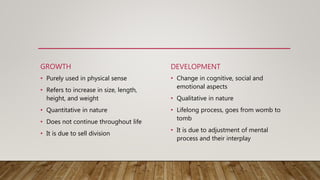
GROWTH
• Purely used in physical sense
• Refers to increase in size, length,
height, and weight
• Quantitative in nature
• Does not continue throughout life
• It is due to sell division
DEVELOPMENT
• Change in cognitive, social and
emotional aspects
• Qualitative in nature
• Lifelong process, goes from womb to
tomb
• It is due to adjustment of mental
process and their interplay
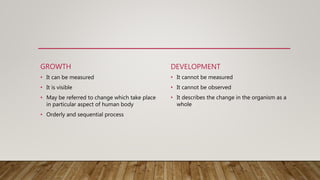
GROWTH
• It can be measured
• It is visible
• May be referred to change which take place
in particular aspect of human body
• Orderly and sequential process
DEVELOPMENT
• It cannot be measured
• It cannot be observed
• It describes the change in the organism as a
whole
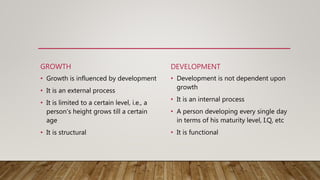
GROWTH
• Growth is influenced by development
• It is an external process
• It is limited to a certain level, i.e., a
person’s height grows till a certain
age
• It is structural
DEVELOPMENT
• Development is not dependent upon
growth
• It is an internal process
• A person developing every single day
in terms of his maturity level, I.Q, etc
• It is functional
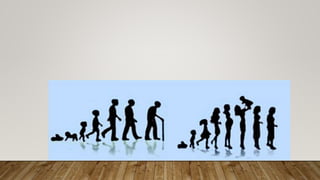
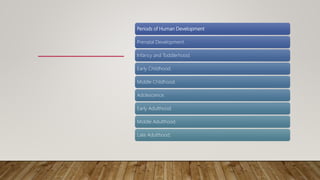
Periods of Human Development
Prenatal Development.
Infancy and Toddlerhood.
Early Childhood.
Middle Childhood.
Adolescence.
Early Adulthood.
Middle Adulthood.
Late Adulthood.
REFERENCES
• https://www.javatpoint.com/growth-vs-development
• https://www.psychologydiscussion.net/educational-psychology/principles-of-
human-growth-and-development/1813

Difference between Growth and Development

  • 1.
    HUMAN DEVELOPMENT AND GROWTH SAADIABASHIR 20BSEDU55 SBBUSBA
  • 2.
  • 3.
    What is Development? •From dependency to autonomy is called development. • It is quantitative, invisible, unmeasurable functional maturation of the organ system. • Both growth and development are closely interrelated with each other, as they are usually assessed simultaneously in a child.
  • 4.
    • What isGrowth • Quantitative, measurable, visible change in human body is called growth. • It includes various changes and stability in sensory capacities, motor skills and health. • It is also known as the physical development. Or physical change causing from growing the number and the size of cells of the body. •
  • 5.
    Diversity in developmentaltheories There are various theories about development of a child. Every psychologist have a different viewpoint with concern to development of a child. Four main theories are as • Psychoanalytic theory of • Behavioral and social cognitive of development • Ethological theory of development • Cognitive theories of development
  • 6.
    • Difference betweengrowth and development
  • 7.
    GROWTH • Purely usedin physical sense • Refers to increase in size, length, height, and weight • Quantitative in nature • Does not continue throughout life • It is due to sell division DEVELOPMENT • Change in cognitive, social and emotional aspects • Qualitative in nature • Lifelong process, goes from womb to tomb • It is due to adjustment of mental process and their interplay
  • 8.
    GROWTH • It canbe measured • It is visible • May be referred to change which take place in particular aspect of human body • Orderly and sequential process DEVELOPMENT • It cannot be measured • It cannot be observed • It describes the change in the organism as a whole
  • 9.
    GROWTH • Growth isinfluenced by development • It is an external process • It is limited to a certain level, i.e., a person’s height grows till a certain age • It is structural DEVELOPMENT • Development is not dependent upon growth • It is an internal process • A person developing every single day in terms of his maturity level, I.Q, etc • It is functional
  • 11.
    Periods of HumanDevelopment Prenatal Development. Infancy and Toddlerhood. Early Childhood. Middle Childhood. Adolescence. Early Adulthood. Middle Adulthood. Late Adulthood.
  • 13.