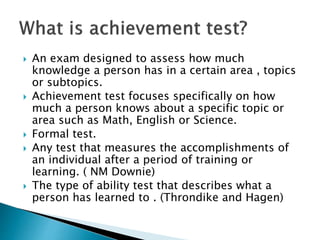
 An exam designed to assess how much 
knowledge a person has in a certain area , topics 
or subtopics. 
 Achievement test focuses specifically on how 
much a person knows about a specific topic or 
area such as Math, English or Science. 
 Formal test. 
 Any test that measures the accomplishments of 
an individual after a period of training or 
learning. ( NM Downie) 
 The type of ability test that describes what a 
person has learned to . (Throndike and Hagen)
 Provides basis for promotion to next grade. 
 Find out where each student stands in 
various academic areas. 
 Motivate the students before a new 
assignment has taken up. 
 Expose pupil’s difficulties which the teacher 
can help them to solve.
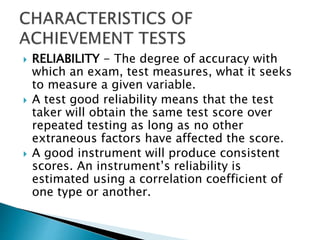
 RELIABILITY - The degree of accuracy with 
which an exam, test measures, what it seeks 
to measure a given variable. 
 A test good reliability means that the test 
taker will obtain the same test score over 
repeated testing as long as no other 
extraneous factors have affected the score. 
 A good instrument will produce consistent 
scores. An instrument’s reliability is 
estimated using a correlation coefficient of 
one type or another.
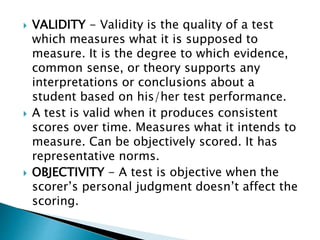
 VALIDITY - Validity is the quality of a test 
which measures what it is supposed to 
measure. It is the degree to which evidence, 
common sense, or theory supports any 
interpretations or conclusions about a 
student based on his/her test performance. 
 A test is valid when it produces consistent 
scores over time. Measures what it intends to 
measure. Can be objectively scored. It has 
representative norms. 
 OBJECTIVITY - A test is objective when the 
scorer’s personal judgment doesn’t affect the 
scoring.
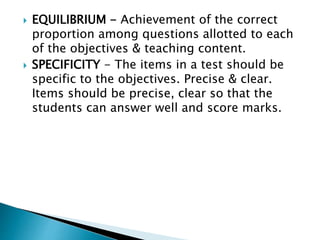
 EQUILIBRIUM - Achievement of the correct 
proportion among questions allotted to each 
of the objectives & teaching content. 
 SPECIFICITY - The items in a test should be 
specific to the objectives. Precise & clear. 
Items should be precise, clear so that the 
students can answer well and score marks.
 Time Generally - the time given to students 
is always in short supply however the 
students too do not accept very long tests. 
Therefore a test should neither be very long 
nor very short. 
 Acceptability - A good test should be 
acceptable to student to whom its being 
given without regard to any specific situation 
that is the question given in the test should 
be neither very difficult nor very easy.
 EASE IN ADMINISTRATION - A test is good 
only when the conditions of answering are 
simple (scientific and logical). Its instruction 
should be simple and clear. 
 COST - A good test should be in expensive, 
not only from the view point of money but 
also from the view point of time and effort 
taken in the construction of a test.
 Objectives of the lesson being assessed. 
 Relative importance assigned to each 
objective 
 Tasks employed in classroom lesson during 
the unit of time 
 Time frame for the test 
 Potential for formative feedback
 Summative- end of term, end of year, and 
end of the lesson. 
 Achievement test range – 5 to 10 minutes to 
3 hours final exam. ( variety of item types and 
formats)
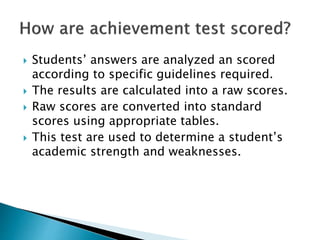
 Students’ answers are analyzed an scored 
according to specific guidelines required. 
 The results are calculated into a raw scores. 
 Raw scores are converted into standard 
scores using appropriate tables. 
 This test are used to determine a student’s 
academic strength and weaknesses.
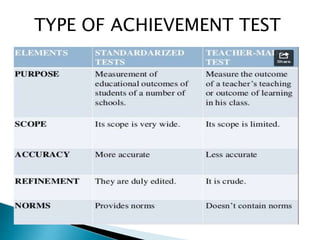
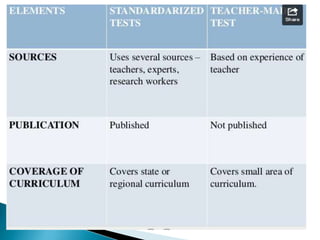
TYPE OF ACHIEVEMENT TEST
Achievement test

Achievement test

  • 2.
     An examdesigned to assess how much knowledge a person has in a certain area , topics or subtopics.  Achievement test focuses specifically on how much a person knows about a specific topic or area such as Math, English or Science.  Formal test.  Any test that measures the accomplishments of an individual after a period of training or learning. ( NM Downie)  The type of ability test that describes what a person has learned to . (Throndike and Hagen)
  • 3.
     Provides basisfor promotion to next grade.  Find out where each student stands in various academic areas.  Motivate the students before a new assignment has taken up.  Expose pupil’s difficulties which the teacher can help them to solve.
  • 4.
     RELIABILITY -The degree of accuracy with which an exam, test measures, what it seeks to measure a given variable.  A test good reliability means that the test taker will obtain the same test score over repeated testing as long as no other extraneous factors have affected the score.  A good instrument will produce consistent scores. An instrument’s reliability is estimated using a correlation coefficient of one type or another.
  • 5.
     VALIDITY -Validity is the quality of a test which measures what it is supposed to measure. It is the degree to which evidence, common sense, or theory supports any interpretations or conclusions about a student based on his/her test performance.  A test is valid when it produces consistent scores over time. Measures what it intends to measure. Can be objectively scored. It has representative norms.  OBJECTIVITY - A test is objective when the scorer’s personal judgment doesn’t affect the scoring.
  • 6.
     EQUILIBRIUM -Achievement of the correct proportion among questions allotted to each of the objectives & teaching content.  SPECIFICITY - The items in a test should be specific to the objectives. Precise & clear. Items should be precise, clear so that the students can answer well and score marks.
  • 7.
     Time Generally- the time given to students is always in short supply however the students too do not accept very long tests. Therefore a test should neither be very long nor very short.  Acceptability - A good test should be acceptable to student to whom its being given without regard to any specific situation that is the question given in the test should be neither very difficult nor very easy.
  • 8.
     EASE INADMINISTRATION - A test is good only when the conditions of answering are simple (scientific and logical). Its instruction should be simple and clear.  COST - A good test should be in expensive, not only from the view point of money but also from the view point of time and effort taken in the construction of a test.
  • 9.
     Objectives ofthe lesson being assessed.  Relative importance assigned to each objective  Tasks employed in classroom lesson during the unit of time  Time frame for the test  Potential for formative feedback
  • 10.
     Summative- endof term, end of year, and end of the lesson.  Achievement test range – 5 to 10 minutes to 3 hours final exam. ( variety of item types and formats)
  • 11.
     Students’ answersare analyzed an scored according to specific guidelines required.  The results are calculated into a raw scores.  Raw scores are converted into standard scores using appropriate tables.  This test are used to determine a student’s academic strength and weaknesses.
  • 12.