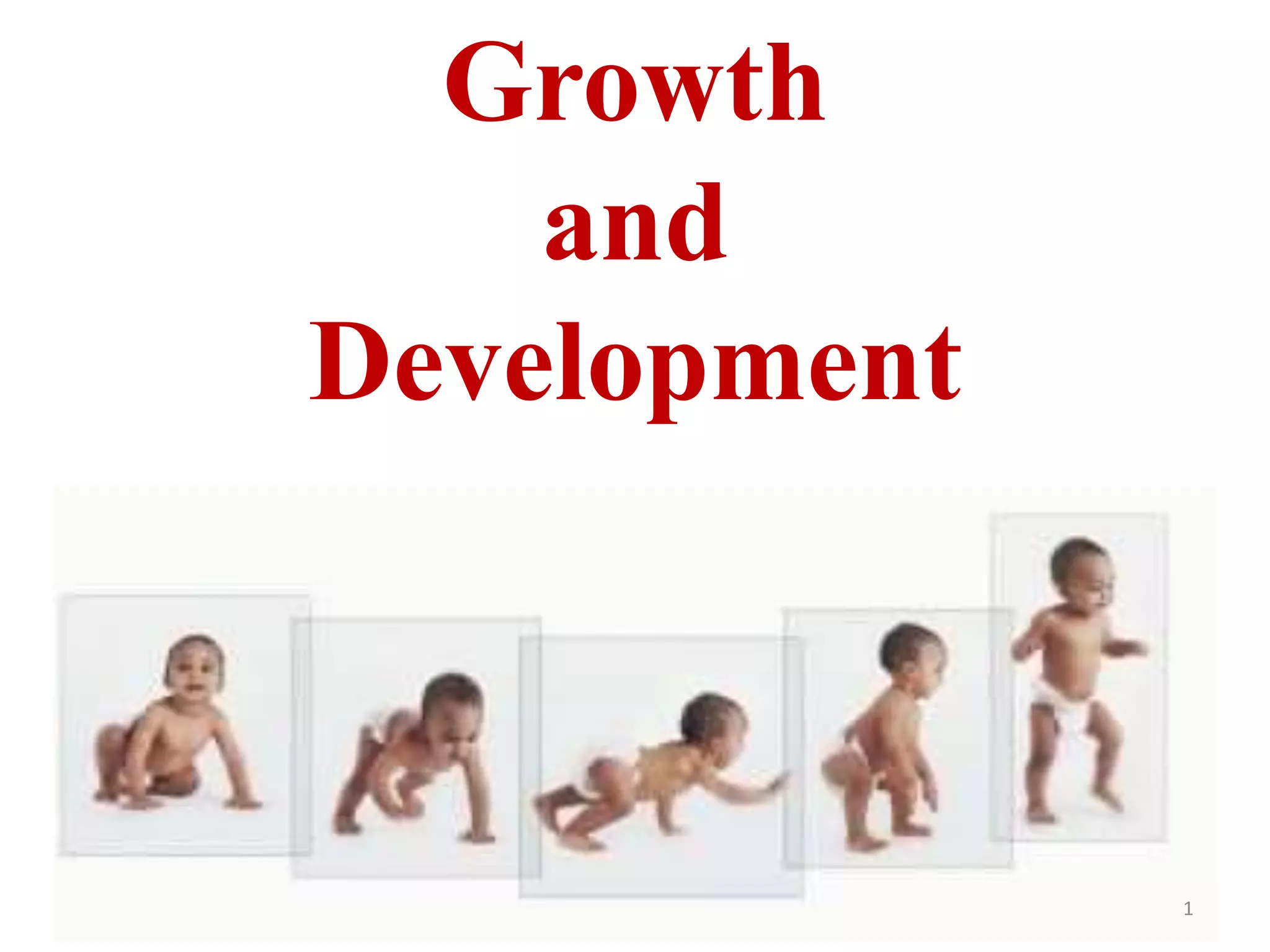
Growth 
and 
Development 
1
Growth 
• It is the process of physical maturation resulting 
an increase in size of the body and various organs. 
It occurs by multiplication of cells and an increase 
in in intracellular substance. It is quantitative 
changes of the body. 
2
Development 
• It is the process of functional and physiological 
maturation of the individual. It is progressive 
increase in skill and capacity to function. It is 
related to maturation and myelination of the 
nervous system. It includes psychological, 
emotional and social changes. It is qualitative 
aspects. 
3
Principle 
of 
Growth 
and 
Development 
4
• Cephalocaudal direction 
• Proximodistal direction 
• General to Specific 
5
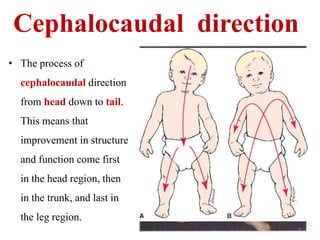
Cephalocaudal direction 
• The process of 
cephalocaudal direction 
from head down to tail. 
This means that 
improvement in structure 
and function come first 
in the head region, then 
in the trunk, and last in 
the leg region. 
6
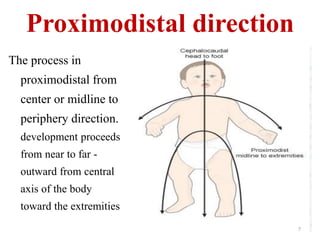
Proximodistal direction 
The process in 
proximodistal from 
center or midline to 
periphery direction. 
development proceeds 
from near to far - 
outward from central 
axis of the body 
toward the extremities 
7
General to Specific 
• Children use their cognitive and language skills to reason 
and solve problems. 
• Children at first are able hold the big things by using both 
arms, In the next part able to hold things in a single hand, 
then only able to pick small objects like peas, cereals etc. 
• Children when able to hold pencil, first starts draw circles 
then squares then only letters after that the words. 
8
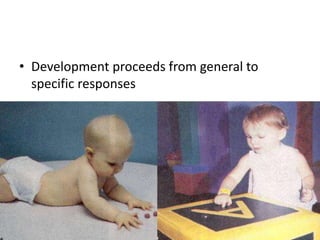
• Development proceeds from general to 
specific responses
Factor influencing 
Growth and Development 
10
• Growth and development depend upon 
multiple factors or determinates. 
• They influence directly or indirectly by 
promoting or hindering the process. 
11
• Genetic factors 
• Prenatal factors 
• Postnatal factors 
12
Genetic factors 
• Genetic predisposition is the importance 
factors which influence the growth and 
development of children. 
• Sex 
• Race and Nationality 
13
Prenatal factors 
• Intrauterine environment is an important 
predominant factor of growth and 
development. Various conditions influence 
the fetal growth in utero. 
14
Cont… 
• Maternal malnutrition 
• Maternal infection 
• Maternal substance abuse 
• Maternal illness 
• Hormones 
• Miscellaneous 
15
Postnatal factors 
• Growth potential 
• Nutrition 
• Childhood illness 
• Physical 
environment 
• Psychological 
environment 
• Cultural influence 
• Socio economic 
status 
• Climate and season 
• Play and exercise 
• Birth order of the 
child 
• Intelligence 
• Hormonal influence 
16
GROWTH AND &DEVELOPMENTAL 
AGE PERIODS 
• Infancy 
–Neonate 
•Birth to 1 month 
–Infancy 
•1 month to 1 year
• Early Childhood 
–Toddler 
•1-3 years 
–Preschool 
•3-6 years 
18
• Middle Childhood 
– School age 
– 6 to 12 years 
• Late Childhood 
• Adolescent 
– 13 years to approximately 
18 years
Growth 
and 
Development 
Monitoring 
20
Assessment of growth 
• Assessment of physical growth can be done by 
anthropometric measurement and the study of 
velocity of physical growth. 
• Measurement of different growth parameters is 
the importance nursing responsibility in child 
care. 
21
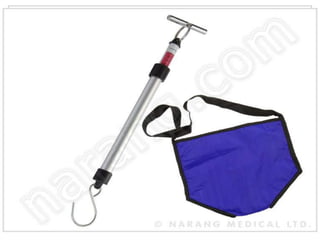
Weight 
• weight is one of the best criteria for assessment of 
growth and a good indicator of health and nutritional 
status of child. 
• Among Indian children, weight of the full terms 
neonate at birth is approximately 2.5 kg to 3.5kg. 
• there is about 10% loss of weight first week of life, 
which regains by 10 days of age. 
22
23
Cont… 
• Then, weight gain is about 25- 30 gm per day for 
1st 3 month and 400gm/ month till one year of 
age. 
• The infants double weight gain their birth weight 
by 5month of age, trebled by one year, fourth 
time by two years, five times by three year, six 
times by five year, seven times by seven year 
and ten times by ten year. 
• Then weight increases rapidly during puberty 
followed by weight increase to adult size. 
24
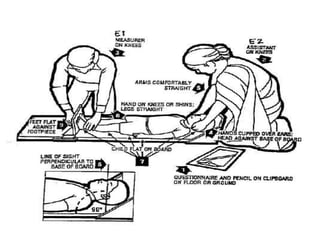
Length and height 
• Increase in height indicates skeletal growth. Yearly 
increments in height gradually diminished from 
birth to maturity. 
• At birth average length of a healthy Indian 
newborn baby is 50 cm. 
• it increases to 60 cm at 3 months, 70 cm of 9 
month and 75 cm at one year of age. 
25
Cont… 
• In second year, there is 12 cm increase, third 
year it is 9 cm, fourth year it is 7 cm and in fifth 
year it is 6 cm. 
• so the child double the birth by 4 to 4.5 years of 
age afterwards there is about 5 cm increase in 
every year till onset of puberty. 
26
27
28
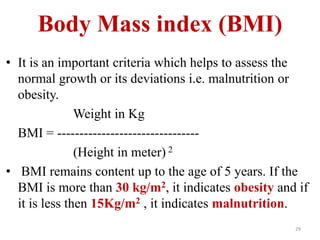
Body Mass index (BMI) 
• It is an important criteria which helps to assess the 
normal growth or its deviations i.e. malnutrition or 
obesity. 
Weight in Kg 
BMI = -------------------------------- 
(Height in meter) 2 
• BMI remains content up to the age of 5 years. If the 
BMI is more than 30 kg/m2, it indicates obesity and if 
it is less then 15Kg/m2 , it indicates malnutrition. 
29
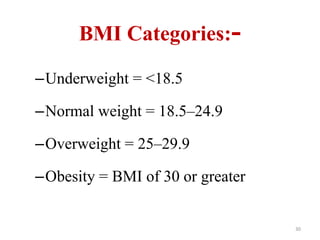
BMI Categories:- 
–Underweight = <18.5 
–Normal weight = 18.5–24.9 
–Overweight = 25–29.9 
–Obesity = BMI of 30 or greater 
30
Head circumference 
• It is related to brain growth and development of 
intracranial volume. Average head circumference 
measured about 35 cm at birth. 
• At 3 months it is about 40 cm, at 6 month 43 cm, at 
one year 45cm, at 2 years 48 cm, at 7 year 50 cm and 
at 12 years of age it is about 52 cm, almost same a 
adult. 
31
Cont… 
• If head circumference increase more than 1 cm in 
two weeks during the first 3 month of age then 
hydrocephalus should be suspected. 
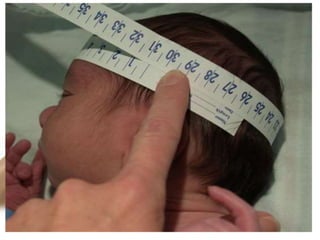
• Head circumference is measured by ordinal tap, 
placing it over the occipital protuberance at the 
back, above the ear on the side and just over the 
supraorbital ridges in front measuring the point of 
height circumference. 
32
33
Fontanelle Closure 
• At birth, anterior and posterior fontanelle are 
usually present. Posterior fontanelle closes early 
few weeks(6-8week) of age. 
• The anterior fontanelle normally closes by 12- 
18 months of age. Early closure of fontanelle 
indicates craniostenosis due to premature closure 
of skull sutures. 
34
35
Chest circumference 
• chest circumference or thoracic diameters is an 
importance parameter of assessment of growth and 
nutrition status. 
• At birth it is 2-3cm less than head circumference. At 
6 to 12 months of age both become equal. 
• After first year of age, chest circumference is greater 
than head circumference by 2.5 cm and by the age of 5 
year, it is about 5 cm larger than head circumference. 
36
Cont… 
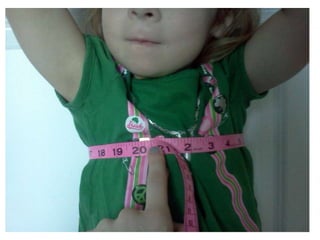
• Chest circumference is measured by placing the 
tape measure around the chest at level by placing 
the tape measure around the chest at the level of 
the nipple, in between inspiration and expiration. 
37
38
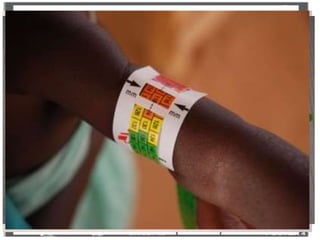
Mid Upper Arm Circumference(MUAC) 
• This measurement helps to asses the nutritional 
status of younger children. 
• There is growth due to inadequate nutritional, 
which can be this simple particle and useful 
measurement. 
39
Cont…. 
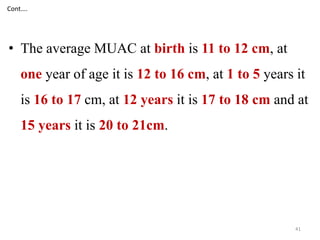
• The average MUAC at birth is 11 to 12 cm, at 
one year of age it is 12 to 16 cm, at 1 to 5 years it 
is 16 to 17 cm, at 12 years it is 17 to 18 cm and at 
15 years it is 20 to 21cm. 
41
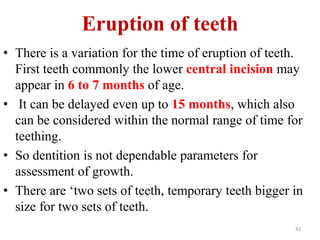
Eruption of teeth 
• There is a variation for the time of eruption of teeth. 
First teeth commonly the lower central incision may 
appear in 6 to 7 months of age. 
• It can be delayed even up to 15 months, which also 
can be considered within the normal range of time for 
teething. 
• So dentition is not dependable parameters for 
assessment of growth. 
• There are ‘two sets of teeth, temporary teeth bigger in 
size for two sets of teeth. 
42
43 
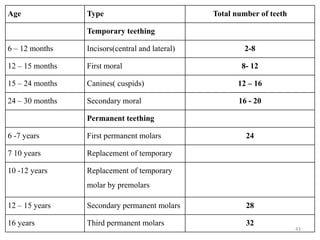
Age Type Total number of teeth 
Temporary teething 
6 – 12 months Incisors(central and lateral) 2-8 
12 – 15 months First moral 8- 12 
15 – 24 months Canines( cuspids) 12 – 16 
24 – 30 months Secondary moral 16 - 20 
Permanent teething 
6 -7 years First permanent molars 24 
7 10 years Replacement of temporary 
10 -12 years Replacement of temporary 
molar by premolars 
12 – 15 years Secondary permanent molars 28 
16 years Third permanent molars 32
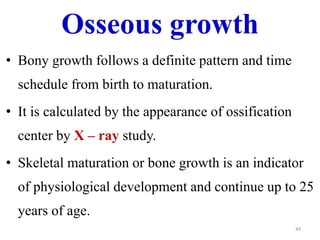
Osseous growth 
• Bony growth follows a definite pattern and time 
schedule from birth to maturation. 
• It is calculated by the appearance of ossification 
center by X – ray study. 
• Skeletal maturation or bone growth is an indicator 
of physiological development and continue up to 25 
years of age. 
44
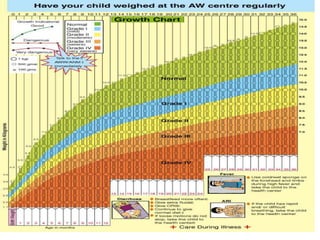
Growth monitoring 
• Assessment of growth may be done by 
longitudinal & cross sectional studies. The 
common parameters used for growth 
monitoring include, head circumference, chest 
circumference, UL/LS ratio. The following are 
the 3 members used for comparisons:- 
45
Cont… 
• Use of mean/median values. 
• Use of percentile 
• Use of indices as weight for height & 
weight for age. 
• Common reference values- 
–WHO reference value 
– Indian standards- 
46
Indian standards- 
• ICMR under took a national wide cross 
sectional study during the year 1956- 1965. 
this tool is widely used in India as the 
reference value to assess growth. 
47
48
Assessment of Development 
• Normal development is a complex process 
& has a multitude of facets. However, it is 
convenient to understand & assess 
development under the following domains. 
49
Cont… 
–Gross motor development 
–Fine motor skill development 
–Personal & social development 
–Language 
–Vision & hearing. 
50
Gross motor development 
• Motor development progress in an orderly 
sequence to ultimate attainment of 
locomotion & more complex motor tasks 
thereafter. In an infant it is assessed & 
observed as follows:- 
51
Cont… 
52 
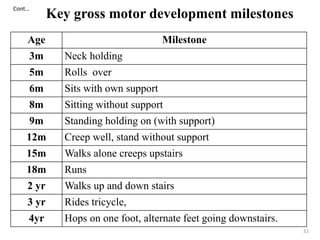
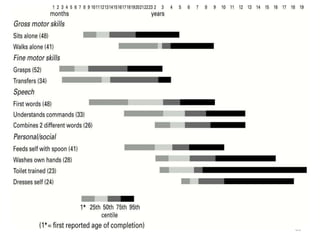
Key gross motor development milestones 
Age Milestone 
3m Neck holding 
5m Rolls over 
6m Sits with own support 
8m Sitting without support 
9m Standing holding on (with support) 
12m Creep well, stand without support 
15m Walks alone creeps upstairs 
18m Runs 
2 yr Walks up and down stairs 
3 yr Rides tricycle, 
4yr Hops on one foot, alternate feet going downstairs.
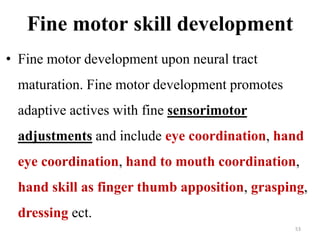
Fine motor skill development 
• Fine motor development upon neural tract 
maturation. Fine motor development promotes 
adaptive actives with fine sensorimotor 
adjustments and include eye coordination, hand 
eye coordination, hand to mouth coordination, 
hand skill as finger thumb apposition, grasping, 
dressing ect. 
53
54 
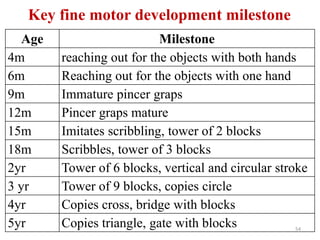
Key fine motor development milestone 
Age Milestone 
4m reaching out for the objects with both hands 
6m Reaching out for the objects with one hand 
9m Immature pincer graps 
12m Pincer graps mature 
15m Imitates scribbling, tower of 2 blocks 
18m Scribbles, tower of 3 blocks 
2yr Tower of 6 blocks, vertical and circular stroke 
3 yr Tower of 9 blocks, copies circle 
4yr Copies cross, bridge with blocks 
5yr Copies triangle, gate with blocks
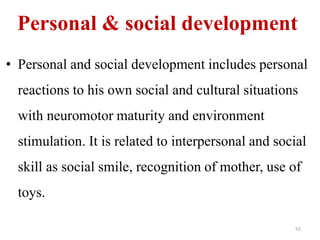
Personal & social development 
• Personal and social development includes personal 
reactions to his own social and cultural situations 
with neuromotor maturity and environment 
stimulation. It is related to interpersonal and social 
skill as social smile, recognition of mother, use of 
toys. 
55
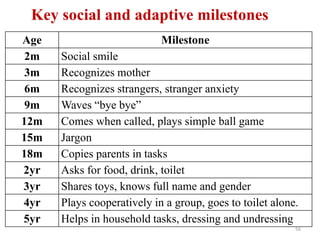
Age Milestone 
2m Social smile 
3m Recognizes mother 
6m Recognizes strangers, stranger anxiety 
9m Waves “bye bye” 
12m Comes when called, plays simple ball game 
15m Jargon 
18m Copies parents in tasks 
2yr Asks for food, drink, toilet 
3yr Shares toys, knows full name and gender 
4yr Plays cooperatively in a group, goes to toilet alone. 
5yr Helps in household tasks, dressing and undressing 
56 
Key social and adaptive milestones
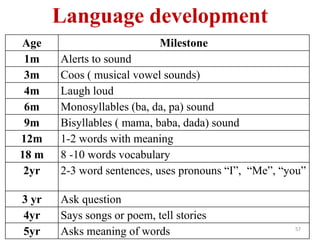
Language development 
Age Milestone 
1m Alerts to sound 
3m Coos ( musical vowel sounds) 
4m Laugh loud 
6m Monosyllables (ba, da, pa) sound 
9m Bisyllables ( mama, baba, dada) sound 
12m 1-2 words with meaning 
18 m 8 -10 words vocabulary 
2yr 2-3 word sentences, uses pronouns “I”, “Me”, “you” 
57 
3 yr Ask question 
4yr Says songs or poem, tell stories 
5yr Asks meaning of words
Assessment of Development 
• Healthy development, in all forms, particularly 
social/emotional, communication, and behavior, 
should be monitored by parents and physicians 
through screenings at each well visit. 
58
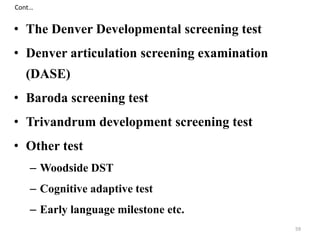
Cont… 
• The Denver Developmental screening test 
• Denver articulation screening examination 
(DASE) 
• Baroda screening test 
• Trivandrum development screening test 
• Other test 
– Woodside DST 
– Cognitive adaptive test 
– Early language milestone etc. 
59
The Denver Developmental 
screening test 
• Developmental originally by Franken – burg and 
dodds(1967), this simple, economic and useful test 
screens for developmental delays during infancy and 
the preschool period. 
• On the test, the age division are monthly unit 2 years 
of age , and half yearly from 2 to 6 years of age. 
60
Baroda Screening test 
• It was developed by Dr. Promila phatak with 25 
test items primarily for psychological aspects. The 
test is relevant for age 0 to 30 months. Gross 
motor, fine motor and cognitive aspects are 
evaluated in 10 mints mainly by the psychologist 
61
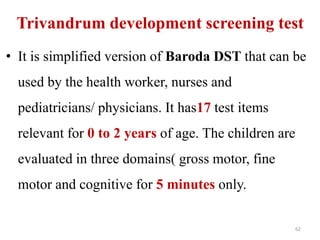
Trivandrum development screening test 
• It is simplified version of Baroda DST that can be 
used by the health worker, nurses and 
pediatricians/ physicians. It has17 test items 
relevant for 0 to 2 years of age. The children are 
evaluated in three domains( gross motor, fine 
motor and cognitive for 5 minutes only. 
62
63
64

Growth and development..ppt

  • 1.
  • 2.
    Growth • Itis the process of physical maturation resulting an increase in size of the body and various organs. It occurs by multiplication of cells and an increase in in intracellular substance. It is quantitative changes of the body. 2
  • 3.
    Development • Itis the process of functional and physiological maturation of the individual. It is progressive increase in skill and capacity to function. It is related to maturation and myelination of the nervous system. It includes psychological, emotional and social changes. It is qualitative aspects. 3
  • 4.
    Principle of Growth and Development 4
  • 5.
    • Cephalocaudal direction • Proximodistal direction • General to Specific 5
  • 6.
    Cephalocaudal direction •The process of cephalocaudal direction from head down to tail. This means that improvement in structure and function come first in the head region, then in the trunk, and last in the leg region. 6
  • 7.
    Proximodistal direction Theprocess in proximodistal from center or midline to periphery direction. development proceeds from near to far - outward from central axis of the body toward the extremities 7
  • 8.
    General to Specific • Children use their cognitive and language skills to reason and solve problems. • Children at first are able hold the big things by using both arms, In the next part able to hold things in a single hand, then only able to pick small objects like peas, cereals etc. • Children when able to hold pencil, first starts draw circles then squares then only letters after that the words. 8
  • 9.
    • Development proceedsfrom general to specific responses
  • 10.
    Factor influencing Growthand Development 10
  • 11.
    • Growth anddevelopment depend upon multiple factors or determinates. • They influence directly or indirectly by promoting or hindering the process. 11
  • 12.
    • Genetic factors • Prenatal factors • Postnatal factors 12
  • 13.
    Genetic factors •Genetic predisposition is the importance factors which influence the growth and development of children. • Sex • Race and Nationality 13
  • 14.
    Prenatal factors •Intrauterine environment is an important predominant factor of growth and development. Various conditions influence the fetal growth in utero. 14
  • 15.
    Cont… • Maternalmalnutrition • Maternal infection • Maternal substance abuse • Maternal illness • Hormones • Miscellaneous 15
  • 16.
    Postnatal factors •Growth potential • Nutrition • Childhood illness • Physical environment • Psychological environment • Cultural influence • Socio economic status • Climate and season • Play and exercise • Birth order of the child • Intelligence • Hormonal influence 16
  • 17.
    GROWTH AND &DEVELOPMENTAL AGE PERIODS • Infancy –Neonate •Birth to 1 month –Infancy •1 month to 1 year
  • 18.
    • Early Childhood –Toddler •1-3 years –Preschool •3-6 years 18
  • 19.
    • Middle Childhood – School age – 6 to 12 years • Late Childhood • Adolescent – 13 years to approximately 18 years
  • 20.
    Growth and Development Monitoring 20
  • 21.
    Assessment of growth • Assessment of physical growth can be done by anthropometric measurement and the study of velocity of physical growth. • Measurement of different growth parameters is the importance nursing responsibility in child care. 21
  • 22.
    Weight • weightis one of the best criteria for assessment of growth and a good indicator of health and nutritional status of child. • Among Indian children, weight of the full terms neonate at birth is approximately 2.5 kg to 3.5kg. • there is about 10% loss of weight first week of life, which regains by 10 days of age. 22
  • 23.
  • 24.
    Cont… • Then,weight gain is about 25- 30 gm per day for 1st 3 month and 400gm/ month till one year of age. • The infants double weight gain their birth weight by 5month of age, trebled by one year, fourth time by two years, five times by three year, six times by five year, seven times by seven year and ten times by ten year. • Then weight increases rapidly during puberty followed by weight increase to adult size. 24
  • 25.
    Length and height • Increase in height indicates skeletal growth. Yearly increments in height gradually diminished from birth to maturity. • At birth average length of a healthy Indian newborn baby is 50 cm. • it increases to 60 cm at 3 months, 70 cm of 9 month and 75 cm at one year of age. 25
  • 26.
    Cont… • Insecond year, there is 12 cm increase, third year it is 9 cm, fourth year it is 7 cm and in fifth year it is 6 cm. • so the child double the birth by 4 to 4.5 years of age afterwards there is about 5 cm increase in every year till onset of puberty. 26
  • 27.
  • 28.
  • 29.
    Body Mass index(BMI) • It is an important criteria which helps to assess the normal growth or its deviations i.e. malnutrition or obesity. Weight in Kg BMI = -------------------------------- (Height in meter) 2 • BMI remains content up to the age of 5 years. If the BMI is more than 30 kg/m2, it indicates obesity and if it is less then 15Kg/m2 , it indicates malnutrition. 29
  • 30.
    BMI Categories:- –Underweight= <18.5 –Normal weight = 18.5–24.9 –Overweight = 25–29.9 –Obesity = BMI of 30 or greater 30
  • 31.
    Head circumference •It is related to brain growth and development of intracranial volume. Average head circumference measured about 35 cm at birth. • At 3 months it is about 40 cm, at 6 month 43 cm, at one year 45cm, at 2 years 48 cm, at 7 year 50 cm and at 12 years of age it is about 52 cm, almost same a adult. 31
  • 32.
    Cont… • Ifhead circumference increase more than 1 cm in two weeks during the first 3 month of age then hydrocephalus should be suspected. • Head circumference is measured by ordinal tap, placing it over the occipital protuberance at the back, above the ear on the side and just over the supraorbital ridges in front measuring the point of height circumference. 32
  • 33.
  • 34.
    Fontanelle Closure •At birth, anterior and posterior fontanelle are usually present. Posterior fontanelle closes early few weeks(6-8week) of age. • The anterior fontanelle normally closes by 12- 18 months of age. Early closure of fontanelle indicates craniostenosis due to premature closure of skull sutures. 34
  • 35.
  • 36.
    Chest circumference •chest circumference or thoracic diameters is an importance parameter of assessment of growth and nutrition status. • At birth it is 2-3cm less than head circumference. At 6 to 12 months of age both become equal. • After first year of age, chest circumference is greater than head circumference by 2.5 cm and by the age of 5 year, it is about 5 cm larger than head circumference. 36
  • 37.
    Cont… • Chestcircumference is measured by placing the tape measure around the chest at level by placing the tape measure around the chest at the level of the nipple, in between inspiration and expiration. 37
  • 38.
  • 39.
    Mid Upper ArmCircumference(MUAC) • This measurement helps to asses the nutritional status of younger children. • There is growth due to inadequate nutritional, which can be this simple particle and useful measurement. 39
  • 41.
    Cont…. • Theaverage MUAC at birth is 11 to 12 cm, at one year of age it is 12 to 16 cm, at 1 to 5 years it is 16 to 17 cm, at 12 years it is 17 to 18 cm and at 15 years it is 20 to 21cm. 41
  • 42.
    Eruption of teeth • There is a variation for the time of eruption of teeth. First teeth commonly the lower central incision may appear in 6 to 7 months of age. • It can be delayed even up to 15 months, which also can be considered within the normal range of time for teething. • So dentition is not dependable parameters for assessment of growth. • There are ‘two sets of teeth, temporary teeth bigger in size for two sets of teeth. 42
  • 43.
    43 Age TypeTotal number of teeth Temporary teething 6 – 12 months Incisors(central and lateral) 2-8 12 – 15 months First moral 8- 12 15 – 24 months Canines( cuspids) 12 – 16 24 – 30 months Secondary moral 16 - 20 Permanent teething 6 -7 years First permanent molars 24 7 10 years Replacement of temporary 10 -12 years Replacement of temporary molar by premolars 12 – 15 years Secondary permanent molars 28 16 years Third permanent molars 32
  • 44.
    Osseous growth •Bony growth follows a definite pattern and time schedule from birth to maturation. • It is calculated by the appearance of ossification center by X – ray study. • Skeletal maturation or bone growth is an indicator of physiological development and continue up to 25 years of age. 44
  • 45.
    Growth monitoring •Assessment of growth may be done by longitudinal & cross sectional studies. The common parameters used for growth monitoring include, head circumference, chest circumference, UL/LS ratio. The following are the 3 members used for comparisons:- 45
  • 46.
    Cont… • Useof mean/median values. • Use of percentile • Use of indices as weight for height & weight for age. • Common reference values- –WHO reference value – Indian standards- 46
  • 47.
    Indian standards- •ICMR under took a national wide cross sectional study during the year 1956- 1965. this tool is widely used in India as the reference value to assess growth. 47
  • 48.
  • 49.
    Assessment of Development • Normal development is a complex process & has a multitude of facets. However, it is convenient to understand & assess development under the following domains. 49
  • 50.
    Cont… –Gross motordevelopment –Fine motor skill development –Personal & social development –Language –Vision & hearing. 50
  • 51.
    Gross motor development • Motor development progress in an orderly sequence to ultimate attainment of locomotion & more complex motor tasks thereafter. In an infant it is assessed & observed as follows:- 51
  • 52.
    Cont… 52 Keygross motor development milestones Age Milestone 3m Neck holding 5m Rolls over 6m Sits with own support 8m Sitting without support 9m Standing holding on (with support) 12m Creep well, stand without support 15m Walks alone creeps upstairs 18m Runs 2 yr Walks up and down stairs 3 yr Rides tricycle, 4yr Hops on one foot, alternate feet going downstairs.
  • 53.
    Fine motor skilldevelopment • Fine motor development upon neural tract maturation. Fine motor development promotes adaptive actives with fine sensorimotor adjustments and include eye coordination, hand eye coordination, hand to mouth coordination, hand skill as finger thumb apposition, grasping, dressing ect. 53
  • 54.
    54 Key finemotor development milestone Age Milestone 4m reaching out for the objects with both hands 6m Reaching out for the objects with one hand 9m Immature pincer graps 12m Pincer graps mature 15m Imitates scribbling, tower of 2 blocks 18m Scribbles, tower of 3 blocks 2yr Tower of 6 blocks, vertical and circular stroke 3 yr Tower of 9 blocks, copies circle 4yr Copies cross, bridge with blocks 5yr Copies triangle, gate with blocks
  • 55.
    Personal & socialdevelopment • Personal and social development includes personal reactions to his own social and cultural situations with neuromotor maturity and environment stimulation. It is related to interpersonal and social skill as social smile, recognition of mother, use of toys. 55
  • 56.
    Age Milestone 2mSocial smile 3m Recognizes mother 6m Recognizes strangers, stranger anxiety 9m Waves “bye bye” 12m Comes when called, plays simple ball game 15m Jargon 18m Copies parents in tasks 2yr Asks for food, drink, toilet 3yr Shares toys, knows full name and gender 4yr Plays cooperatively in a group, goes to toilet alone. 5yr Helps in household tasks, dressing and undressing 56 Key social and adaptive milestones
  • 57.
    Language development AgeMilestone 1m Alerts to sound 3m Coos ( musical vowel sounds) 4m Laugh loud 6m Monosyllables (ba, da, pa) sound 9m Bisyllables ( mama, baba, dada) sound 12m 1-2 words with meaning 18 m 8 -10 words vocabulary 2yr 2-3 word sentences, uses pronouns “I”, “Me”, “you” 57 3 yr Ask question 4yr Says songs or poem, tell stories 5yr Asks meaning of words
  • 58.
    Assessment of Development • Healthy development, in all forms, particularly social/emotional, communication, and behavior, should be monitored by parents and physicians through screenings at each well visit. 58
  • 59.
    Cont… • TheDenver Developmental screening test • Denver articulation screening examination (DASE) • Baroda screening test • Trivandrum development screening test • Other test – Woodside DST – Cognitive adaptive test – Early language milestone etc. 59
  • 60.
    The Denver Developmental screening test • Developmental originally by Franken – burg and dodds(1967), this simple, economic and useful test screens for developmental delays during infancy and the preschool period. • On the test, the age division are monthly unit 2 years of age , and half yearly from 2 to 6 years of age. 60
  • 61.
    Baroda Screening test • It was developed by Dr. Promila phatak with 25 test items primarily for psychological aspects. The test is relevant for age 0 to 30 months. Gross motor, fine motor and cognitive aspects are evaluated in 10 mints mainly by the psychologist 61
  • 62.
    Trivandrum development screeningtest • It is simplified version of Baroda DST that can be used by the health worker, nurses and pediatricians/ physicians. It has17 test items relevant for 0 to 2 years of age. The children are evaluated in three domains( gross motor, fine motor and cognitive for 5 minutes only. 62
  • 63.
  • 64.