ES-332.
Psychology of development and learning
 It is an offshoot of philosophy.
 Defining psychology.
 Etymologically the very word psychology
means the study of the soul.
 Greek word psyche, meaning soul and logos
signifying a rational course of study.
 What is mind how it can be studied. Then it
also rejected.
 In 1890 William James in his book Principles
of Psychology as “the description and
explanation of state of consciousness as
such”
 He established first psychology laboratory at
the university of Leipzig in Germany.
 William McDougall a British Psychologist
defined psychology as a science of behavior.
 Behavior is the activities of a human being.
 It is motor or cognitive or affective activities.
 Animal, insects, birds and even plants.
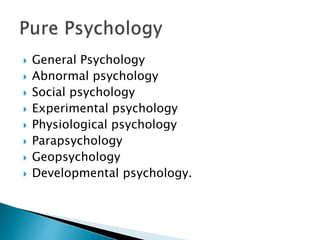
 General Psychology
 Abnormal psychology
 Social psychology
 Experimental psychology
 Physiological psychology
 Parapsychology
 Geopsychology
 Developmental psychology.
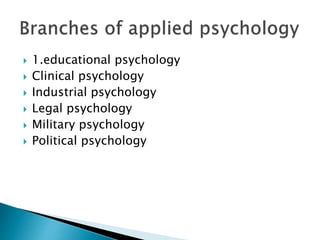
 1.educational psychology
 Clinical psychology
 Industrial psychology
 Legal psychology
 Military psychology
 Political psychology
 Unit .1.
Concept and principles of Growth and
development.
 Various aspects of human developments
 1.cognitive
 2.psychomotor
 3.affective. these are the areas we wanted to
cover.
The concept and principles of learning and
development also to be noted.
 The four units are.
 1. understanding the development of the
learner
 2. understanding the learner as a unique
individual
 3.understanding the learning process
 4. facilitating learning and development.
 It is dynamic from conception to death
undergoes changes.
 The concept of growth.
 It is quantitative change in size which
includes physical change in height, weight,
size, internal organs, etc.,
 Hair, teeth, sex, shyness, etc.,
 Body steadily becomes larger, taller, and
heavier.
 The term growth indicates an increase in
bodily dimensions.
 The rate of growth differ from one person to
another one.
 It is qualitative change taking place
simultaneously with quantitative change of
growth.
 It is defined as a progressive series of
orderly, coherent changes.
 Progressive means it is directional, that they
lead forward rather than backward.
 Orderly and coherent suggest that there is a
definite relationship between the changes
taking places and those that precede or will
follow them.
 Overall changes in an individual due to the
emergence of modified structures and
functions that are the outcome of the
interactions and exchanges between the
organism and its environment.
 It is for both scientific and practical reason .
 A knowledge of the pattern of development
will help you know what to expect from the
children.
 It will help you know approximately at what
stage behavioral changes take place and
when these pattern are generally replaced by
more mature patterns
 If too much is expected from the children
they develop a feeling of inadequacy.
 If too little is expected they do not have an
incentive to realise their potential.
 It will help the parent and teacher to guide
the children properly.
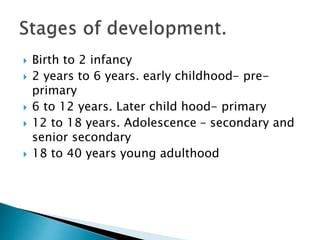
 Birth to 2 infancy
 2 years to 6 years. early childhood- pre-
primary
 6 to 12 years. Later child hood- primary
 12 to 18 years. Adolescence – secondary and
senior secondary
 18 to 40 years young adulthood
 40 to 65 years- mature adulthood
 Over 65 years- aged adulthood
 Infants during the first two weeks are called
neonates.
 Observe a child and write their bodily
movements and language expressions.
 It is preschool period.
 The scope of behavior is enlarged here.
 Love and affection are shown.
 They need socialization groups.
 Rapid expansion of cognitive abilities.
 Child seeks information's, questions etc.,
 An effort for gender identification (biology
and environment influences)
 Physical growth is initially slow.
 Intellectual, social and moral development is
high.
 Understands the meaning of laws.
 Friendship is restricted to one or two.
 They climb trees, walls etc.,
 Period of transition from childhood to
adulthood is called adolescence.
 Physical development
1. Growth Spurt.
A rapid increase in height and weight. The
growth of girls are faster than boys. By the
age of 17 and 18 girls and boys will come to
the final stage of growth.
 Rapid development of reproductive organs
that signals the sexual maturity.
 The question “who am I”
 The style of thought, imagination judgment
and insight.
 Rapid accumulation of knowledge.
 To plan and think. Develops the thinking
capacity.
 The adolescence when it is completed.
 The goal and aspirations are developed here.
 Middle life of transition.
 In women hormonal changes of menopause
generate anxiety and depression.
 Aging is a process which causes loss of
vitality.
 They are concerned more about health and
death.
 Retirement.
 Some turns to God, social work etc.,
 Development is a product of maturity and
learning.
 The first principle of human development
 1.continuity.
form conception to death it is a continuous
process.
2.Sequentiality.
It is orderly. A pattern of development is there.
 1.from head to foot.
 2.from central axis to the extrimeities of the
body.
 3ed principle
Generality to specificity.
Even you may observe the language
developments
 Boys and girls have different development
rates.
 Development is both mental and physcial
 In facilitating growth and development.
 What to expect form the child what one
needed physical, mental, social and
emotional.
 Teacher is the one who guides the nation.
 Physical, socio emotional and moral
development.
Physical development is the psychomotor
development.
For teaching learning process the children have
categorized into two groups
1.Upper primary.10-13.
2.secondary/ senior secondary.13-17.
 Children from 5 to 8/9.years show relatively
slow physical development.
 Period of adolescence starts here.
 Variability in onset and rate of puberty
 Reaction to puberty
 Early and late maturing.
 Upper primary school children.
First – parents and family.
Second – peer group
Third- is the school experience.
Here the children prove that they can do
something . “ I can do it by myself”
 In pre- adolescents generally they are happy
and optimistic.
 They have the fear.
 Not having a best friend.
 Being punished by their parents.
 Not doing well at school
 Getting hurt.
 1.emotions are intense
 2. emotions appear frequently
 3. emotions are transitory
 4. responses reflect individuality
 5. emotions change in strength.
 6. emotions can be detected by behaviour
symtoms
 Who am I
 And What
 This will be there in their personality.
 Sense of identity
 Autonomy
 Conformity
 Interpersonal development
 Intimacy
 Peer relations
 Dating
 Emotional disorder
 Drug and alcohol abuse
 Pregnancy
 Piaget’s view.
 1. Anomy 1-5 age the stage with out law. this
period to them is amoral.
 They controls the behavior only from pain
and pleasure.
 2.heteronomy5-8- authority.
 The moral development is controlled by
external authority. Rewards and punishments
regulate moral development.
 3. Heteronomy 9-13 – reciprocity. There is
the morality of cooperation with peers or
equals.
 Should not do what is offensive to others.
 The individual at this stage is fully
responsible for his/her behavior.
 Regular health education programmes.
 Practical education about physical growth
 Educational implication of emotional
development.
 Cognitive and Language development.
 Here child’s thinking and cognition is
studied.
 So cognitive development means how
knowledge is acquired and developed
through successive stages and at various age
levels.
 Theory of cognition is also called genetic
epistemology.
 Piaget’s concept of cognitive development.
Assimilation= taking in or absorbing.
Accommodation = making room for incoming
information's.
 Take the page 37.
 It is inquiry oriented method- also known as
clinical method.
 1.internal readiness.
 2.enviornmental experience
 3.social experience
 4.equilibration.
 It is also known as lateral thinking. Think in
unusual, novel and unique ways. It is original
way of enquiry.
 It will lead to creativity.
 1.flency.
 2.flexibility.
 3.originality.
 4.elaboration.
 Original thought
 Asks disturbing questions
 Argues for the view points
 Propose alternative solution
 Risk taking mentality
 Self concept is high
 More tolerant of ambiguity
 Curiosity and independent judgment
 Give divergent questions
 Encourage all the answers
 Encourage innovation
 Develop sprit of inquiry
 Encourage the creative efforts
 Give inter disciplinary activities
 Use the teaching aids to foster imagination.
 Avoid premature evaluation.
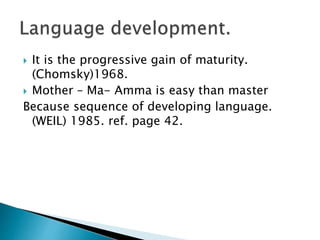
 It is the progressive gain of maturity.
(Chomsky)1968.
 Mother – Ma- Amma is easy than master
Because sequence of developing language.
(WEIL) 1985. ref. page 42.
 Factors Influencing Development of
Personality
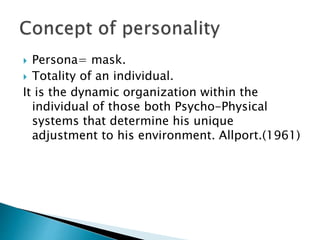
 Persona= mask.
 Totality of an individual.
It is the dynamic organization within the
individual of those both Psycho-Physical
systems that determine his unique
adjustment to his environment. Allport.(1961)
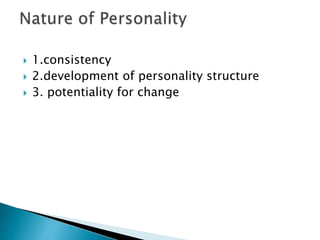
 1.consistency
 2.development of personality structure
 3. potentiality for change
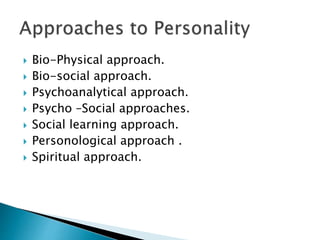
 Bio-Physical approach.
 Bio-social approach.
 Psychoanalytical approach.
 Psycho –Social approaches.
 Social learning approach.
 Personological approach .
 Spiritual approach.
 1. Heredity.
 2.Envirmental factors.
Page 55.
 Films
 Television
 Radio
 Newspaper
 Magazines
 Teacher is the one to give the positive
regards.
 Be a friend, philosopher and a guide.
 Individual difference and cognitive domain.
the concept. Each one is different .some are
physically good
Mentally good
Emotionally good. Influenced personalities of
the world.
 Intelligence is the global or aggregate
capacity of an individual to act purposefully,
to think rationally and to deal effectively with
the enviornment.
 1.Psychometric Approach.
measuring difference in intellectual abilities.
Abstract thoughts------------ learning
ability------------- adaptability.
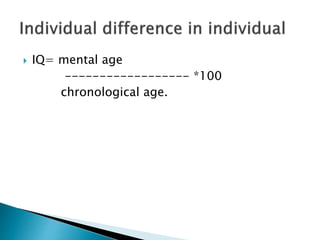
 IQ= mental age
------------------ *100
chronological age.
 It is the set of abilities essential for acquiring
knowledge and skills specific to an area of
performance.
 Specialized activity is performed by it.
 It is the intellectual process of relation.
 They are memory process, restructuring
symbols and ideas, perception of relation and
pattern between ideas, spatial
comprehension, reasoning, problem solving,
judgment etc.,
 How to handle such students. P.13.
 1.encourage unusual or odd questions
 2. provide activities to promote creative
thinking abilities
 3. organize brainstorming sessions
 4. Use synectics.
 5.provide students situation to evaluate their
own ideas and thinking.
 6 extra credit for creative thinking.
 It is the mark scored in subject or subjects.
 (it is the value of the knowledge and
capabilities attained)
 Schema= knowledge structure created by
student in their memory.
 Knowledge structure is the internal
representation of the external realities.
 Progressive difference in knowledge
attainment leads to cumulative difference in
knowledge attainment this form of difference
is called Mathew Effect. It means academically
rich get richer and those who are poor
continue to be poor.
 Provide appropriate pre-requisites to
organize and learn information.
 Use visual aids.
 Use analogy, example and illustration.
 Ensure learner’s active involvement in
learning.
 Individual difference affective Domain.
 The success of the teacher is on the extend
she can make her students what they are
expected to do.
 What a child want to do and will not do.
 It has an influence on human behaviour.
 It has both subjective and objective aspect.
 Subjective is feeling components.
 It is the motor behaviour of the individual.
Page.26.
 It is a personality trait which indicates
individuals like or dislikes.
 Nature and development of value.
 Every individual is different but the nation is
same, value never chanes.
 Those who are having social skills will adjust
with the socity.
 To judge that whether the student is socially
adjusted or not.
 1 overt performance
2 adjustment to different group
 3 social attitudes
 Personal satisfaction.
 It is the total view by oneself.
 I orME . What is your self concept.
 It refers the why of the behavior.
 Physiological need- need of food, drink, sleep
 Need for safety- desire of security, family
stability.
 Need for love and belongingness- need for
affection
 Need for self- esteem
 Need for self-actualization
 Need to know
 Aesthetic need.
 Differences in intelligence and the more
narrowly defined intellectual process such as
memory, judgment, and problem solving
 On the basis of caste, age, socio economic
status.
 Difference in terms of age
 Difference in terms of cast
 Difference in terms of socio economic status
 Difference in terms of personality.
 To the female child
 Factors producing individual difference.
 Heredity and enviornment

Psychology of development and learning

  • 1.
  • 2.
     It isan offshoot of philosophy.  Defining psychology.  Etymologically the very word psychology means the study of the soul.  Greek word psyche, meaning soul and logos signifying a rational course of study.
  • 3.
     What ismind how it can be studied. Then it also rejected.
  • 4.
     In 1890William James in his book Principles of Psychology as “the description and explanation of state of consciousness as such”
  • 5.
     He establishedfirst psychology laboratory at the university of Leipzig in Germany.
  • 6.
     William McDougalla British Psychologist defined psychology as a science of behavior.  Behavior is the activities of a human being.  It is motor or cognitive or affective activities.
  • 7.
     Animal, insects,birds and even plants.
  • 8.
     General Psychology Abnormal psychology  Social psychology  Experimental psychology  Physiological psychology  Parapsychology  Geopsychology  Developmental psychology.
  • 9.
     1.educational psychology Clinical psychology  Industrial psychology  Legal psychology  Military psychology  Political psychology
  • 10.
     Unit .1. Conceptand principles of Growth and development.
  • 11.
     Various aspectsof human developments  1.cognitive  2.psychomotor  3.affective. these are the areas we wanted to cover. The concept and principles of learning and development also to be noted.
  • 12.
     The fourunits are.  1. understanding the development of the learner  2. understanding the learner as a unique individual  3.understanding the learning process  4. facilitating learning and development.
  • 13.
     It isdynamic from conception to death undergoes changes.
  • 14.
     The conceptof growth.  It is quantitative change in size which includes physical change in height, weight, size, internal organs, etc.,
  • 15.
     Hair, teeth,sex, shyness, etc.,  Body steadily becomes larger, taller, and heavier.  The term growth indicates an increase in bodily dimensions.  The rate of growth differ from one person to another one.
  • 16.
     It isqualitative change taking place simultaneously with quantitative change of growth.  It is defined as a progressive series of orderly, coherent changes.  Progressive means it is directional, that they lead forward rather than backward.
  • 17.
     Orderly andcoherent suggest that there is a definite relationship between the changes taking places and those that precede or will follow them.
  • 18.
     Overall changesin an individual due to the emergence of modified structures and functions that are the outcome of the interactions and exchanges between the organism and its environment.
  • 19.
     It isfor both scientific and practical reason .  A knowledge of the pattern of development will help you know what to expect from the children.  It will help you know approximately at what stage behavioral changes take place and when these pattern are generally replaced by more mature patterns
  • 20.
     If toomuch is expected from the children they develop a feeling of inadequacy.  If too little is expected they do not have an incentive to realise their potential.
  • 21.
     It willhelp the parent and teacher to guide the children properly.
  • 22.
     Birth to2 infancy  2 years to 6 years. early childhood- pre- primary  6 to 12 years. Later child hood- primary  12 to 18 years. Adolescence – secondary and senior secondary  18 to 40 years young adulthood
  • 23.
     40 to65 years- mature adulthood  Over 65 years- aged adulthood
  • 24.
     Infants duringthe first two weeks are called neonates.  Observe a child and write their bodily movements and language expressions.
  • 25.
     It ispreschool period.  The scope of behavior is enlarged here.  Love and affection are shown.  They need socialization groups.  Rapid expansion of cognitive abilities.  Child seeks information's, questions etc.,  An effort for gender identification (biology and environment influences)
  • 26.
     Physical growthis initially slow.  Intellectual, social and moral development is high.  Understands the meaning of laws.  Friendship is restricted to one or two.  They climb trees, walls etc.,
  • 27.
     Period oftransition from childhood to adulthood is called adolescence.  Physical development 1. Growth Spurt. A rapid increase in height and weight. The growth of girls are faster than boys. By the age of 17 and 18 girls and boys will come to the final stage of growth.
  • 28.
     Rapid developmentof reproductive organs that signals the sexual maturity.
  • 29.
     The question“who am I”
  • 30.
     The styleof thought, imagination judgment and insight.  Rapid accumulation of knowledge.  To plan and think. Develops the thinking capacity.
  • 31.
     The adolescencewhen it is completed.  The goal and aspirations are developed here.
  • 32.
     Middle lifeof transition.  In women hormonal changes of menopause generate anxiety and depression.
  • 33.
     Aging isa process which causes loss of vitality.  They are concerned more about health and death.  Retirement.  Some turns to God, social work etc.,
  • 34.
     Development isa product of maturity and learning.  The first principle of human development  1.continuity. form conception to death it is a continuous process. 2.Sequentiality. It is orderly. A pattern of development is there.
  • 35.
     1.from headto foot.  2.from central axis to the extrimeities of the body.  3ed principle Generality to specificity. Even you may observe the language developments
  • 36.
     Boys andgirls have different development rates.  Development is both mental and physcial
  • 37.
     In facilitatinggrowth and development.  What to expect form the child what one needed physical, mental, social and emotional.  Teacher is the one who guides the nation.
  • 38.
     Physical, socioemotional and moral development. Physical development is the psychomotor development. For teaching learning process the children have categorized into two groups 1.Upper primary.10-13. 2.secondary/ senior secondary.13-17.
  • 39.
     Children from5 to 8/9.years show relatively slow physical development.
  • 40.
     Period ofadolescence starts here.  Variability in onset and rate of puberty  Reaction to puberty  Early and late maturing.
  • 41.
     Upper primaryschool children. First – parents and family. Second – peer group Third- is the school experience. Here the children prove that they can do something . “ I can do it by myself”
  • 42.
     In pre-adolescents generally they are happy and optimistic.  They have the fear.  Not having a best friend.  Being punished by their parents.  Not doing well at school  Getting hurt.
  • 43.
     1.emotions areintense  2. emotions appear frequently  3. emotions are transitory  4. responses reflect individuality  5. emotions change in strength.  6. emotions can be detected by behaviour symtoms
  • 44.
     Who amI  And What  This will be there in their personality.  Sense of identity  Autonomy  Conformity  Interpersonal development
  • 45.
     Intimacy  Peerrelations  Dating  Emotional disorder  Drug and alcohol abuse  Pregnancy
  • 46.
     Piaget’s view. 1. Anomy 1-5 age the stage with out law. this period to them is amoral.  They controls the behavior only from pain and pleasure.
  • 47.
     2.heteronomy5-8- authority. The moral development is controlled by external authority. Rewards and punishments regulate moral development.  3. Heteronomy 9-13 – reciprocity. There is the morality of cooperation with peers or equals.  Should not do what is offensive to others.
  • 48.
     The individualat this stage is fully responsible for his/her behavior.
  • 49.
     Regular healtheducation programmes.  Practical education about physical growth
  • 50.
     Educational implicationof emotional development.
  • 51.
     Cognitive andLanguage development.  Here child’s thinking and cognition is studied.  So cognitive development means how knowledge is acquired and developed through successive stages and at various age levels.
  • 52.
     Theory ofcognition is also called genetic epistemology.  Piaget’s concept of cognitive development. Assimilation= taking in or absorbing. Accommodation = making room for incoming information's.
  • 53.
     Take thepage 37.
  • 54.
     It isinquiry oriented method- also known as clinical method.
  • 55.
     1.internal readiness. 2.enviornmental experience  3.social experience  4.equilibration.
  • 56.
     It isalso known as lateral thinking. Think in unusual, novel and unique ways. It is original way of enquiry.  It will lead to creativity.
  • 57.
     1.flency.  2.flexibility. 3.originality.  4.elaboration.
  • 58.
     Original thought Asks disturbing questions  Argues for the view points  Propose alternative solution  Risk taking mentality  Self concept is high  More tolerant of ambiguity  Curiosity and independent judgment
  • 59.
     Give divergentquestions  Encourage all the answers  Encourage innovation  Develop sprit of inquiry  Encourage the creative efforts  Give inter disciplinary activities  Use the teaching aids to foster imagination.  Avoid premature evaluation.
  • 60.
     It isthe progressive gain of maturity. (Chomsky)1968.  Mother – Ma- Amma is easy than master Because sequence of developing language. (WEIL) 1985. ref. page 42.
  • 61.
     Factors InfluencingDevelopment of Personality
  • 62.
     Persona= mask. Totality of an individual. It is the dynamic organization within the individual of those both Psycho-Physical systems that determine his unique adjustment to his environment. Allport.(1961)
  • 63.
     1.consistency  2.developmentof personality structure  3. potentiality for change
  • 64.
     Bio-Physical approach. Bio-social approach.  Psychoanalytical approach.  Psycho –Social approaches.  Social learning approach.  Personological approach .  Spiritual approach.
  • 65.
     1. Heredity. 2.Envirmental factors. Page 55.
  • 66.
     Films  Television Radio  Newspaper  Magazines
  • 67.
     Teacher isthe one to give the positive regards.  Be a friend, philosopher and a guide.
  • 68.
     Individual differenceand cognitive domain.
  • 69.
    the concept. Eachone is different .some are physically good Mentally good Emotionally good. Influenced personalities of the world.
  • 70.
     Intelligence isthe global or aggregate capacity of an individual to act purposefully, to think rationally and to deal effectively with the enviornment.
  • 71.
     1.Psychometric Approach. measuringdifference in intellectual abilities. Abstract thoughts------------ learning ability------------- adaptability.
  • 72.
     IQ= mentalage ------------------ *100 chronological age.
  • 73.
     It isthe set of abilities essential for acquiring knowledge and skills specific to an area of performance.  Specialized activity is performed by it.
  • 74.
     It isthe intellectual process of relation.  They are memory process, restructuring symbols and ideas, perception of relation and pattern between ideas, spatial comprehension, reasoning, problem solving, judgment etc.,
  • 75.
     How tohandle such students. P.13.
  • 76.
     1.encourage unusualor odd questions  2. provide activities to promote creative thinking abilities  3. organize brainstorming sessions  4. Use synectics.  5.provide students situation to evaluate their own ideas and thinking.  6 extra credit for creative thinking.
  • 77.
     It isthe mark scored in subject or subjects.  (it is the value of the knowledge and capabilities attained)
  • 78.
     Schema= knowledgestructure created by student in their memory.  Knowledge structure is the internal representation of the external realities.
  • 79.
     Progressive differencein knowledge attainment leads to cumulative difference in knowledge attainment this form of difference is called Mathew Effect. It means academically rich get richer and those who are poor continue to be poor.
  • 80.
     Provide appropriatepre-requisites to organize and learn information.  Use visual aids.  Use analogy, example and illustration.  Ensure learner’s active involvement in learning.
  • 81.
     Individual differenceaffective Domain.  The success of the teacher is on the extend she can make her students what they are expected to do.  What a child want to do and will not do.
  • 82.
     It hasan influence on human behaviour.  It has both subjective and objective aspect.  Subjective is feeling components.  It is the motor behaviour of the individual. Page.26.
  • 83.
     It isa personality trait which indicates individuals like or dislikes.
  • 84.
     Nature anddevelopment of value.  Every individual is different but the nation is same, value never chanes.
  • 85.
     Those whoare having social skills will adjust with the socity.
  • 86.
     To judgethat whether the student is socially adjusted or not.  1 overt performance 2 adjustment to different group  3 social attitudes  Personal satisfaction.
  • 87.
     It isthe total view by oneself.  I orME . What is your self concept.
  • 88.
     It refersthe why of the behavior.
  • 89.
     Physiological need-need of food, drink, sleep  Need for safety- desire of security, family stability.  Need for love and belongingness- need for affection  Need for self- esteem  Need for self-actualization  Need to know  Aesthetic need.
  • 90.
     Differences inintelligence and the more narrowly defined intellectual process such as memory, judgment, and problem solving
  • 91.
     On thebasis of caste, age, socio economic status.
  • 92.
     Difference interms of age  Difference in terms of cast  Difference in terms of socio economic status  Difference in terms of personality.
  • 93.
     To thefemale child
  • 94.
     Factors producingindividual difference.  Heredity and enviornment