Gramática Libro By Jeremías Moss
Table of Contents Present Tense Stem Changers Irregular “Yo” Form Saber Vs. Conocer Reflexive Verbs “ Se” Impersonal Verbs Similar to Gustar Irregular Verbs Ending in -guir/-uir, -ger/-gir, & -cer/-cir Hacer Expression Imperfect Irregular Trigger Words Preterite Tense  Irregular (-car/gar/zar, spock, cucarcha, & snake/snakeys) Trigger Words Comparatives/Superlatives Future Irregular Trigger Words
Present Tense Used to express a past action that continues to have importance until the present.  -ar Nadar (to swim)- nado, nadas, nada, nadamos, nadàis, nadan -er Comer (to eat)- como, comes, come, comemos, coméis, comen -ir Vivir (to live)- vivo, vives, vive, vivimos, vivis, viven
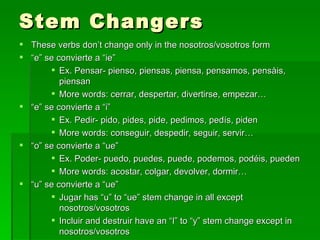
Stem Changers These verbs don’t change only in the nosotros/vosotros form “ e” se convierte a “ie” Ex. Pensar- pienso, piensas, piensa, pensamos, pensàis, piensan More words: cerrar, despertar, divertirse, empezar… “ e” se convierte a “i” Ex. Pedir- pido, pides, pide, pedimos, pedís, piden More words: conseguir, despedir, seguir, servir… “ o” se convierte a “ue” Ex. Poder- puedo, puedes, puede, podemos, podéis, pueden More words: acostar, colgar, devolver, dormir… “ u” se convierte a “ue” Jugar has “u” to “ue” stem change in all except nosotros/vosotros Incluir and destruir have an “I” to “y” stem change except in nosotros/vosotros
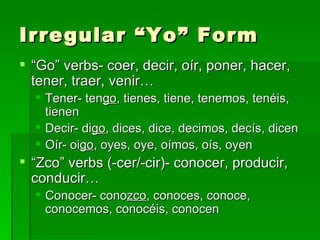
Irregular “Yo” Form “ Go” verbs- coer, decir, oír, poner, hacer, tener, traer, venir… Tener- ten go , tienes, tiene, tenemos, tenéis, tienen Decir- di go , dices, dice, decimos, decís, dicen Oír- oi go , oyes, oye, oímos, oís, oyen “ Zco” verbs (-cer/-cir)- conocer, producir, conducir… Conocer- cono zco , conoces, conoce, conocemos, conocéis, conocen
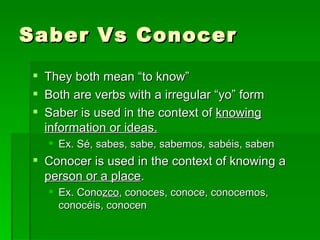
Saber Vs Conocer They both mean “to know” Both are verbs with a irregular “yo” form Saber is used in the context of  knowing information or ideas. Ex. Sé, sabes, sabe, sabemos, sabéis, saben Conocer is used in the context of knowing a  person or a place .  Ex. Cono zco , conoces, conoce, conocemos, conocéis, conocen
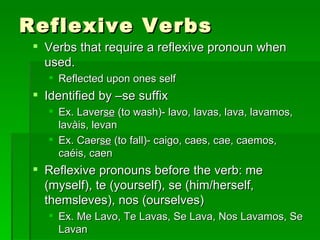
Reflexive Verbs Verbs that require a reflexive pronoun when used. Reflected upon ones self  Identified by –se suffix Ex. Laver se  (to wash)- lavo, lavas, lava, lavamos, lavàis, levan Ex. Caer se  (to fall)- caigo, caes, cae, caemos, caéis, caen Reflexive pronouns before the verb: me (myself), te (yourself), se (him/herself, themsleves), nos (ourselves) Ex. Me Lavo, Te Lavas, Se Lava, Nos Lavamos, Se Lavan
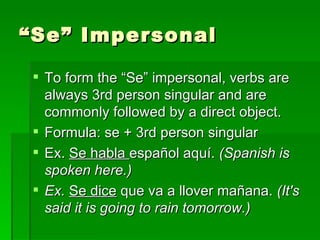
“ Se” Impersonal To form the “Se” impersonal, verbs are always 3rd person singular and are commonly followed by a direct object. Formula: se + 3rd person singular Ex.  Se habla  español aquí.  (Spanish is spoken here.) Ex.  Se dice  que va a llover mañana.  (It's said it is going to rain tomorrow.)
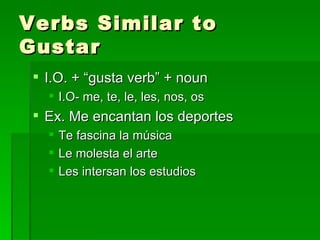
Verbs Similar to Gustar I.O. + “gusta verb” + noun I.O- me, te, le, les, nos, os Ex. Me encantan los deportes Te fascina la música Le molesta el arte Les intersan los estudios
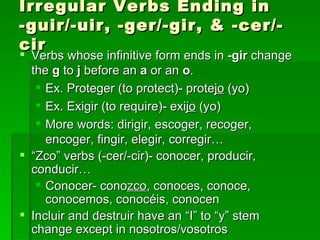
Irregular Verbs Ending in -guir/-uir, -ger/-gir, & -cer/-cir Verbs whose infinitive form ends in  -gir  change the  g  to  j  before an  a  or an  o .  Ex. Proteger (to protect)- prote jo  (yo) Ex. Exigir (to require)- exi jo  (yo) More words: dirigir, escoger, recoger, encoger, fingir, elegir, corregir… “ Zco” verbs (-cer/-cir)- conocer, producir, conducir… Conocer- cono zco , conoces, conoce, conocemos, conocéis, conocen Incluir and destruir have an “I” to “y” stem change except in nosotros/vosotros
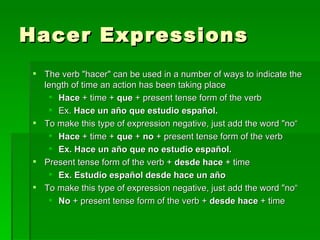
Hacer Expressions The verb "hacer" can be used in a number of ways to indicate the length of time an action has been taking place Hace  + time +  que  + present tense form of the verb Ex.  Hace un año que estudio español. To make this type of expression negative, just add the word "no“ Hace  + time +  que  +  no  + present tense form of the verb Ex. Hace un año que no estudio español. Present tense form of the verb +  desde hace  + time Ex. Estudio español desde hace un año To make this type of expression negative, just add the word "no“ No  + present tense form of the verb +  desde hace  + time
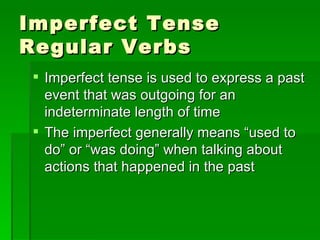
Imperfect Tense Regular Verbs Imperfect tense is used to express a past event that was outgoing for an indeterminate length of time The imperfect generally means “used to do” or “was doing” when talking about actions that happened in the past
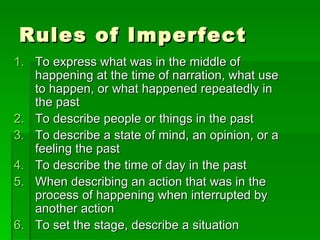
Rules of Imperfect To express what was in the middle of happening at the time of narration, what use to happen, or what happened repeatedly in the past To describe people or things in the past To describe a state of mind, an opinion, or a feeling the past To describe the time of day in the past When describing an action that was in the process of happening when interrupted by another action To set the stage, describe a situation
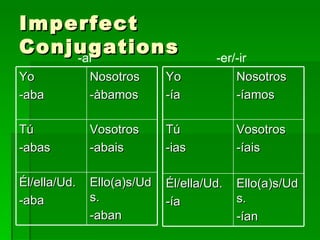
Imperfect Conjugations  -ar -er/-ir Yo  -aba Nosotros -àbamos Tú  -abas Vosotros -abais Él/ella/Ud. -aba Ello(a)s/Uds. -aban Yo  -ía Nosotros -íamos Tú -ias  Vosotros -íais Él/ella/Ud. -ía Ello(a)s/Uds. -ían
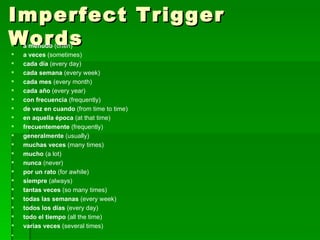
Imperfect Trigger Words a menudo  (often)  a veces  (sometimes)  cada día  (every day)  cada semana  (every week)  cada mes  (every month)  cada año  (every year)  con frecuencia  (frequently)  de vez en cuando  (from time to time)  en aquella época  (at that time)  frecuentemente  (frequently)  generalmente  (usually)  muchas veces  (many times)  mucho  (a lot)  nunca  (never)  por un rato  (for awhile)  siempre  (always)  tantas veces  (so many times)  todas las semanas  (every week)  todos los días  (every day)  todo el tiempo  (all the time)  varias veces  (several times)
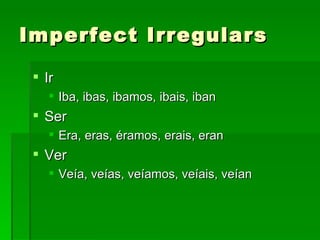
Imperfect Irregulars Ir Iba, ibas, ibamos, ibais, iban Ser Era, eras, éramos, erais, eran Ver Veía, veías, veíamos, veíais, veían
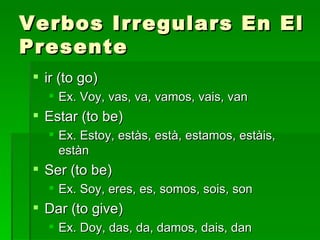
Verbos Irregulars En El Presente ir (to go) Ex. Voy, vas, va, vamos, vais, van Estar (to be) Ex. Estoy, estàs, està, estamos, estàis, estàn Ser (to be) Ex. Soy, eres, es, somos, sois, son Dar (to give) Ex. Doy, das, da, damos, dais, dan
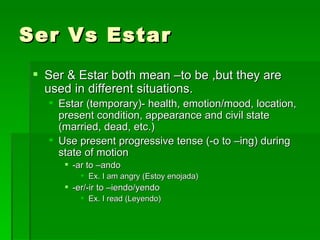
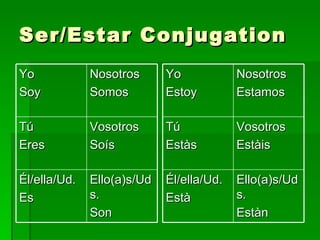
Ser Vs Estar Ser & Estar both mean –to be ,but they are used in different situations. Estar (temporary)- health, emotion/mood, location, present condition, appearance and civil state (married, dead, etc.) Use present progressive tense (-o to –ing) during state of motion -ar to –ando  Ex. I am angry (Estoy enojada) -er/-ir to –iendo/yendo Ex. I read (Leyendo)
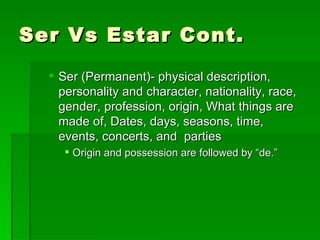
Ser Vs Estar Cont. Ser (Permanent)- physical description, personality and character, nationality, race, gender, profession, origin, What things are made of, Dates, days, seasons, time, events, concerts, and  parties  Origin and possession are followed by “de.”
Ser/Estar Conjugation Yo Soy Nosotros Somos Tú  Eres Vosotros Soís Él/ella/Ud. Es Ello(a)s/Uds. Son  Yo Estoy Nosotros Estamos Tú  Estàs Vosotros Estàis Él/ella/Ud. Està Ello(a)s/Uds. Estàn
Ser/Estar Rap http:// www.youtube.com/watch?feature = player_detailpage&v =lY10_T_ROq4
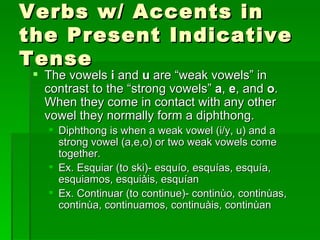
Verbs w/ Accents in the Present Indicative Tense The vowels  i  and  u  are “weak vowels” in contrast to the “strong vowels”  a ,  e , and  o . When they come in contact with any other vowel they normally form a diphthong. Diphthong is when a weak vowel (i/y, u) and a strong vowel (a,e,o) or two weak vowels come together. Ex. Esquiar (to ski)- esquío, esquías, esquía, esquiamos, esquiàis, esquían Ex. Continuar (to continue)- continùo, continùas, continùa, continuamos, continuàis, continùan
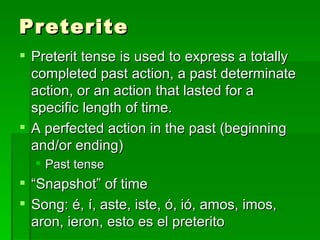
Preterite Preterit tense is used to express a totally completed past action, a past determinate action, or an action that lasted for a specific length of time. A perfected action in the past (beginning and/or ending) Past tense “ Snapshot” of time Song: é, í, aste, iste, ó, ió, amos, imos, aron, ieron, esto es el preterito
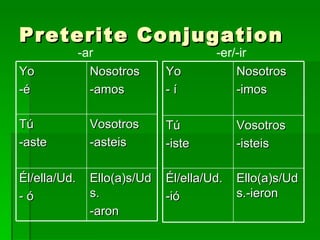
Preterite Conjugation  -ar -er/-ir Yo -é Nosotros -amos Tú  -aste Vosotros -asteis Él/ella/Ud. - ó Ello(a)s/Uds. -aron Yo - í Nosotros -imos Tú  -iste Vosotros -isteis Él/ella/Ud. -ió Ello(a)s/Uds.-ieron
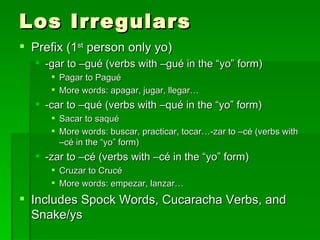
Los Irregulars Prefix (1 st  person only yo) -gar to –gué (verbs with –gué in the “yo” form) Pagar to Pagué More words: apagar, jugar, llegar… -car to –qué (verbs with –qué in the “yo” form) Sacar to saqué More words: buscar, practicar, tocar…-zar to –cé (verbs with –cé in the “yo” form) -zar to –cé (verbs with –cé in the “yo” form) Cruzar to Crucé More words: empezar, lanzar… Includes Spock Words, Cucaracha Verbs, and Snake/ys
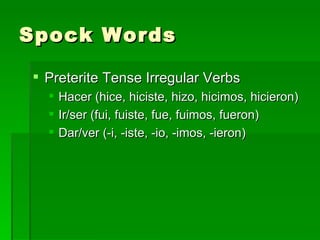
Spock Words Preterite Tense Irregular Verbs  Hacer (hice, hiciste, hizo, hicimos, hicieron) Ir/ser (fui, fuiste, fue, fuimos, fueron) Dar/ver (-i, -iste, -io, -imos, -ieron)
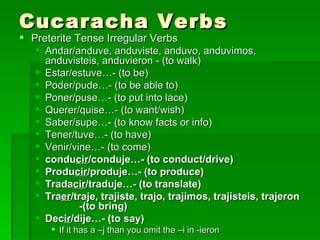
Cucaracha Verbs Preterite Tense Irregular Verbs Andar/anduve, anduviste, anduvo, anduvimos, anduvisteis, anduvieron - (to walk) Estar/estuve…- (to be) Poder/pude…- (to be able to) Poner/puse…- (to put into lace) Querer/quise…- (to want/wish) Saber/supe…- (to know facts or info) Tener/tuve…- (to have) Venir/vine…- (to come) condu cir /conduje…- (to conduct/drive) Produ cir /produje…- (to produce) Trada cir /traduje…- (to translate) Tra er /traje, trajiste, trajo, trajimos, trajisteis, trajeron  -(to bring) Dec ir /dije…- (to say) If it has a –j than you omit the –i in -ieron
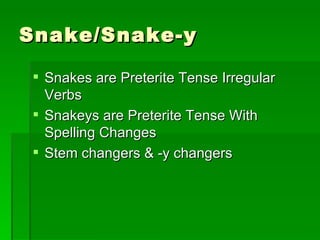
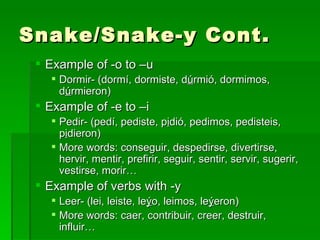
Snake/Snake-y Snakes are Preterite Tense Irregular Verbs  Snakeys are Preterite Tense With Spelling Changes Stem changers & -y changers
Snake/Snake-y Cont.  Example of -o to –u Dormir- (dormí, dormiste, d ú rmió, dormimos, d ú rmieron) Example of -e to –i Pedir- (pedí, pediste, p i dió, pedimos, pedisteis, p i dieron) More words: conseguir, despedirse, divertirse, hervir, mentir, prefirir, seguir, sentir, servir, sugerir, vestirse, morir… Example of verbs with -y  Leer- (lei, leiste, le ý o, leimos, le ý eron) More words: caer, contribuir, creer, destruir, influir…
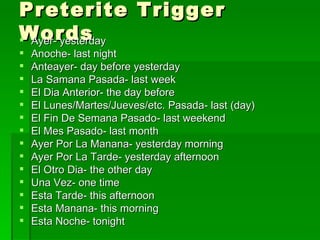
Preterite Trigger Words Ayer- yesterday Anoche- last night Anteayer- day before yesterday La Samana Pasada- last week El Dia Anterior- the day before El Lunes/Martes/Jueves/etc. Pasada- last (day) El Fin De Semana Pasado- last weekend El Mes Pasado- last month Ayer Por La Manana- yesterday morning Ayer Por La Tarde- yesterday afternoon El Otro Dia- the other day Una Vez- one time Esta Tarde- this afternoon Esta Manana- this morning Esta Noche- tonight
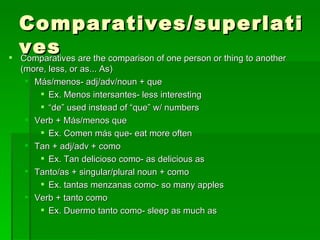
Comparatives/superlatives Comparatives are the comparison of one person or thing to another (more, less, or as... As) M ás/menos- adj/adv/noun + que Ex. Menos intersantes- less interesting “ de” used instead of “que” w/ numbers Verb +  M ás/menos que Ex. Comen m ás que- eat more often Tan + adj/adv + como Ex. Tan delicioso como- as delicious as Tanto/as + singular/plural noun + como Ex. tantas menzanas como- so many apples Verb + tanto como Ex. Duermo tanto como- sleep as much as
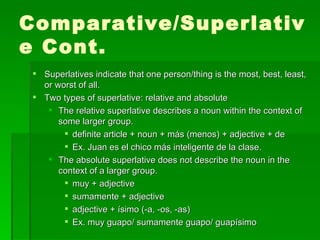
Comparative/Superlative Cont. Superlatives indicate that one person/thing is the most, best, least, or worst of all. Two types of superlative: relative and absolute The relative superlative describes a noun within the context of some larger group. definite article + noun + más (menos) + adjective + de Ex. Juan es el chico más inteligente de la clase. The absolute superlative does not describe the noun in the context of a larger group. muy + adjective sumamente + adjective adjective + ísimo (-a, -os, -as) Ex.  muy guapo/ sumamente guapo/ guapísimo
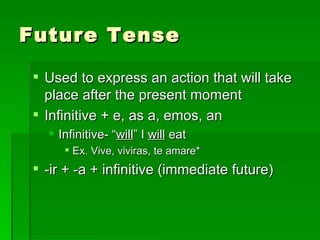
Future Tense Used to express an action that will take place after the present moment  Infinitive + e, as a, emos, an Infinitive- “ will ” I  will  eat Ex. Vive, viviras, te amare* -ir + -a + infinitive (immediate future)
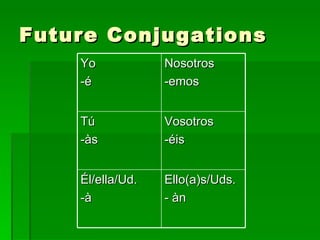
Future Conjugations Yo -é Nosotros -emos Tú  -às Vosotros -éis Él/ella/Ud. -à Ello(a)s/Uds. - àn
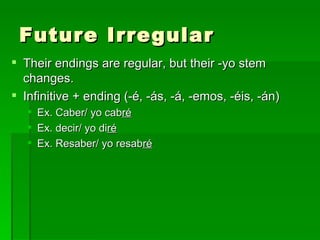
Future Irregular Their endings are regular, but their -yo stem changes. Infinitive + ending (-é, -ás, -á, -emos, -éis, -án) Ex. Caber/ yo cab ré Ex. decir/ yo di ré Ex. Resaber/ yo resab ré
Future Irregular Tense Tener (to have): tendré, tendràs, tendrà, tendremos, tendréis, tendràn Decir (to say): dir- Hacer (to do): har- Haber (to have): habr- Saber (to know): sabr- Poder (to be able to): podr- Querer (to want): querr- Salir (to exit): saldr- Poner (to place): pondr- Venir (to come): vendr-

Preterite[1]

  • 1.
    Gramática Libro ByJeremías Moss
  • 2.
    Table of ContentsPresent Tense Stem Changers Irregular “Yo” Form Saber Vs. Conocer Reflexive Verbs “ Se” Impersonal Verbs Similar to Gustar Irregular Verbs Ending in -guir/-uir, -ger/-gir, & -cer/-cir Hacer Expression Imperfect Irregular Trigger Words Preterite Tense Irregular (-car/gar/zar, spock, cucarcha, & snake/snakeys) Trigger Words Comparatives/Superlatives Future Irregular Trigger Words
  • 3.
    Present Tense Usedto express a past action that continues to have importance until the present. -ar Nadar (to swim)- nado, nadas, nada, nadamos, nadàis, nadan -er Comer (to eat)- como, comes, come, comemos, coméis, comen -ir Vivir (to live)- vivo, vives, vive, vivimos, vivis, viven
  • 4.
    Stem Changers Theseverbs don’t change only in the nosotros/vosotros form “ e” se convierte a “ie” Ex. Pensar- pienso, piensas, piensa, pensamos, pensàis, piensan More words: cerrar, despertar, divertirse, empezar… “ e” se convierte a “i” Ex. Pedir- pido, pides, pide, pedimos, pedís, piden More words: conseguir, despedir, seguir, servir… “ o” se convierte a “ue” Ex. Poder- puedo, puedes, puede, podemos, podéis, pueden More words: acostar, colgar, devolver, dormir… “ u” se convierte a “ue” Jugar has “u” to “ue” stem change in all except nosotros/vosotros Incluir and destruir have an “I” to “y” stem change except in nosotros/vosotros
  • 5.
    Irregular “Yo” Form“ Go” verbs- coer, decir, oír, poner, hacer, tener, traer, venir… Tener- ten go , tienes, tiene, tenemos, tenéis, tienen Decir- di go , dices, dice, decimos, decís, dicen Oír- oi go , oyes, oye, oímos, oís, oyen “ Zco” verbs (-cer/-cir)- conocer, producir, conducir… Conocer- cono zco , conoces, conoce, conocemos, conocéis, conocen
  • 6.
    Saber Vs ConocerThey both mean “to know” Both are verbs with a irregular “yo” form Saber is used in the context of knowing information or ideas. Ex. Sé, sabes, sabe, sabemos, sabéis, saben Conocer is used in the context of knowing a person or a place . Ex. Cono zco , conoces, conoce, conocemos, conocéis, conocen
  • 7.
    Reflexive Verbs Verbsthat require a reflexive pronoun when used. Reflected upon ones self Identified by –se suffix Ex. Laver se (to wash)- lavo, lavas, lava, lavamos, lavàis, levan Ex. Caer se (to fall)- caigo, caes, cae, caemos, caéis, caen Reflexive pronouns before the verb: me (myself), te (yourself), se (him/herself, themsleves), nos (ourselves) Ex. Me Lavo, Te Lavas, Se Lava, Nos Lavamos, Se Lavan
  • 8.
    “ Se” ImpersonalTo form the “Se” impersonal, verbs are always 3rd person singular and are commonly followed by a direct object. Formula: se + 3rd person singular Ex. Se habla español aquí. (Spanish is spoken here.) Ex. Se dice que va a llover mañana. (It's said it is going to rain tomorrow.)
  • 9.
    Verbs Similar toGustar I.O. + “gusta verb” + noun I.O- me, te, le, les, nos, os Ex. Me encantan los deportes Te fascina la música Le molesta el arte Les intersan los estudios
  • 10.
    Irregular Verbs Endingin -guir/-uir, -ger/-gir, & -cer/-cir Verbs whose infinitive form ends in -gir change the g to j before an a or an o . Ex. Proteger (to protect)- prote jo (yo) Ex. Exigir (to require)- exi jo (yo) More words: dirigir, escoger, recoger, encoger, fingir, elegir, corregir… “ Zco” verbs (-cer/-cir)- conocer, producir, conducir… Conocer- cono zco , conoces, conoce, conocemos, conocéis, conocen Incluir and destruir have an “I” to “y” stem change except in nosotros/vosotros
  • 11.
    Hacer Expressions Theverb "hacer" can be used in a number of ways to indicate the length of time an action has been taking place Hace + time + que + present tense form of the verb Ex. Hace un año que estudio español. To make this type of expression negative, just add the word "no“ Hace + time + que + no + present tense form of the verb Ex. Hace un año que no estudio español. Present tense form of the verb + desde hace + time Ex. Estudio español desde hace un año To make this type of expression negative, just add the word "no“ No + present tense form of the verb + desde hace + time
  • 12.
    Imperfect Tense RegularVerbs Imperfect tense is used to express a past event that was outgoing for an indeterminate length of time The imperfect generally means “used to do” or “was doing” when talking about actions that happened in the past
  • 13.
    Rules of ImperfectTo express what was in the middle of happening at the time of narration, what use to happen, or what happened repeatedly in the past To describe people or things in the past To describe a state of mind, an opinion, or a feeling the past To describe the time of day in the past When describing an action that was in the process of happening when interrupted by another action To set the stage, describe a situation
  • 14.
    Imperfect Conjugations -ar -er/-ir Yo -aba Nosotros -àbamos Tú -abas Vosotros -abais Él/ella/Ud. -aba Ello(a)s/Uds. -aban Yo -ía Nosotros -íamos Tú -ias Vosotros -íais Él/ella/Ud. -ía Ello(a)s/Uds. -ían
  • 15.
    Imperfect Trigger Wordsa menudo (often) a veces (sometimes) cada día (every day) cada semana (every week) cada mes (every month) cada año (every year) con frecuencia (frequently) de vez en cuando (from time to time) en aquella época (at that time) frecuentemente (frequently) generalmente (usually) muchas veces (many times) mucho (a lot) nunca (never) por un rato (for awhile) siempre (always) tantas veces (so many times) todas las semanas (every week) todos los días (every day) todo el tiempo (all the time) varias veces (several times)
  • 16.
    Imperfect Irregulars IrIba, ibas, ibamos, ibais, iban Ser Era, eras, éramos, erais, eran Ver Veía, veías, veíamos, veíais, veían
  • 17.
    Verbos Irregulars EnEl Presente ir (to go) Ex. Voy, vas, va, vamos, vais, van Estar (to be) Ex. Estoy, estàs, està, estamos, estàis, estàn Ser (to be) Ex. Soy, eres, es, somos, sois, son Dar (to give) Ex. Doy, das, da, damos, dais, dan
  • 18.
    Ser Vs EstarSer & Estar both mean –to be ,but they are used in different situations. Estar (temporary)- health, emotion/mood, location, present condition, appearance and civil state (married, dead, etc.) Use present progressive tense (-o to –ing) during state of motion -ar to –ando Ex. I am angry (Estoy enojada) -er/-ir to –iendo/yendo Ex. I read (Leyendo)
  • 19.
    Ser Vs EstarCont. Ser (Permanent)- physical description, personality and character, nationality, race, gender, profession, origin, What things are made of, Dates, days, seasons, time, events, concerts, and parties Origin and possession are followed by “de.”
  • 20.
    Ser/Estar Conjugation YoSoy Nosotros Somos Tú Eres Vosotros Soís Él/ella/Ud. Es Ello(a)s/Uds. Son Yo Estoy Nosotros Estamos Tú Estàs Vosotros Estàis Él/ella/Ud. Està Ello(a)s/Uds. Estàn
  • 21.
    Ser/Estar Rap http://www.youtube.com/watch?feature = player_detailpage&v =lY10_T_ROq4
  • 22.
    Verbs w/ Accentsin the Present Indicative Tense The vowels i and u are “weak vowels” in contrast to the “strong vowels” a , e , and o . When they come in contact with any other vowel they normally form a diphthong. Diphthong is when a weak vowel (i/y, u) and a strong vowel (a,e,o) or two weak vowels come together. Ex. Esquiar (to ski)- esquío, esquías, esquía, esquiamos, esquiàis, esquían Ex. Continuar (to continue)- continùo, continùas, continùa, continuamos, continuàis, continùan
  • 23.
    Preterite Preterit tenseis used to express a totally completed past action, a past determinate action, or an action that lasted for a specific length of time. A perfected action in the past (beginning and/or ending) Past tense “ Snapshot” of time Song: é, í, aste, iste, ó, ió, amos, imos, aron, ieron, esto es el preterito
  • 24.
    Preterite Conjugation -ar -er/-ir Yo -é Nosotros -amos Tú -aste Vosotros -asteis Él/ella/Ud. - ó Ello(a)s/Uds. -aron Yo - í Nosotros -imos Tú -iste Vosotros -isteis Él/ella/Ud. -ió Ello(a)s/Uds.-ieron
  • 25.
    Los Irregulars Prefix(1 st person only yo) -gar to –gué (verbs with –gué in the “yo” form) Pagar to Pagué More words: apagar, jugar, llegar… -car to –qué (verbs with –qué in the “yo” form) Sacar to saqué More words: buscar, practicar, tocar…-zar to –cé (verbs with –cé in the “yo” form) -zar to –cé (verbs with –cé in the “yo” form) Cruzar to Crucé More words: empezar, lanzar… Includes Spock Words, Cucaracha Verbs, and Snake/ys
  • 26.
    Spock Words PreteriteTense Irregular Verbs Hacer (hice, hiciste, hizo, hicimos, hicieron) Ir/ser (fui, fuiste, fue, fuimos, fueron) Dar/ver (-i, -iste, -io, -imos, -ieron)
  • 27.
    Cucaracha Verbs PreteriteTense Irregular Verbs Andar/anduve, anduviste, anduvo, anduvimos, anduvisteis, anduvieron - (to walk) Estar/estuve…- (to be) Poder/pude…- (to be able to) Poner/puse…- (to put into lace) Querer/quise…- (to want/wish) Saber/supe…- (to know facts or info) Tener/tuve…- (to have) Venir/vine…- (to come) condu cir /conduje…- (to conduct/drive) Produ cir /produje…- (to produce) Trada cir /traduje…- (to translate) Tra er /traje, trajiste, trajo, trajimos, trajisteis, trajeron -(to bring) Dec ir /dije…- (to say) If it has a –j than you omit the –i in -ieron
  • 28.
    Snake/Snake-y Snakes arePreterite Tense Irregular Verbs Snakeys are Preterite Tense With Spelling Changes Stem changers & -y changers
  • 29.
    Snake/Snake-y Cont. Example of -o to –u Dormir- (dormí, dormiste, d ú rmió, dormimos, d ú rmieron) Example of -e to –i Pedir- (pedí, pediste, p i dió, pedimos, pedisteis, p i dieron) More words: conseguir, despedirse, divertirse, hervir, mentir, prefirir, seguir, sentir, servir, sugerir, vestirse, morir… Example of verbs with -y Leer- (lei, leiste, le ý o, leimos, le ý eron) More words: caer, contribuir, creer, destruir, influir…
  • 30.
    Preterite Trigger WordsAyer- yesterday Anoche- last night Anteayer- day before yesterday La Samana Pasada- last week El Dia Anterior- the day before El Lunes/Martes/Jueves/etc. Pasada- last (day) El Fin De Semana Pasado- last weekend El Mes Pasado- last month Ayer Por La Manana- yesterday morning Ayer Por La Tarde- yesterday afternoon El Otro Dia- the other day Una Vez- one time Esta Tarde- this afternoon Esta Manana- this morning Esta Noche- tonight
  • 31.
    Comparatives/superlatives Comparatives arethe comparison of one person or thing to another (more, less, or as... As) M ás/menos- adj/adv/noun + que Ex. Menos intersantes- less interesting “ de” used instead of “que” w/ numbers Verb + M ás/menos que Ex. Comen m ás que- eat more often Tan + adj/adv + como Ex. Tan delicioso como- as delicious as Tanto/as + singular/plural noun + como Ex. tantas menzanas como- so many apples Verb + tanto como Ex. Duermo tanto como- sleep as much as
  • 32.
    Comparative/Superlative Cont. Superlativesindicate that one person/thing is the most, best, least, or worst of all. Two types of superlative: relative and absolute The relative superlative describes a noun within the context of some larger group. definite article + noun + más (menos) + adjective + de Ex. Juan es el chico más inteligente de la clase. The absolute superlative does not describe the noun in the context of a larger group. muy + adjective sumamente + adjective adjective + ísimo (-a, -os, -as) Ex. muy guapo/ sumamente guapo/ guapísimo
  • 33.
    Future Tense Usedto express an action that will take place after the present moment Infinitive + e, as a, emos, an Infinitive- “ will ” I will eat Ex. Vive, viviras, te amare* -ir + -a + infinitive (immediate future)
  • 34.
    Future Conjugations Yo-é Nosotros -emos Tú -às Vosotros -éis Él/ella/Ud. -à Ello(a)s/Uds. - àn
  • 35.
    Future Irregular Theirendings are regular, but their -yo stem changes. Infinitive + ending (-é, -ás, -á, -emos, -éis, -án) Ex. Caber/ yo cab ré Ex. decir/ yo di ré Ex. Resaber/ yo resab ré
  • 36.
    Future Irregular TenseTener (to have): tendré, tendràs, tendrà, tendremos, tendréis, tendràn Decir (to say): dir- Hacer (to do): har- Haber (to have): habr- Saber (to know): sabr- Poder (to be able to): podr- Querer (to want): querr- Salir (to exit): saldr- Poner (to place): pondr- Venir (to come): vendr-