By: Zorro Basel
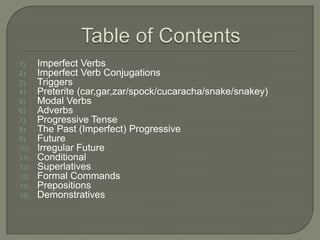
1)    Imperfect Verbs
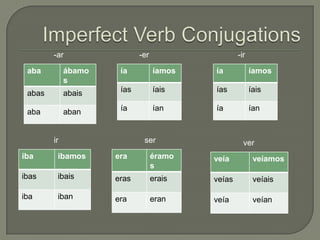
2)    Imperfect Verb Conjugations
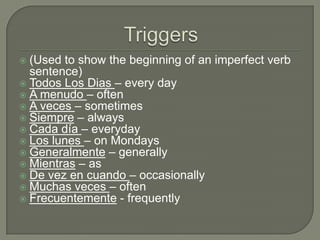
3)    Triggers
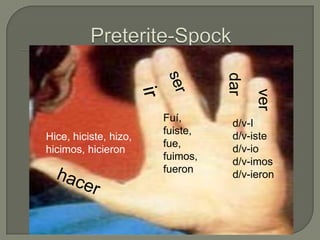
4)    Preterite (car,gar,zar/spock/cucaracha/snake/snakey)
5)    Modal Verbs
6)    Adverbs
7)    Progressive Tense
8)    The Past (Imperfect) Progressive
9)    Future
10)   Irregular Future
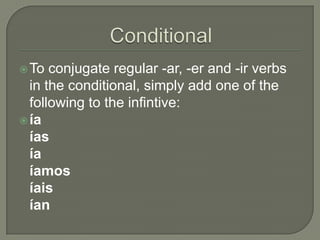
11)   Conditional
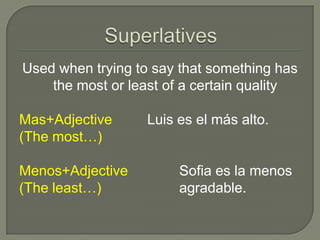
12)   Superlatives
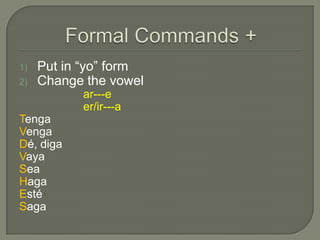
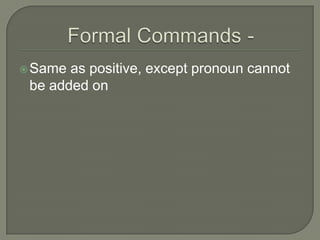
13)   Formal Commands
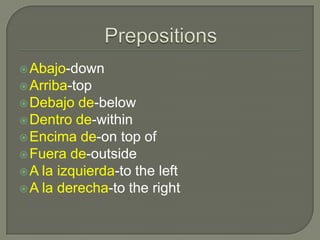
14)   Prepositions
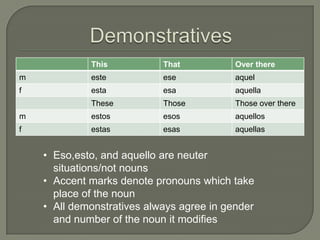
15)   Demonstratives
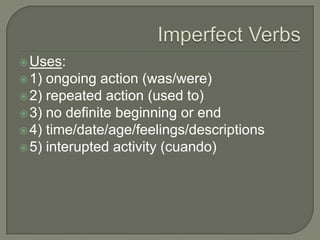
 Uses:
 1) ongoing action (was/were)
 2) repeated action (used to)
 3) no definite beginning or end
 4) time/date/age/feelings/descriptions
 5) interupted activity (cuando)
-ar                 -er                   -ir

 aba         ábamo    ía          íamos   ía            íamos
             s
 abas        abais    ías         íais    ías           íais

 aba         aban     ía          ían     ía            ían


        ir                   ser                    ver
iba      ibamos      era          éramo   veía           veíamos
                                  s
ibas     ibais       eras         erais   veías          veíais

iba      iban        era          eran    veía           veían
 (Used to show the beginning of an imperfect verb
  sentence)
 Todos Los Dias – every day
 A menudo – often
 A veces – sometimes
 Siempre – always
 Cada día – everyday
 Los lunes – on Mondays
 Generalmente – generally
 Mientras – as
 De vez en cuando – occasionally
 Muchas veces – often
 Frecuentemente - frequently
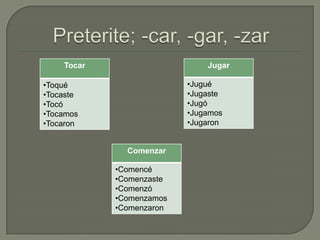
Tocar                     Jugar

•Toqué                    •Jugué
•Tocaste                  •Jugaste
•Tocó                     •Jugó
•Tocamos                  •Jugamos
•Tocaron                  •Jugaron


              Comenzar

            •Comencé
            •Comenzaste
            •Comenzó
            •Comenzamos
            •Comenzaron
dar
                                       ver
                       Fuí,       d/v-I
                       fuiste,
Hice, hiciste, hizo,              d/v-iste
                       fue,
hicimos, hicieron                 d/v-io
                       fuimos,    d/v-imos
                       fueron     d/v-ieron
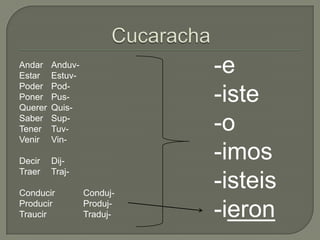
Andar
Estar
         Anduv-
         Estuv-
                            -e
Poder    Pod-
Poner
Querer
         Pus-
         Quis-
                            -iste
Saber
Tener
Venir
         Sup-
         Tuv-
         Vin-
                            -o
Decir    Dij-
                            -imos
Traer    Traj-

Conducir          Conduj-
                            -isteis
Producir
Traucir
                  Produj-
                  Traduj-   -ieron
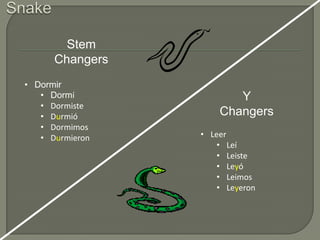
Stem
      Changers
• Dormir
   • Dormí              Y
   • Dormiste
   • Durmió          Changers
   • Dormimos
   • Durmieron   • Leer
                     • Leí
                     • Leiste
                     • Leyó
                     • Leimos
                     • Leyeron
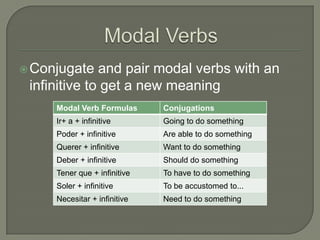
 Conjugate   and pair modal verbs with an
 infinitive to get a new meaning
     Modal Verb Formulas      Conjugations
     Ir+ a + infinitive       Going to do something
     Poder + infinitive       Are able to do something
     Querer + infinitive      Want to do something
     Deber + infinitive       Should do something
     Tener que + infinitive   To have to do something
     Soler + infinitive       To be accustomed to...
     Necesitar + infinitive   Need to do something
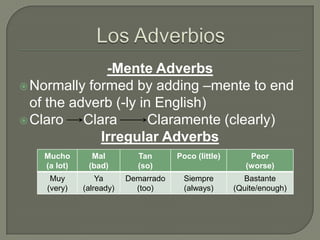
-Mente Adverbs
 Normally formed by adding –mente to end
  of the adverb (-ly in English)
 Claro    Clara       Claramente (clearly)
              Irregular Adverbs
   Mucho       Mal         Tan       Poco (little)       Peor
   (a lot)    (bad)        (so)                         (worse)
     Muy         Ya      Demarrado     Siempre         Bastante
    (very)   (already)     (too)       (always)      (Quite/enough)
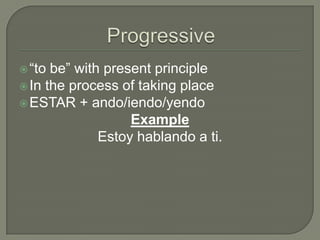
 “to be” with present principle
 In the process of taking place
 ESTAR + ando/iendo/yendo
                   Example
              Estoy hablando a ti.
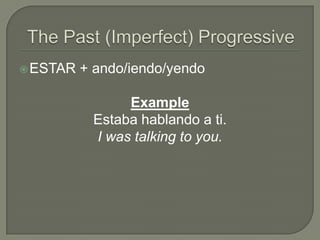
 ESTAR   + ando/iendo/yendo

                Example
           Estaba hablando a ti.
           I was talking to you.
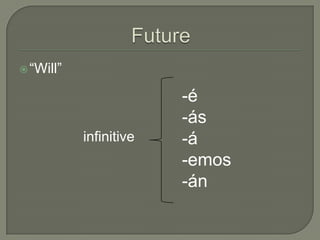
 “Will”

                        -é
                        -ás
           infinitive   -á
                        -emos
                        -án
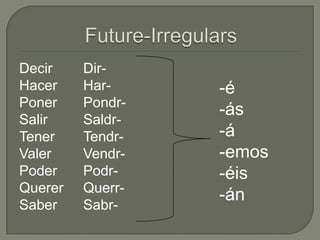
Decir    Dir-
Hacer    Har-     -é
Poner    Pondr-
                  -ás
Salir    Saldr-
Tener    Tendr-   -á
Valer    Vendr-   -emos
Poder    Podr-    -éis
Querer   Querr-
                  -án
Saber    Sabr-
 To  conjugate regular -ar, -er and -ir verbs
  in the conditional, simply add one of the
  following to the infintive:
 ía
  ías
  ía
  íamos
  íais
  ían
Used when trying to say that something has
    the most or least of a certain quality

Mas+Adjective      Luis es el más alto.
(The most…)

Menos+Adjective         Sofia es la menos
(The least…)            agradable.
1)   Put in “yo” form
2)   Change the vowel
           ar---e
           er/ir---a
Tenga
Venga
Dé, diga
Vaya
Sea
Haga
Esté
Saga
 Same as positive, except pronoun cannot
 be added on
 Abajo-down
 Arriba-top
 Debajo  de-below
 Dentro de-within
 Encima de-on top of
 Fuera de-outside
 A la izquierda-to the left
 A la derecha-to the right
This           That           Over there
m            este           ese            aquel
f            esta           esa            aquella
             These          Those          Those over there
m            estos          esos           aquellos
f            estas          esas           aquellas


    • Eso,esto, and aquello are neuter
      situations/not nouns
    • Accent marks denote pronouns which take
      place of the noun
    • All demonstratives always agree in gender
      and number of the noun it modifies

Grammar book 2

  • 1.
  • 2.
    1) Imperfect Verbs 2) Imperfect Verb Conjugations 3) Triggers 4) Preterite (car,gar,zar/spock/cucaracha/snake/snakey) 5) Modal Verbs 6) Adverbs 7) Progressive Tense 8) The Past (Imperfect) Progressive 9) Future 10) Irregular Future 11) Conditional 12) Superlatives 13) Formal Commands 14) Prepositions 15) Demonstratives
  • 3.
     Uses:  1)ongoing action (was/were)  2) repeated action (used to)  3) no definite beginning or end  4) time/date/age/feelings/descriptions  5) interupted activity (cuando)
  • 4.
    -ar -er -ir aba ábamo ía íamos ía íamos s abas abais ías íais ías íais aba aban ía ían ía ían ir ser ver iba ibamos era éramo veía veíamos s ibas ibais eras erais veías veíais iba iban era eran veía veían
  • 5.
     (Used toshow the beginning of an imperfect verb sentence)  Todos Los Dias – every day  A menudo – often  A veces – sometimes  Siempre – always  Cada día – everyday  Los lunes – on Mondays  Generalmente – generally  Mientras – as  De vez en cuando – occasionally  Muchas veces – often  Frecuentemente - frequently
  • 6.
    Tocar Jugar •Toqué •Jugué •Tocaste •Jugaste •Tocó •Jugó •Tocamos •Jugamos •Tocaron •Jugaron Comenzar •Comencé •Comenzaste •Comenzó •Comenzamos •Comenzaron
  • 7.
    dar ver Fuí, d/v-I fuiste, Hice, hiciste, hizo, d/v-iste fue, hicimos, hicieron d/v-io fuimos, d/v-imos fueron d/v-ieron
  • 8.
    Andar Estar Anduv- Estuv- -e Poder Pod- Poner Querer Pus- Quis- -iste Saber Tener Venir Sup- Tuv- Vin- -o Decir Dij- -imos Traer Traj- Conducir Conduj- -isteis Producir Traucir Produj- Traduj- -ieron
  • 9.
    Stem Changers • Dormir • Dormí Y • Dormiste • Durmió Changers • Dormimos • Durmieron • Leer • Leí • Leiste • Leyó • Leimos • Leyeron
  • 10.
     Conjugate and pair modal verbs with an infinitive to get a new meaning Modal Verb Formulas Conjugations Ir+ a + infinitive Going to do something Poder + infinitive Are able to do something Querer + infinitive Want to do something Deber + infinitive Should do something Tener que + infinitive To have to do something Soler + infinitive To be accustomed to... Necesitar + infinitive Need to do something
  • 11.
    -Mente Adverbs  Normallyformed by adding –mente to end of the adverb (-ly in English)  Claro Clara Claramente (clearly) Irregular Adverbs Mucho Mal Tan Poco (little) Peor (a lot) (bad) (so) (worse) Muy Ya Demarrado Siempre Bastante (very) (already) (too) (always) (Quite/enough)
  • 12.
     “to be”with present principle  In the process of taking place  ESTAR + ando/iendo/yendo Example Estoy hablando a ti.
  • 13.
     ESTAR + ando/iendo/yendo Example Estaba hablando a ti. I was talking to you.
  • 14.
     “Will” -é -ás infinitive -á -emos -án
  • 15.
    Decir Dir- Hacer Har- -é Poner Pondr- -ás Salir Saldr- Tener Tendr- -á Valer Vendr- -emos Poder Podr- -éis Querer Querr- -án Saber Sabr-
  • 16.
     To conjugate regular -ar, -er and -ir verbs in the conditional, simply add one of the following to the infintive:  ía ías ía íamos íais ían
  • 17.
    Used when tryingto say that something has the most or least of a certain quality Mas+Adjective Luis es el más alto. (The most…) Menos+Adjective Sofia es la menos (The least…) agradable.
  • 18.
    1) Put in “yo” form 2) Change the vowel ar---e er/ir---a Tenga Venga Dé, diga Vaya Sea Haga Esté Saga
  • 19.
     Same aspositive, except pronoun cannot be added on
  • 20.
     Abajo-down  Arriba-top Debajo de-below  Dentro de-within  Encima de-on top of  Fuera de-outside  A la izquierda-to the left  A la derecha-to the right
  • 21.
    This That Over there m este ese aquel f esta esa aquella These Those Those over there m estos esos aquellos f estas esas aquellas • Eso,esto, and aquello are neuter situations/not nouns • Accent marks denote pronouns which take place of the noun • All demonstratives always agree in gender and number of the noun it modifies