Ibi Fornuto
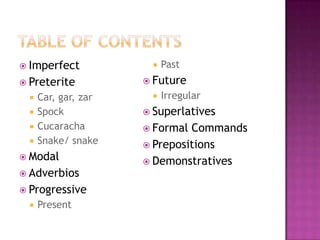
 Imperfect               Past
 Preterite            Future
     Car, gar, zar       Irregular
     Spock            Superlatives
     Cucaracha        Formal Commands
     Snake/ snake     Prepositions
 Modal
                       Demonstratives
 Adverbios
 Progressive
     Present
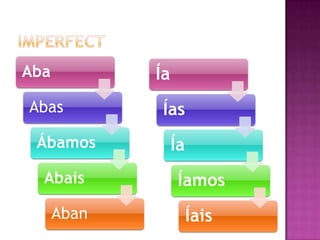
Aba          Ía
Abas          Ías
 Ábamos           Ía
  Abais            Íamos
      Aban             Íais
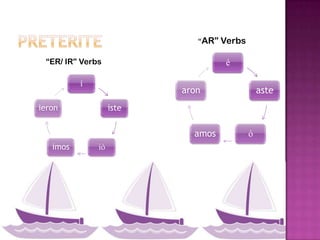
“AR” Verbs

 “ER/ IR” Verbs                    é

          í
                          aron                aste
ieron              iste


                            amos          ó
   imos       ió
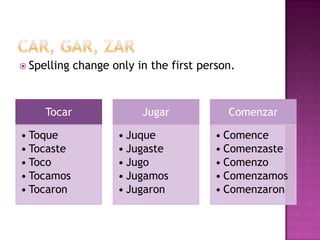
 Spelling   change only in the first person.


     Tocar                Jugar            Comenzar

• Toque              • Juque             • Comence
• Tocaste            • Jugaste           • Comenzaste
• Toco               • Jugo              • Comenzo
• Tocamos            • Jugamos           • Comenzamos
• Tocaron            • Jugaron           • Comenzaron
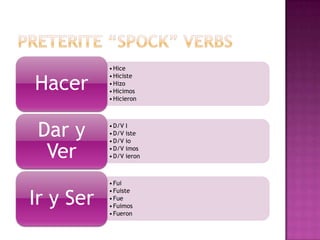
• Hice


Hacer
           • Hiciste
           • Hizo
           • Hicimos
           • Hicieron


 Dar y     • D/V I
           • D/V iste
           • D/V io

  Ver      • D/V imos
           • D/V ieron


           • Fui


Ir y Ser
           • Fuiste
           • Fue
           • Fuimos
           • Fueron
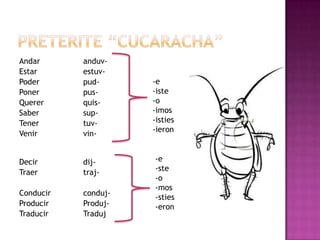
Andar      anduv-
Estar      estuv-
Poder      pud-      -e
Poner      pus-      -iste
Querer     quis-     -o
Saber      sup-      -imos
Tener      tuv-      -isties
                     -ieron
Venir      vin-


Decir      dij-      -e
Traer      traj-     -ste
                     -o
                     -mos
Conducir   conduj-
                     -sties
Producir   Produj-   -eron
Traducir   Traduj
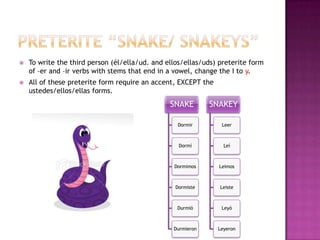
   To write the third person (él/ella/ud. and ellos/ellas/uds) preterite form
    of –er and –ir verbs with stems that end in a vowel, change the I to y.
   All of these preterite form require an accent, EXCEPT the
    ustedes/ellos/ellas forms.
                                                SNAKE        SNAKEY

                                                  Dormir         Leer


                                                   Dormí          Leí


                                                 Dormimos       Leimos


                                                  Dormiste      Leiste


                                                  Durmió         Leyó


                                                 Durmieron      Leyeron
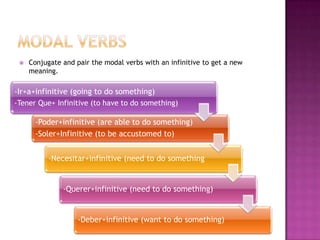
   Conjugate and pair the modal verbs with an infinitive to get a new
     meaning.

-Ir+a+infinitive (going to do something)
-Tener Que+ Infinitive (to have to do something)

      -Poder+infinitive (are able to do something)
      -Soler+Infinitive (to be accustomed to)


           -Necesitar+infinitive (need to do something


               -Querer+infinitive (need to do something)


                    -Deber+infinitive (want to do something)
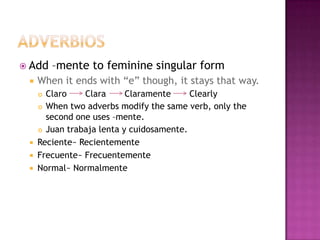
 Add    –mente to feminine singular form
    When it ends with “e” though, it stays that way.
      Claro    Clara      Claramente     Clearly
      When two adverbs modify the same verb, only the

       second one uses –mente.
      Juan trabaja lenta y cuidosamente.

    Reciente~ Recientemente
    Frecuente~ Frecuentemente
    Normal~ Normalmente
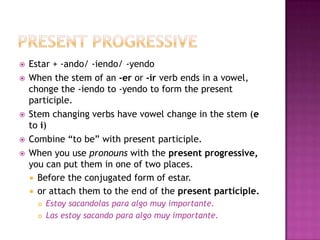
   Estar + -ando/ -iendo/ -yendo
   When the stem of an -er or -ir verb ends in a vowel,
    chonge the -iendo to -yendo to form the present
    participle.
   Stem changing verbs have vowel change in the stem (e
    to i)
   Combine “to be” with present participle.
   When you use pronouns with the present progressive,
    you can put them in one of two places.
     Before the conjugated form of estar.
     or attach them to the end of the present participle.
         Estoy sacandolas para algo muy importante.
         Las estoy sacando para algo muy importante.
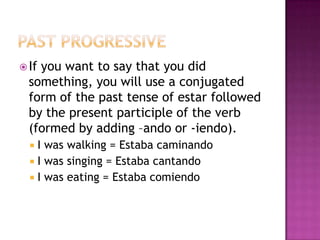
 Ifyou want to say that you did
  something, you will use a conjugated
  form of the past tense of estar followed
  by the present participle of the verb
  (formed by adding –ando or -iendo).
   I was walking = Estaba caminando
   I was singing = Estaba cantando
   I was eating = Estaba comiendo
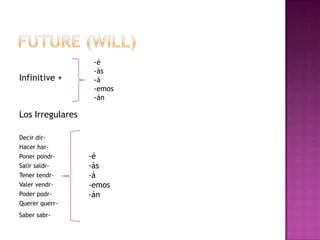
-é
                   -ás
Infinitive +       -á
                   -emos
                   -án

Los Irregulares

Decir dir-
Hacer har-
Poner pondr-      -é
Salir saldr-      -ás
Tener tendr-      -á
Valer vendr-      -emos
Poder podr-       -án
Querer querr-
Saber sabr-
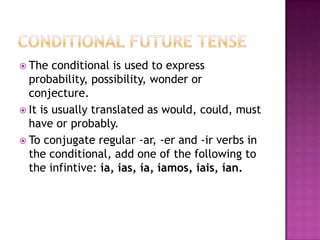
 The   conditional is used to express
  probability, possibility, wonder or
  conjecture.
 It is usually translated as would, could, must
  have or probably.
 To conjugate regular -ar, -er and -ir verbs in
  the conditional, add one of the following to
  the infintive: ía, ías, ía, íamos, íais, ían.
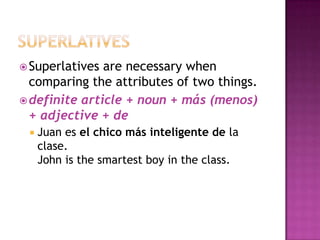
 Superlatives are necessary when
  comparing the attributes of two things.
 definite article + noun + más (menos)
  + adjective + de
    Juan es el chico más inteligente de la
     clase.
     John is the smartest boy in the class.
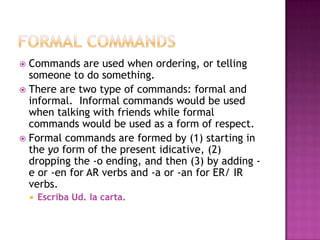
 Commands are used when ordering, or telling
  someone to do something.
 There are two type of commands: formal and
  informal. Informal commands would be used
  when talking with friends while formal
  commands would be used as a form of respect.
 Formal commands are formed by (1) starting in
  the yo form of the present idicative, (2)
  dropping the -o ending, and then (3) by adding -
  e or -en for AR verbs and -a or -an for ER/ IR
  verbs.
       Escriba Ud. la carta.
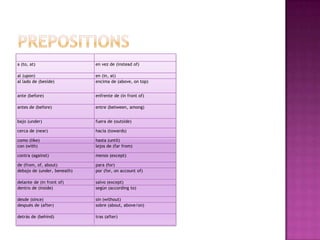
a (to, at)                   en vez de (instead of)

al (upon)                    en (in, at)
al lado de (beside)          encima de (above, on top)


ante (before)                enfrente de (in front of)

antes de (before)            entre (between, among)


bajo (under)                 fuera de (outside)

cerca de (near)              hacia (towards)

como (like)                  hasta (until)
con (with)                   lejos de (far from)

contra (against)             menos (except)

de (from, of, about)         para (for)
debajo de (under, beneath)   por (for, on account of)

delante de (in front of)     salvo (except)
dentro de (inside)           según (according to)

desde (since)                sin (without)
después de (after)           sobre (about, above/on)

detrás de (behind)           tras (after)
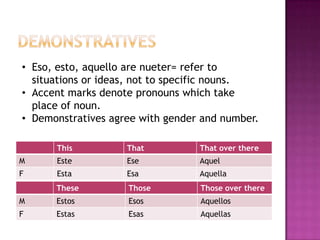
• Eso, esto, aquello are nueter= refer to
  situations or ideas, not to specific nouns.
• Accent marks denote pronouns which take
  place of noun.
• Demonstratives agree with gender and number.

      This          That          That over there
M     Este          Ese           Aquel
F     Esta          Esa           Aquella
      These         Those         Those over there
M     Estos         Esos          Aquellos
F     Estas         Esas          Aquellas

Grammer book 3

  • 1.
  • 2.
     Imperfect  Past  Preterite  Future  Car, gar, zar  Irregular  Spock  Superlatives  Cucaracha  Formal Commands  Snake/ snake  Prepositions  Modal  Demonstratives  Adverbios  Progressive  Present
  • 3.
    Aba Ía Abas Ías Ábamos Ía Abais Íamos Aban Íais
  • 4.
    “AR” Verbs “ER/IR” Verbs é í aron aste ieron iste amos ó imos ió
  • 5.
     Spelling change only in the first person. Tocar Jugar Comenzar • Toque • Juque • Comence • Tocaste • Jugaste • Comenzaste • Toco • Jugo • Comenzo • Tocamos • Jugamos • Comenzamos • Tocaron • Jugaron • Comenzaron
  • 6.
    • Hice Hacer • Hiciste • Hizo • Hicimos • Hicieron Dar y • D/V I • D/V iste • D/V io Ver • D/V imos • D/V ieron • Fui Ir y Ser • Fuiste • Fue • Fuimos • Fueron
  • 7.
    Andar anduv- Estar estuv- Poder pud- -e Poner pus- -iste Querer quis- -o Saber sup- -imos Tener tuv- -isties -ieron Venir vin- Decir dij- -e Traer traj- -ste -o -mos Conducir conduj- -sties Producir Produj- -eron Traducir Traduj
  • 8.
    To write the third person (él/ella/ud. and ellos/ellas/uds) preterite form of –er and –ir verbs with stems that end in a vowel, change the I to y.  All of these preterite form require an accent, EXCEPT the ustedes/ellos/ellas forms. SNAKE SNAKEY Dormir Leer Dormí Leí Dormimos Leimos Dormiste Leiste Durmió Leyó Durmieron Leyeron
  • 9.
    Conjugate and pair the modal verbs with an infinitive to get a new meaning. -Ir+a+infinitive (going to do something) -Tener Que+ Infinitive (to have to do something) -Poder+infinitive (are able to do something) -Soler+Infinitive (to be accustomed to) -Necesitar+infinitive (need to do something -Querer+infinitive (need to do something) -Deber+infinitive (want to do something)
  • 10.
     Add –mente to feminine singular form  When it ends with “e” though, it stays that way.  Claro Clara Claramente Clearly  When two adverbs modify the same verb, only the second one uses –mente.  Juan trabaja lenta y cuidosamente.  Reciente~ Recientemente  Frecuente~ Frecuentemente  Normal~ Normalmente
  • 11.
    Estar + -ando/ -iendo/ -yendo  When the stem of an -er or -ir verb ends in a vowel, chonge the -iendo to -yendo to form the present participle.  Stem changing verbs have vowel change in the stem (e to i)  Combine “to be” with present participle.  When you use pronouns with the present progressive, you can put them in one of two places.  Before the conjugated form of estar.  or attach them to the end of the present participle.  Estoy sacandolas para algo muy importante.  Las estoy sacando para algo muy importante.
  • 12.
     Ifyou wantto say that you did something, you will use a conjugated form of the past tense of estar followed by the present participle of the verb (formed by adding –ando or -iendo).  I was walking = Estaba caminando  I was singing = Estaba cantando  I was eating = Estaba comiendo
  • 13.
    -ás Infinitive + -á -emos -án Los Irregulares Decir dir- Hacer har- Poner pondr- -é Salir saldr- -ás Tener tendr- -á Valer vendr- -emos Poder podr- -án Querer querr- Saber sabr-
  • 14.
     The conditional is used to express probability, possibility, wonder or conjecture.  It is usually translated as would, could, must have or probably.  To conjugate regular -ar, -er and -ir verbs in the conditional, add one of the following to the infintive: ía, ías, ía, íamos, íais, ían.
  • 15.
     Superlatives arenecessary when comparing the attributes of two things.  definite article + noun + más (menos) + adjective + de  Juan es el chico más inteligente de la clase. John is the smartest boy in the class.
  • 16.
     Commands areused when ordering, or telling someone to do something.  There are two type of commands: formal and informal. Informal commands would be used when talking with friends while formal commands would be used as a form of respect.  Formal commands are formed by (1) starting in the yo form of the present idicative, (2) dropping the -o ending, and then (3) by adding - e or -en for AR verbs and -a or -an for ER/ IR verbs.  Escriba Ud. la carta.
  • 17.
    a (to, at) en vez de (instead of) al (upon) en (in, at) al lado de (beside) encima de (above, on top) ante (before) enfrente de (in front of) antes de (before) entre (between, among) bajo (under) fuera de (outside) cerca de (near) hacia (towards) como (like) hasta (until) con (with) lejos de (far from) contra (against) menos (except) de (from, of, about) para (for) debajo de (under, beneath) por (for, on account of) delante de (in front of) salvo (except) dentro de (inside) según (according to) desde (since) sin (without) después de (after) sobre (about, above/on) detrás de (behind) tras (after)
  • 18.
    • Eso, esto,aquello are nueter= refer to situations or ideas, not to specific nouns. • Accent marks denote pronouns which take place of noun. • Demonstratives agree with gender and number. This That That over there M Este Ese Aquel F Esta Esa Aquella These Those Those over there M Estos Esos Aquellos F Estas Esas Aquellas