GLOBAL POSITIONING SYSTEM (GPS)
MASHHOOD ARIF
What is GPS
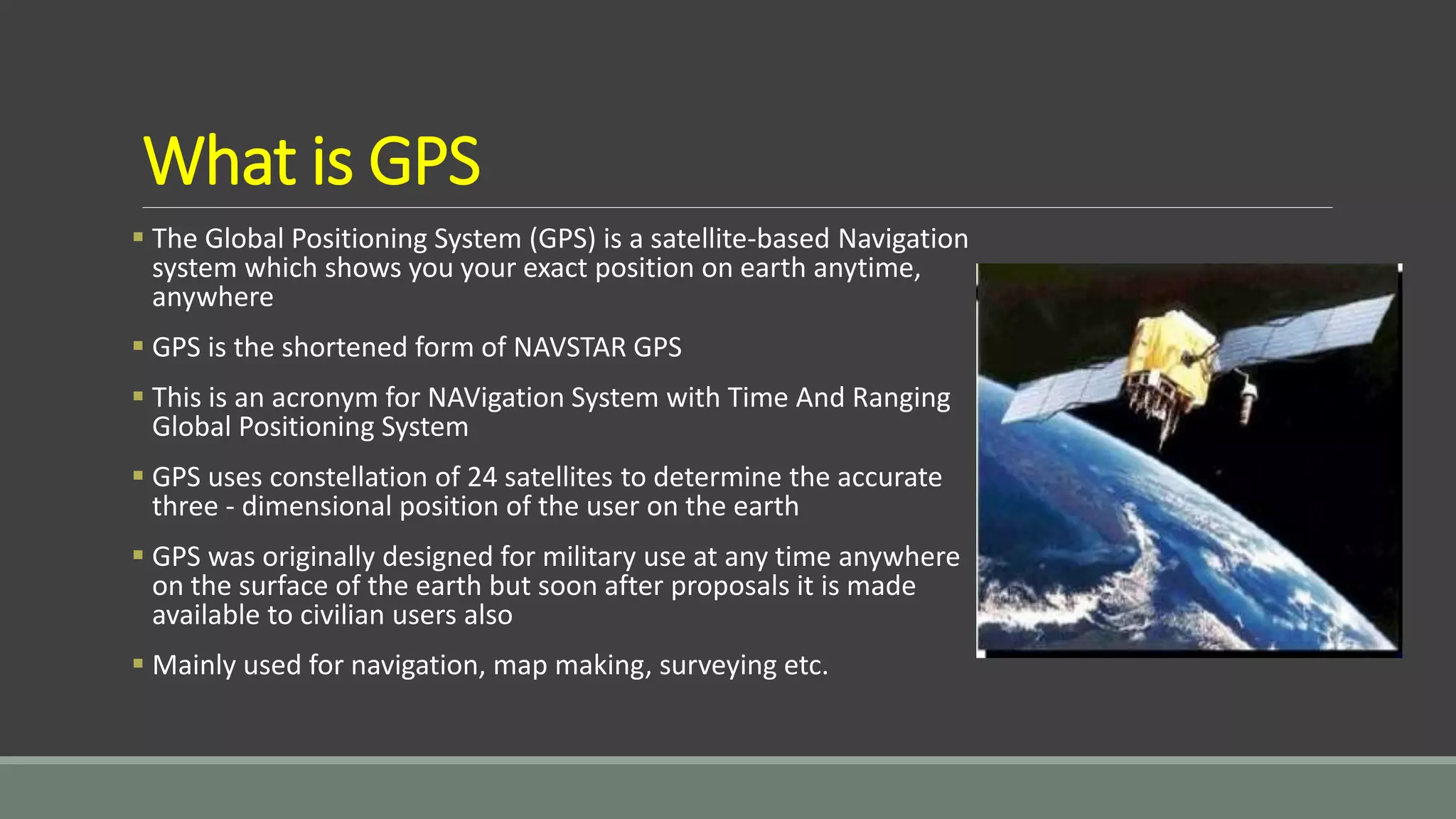
 The Global Positioning System (GPS) is a satellite-based Navigation
system which shows you your exact position on earth anytime,
anywhere
 GPS is the shortened form of NAVSTAR GPS
 This is an acronym for NAVigation System with Time And Ranging
Global Positioning System
 GPS uses constellation of 24 satellites to determine the accurate
three - dimensional position of the user on the earth
 GPS was originally designed for military use at any time anywhere
on the surface of the earth but soon after proposals it is made
available to civilian users also
 Mainly used for navigation, map making, surveying etc.
Evolution of GPS
 The GPS project was proposed in 1973 to overcome the limitations of earlier navigation systems
 It was created by the US department of Defense and was originally run with 24 satellites known
as satellite constellation
 First satellite was launched in 1978 but It became fully operational with launching of 24th
satellite in 1995
 Advances in technology and new demands on the existing system have now led to efforts to
modernize the GPS system and implement the next generation of GPS III satellites
 In addition to GPS of US, other systems are also in use or under development, like
RUSSIAN’s - Global Navigation Satellite System (GLONASS)
EUROPEAN’s - Galileo Positioning System
INDIA’s - Indian Regional Navigational Satellite System
CHINA’s - Compass Navigation System but these systems are suffered from incomplete
coverage of the globe and failed to provide the accurate information
GPS Satellites
 There are quite a number of satellites out there in space. They are used for a
wide range of purposes: satellite TV, cellular phones, military purposes and etc.
 Satellites can also be used by GPS receivers
 GPS Satellites: The GPS Operational Constellation consists of 24 satellites that
orbit the Earth in very precise orbits twice a day. GPS satellites emit continuous
navigation signals
Working of GPS
 A GPS receiver can tell its own position by using the position data of itself, and
compares that data with 3 or more GPS satellites
 To get the distance to each satellite, the GPS
transmits a signal to each satellite.
- The signal travels at a known speed
- The system measures the time delay
between the signal transmission and signal
reception of the GPS signal
- The signals carry information about the
satellite’s location
- Determines the position of, and distance
to, at least three satellites
- The receiver computes position using
TRIANGULATION
Working of GPS (Contd..)
 The GPS uses technique of "triangulation" to find
location
 To "triangulate," a GPS receiver measures distance
from the satellite using the travel time of radio signals
 To measure travel time, GPS needs very
accurate timing, which is provided by atomic
clocks used in the satellites
 Along with distance, we need to know exactly
where the satellites are in space
 Finally we must correct for any delays the
signal experiences as it travels through the atmosphere
 To compute a positions in three dimensions.
We need to have four satellite measurements.
The GPS uses a trigonometric approach to calculate
the positions
GPS Segments & Functionality
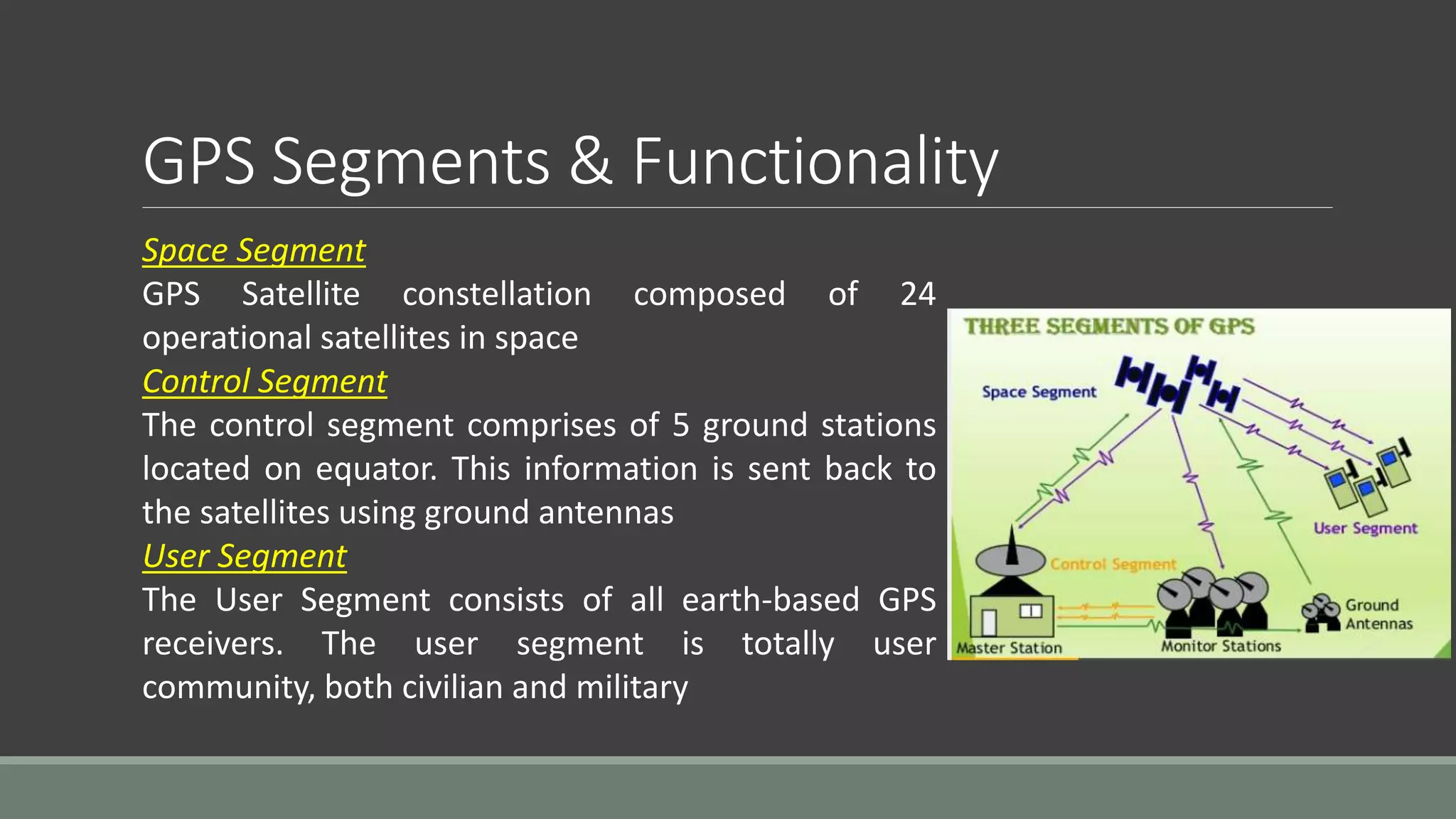
GPS Systems has three segments:
1.Space Segment (SS)
2.Control Segment (CS)
3.User Segment (US)
GPS Segments & Functionality
Space Segment
GPS Satellite constellation composed of 24
operational satellites in space
Control Segment
The control segment comprises of 5 ground stations
located on equator. This information is sent back to
the satellites using ground antennas
User Segment
The User Segment consists of all earth-based GPS
receivers. The user segment is totally user
community, both civilian and military
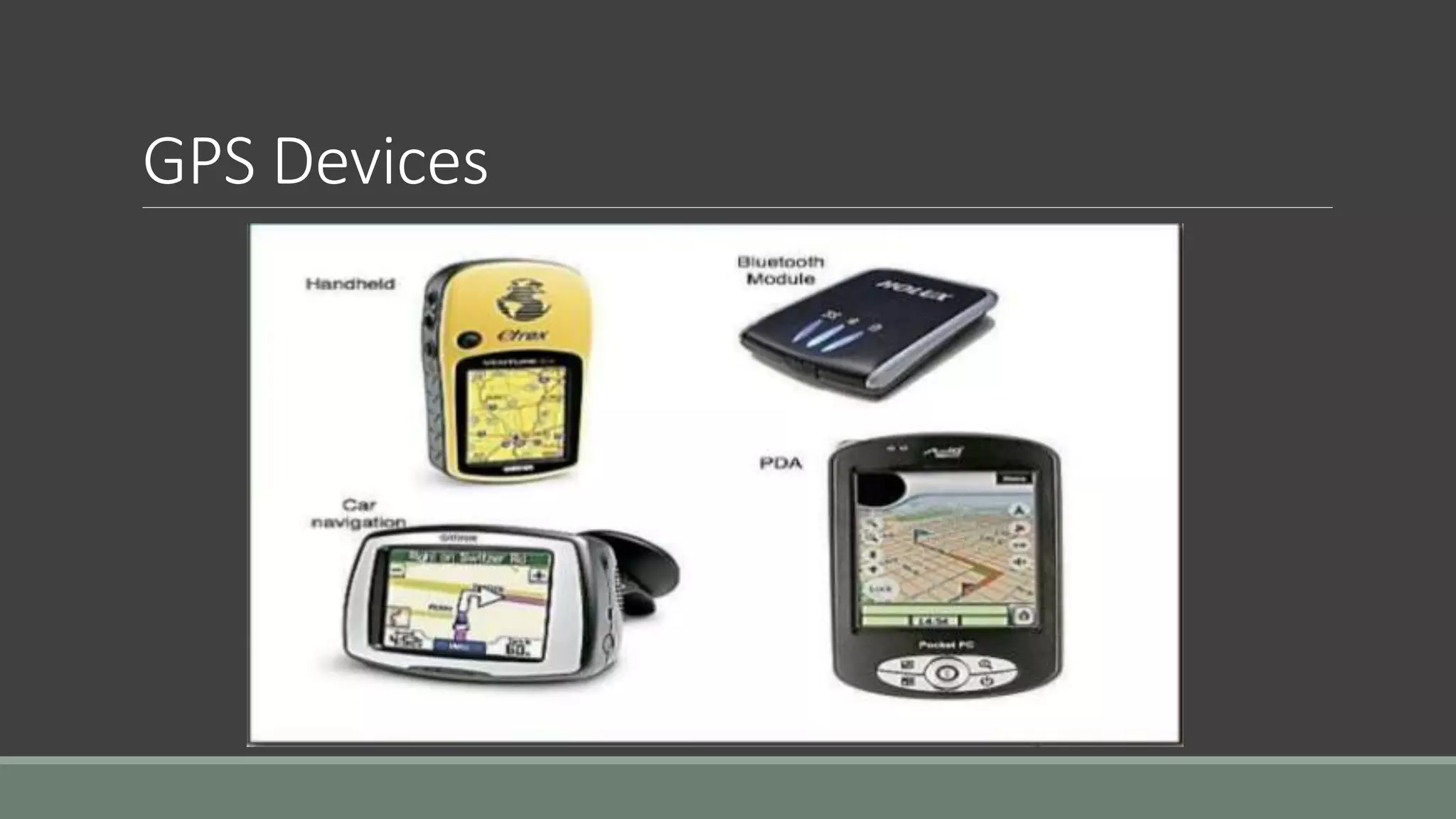
GPS Devices
Errors in GPS
The receiver is not synchronized with the atomic clock in the satellite
The estimate of the position of the satellite
Speed of light is only constant in vacuum
“Multi path errors” : Ghost signals from reflected radio waves
“Selective availability (SA)”: Added noise from department of defense
Not free sight to many enough satellites
Noise in the receiver
Advantages of GPS
 GPS is extremely easy to navigate as it tells
you to the direction for each turns you take or
you have to take to reach to your destination
 GPS works in all weather so you need not to
worry of the climate as in other navigating
systems
 The GPS costs you very low.
 The most attractive feature of this system is
its100% coverage on the planet
 It also helps you to search the nearby
restaurants, hotels and gas stations and is
very useful for a new place
 Due to its low cost, it is very easy to integrate
into other technologies like cell phone
 The system is updated regularly by the US
government (as compared to other
navigations systems by other countries e.g.
GLONASS) and hence is very advance
 This is the best navigating system in water as
in larger water bodies we are often misled
due to lack of proper directions
 Accuracy can vary from millimeters to several
meters depending on the technique that is
used
Disadvantages of GPS
GPS satellite signals are weak, so it doesn't work as well indoors, underwater,
under trees, etc.
The highest accuracy requires line-of-sight from the receiver to the satellite, this
is why GPS doesn't work very well in an urban environment
The US DoD (dept. of defence) can, at any time, deny users use of the system
(i.e. they degrade/shut down the satellites)
If you are using GPS on a battery operated device, there may be a battery
failure and you may need a external power supply which is not always possible
Sometimes the GPS signals are not accurate due to some obstacles to the
signals
Applications of GPS
Military
 Target Tracking: Tracking potential ground and
air targets before flagging them as hostile
 Navigation
 Missile and Projectile Guidance: Allows
accurate targeting of various military
weapons including cruise missiles and
precision-guided munitions
 Reconnaissance
 Search and Rescue: Downed pilots can be
located faster if their position is known
Civilian
 Geotagging: Applying location coordinates to
digital objects such as photographs and other
documents
 Disaster Relief / Emergency Services
 Vehicle Tracking Systems
 GPS Aircraft Tracking
 Telematics: GPS technology integrated with
computer and mobile communication
technology in automotive navigation systems
Two major applications of GPS are Military and Civilian
Some other Applications..
 Railway Systems
 Recreational Activities
 Weather Prediction
 Skydiving
 And many more…
Conclusion
 GPS is a network of satellites that continuously transmit coded
information, which makes it possible to precisely identify locations
on earth by measuring distance from the satellites
 GPS although was developed for military purposes, but the number
of civilian users of GPS already well far exceeds than number of
potential military
 As discussed in previous topic, its application field is vast and new
applications will continue to be created as the technology evolves

GPS in Planning

  • 1.
    GLOBAL POSITIONING SYSTEM(GPS) MASHHOOD ARIF
  • 2.
    What is GPS The Global Positioning System (GPS) is a satellite-based Navigation system which shows you your exact position on earth anytime, anywhere  GPS is the shortened form of NAVSTAR GPS  This is an acronym for NAVigation System with Time And Ranging Global Positioning System  GPS uses constellation of 24 satellites to determine the accurate three - dimensional position of the user on the earth  GPS was originally designed for military use at any time anywhere on the surface of the earth but soon after proposals it is made available to civilian users also  Mainly used for navigation, map making, surveying etc.
  • 3.
    Evolution of GPS The GPS project was proposed in 1973 to overcome the limitations of earlier navigation systems  It was created by the US department of Defense and was originally run with 24 satellites known as satellite constellation  First satellite was launched in 1978 but It became fully operational with launching of 24th satellite in 1995  Advances in technology and new demands on the existing system have now led to efforts to modernize the GPS system and implement the next generation of GPS III satellites  In addition to GPS of US, other systems are also in use or under development, like RUSSIAN’s - Global Navigation Satellite System (GLONASS) EUROPEAN’s - Galileo Positioning System INDIA’s - Indian Regional Navigational Satellite System CHINA’s - Compass Navigation System but these systems are suffered from incomplete coverage of the globe and failed to provide the accurate information
  • 4.
    GPS Satellites  Thereare quite a number of satellites out there in space. They are used for a wide range of purposes: satellite TV, cellular phones, military purposes and etc.  Satellites can also be used by GPS receivers  GPS Satellites: The GPS Operational Constellation consists of 24 satellites that orbit the Earth in very precise orbits twice a day. GPS satellites emit continuous navigation signals
  • 5.
    Working of GPS A GPS receiver can tell its own position by using the position data of itself, and compares that data with 3 or more GPS satellites  To get the distance to each satellite, the GPS transmits a signal to each satellite. - The signal travels at a known speed - The system measures the time delay between the signal transmission and signal reception of the GPS signal - The signals carry information about the satellite’s location - Determines the position of, and distance to, at least three satellites - The receiver computes position using TRIANGULATION
  • 6.
    Working of GPS(Contd..)  The GPS uses technique of "triangulation" to find location  To "triangulate," a GPS receiver measures distance from the satellite using the travel time of radio signals  To measure travel time, GPS needs very accurate timing, which is provided by atomic clocks used in the satellites  Along with distance, we need to know exactly where the satellites are in space  Finally we must correct for any delays the signal experiences as it travels through the atmosphere  To compute a positions in three dimensions. We need to have four satellite measurements. The GPS uses a trigonometric approach to calculate the positions
  • 7.
    GPS Segments &Functionality GPS Systems has three segments: 1.Space Segment (SS) 2.Control Segment (CS) 3.User Segment (US)
  • 8.
    GPS Segments &Functionality Space Segment GPS Satellite constellation composed of 24 operational satellites in space Control Segment The control segment comprises of 5 ground stations located on equator. This information is sent back to the satellites using ground antennas User Segment The User Segment consists of all earth-based GPS receivers. The user segment is totally user community, both civilian and military
  • 10.
  • 11.
    Errors in GPS Thereceiver is not synchronized with the atomic clock in the satellite The estimate of the position of the satellite Speed of light is only constant in vacuum “Multi path errors” : Ghost signals from reflected radio waves “Selective availability (SA)”: Added noise from department of defense Not free sight to many enough satellites Noise in the receiver
  • 12.
    Advantages of GPS GPS is extremely easy to navigate as it tells you to the direction for each turns you take or you have to take to reach to your destination  GPS works in all weather so you need not to worry of the climate as in other navigating systems  The GPS costs you very low.  The most attractive feature of this system is its100% coverage on the planet  It also helps you to search the nearby restaurants, hotels and gas stations and is very useful for a new place  Due to its low cost, it is very easy to integrate into other technologies like cell phone  The system is updated regularly by the US government (as compared to other navigations systems by other countries e.g. GLONASS) and hence is very advance  This is the best navigating system in water as in larger water bodies we are often misled due to lack of proper directions  Accuracy can vary from millimeters to several meters depending on the technique that is used
  • 13.
    Disadvantages of GPS GPSsatellite signals are weak, so it doesn't work as well indoors, underwater, under trees, etc. The highest accuracy requires line-of-sight from the receiver to the satellite, this is why GPS doesn't work very well in an urban environment The US DoD (dept. of defence) can, at any time, deny users use of the system (i.e. they degrade/shut down the satellites) If you are using GPS on a battery operated device, there may be a battery failure and you may need a external power supply which is not always possible Sometimes the GPS signals are not accurate due to some obstacles to the signals
  • 14.
    Applications of GPS Military Target Tracking: Tracking potential ground and air targets before flagging them as hostile  Navigation  Missile and Projectile Guidance: Allows accurate targeting of various military weapons including cruise missiles and precision-guided munitions  Reconnaissance  Search and Rescue: Downed pilots can be located faster if their position is known Civilian  Geotagging: Applying location coordinates to digital objects such as photographs and other documents  Disaster Relief / Emergency Services  Vehicle Tracking Systems  GPS Aircraft Tracking  Telematics: GPS technology integrated with computer and mobile communication technology in automotive navigation systems Two major applications of GPS are Military and Civilian
  • 15.
    Some other Applications.. Railway Systems  Recreational Activities  Weather Prediction  Skydiving  And many more…
  • 16.
    Conclusion  GPS isa network of satellites that continuously transmit coded information, which makes it possible to precisely identify locations on earth by measuring distance from the satellites  GPS although was developed for military purposes, but the number of civilian users of GPS already well far exceeds than number of potential military  As discussed in previous topic, its application field is vast and new applications will continue to be created as the technology evolves