LAND USE LAND
COVER
Name :- Jatin Kumar
Roll No. :- 164511
GOVT. P. G. COLLEGE HISAR
Introduction:-
The earth is constantly under observation from
dozens of satellites orbiting the planet and
collecting image data of the earth’s surface and
it’s environment.
 Some data can be analysed in different ways for
different applications.
 Some of the fields that use remote sensing are
agriculture, geology, archaeology, oceanography,
etc.
Introduction:- Land cover
Land cover mapping is one of the most important &
typical application of Remote sensing data
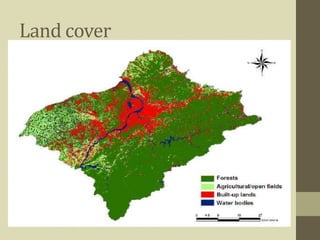
Land cover corresponds to the physical condition of the
ground surface for eg. Forest, grassland, etc.
Land cover refers to features of land surface which may
be natural, semi-natural, managed or manmade . They
are directly observable by a remote sensor.
Land cover denotes the physical state of land, such as
the quantity and type of surface vegetation, water and
earth materials.
Land cover
Introduction :- Land Use
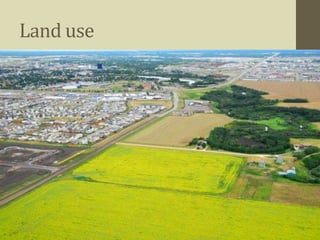
Land use reflects human activities such as the
use of the land for eg. Industrial zones,
residential zones, agricultural fields etc.
Land use denotes the human employment of
the land, such as residential industrial,
commercial, agricultural, recreational, urban,
rural, etc.
A change in land use at any location may involve
a shift to a different type of use ,for instance,
from framing to residential, or a change in the
intensity of use.
Land use
Land-useapplicationsofremotesensing includethe
following:-
 Natural resource management
 Wildlife habitat protection
Baseline mapping for geographic information system(GIS)
input
Urban expansion/encroachment
Routing and logistics planning for
seismic/exploration/resource extraction activities
Damage delineation (tornadoes, flooding, volcanic, seismic,
fire and terrorist activities)
Legal boundaries for tax and property evaluation
Target detection- identification of landing strips, roads,
clearings, bridges and land/water interface
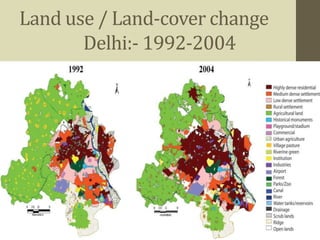
Land use / Land-cover change
Delhi:- 1992-2004
Housing:-
• In developing countries that often do not have
reliable population databases, interpretation of high
–resolution imageries can be used to estimate
housing density. By calculating the housing density
for representative sample areas with an image,
reliable estimates of housing density can be
obtained for other similar areas in the image. If
information is available on the average household
size, this method can be extended to produce
estimates of population density.
Transportation:-
•High –resolution image have often
been used in transportation studies
and can be used to identify vehicle
types, estimate traffic flows, indentify
parking problems on city streets,
estimate parking lot usage, and even
to measure the speed of vehicles on a
highway.
Agricultural:-
• Analyzing agricultural versus urban land
using important for ensuing that
development does not encroach on
valuable agriculture land, and to likewise
ensure that agricultures is being done on
the most appropriate land and does not
degrade due to improper adjacent
development or infrastructure.
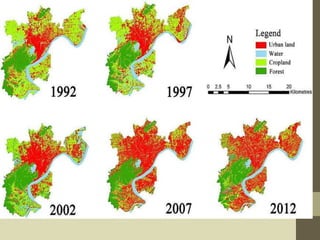
The change is usually detected by
comparison between two multi-date
images, or sometimes between an old
map and an updated remote sensing
image.
• The land-cover change can be divided into two categories, as
following-
• 1. Seasonal change, for instance, agricultural lands and
deciduous forests change seasonally.
• 2. Annual change (change over years) , for example, land –
cover or land –use changes, which are real changes, for
instance deforested areas or newly built towns.
Land use land cover
Land use land cover

Land use land cover

  • 1.
    LAND USE LAND COVER Name:- Jatin Kumar Roll No. :- 164511 GOVT. P. G. COLLEGE HISAR
  • 2.
    Introduction:- The earth isconstantly under observation from dozens of satellites orbiting the planet and collecting image data of the earth’s surface and it’s environment.  Some data can be analysed in different ways for different applications.  Some of the fields that use remote sensing are agriculture, geology, archaeology, oceanography, etc.
  • 3.
    Introduction:- Land cover Landcover mapping is one of the most important & typical application of Remote sensing data Land cover corresponds to the physical condition of the ground surface for eg. Forest, grassland, etc. Land cover refers to features of land surface which may be natural, semi-natural, managed or manmade . They are directly observable by a remote sensor. Land cover denotes the physical state of land, such as the quantity and type of surface vegetation, water and earth materials.
  • 4.
  • 5.
    Introduction :- LandUse Land use reflects human activities such as the use of the land for eg. Industrial zones, residential zones, agricultural fields etc. Land use denotes the human employment of the land, such as residential industrial, commercial, agricultural, recreational, urban, rural, etc. A change in land use at any location may involve a shift to a different type of use ,for instance, from framing to residential, or a change in the intensity of use.
  • 6.
  • 7.
    Land-useapplicationsofremotesensing includethe following:-  Naturalresource management  Wildlife habitat protection Baseline mapping for geographic information system(GIS) input Urban expansion/encroachment Routing and logistics planning for seismic/exploration/resource extraction activities Damage delineation (tornadoes, flooding, volcanic, seismic, fire and terrorist activities) Legal boundaries for tax and property evaluation Target detection- identification of landing strips, roads, clearings, bridges and land/water interface
  • 8.
    Land use /Land-cover change Delhi:- 1992-2004
  • 10.
    Housing:- • In developingcountries that often do not have reliable population databases, interpretation of high –resolution imageries can be used to estimate housing density. By calculating the housing density for representative sample areas with an image, reliable estimates of housing density can be obtained for other similar areas in the image. If information is available on the average household size, this method can be extended to produce estimates of population density.
  • 11.
    Transportation:- •High –resolution imagehave often been used in transportation studies and can be used to identify vehicle types, estimate traffic flows, indentify parking problems on city streets, estimate parking lot usage, and even to measure the speed of vehicles on a highway.
  • 12.
    Agricultural:- • Analyzing agriculturalversus urban land using important for ensuing that development does not encroach on valuable agriculture land, and to likewise ensure that agricultures is being done on the most appropriate land and does not degrade due to improper adjacent development or infrastructure.
  • 13.
    The change isusually detected by comparison between two multi-date images, or sometimes between an old map and an updated remote sensing image. • The land-cover change can be divided into two categories, as following- • 1. Seasonal change, for instance, agricultural lands and deciduous forests change seasonally. • 2. Annual change (change over years) , for example, land – cover or land –use changes, which are real changes, for instance deforested areas or newly built towns.