- “
:-
:-
-
FLOW OF PRESENTATION
Global Positioning System (GPS)
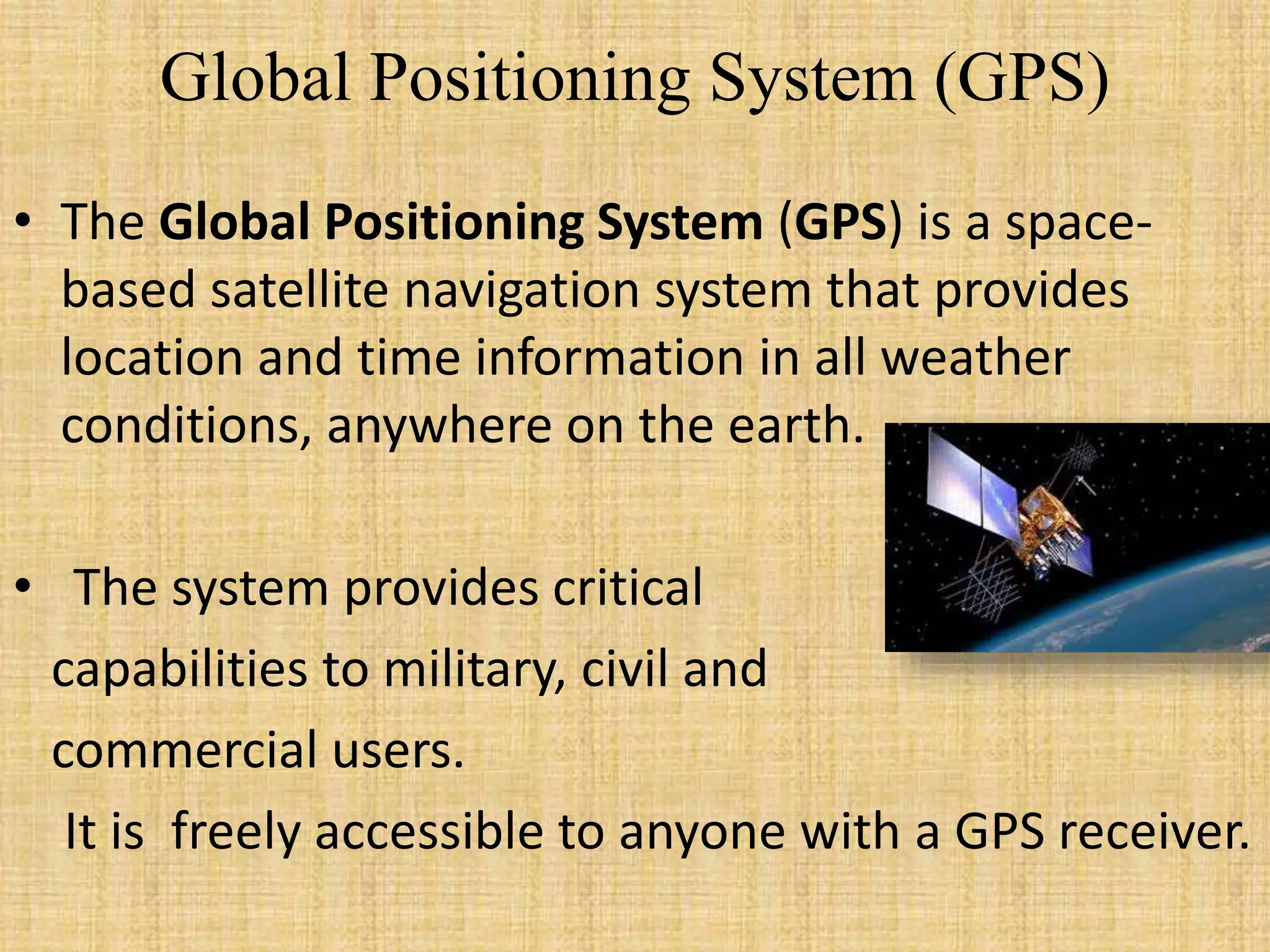
• The Global Positioning System (GPS) is a space-
based satellite navigation system that provides
location and time information in all weather
conditions, anywhere on the earth.
• The system provides critical
capabilities to military, civil and
commercial users.
It is freely accessible to anyone with a GPS receiver.
Past view on GPS
• Bradford Parkinson, Roger L. Easton, and Ivan
A. Getting are credited with inventing it.
• The GPS project was developed in 1973 to
overcome the limitations of previous
navigation systems
• GPS was created and realized by the U.S.
Department of Defense (DoD) and was
originally run with 24 satellites. It became fully
operational in 1995.
OTHER NAVIGATION SYSTEMS
• Russia developed Russian Global Navigation
Satellite System (GLONASS) in comparison to
GPS system
• European Union Galileo positioning system
• India's Indian Regional Navigation Satellite
System and,
• Chinese Beidou Navigation Satellite System
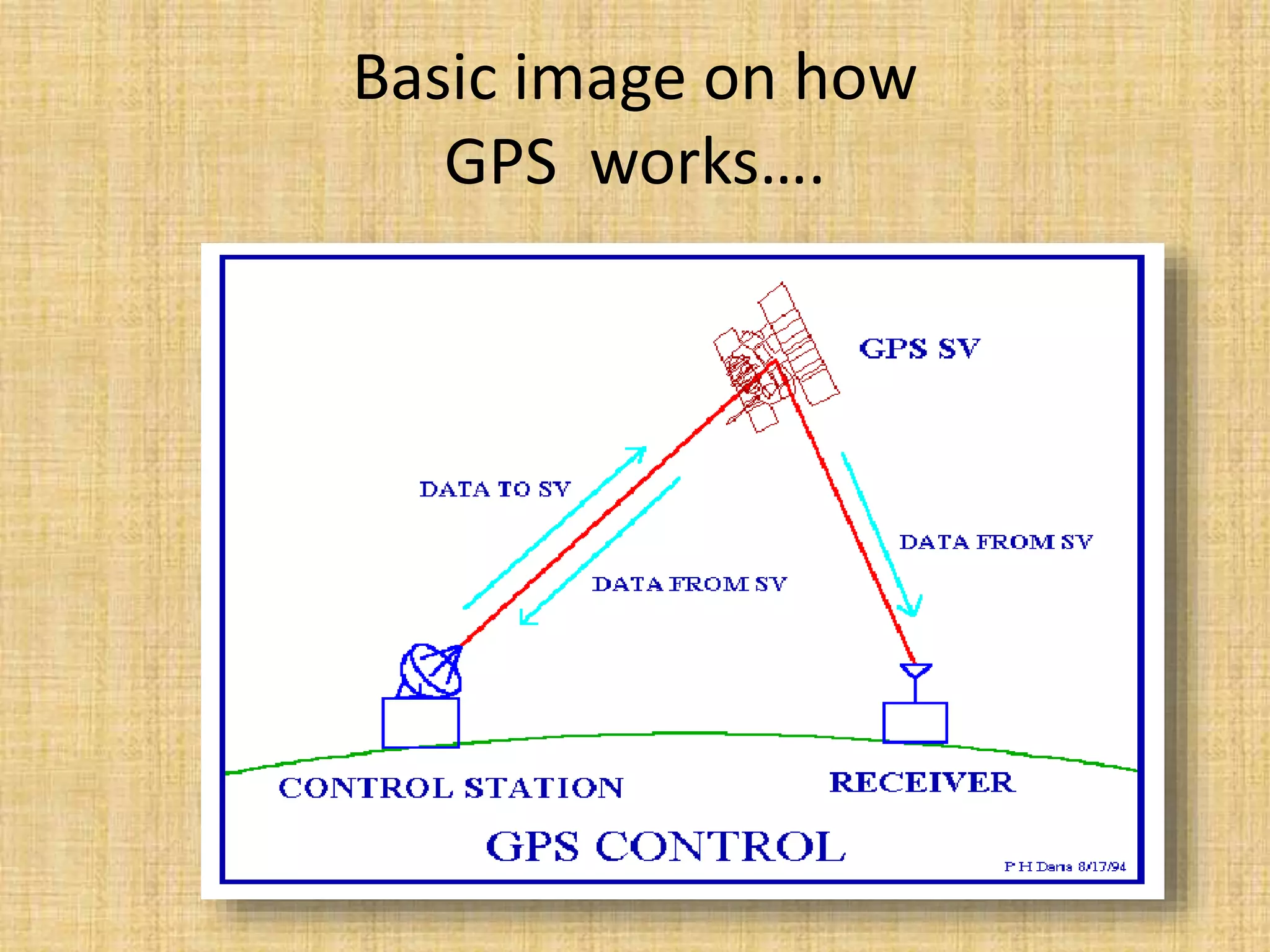
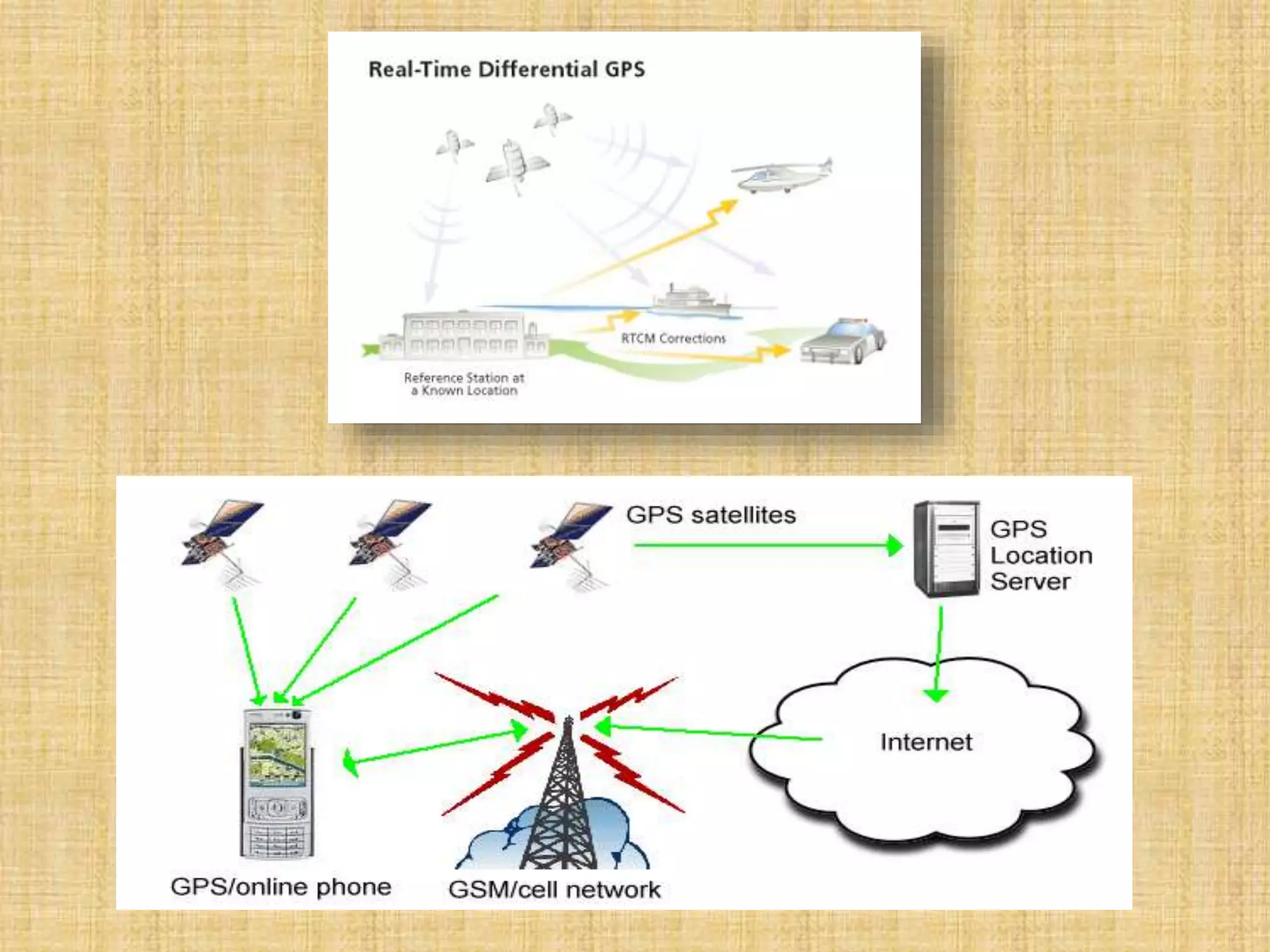
Basic image on how
GPS works….
DEVELOPMENT OF GPS
LORAN and the Decca Navigator were a base
concept for GPS, developed in the early 1940s
• In 1973, a meeting of about twelve military
officers at the Pentagon discussed the creation of
a Defense Navigation Satellite System (DNSS). It
was at this meeting that "the real synthesis that
became GPS was created.“
• Later that year, the DNSS program was
named Navstar
• Initially, the highest quality signal was reserved
for military use, and the signal available for
civilian use was intentionally degraded.
• This changed with President Bill Clinton ordering
Selective Availability to be turned off.
• GPS is owned and operated by the United States
Government .
• On February 10, 1993, the National Aeronautic
Association selected the GPS Team as winners of
the 1992 Robert J. Collier Trophy, the nation's
most prestigious aviation award.
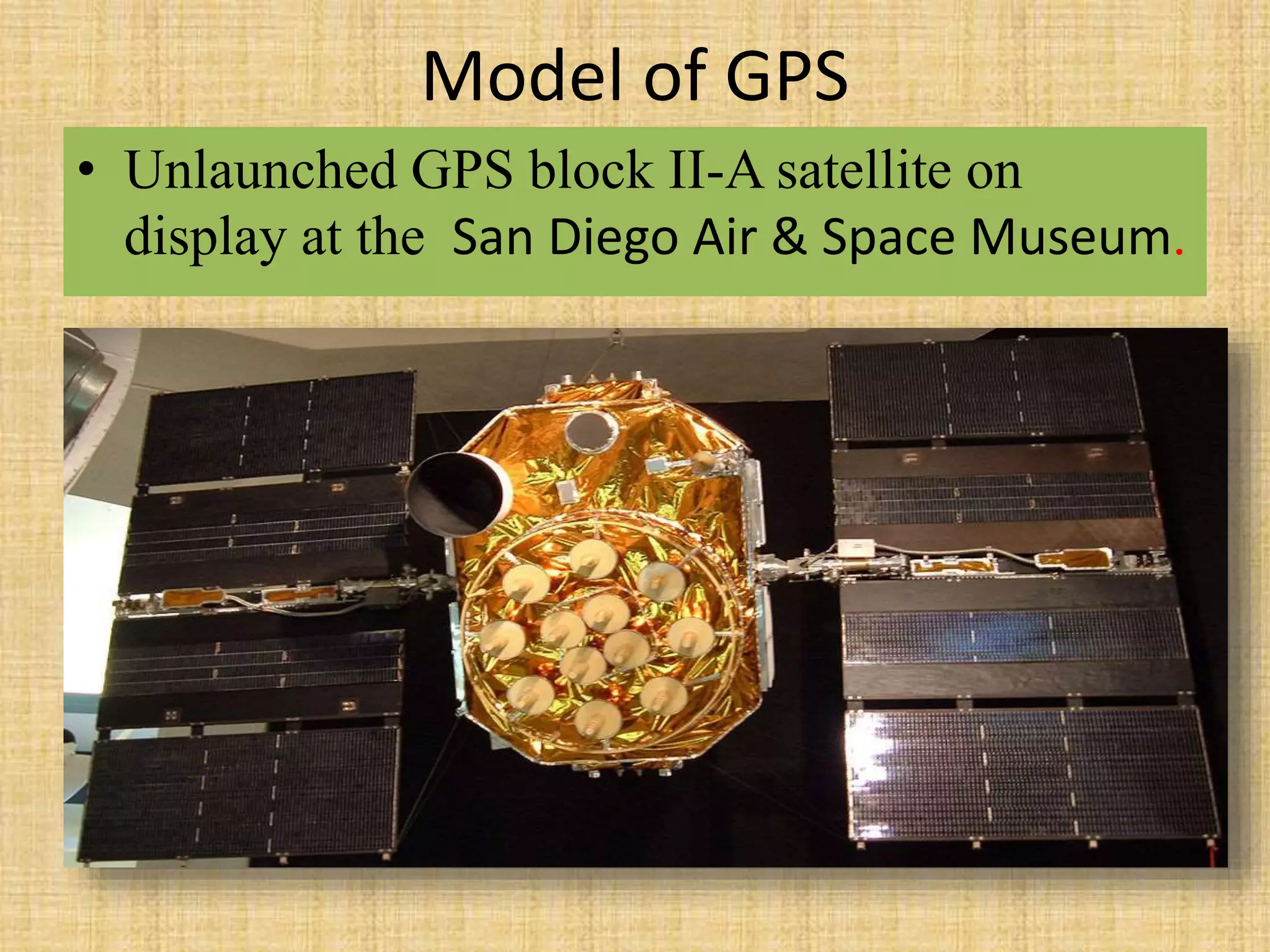
Model of GPS
• Unlaunched GPS block II-A satellite on
display at the San Diego Air & Space Museum.
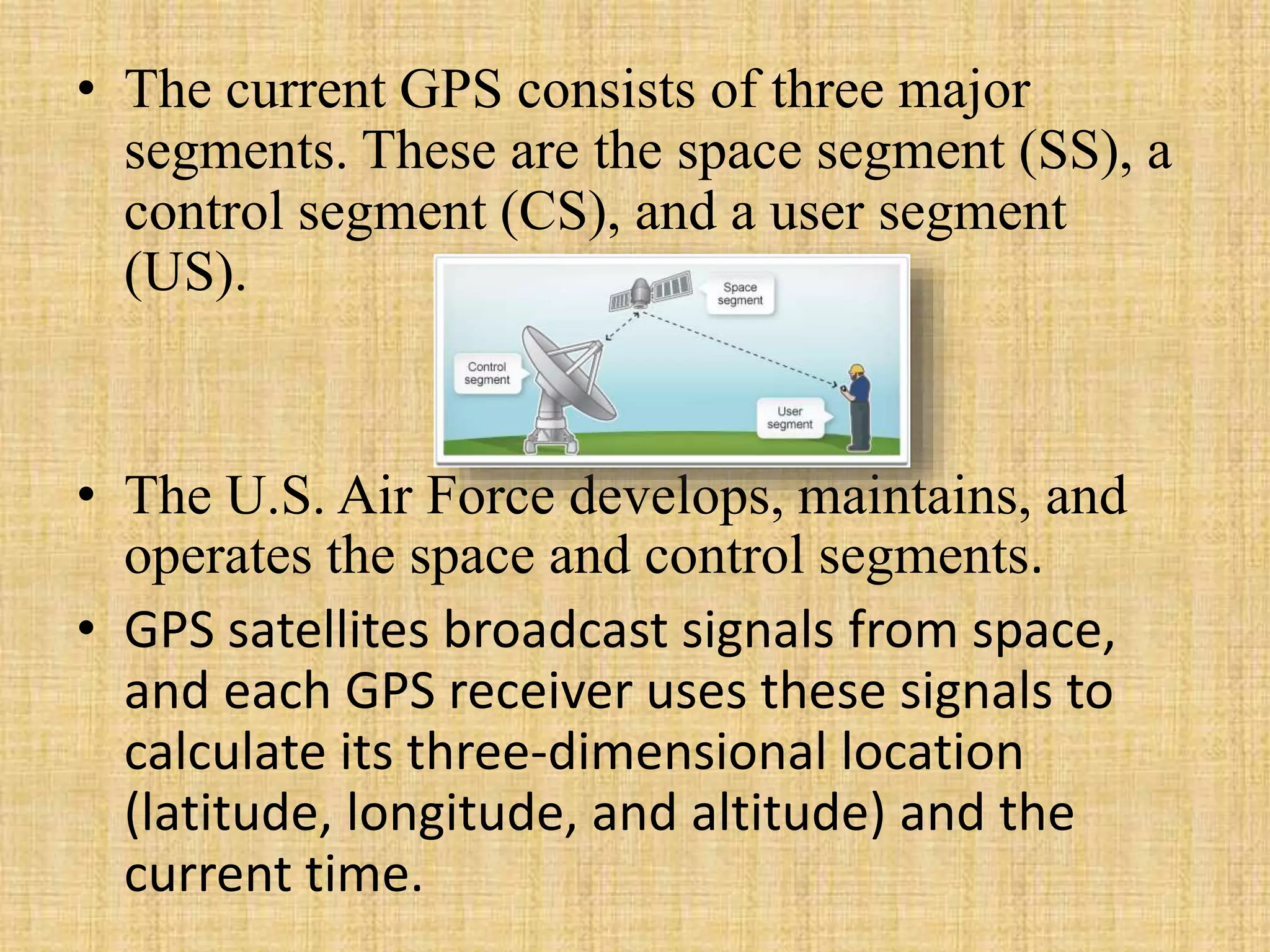
• The current GPS consists of three major
segments. These are the space segment (SS), a
control segment (CS), and a user segment
(US).
• The U.S. Air Force develops, maintains, and
operates the space and control segments.
• GPS satellites broadcast signals from space,
and each GPS receiver uses these signals to
calculate its three-dimensional location
(latitude, longitude, and altitude) and the
current time.
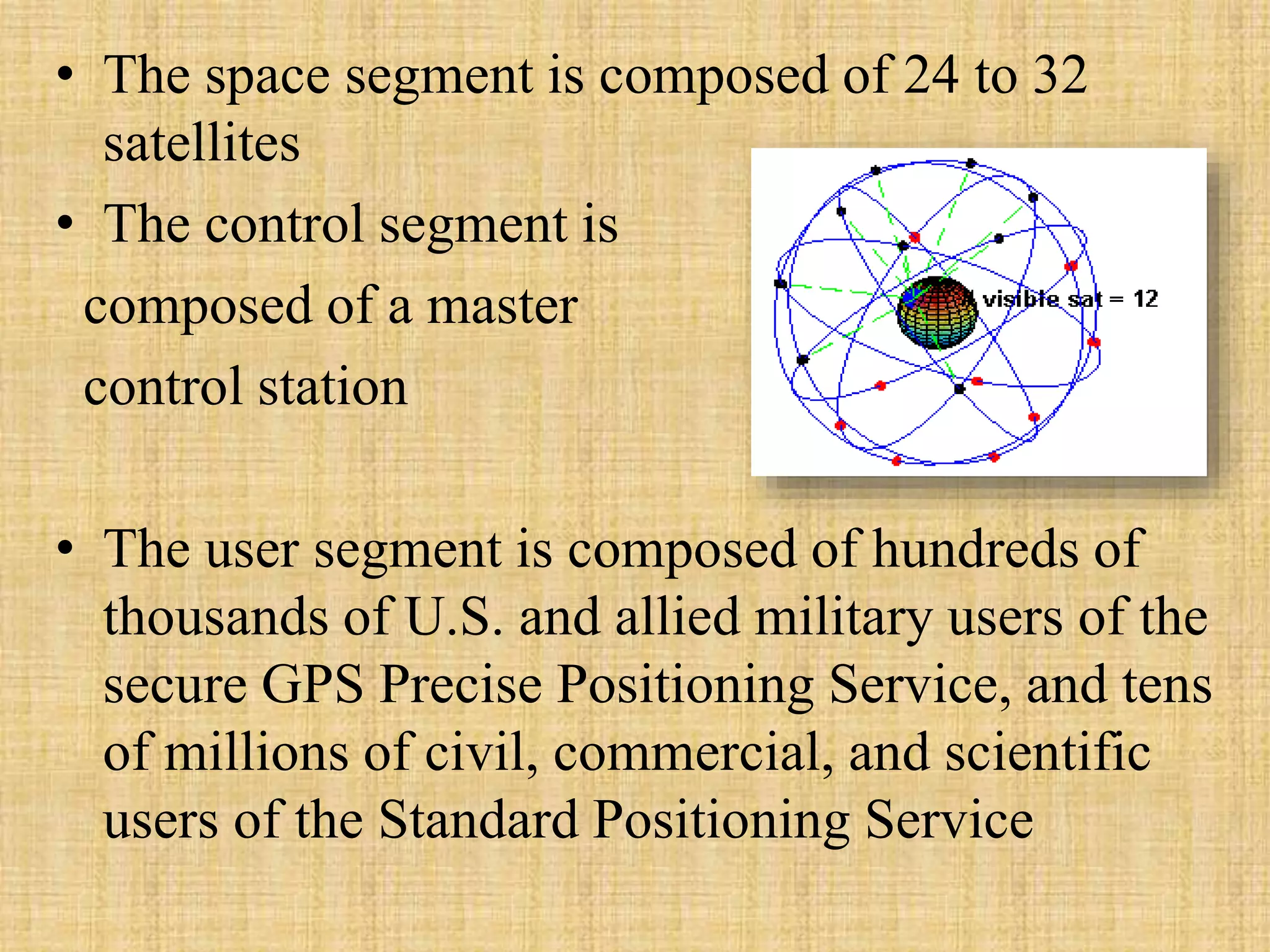
• The space segment is composed of 24 to 32
satellites
• The control segment is
composed of a master
control station
• The user segment is composed of hundreds of
thousands of U.S. and allied military users of the
secure GPS Precise Positioning Service, and tens
of millions of civil, commercial, and scientific
users of the Standard Positioning Service
SPACE SEGMENT
• The space segment (SS) is composed of the
orbiting GPS satellites,
or Space Vehicles (SV)
in GPS parlance.
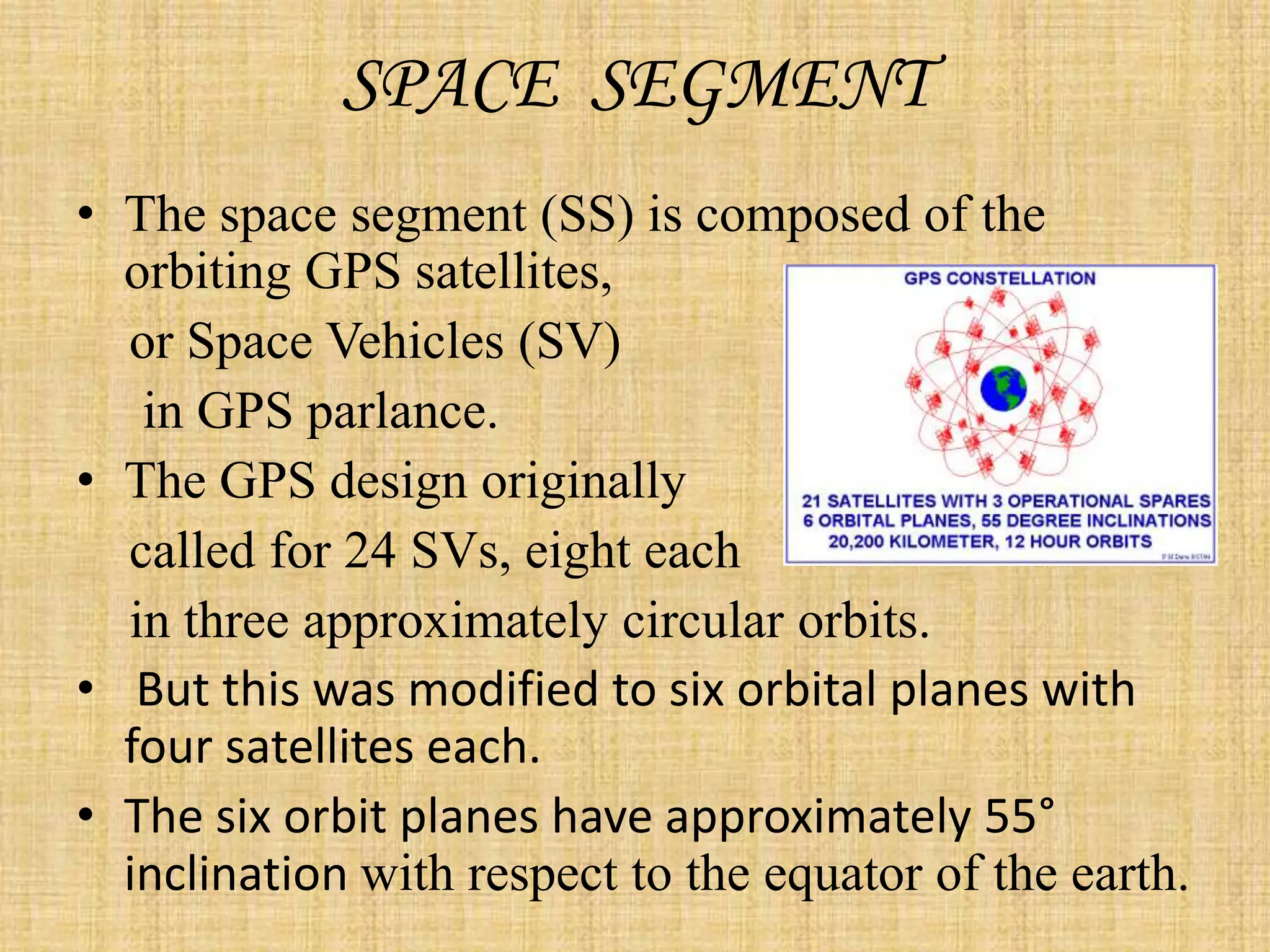
• The GPS design originally
called for 24 SVs, eight each
in three approximately circular orbits.
• But this was modified to six orbital planes with
four satellites each.
• The six orbit planes have approximately 55°
inclination with respect to the equator of the earth.
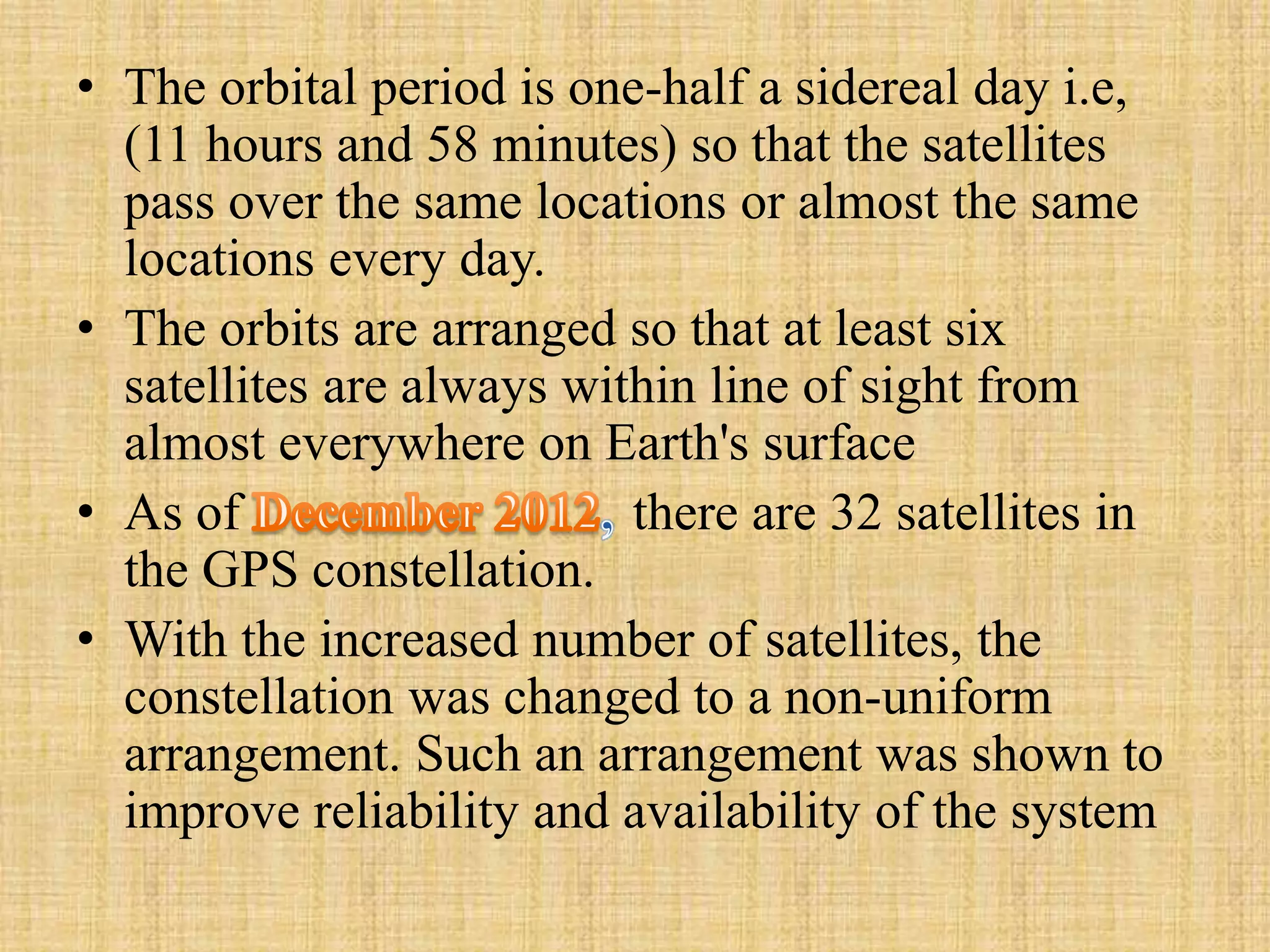
• The orbital period is one-half a sidereal day i.e,
(11 hours and 58 minutes) so that the satellites
pass over the same locations or almost the same
locations every day.
• The orbits are arranged so that at least six
satellites are always within line of sight from
almost everywhere on Earth's surface
• As of there are 32 satellites in
the GPS constellation.
• With the increased number of satellites, the
constellation was changed to a non-uniform
arrangement. Such an arrangement was shown to
improve reliability and availability of the system
CONTROL SEGMENT
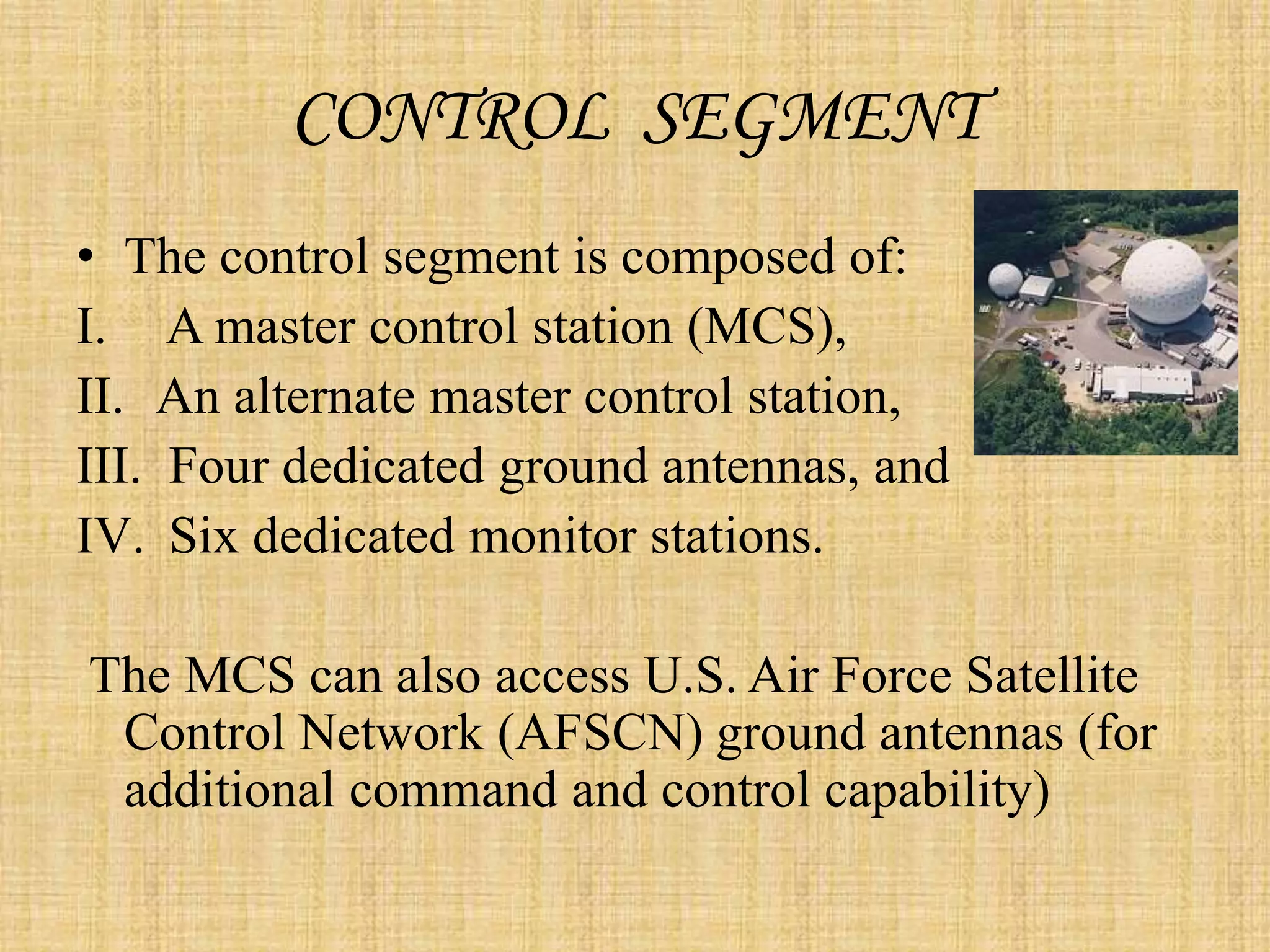
• The control segment is composed of:
I. A master control station (MCS),
II. An alternate master control station,
III. Four dedicated ground antennas, and
IV. Six dedicated monitor stations.
The MCS can also access U.S. Air Force Satellite
Control Network (AFSCN) ground antennas (for
additional command and control capability)
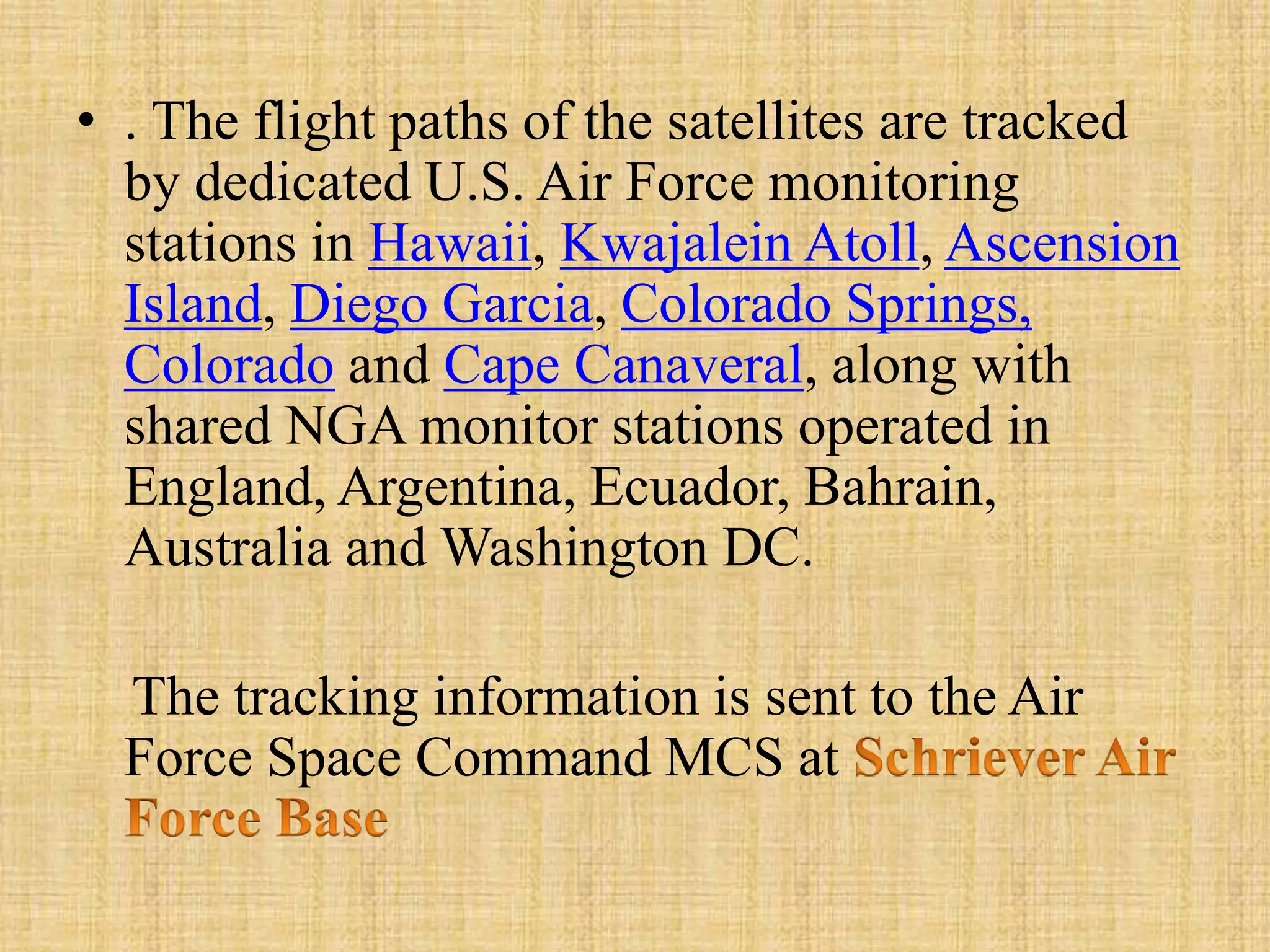
• . The flight paths of the satellites are tracked
by dedicated U.S. Air Force monitoring
stations in Hawaii, Kwajalein Atoll, Ascension
Island, Diego Garcia, Colorado Springs,
Colorado and Cape Canaveral, along with
shared NGA monitor stations operated in
England, Argentina, Ecuador, Bahrain,
Australia and Washington DC.
The tracking information is sent to the Air
Force Space Command MCS at
USER SEGMENT
• The user segment is composed of hundreds of
thousands of U.S. and allied military users of
the secure GPS Precise Positioning Service, and
tens of millions of civil, commercial and
scientific users of the Standard Positioning
Service.
• In general, GPS receivers are composed of an
antenna, tuned to the frequencies transmitted by
the satellites, receiver-processors.
• A receiver is often described by its number of
channels: this signifies how many satellites it
can monitor simultaneously, receivers typically
have between 12 and 20 channels
• Receivers can interface with other devices using
methods including a serial connection, USB,
or Bluetooth
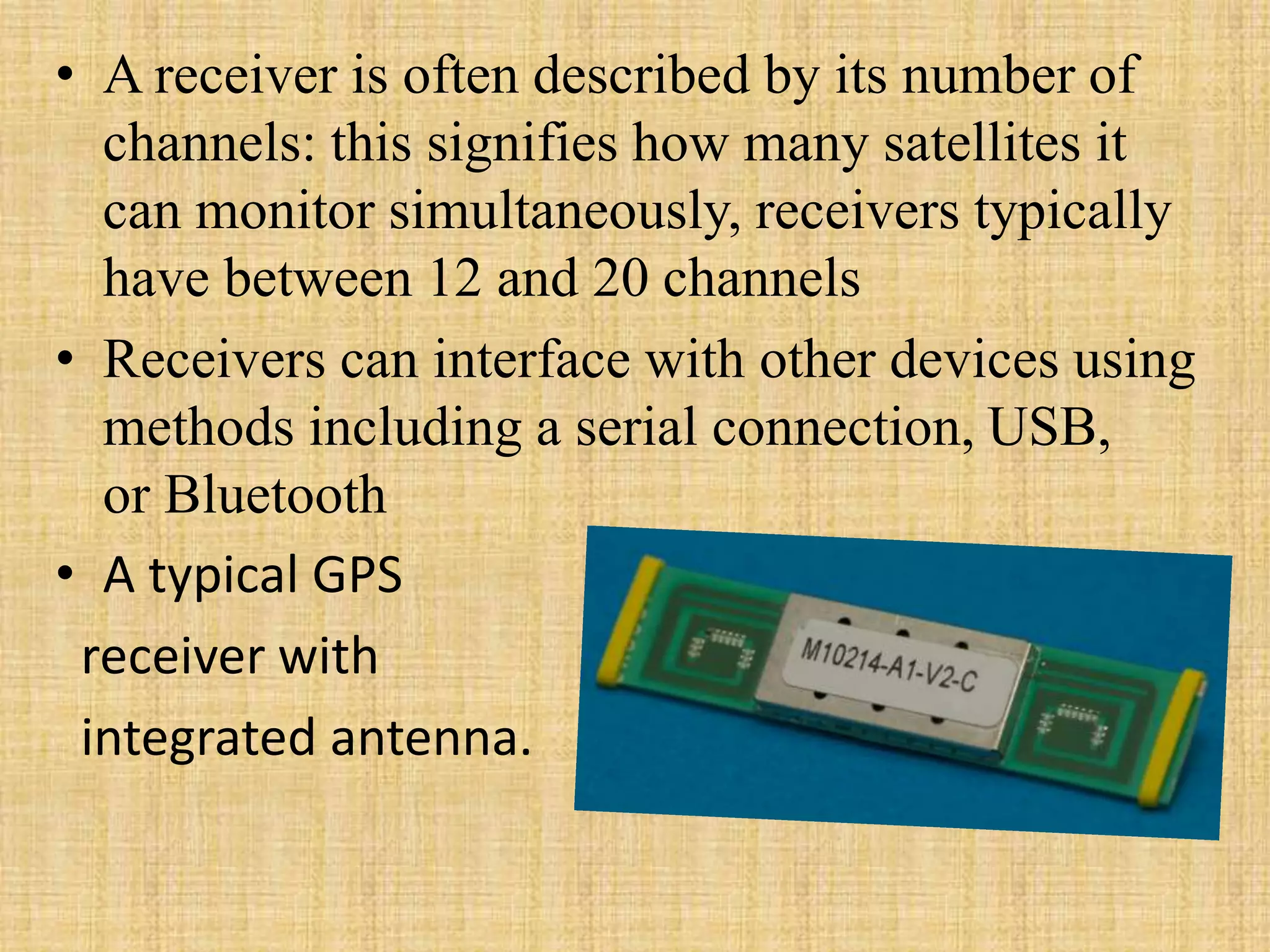
• A typical GPS
receiver with
integrated antenna.
APPLICATIONS
• Used by military and civilians also
 Used in surveying , surveyors use absolute
locations to make maps and determine
property boundaries.
 Also used for astronomy.
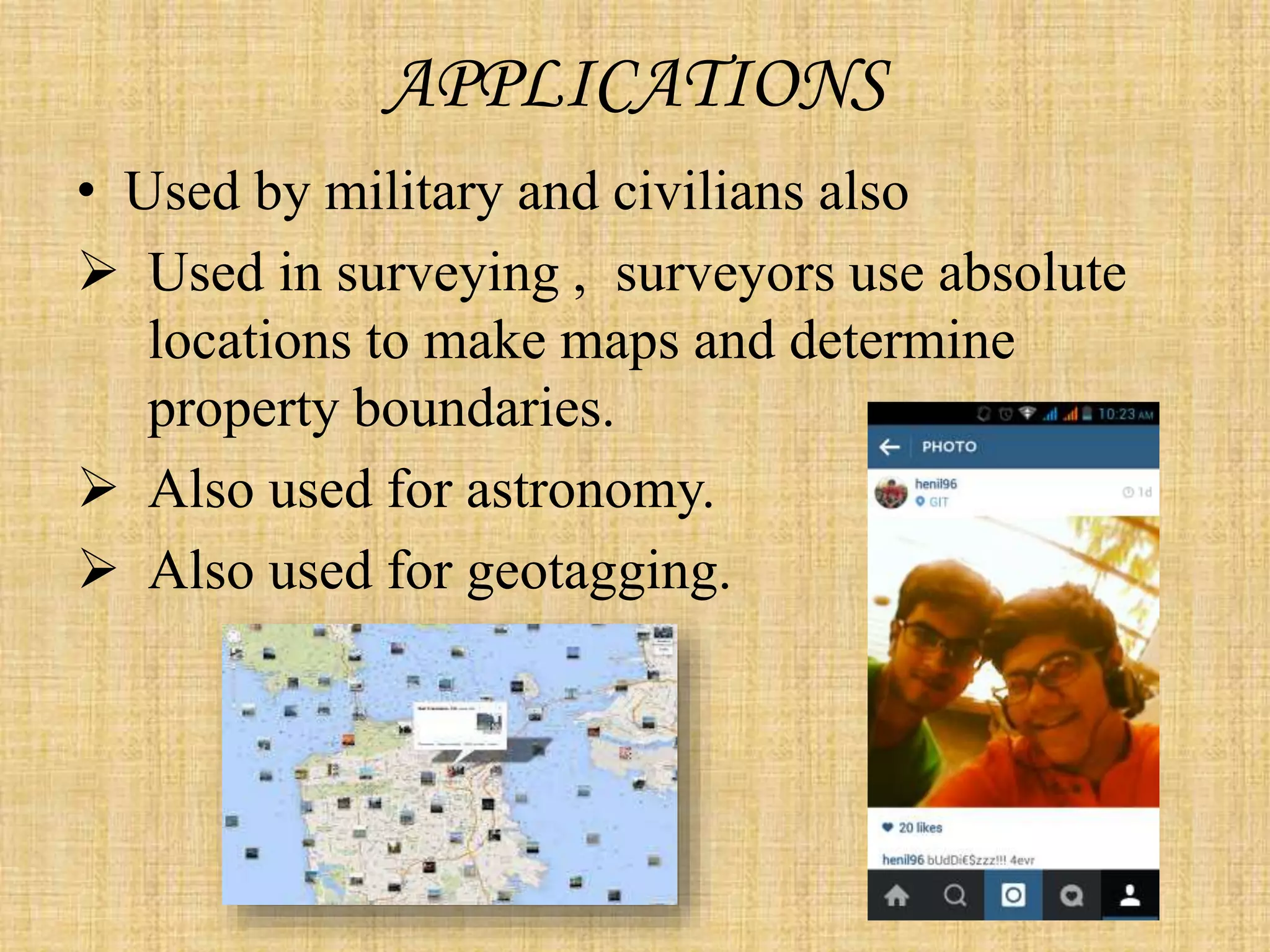
 Also used for geotagging.
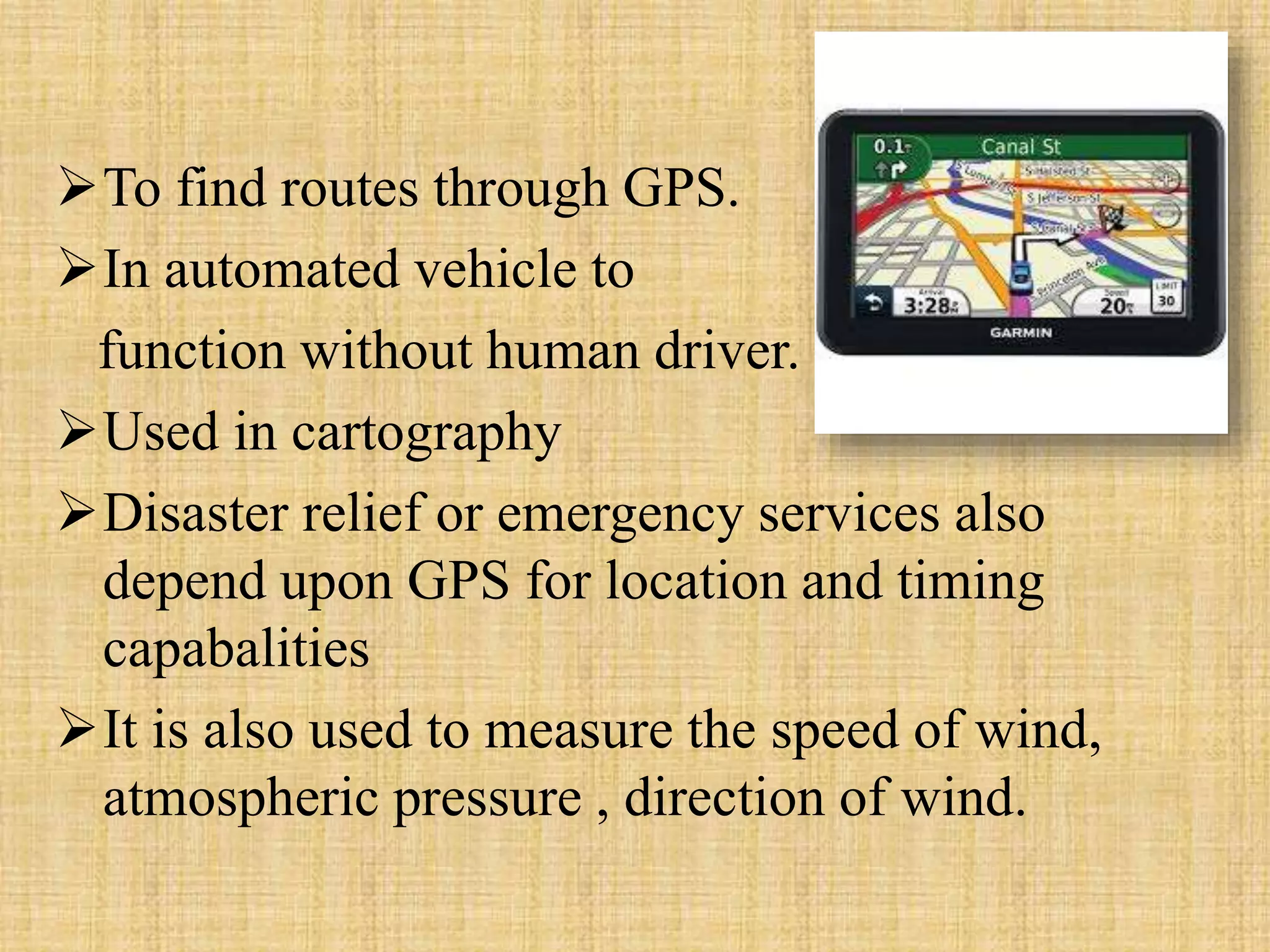
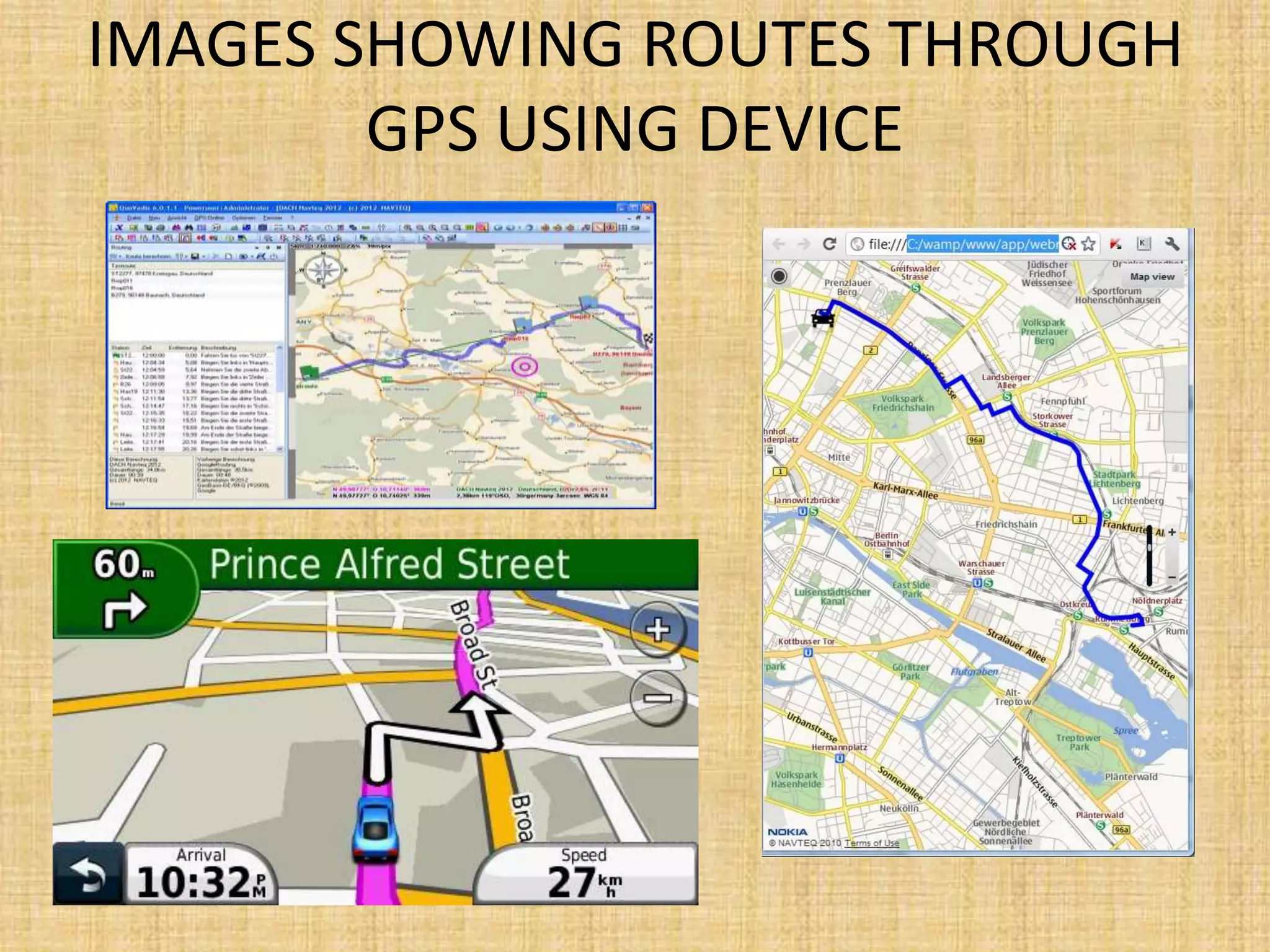
To find routes through GPS.
In automated vehicle to
function without human driver.
Used in cartography
Disaster relief or emergency services also
depend upon GPS for location and timing
capabalities
It is also used to measure the speed of wind,
atmospheric pressure , direction of wind.
Also used for aircraft tracking.
Used in making robots which can self-navigate
using GPS.
Used in mining.
 Pet tracking systems use GPS to locate a pet.
These devices are attached to the pet collar.
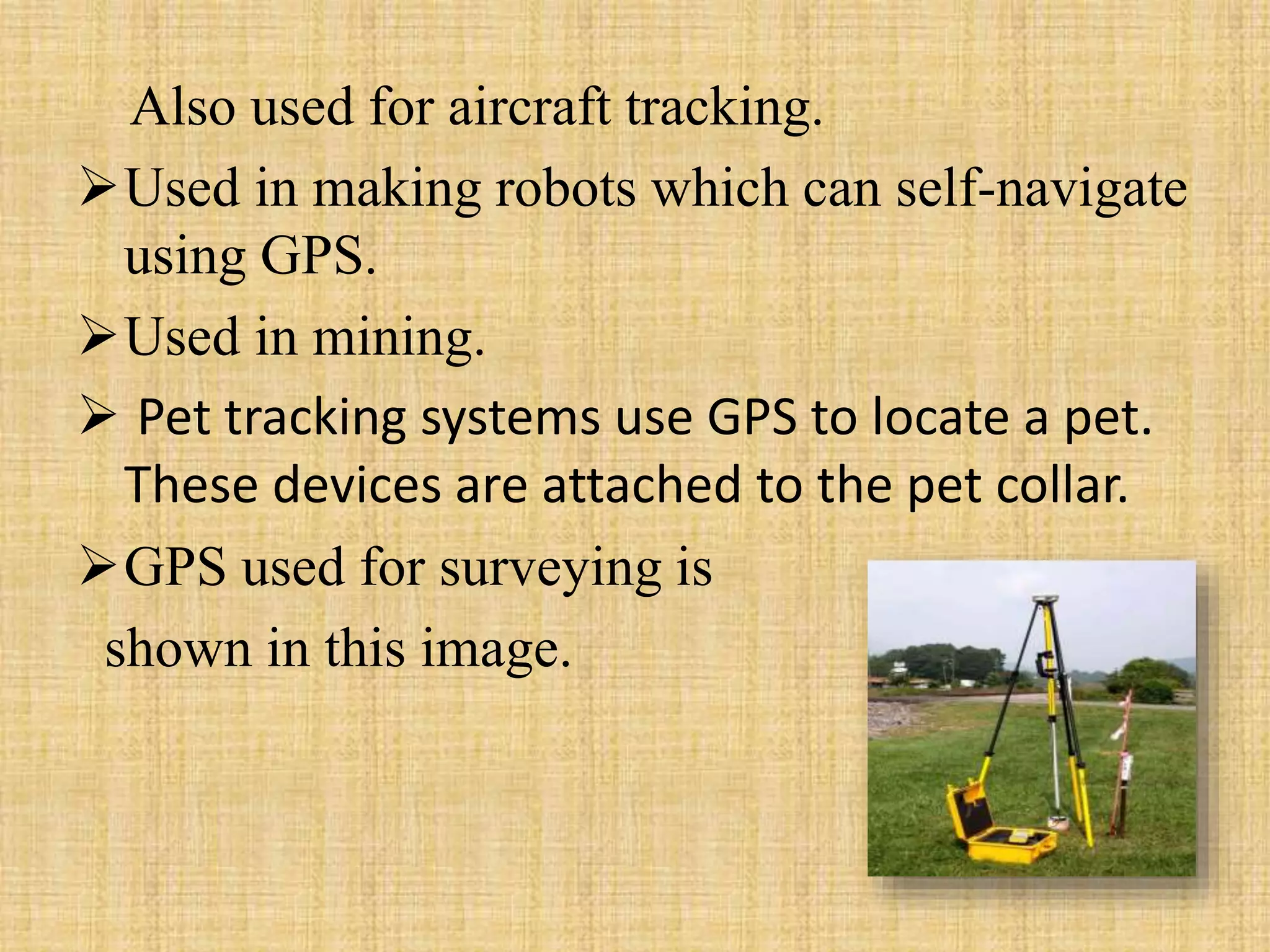
GPS used for surveying is
shown in this image.
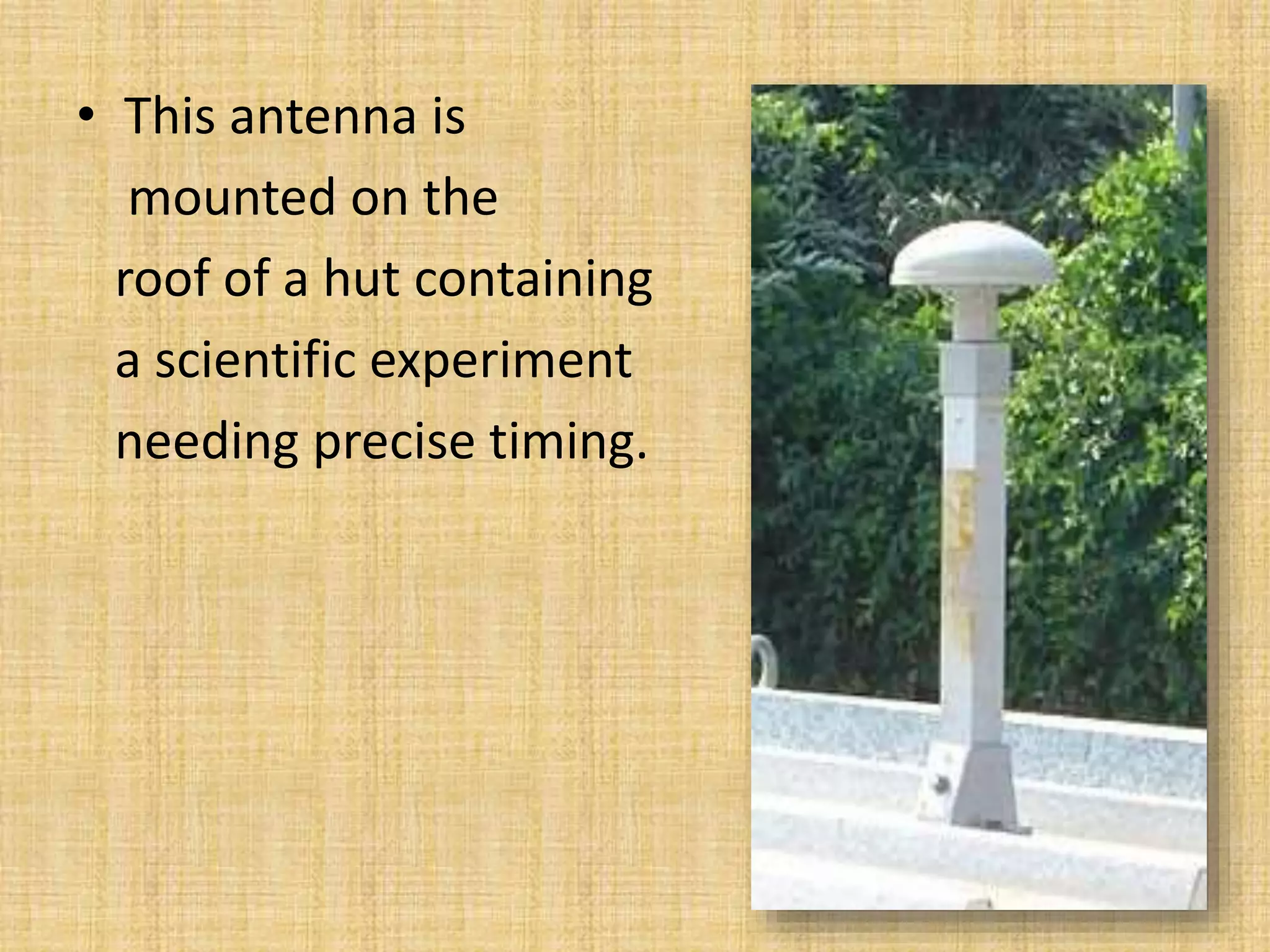
• This antenna is
mounted on the
roof of a hut containing
a scientific experiment
needing precise timing.
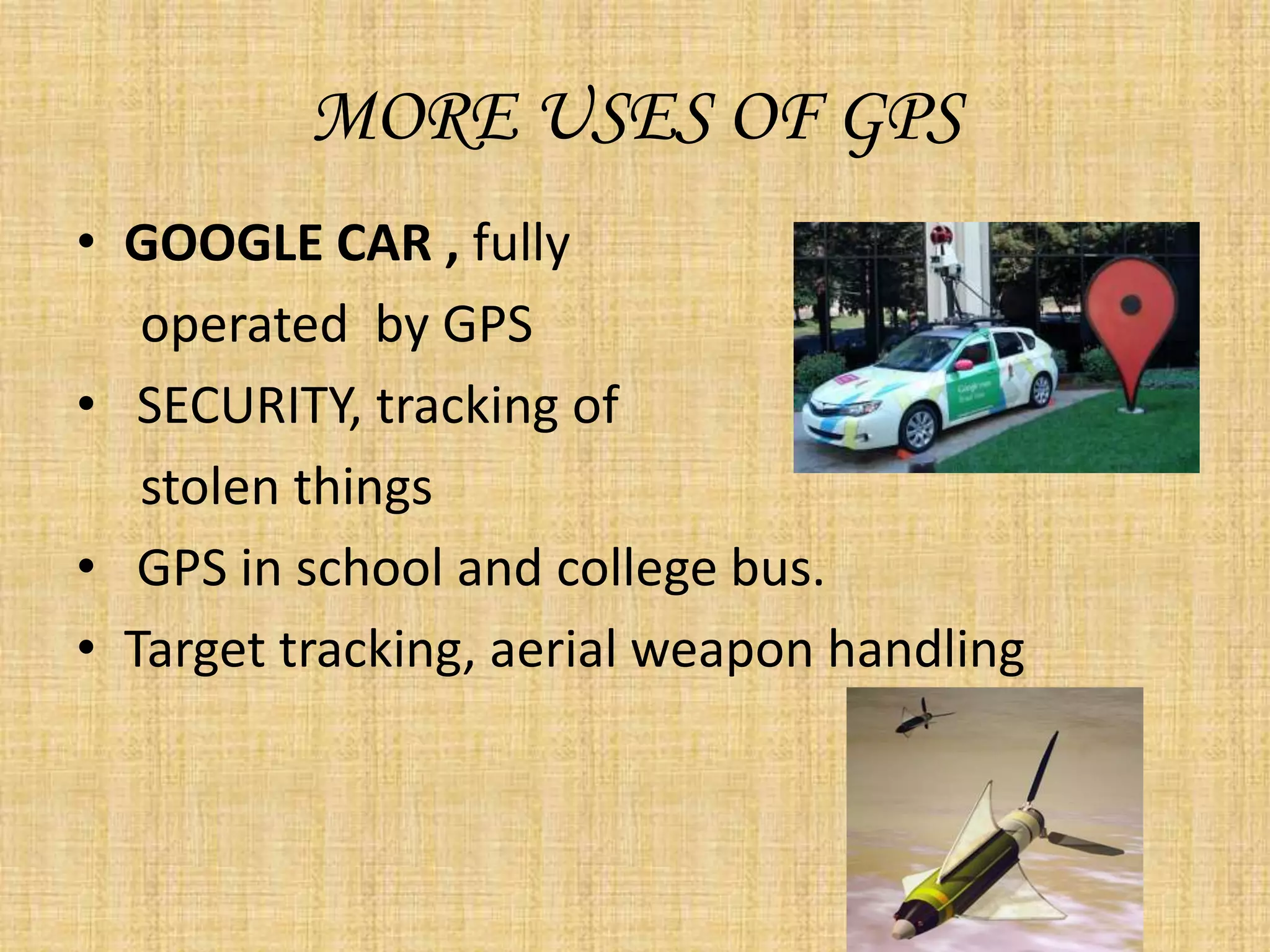
MORE USES OF GPS
• GOOGLE CAR , fully
operated by GPS
• SECURITY, tracking of
stolen things
• GPS in school and college bus.
• Target tracking, aerial weapon handling
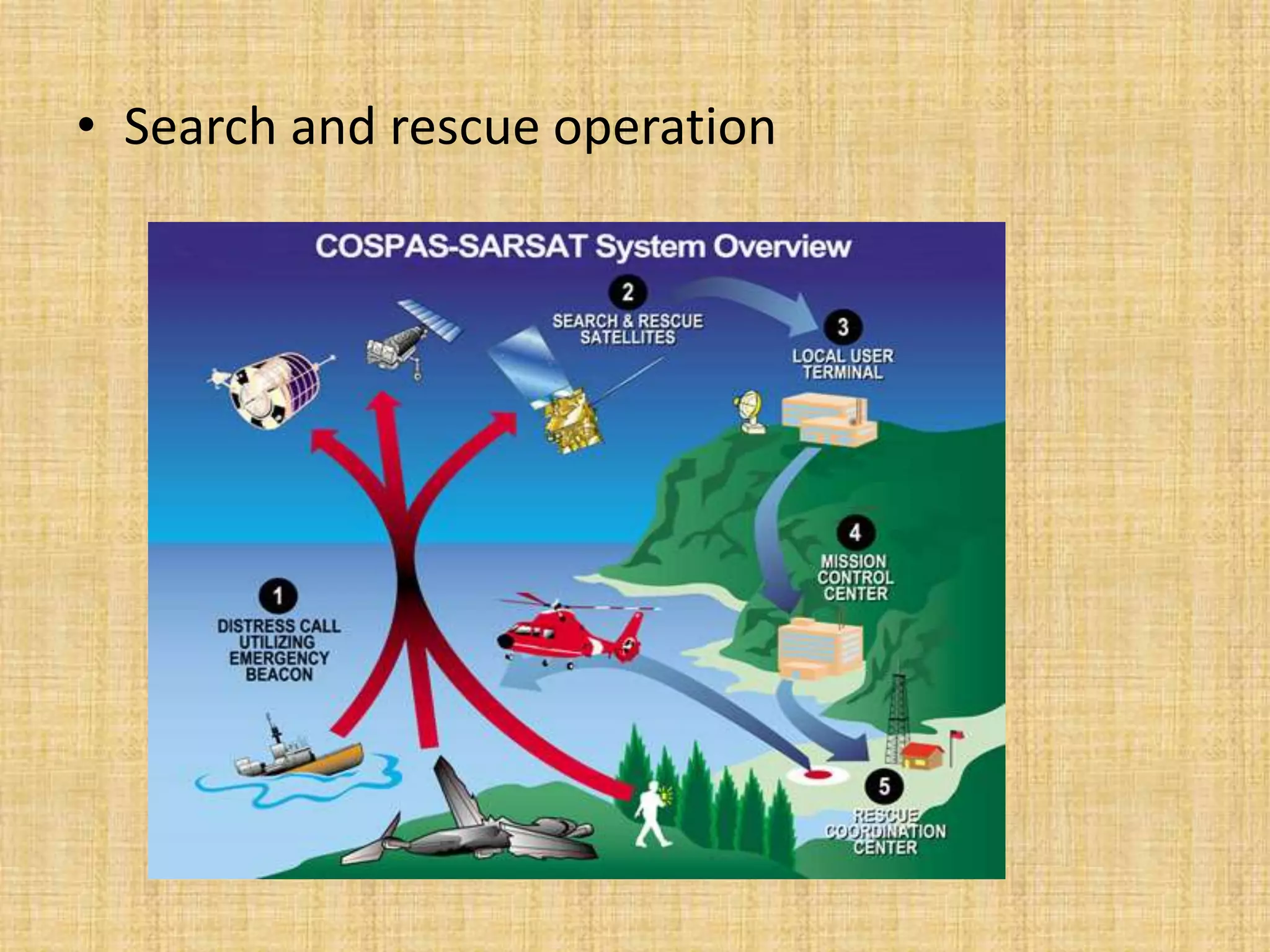
• Search and rescue operation
IMAGES SHOWING ROUTES THROUGH
GPS USING DEVICE
DISADVANTAGES OF GPS
• Completely reply on satellite signals.
• A lot of GPS users are prone to accidents
• Another issue is accuracy
• When number of satellites were restricted, then
there could be error in your position.
• Signals receiving from GPS could be tracked.
• Tracking of signals leads some security issues.
Video explaining basic’s of GPS
REFRENCES:-
WWW.GOOGLE.COM
WWW.WIKIPEDIA.ORG
WWW.TARGETSTUDY.COM
WWW.EHOW.COM
WWW.TRAILS.COM
Global positioning system (GPS)

Global positioning system (GPS)

  • 1.
  • 2.
  • 3.
    Global Positioning System(GPS) • The Global Positioning System (GPS) is a space- based satellite navigation system that provides location and time information in all weather conditions, anywhere on the earth. • The system provides critical capabilities to military, civil and commercial users. It is freely accessible to anyone with a GPS receiver.
  • 4.
    Past view onGPS • Bradford Parkinson, Roger L. Easton, and Ivan A. Getting are credited with inventing it. • The GPS project was developed in 1973 to overcome the limitations of previous navigation systems • GPS was created and realized by the U.S. Department of Defense (DoD) and was originally run with 24 satellites. It became fully operational in 1995.
  • 5.
    OTHER NAVIGATION SYSTEMS •Russia developed Russian Global Navigation Satellite System (GLONASS) in comparison to GPS system • European Union Galileo positioning system • India's Indian Regional Navigation Satellite System and, • Chinese Beidou Navigation Satellite System
  • 6.
    Basic image onhow GPS works….
  • 7.
    DEVELOPMENT OF GPS LORANand the Decca Navigator were a base concept for GPS, developed in the early 1940s • In 1973, a meeting of about twelve military officers at the Pentagon discussed the creation of a Defense Navigation Satellite System (DNSS). It was at this meeting that "the real synthesis that became GPS was created.“ • Later that year, the DNSS program was named Navstar
  • 8.
    • Initially, thehighest quality signal was reserved for military use, and the signal available for civilian use was intentionally degraded. • This changed with President Bill Clinton ordering Selective Availability to be turned off. • GPS is owned and operated by the United States Government . • On February 10, 1993, the National Aeronautic Association selected the GPS Team as winners of the 1992 Robert J. Collier Trophy, the nation's most prestigious aviation award.
  • 9.
    Model of GPS •Unlaunched GPS block II-A satellite on display at the San Diego Air & Space Museum.
  • 10.
    • The currentGPS consists of three major segments. These are the space segment (SS), a control segment (CS), and a user segment (US). • The U.S. Air Force develops, maintains, and operates the space and control segments. • GPS satellites broadcast signals from space, and each GPS receiver uses these signals to calculate its three-dimensional location (latitude, longitude, and altitude) and the current time.
  • 11.
    • The spacesegment is composed of 24 to 32 satellites • The control segment is composed of a master control station • The user segment is composed of hundreds of thousands of U.S. and allied military users of the secure GPS Precise Positioning Service, and tens of millions of civil, commercial, and scientific users of the Standard Positioning Service
  • 12.
    SPACE SEGMENT • Thespace segment (SS) is composed of the orbiting GPS satellites, or Space Vehicles (SV) in GPS parlance. • The GPS design originally called for 24 SVs, eight each in three approximately circular orbits. • But this was modified to six orbital planes with four satellites each. • The six orbit planes have approximately 55° inclination with respect to the equator of the earth.
  • 13.
    • The orbitalperiod is one-half a sidereal day i.e, (11 hours and 58 minutes) so that the satellites pass over the same locations or almost the same locations every day. • The orbits are arranged so that at least six satellites are always within line of sight from almost everywhere on Earth's surface • As of there are 32 satellites in the GPS constellation. • With the increased number of satellites, the constellation was changed to a non-uniform arrangement. Such an arrangement was shown to improve reliability and availability of the system
  • 14.
    CONTROL SEGMENT • Thecontrol segment is composed of: I. A master control station (MCS), II. An alternate master control station, III. Four dedicated ground antennas, and IV. Six dedicated monitor stations. The MCS can also access U.S. Air Force Satellite Control Network (AFSCN) ground antennas (for additional command and control capability)
  • 15.
    • . Theflight paths of the satellites are tracked by dedicated U.S. Air Force monitoring stations in Hawaii, Kwajalein Atoll, Ascension Island, Diego Garcia, Colorado Springs, Colorado and Cape Canaveral, along with shared NGA monitor stations operated in England, Argentina, Ecuador, Bahrain, Australia and Washington DC. The tracking information is sent to the Air Force Space Command MCS at
  • 16.
    USER SEGMENT • Theuser segment is composed of hundreds of thousands of U.S. and allied military users of the secure GPS Precise Positioning Service, and tens of millions of civil, commercial and scientific users of the Standard Positioning Service. • In general, GPS receivers are composed of an antenna, tuned to the frequencies transmitted by the satellites, receiver-processors.
  • 17.
    • A receiveris often described by its number of channels: this signifies how many satellites it can monitor simultaneously, receivers typically have between 12 and 20 channels • Receivers can interface with other devices using methods including a serial connection, USB, or Bluetooth • A typical GPS receiver with integrated antenna.
  • 18.
    APPLICATIONS • Used bymilitary and civilians also  Used in surveying , surveyors use absolute locations to make maps and determine property boundaries.  Also used for astronomy.  Also used for geotagging.
  • 19.
    To find routesthrough GPS. In automated vehicle to function without human driver. Used in cartography Disaster relief or emergency services also depend upon GPS for location and timing capabalities It is also used to measure the speed of wind, atmospheric pressure , direction of wind.
  • 20.
    Also used foraircraft tracking. Used in making robots which can self-navigate using GPS. Used in mining.  Pet tracking systems use GPS to locate a pet. These devices are attached to the pet collar. GPS used for surveying is shown in this image.
  • 21.
    • This antennais mounted on the roof of a hut containing a scientific experiment needing precise timing.
  • 23.
    MORE USES OFGPS • GOOGLE CAR , fully operated by GPS • SECURITY, tracking of stolen things • GPS in school and college bus. • Target tracking, aerial weapon handling
  • 24.
    • Search andrescue operation
  • 25.
    IMAGES SHOWING ROUTESTHROUGH GPS USING DEVICE
  • 26.
    DISADVANTAGES OF GPS •Completely reply on satellite signals. • A lot of GPS users are prone to accidents • Another issue is accuracy • When number of satellites were restricted, then there could be error in your position. • Signals receiving from GPS could be tracked. • Tracking of signals leads some security issues.
  • 27.
  • 28.