Planning of Open
Spaces
Importance of Open Space Planning
• They can play an important role in establishing a desirable
living environment for new town residents
• Open spaces serve as a medium through which man can
maintain contact with nature
• Careful use of such spaces can avoid the inequality between
private and public open spaces
• Careful planning of open spaces can avoid mixing of industrial
and residential land uses, and could increase or strengthen
the territorial identity of neighborhoods and of new town
Types of Recreation
• Parks: Parks are necessary in order to provide
relief to the inhabitants from air and noise
pollution and to satisfy the needs of fresh air
and peaceful enjoyment of the unspoiled
nature. Parks furnish the passive type of
recreation to the town
• Playgrounds: Playgrounds are necessary for
physical development of body by actively
engaging in various games.
Classification of Parks
As per character parks can be classified as
• Artificial Parks: These parks specially prepared with grass,
shrubs, flowers, trees and water introduced in
form of waterfalls, pools, fountains, etc. they are usually
provided to enhance the aesthetics of the surroundings.
• Natural Parks: These parks are prepared at the site where the
soil is naturally rich. With very little effort and investment a
very attractive park can be prepared for the public use.
Classification of Parks
Keeping in view the purpose of the park which it serves parks can be
classified as
• Botanical Parks: the primary purpose of these parks is to further advance
the study of plants specimens. These parks should provide exclusive
opportunities to scientists and students of botany to study natural flora.
• Zoological Parks; in these parks variety of fauna is housed. A library and a
laboratory can be a feature of this park for scientists and students of
zoology. Playing equipment and amusement features and be added to a
zoological garden for general public who visit zoo for outing or a picnic.
Classification of Parks
According to size, parks are classified as
• A small Size Parks: these parks are provided in front or
enriching the important buildings. From architecture point of
view, these parks serve two purposes. These parks mitigate
the effects of hot and dry climate and enhance the aesthetic
view of the public building.
• Medium Size Parks: these parks are provided for every
neighborhood of the town. Both types of recreation, active as
well as passive are provided in these parks.
Classification of Parks
• Large Size Parks: this park serve the entire population of the town and act
as an outdoor recreational place for the population. both types of
recreations are to be provided in this park and it may also contain zoo.
Large beaches on the ocean or river front may also be included in this
class of parks.
• Reservations: these parks are situated outside the town limits and provide
fun of riding away form the town. These are generally the places of
natural beauty with greenery, water, hills, etc.
• National Parks: these parks include within their limits rivers, forests,
waterfalls, mountains, wildlife, places of historical importance, coastal
belts, etc. these parks should be evenly be distributed throughout the
country.
Benefits of Open Space Planning
• Social benefits: mental peace, comfort,
cheerfulness, social contacts, physical health
of public
• Economical benefits: promote tourism, job
opportunities, increase the value of adjacent
residential plots
• Environmental benefit: serve as buffers, clean
the environment, make the climate cool
Park Design
The design of parks depends on its purpose and site characteristics but for
average parks, the general principles to be observed in their design can be
mentioned as
• Collection of data: characteristics of the site, population likely to visit the park,
purpose of park, facilities to be provided, etc is to be collected
• Commercial Sports; the sports such as cricket, hockey, football, etc. attract large
crowds. Such sports are to be played on commercial basis.
• Division: the park area may be broadly divided into three districts which are
Area for passive recreation
Buffer area consisting flowers and some relevant buildings such as canteens
Park Design
Area for active recreation or playground area
• Facilities: the design of the park should accommodate facilities such as
sanitary blocks, shelters, seats, fountains, etc.
• Paths and walks: these should be provided for easy circulation
throughout the area
• Proportion of recreation type: proportion of active and passive type of
recreation should be worked out
• Water: can be given in the form of lakes or flowing water as it
contributes to the decorative effect of the park.
Active Recreation Standards
• Age up to 6 years: playgrounds should be near their homes
with proper fencing all around
• Children at school: each school should have its own
playground.
• Youth and Adults: the playgrounds should be within a range
of 3 km or so
• Private Clubs: the provision should be made according to
population density and type
Parkways
• A parkway may be defined as well designed fast speed, dual
carriage within the city limits leading to some important
development or parks.
• It prohibits the entry of slow moving vehicles.
• The planting along parkway is done very carefully so that
trees , vegetation and flora should not interfere vision
specially near curves
• It has a landscaped strip of land between a thoroughfare and
its sidewalk or running in the center of a thoroughfare
Parkways
Parkways of Islamabad
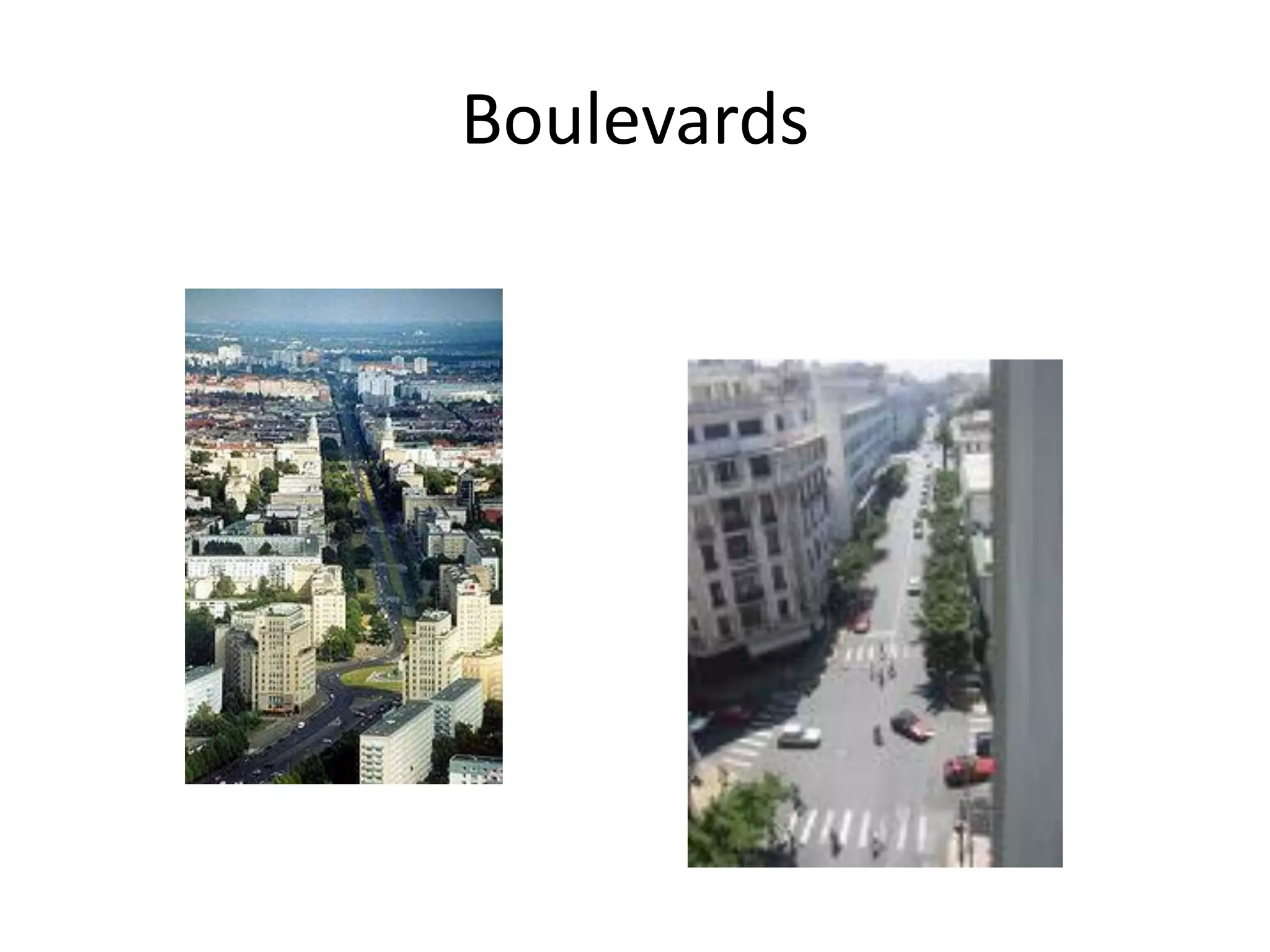
Boulevards
• A wide tree lined avenue in a town.
• It may connect some very important building
or may connect various recreational reserves
of the town it may connect industrial estate
with the housing estates
• It is desired to provide separate arrangements
for cyclists, pedestrians and vehicles
Boulevards
Boulevards of Lahore
City Park, Denver
• City Park is an urban park and neighborhood in Denver,
Colorado. The park is 330 acres (1.3 km2) and is located in
east-central Denver. The park contains the Denver Zoo, the
Denver Museum of Nature and Science, Ferril and Duck Lakes,
and a boathouse. City Park is also the name of the
neighborhood that contains the park, though the park is the
vast majority of the neighborhood. To the immediate north of
the park is the City Park Golf Course. City Park is the largest
and most notable park in Denver.
City Park, Denver

Planning Open spaces

  • 1.
  • 2.
    Importance of OpenSpace Planning • They can play an important role in establishing a desirable living environment for new town residents • Open spaces serve as a medium through which man can maintain contact with nature • Careful use of such spaces can avoid the inequality between private and public open spaces • Careful planning of open spaces can avoid mixing of industrial and residential land uses, and could increase or strengthen the territorial identity of neighborhoods and of new town
  • 3.
    Types of Recreation •Parks: Parks are necessary in order to provide relief to the inhabitants from air and noise pollution and to satisfy the needs of fresh air and peaceful enjoyment of the unspoiled nature. Parks furnish the passive type of recreation to the town • Playgrounds: Playgrounds are necessary for physical development of body by actively engaging in various games.
  • 4.
    Classification of Parks Asper character parks can be classified as • Artificial Parks: These parks specially prepared with grass, shrubs, flowers, trees and water introduced in form of waterfalls, pools, fountains, etc. they are usually provided to enhance the aesthetics of the surroundings. • Natural Parks: These parks are prepared at the site where the soil is naturally rich. With very little effort and investment a very attractive park can be prepared for the public use.
  • 5.
    Classification of Parks Keepingin view the purpose of the park which it serves parks can be classified as • Botanical Parks: the primary purpose of these parks is to further advance the study of plants specimens. These parks should provide exclusive opportunities to scientists and students of botany to study natural flora. • Zoological Parks; in these parks variety of fauna is housed. A library and a laboratory can be a feature of this park for scientists and students of zoology. Playing equipment and amusement features and be added to a zoological garden for general public who visit zoo for outing or a picnic.
  • 6.
    Classification of Parks Accordingto size, parks are classified as • A small Size Parks: these parks are provided in front or enriching the important buildings. From architecture point of view, these parks serve two purposes. These parks mitigate the effects of hot and dry climate and enhance the aesthetic view of the public building. • Medium Size Parks: these parks are provided for every neighborhood of the town. Both types of recreation, active as well as passive are provided in these parks.
  • 7.
    Classification of Parks •Large Size Parks: this park serve the entire population of the town and act as an outdoor recreational place for the population. both types of recreations are to be provided in this park and it may also contain zoo. Large beaches on the ocean or river front may also be included in this class of parks. • Reservations: these parks are situated outside the town limits and provide fun of riding away form the town. These are generally the places of natural beauty with greenery, water, hills, etc. • National Parks: these parks include within their limits rivers, forests, waterfalls, mountains, wildlife, places of historical importance, coastal belts, etc. these parks should be evenly be distributed throughout the country.
  • 8.
    Benefits of OpenSpace Planning • Social benefits: mental peace, comfort, cheerfulness, social contacts, physical health of public • Economical benefits: promote tourism, job opportunities, increase the value of adjacent residential plots • Environmental benefit: serve as buffers, clean the environment, make the climate cool
  • 9.
    Park Design The designof parks depends on its purpose and site characteristics but for average parks, the general principles to be observed in their design can be mentioned as • Collection of data: characteristics of the site, population likely to visit the park, purpose of park, facilities to be provided, etc is to be collected • Commercial Sports; the sports such as cricket, hockey, football, etc. attract large crowds. Such sports are to be played on commercial basis. • Division: the park area may be broadly divided into three districts which are Area for passive recreation Buffer area consisting flowers and some relevant buildings such as canteens
  • 10.
    Park Design Area foractive recreation or playground area • Facilities: the design of the park should accommodate facilities such as sanitary blocks, shelters, seats, fountains, etc. • Paths and walks: these should be provided for easy circulation throughout the area • Proportion of recreation type: proportion of active and passive type of recreation should be worked out • Water: can be given in the form of lakes or flowing water as it contributes to the decorative effect of the park.
  • 11.
    Active Recreation Standards •Age up to 6 years: playgrounds should be near their homes with proper fencing all around • Children at school: each school should have its own playground. • Youth and Adults: the playgrounds should be within a range of 3 km or so • Private Clubs: the provision should be made according to population density and type
  • 12.
    Parkways • A parkwaymay be defined as well designed fast speed, dual carriage within the city limits leading to some important development or parks. • It prohibits the entry of slow moving vehicles. • The planting along parkway is done very carefully so that trees , vegetation and flora should not interfere vision specially near curves • It has a landscaped strip of land between a thoroughfare and its sidewalk or running in the center of a thoroughfare
  • 13.
  • 14.
  • 15.
    Boulevards • A widetree lined avenue in a town. • It may connect some very important building or may connect various recreational reserves of the town it may connect industrial estate with the housing estates • It is desired to provide separate arrangements for cyclists, pedestrians and vehicles
  • 16.
  • 17.
  • 18.
    City Park, Denver •City Park is an urban park and neighborhood in Denver, Colorado. The park is 330 acres (1.3 km2) and is located in east-central Denver. The park contains the Denver Zoo, the Denver Museum of Nature and Science, Ferril and Duck Lakes, and a boathouse. City Park is also the name of the neighborhood that contains the park, though the park is the vast majority of the neighborhood. To the immediate north of the park is the City Park Golf Course. City Park is the largest and most notable park in Denver.
  • 19.