Destination: understand how moraine is
transported and deposited to form
landforms
Route: examine the different types of
moraine, drumlins, glacial till and
erratics. Identify, describe and explain
them.
 Match the feature to the correct description
and explanation…
 Glaciers transport large amounts of debris.
 The debris may be derived from rockfalls on
the valley sides.
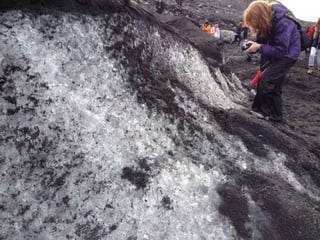
 It can be transported on the surface of the
glacier (supraglacial debris).
 It can be buried within the ice (englacial)
 It may be at the base of the glacier
(subglacial)
 It will eventually be deposited, mainly by
melting at the snout
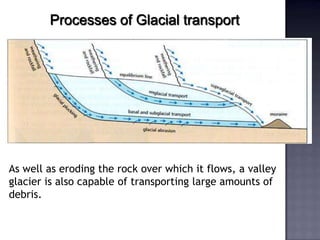
Processes of Glacial transport
As well as eroding the rock over which it flows, a valley
glacier is also capable of transporting large amounts of
debris.
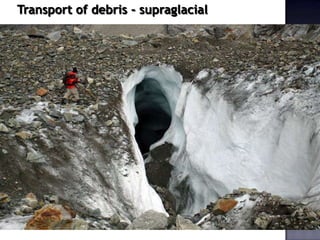
Transport of debris - supraglacial
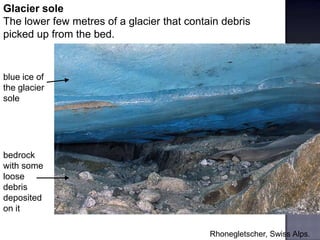
Glacier sole
The lower few metres of a glacier that contain debris
picked up from the bed.
Rhonegletscher, Swiss Alps.
blue ice of
the glacier
sole
bedrock
with some
loose
debris
deposited
on it
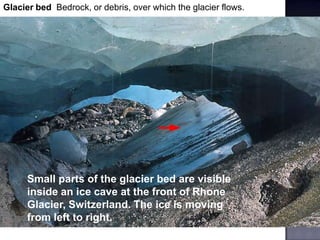
Small parts of the glacier bed are visible
inside an ice cave at the front of Rhone
Glacier, Switzerland. The ice is moving
from left to right.
Glacier bed Bedrock, or debris, over which the glacier flows.
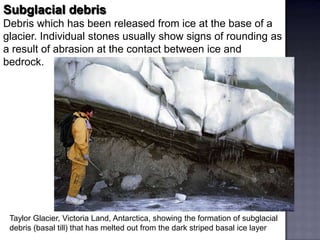
Subglacial debris
Debris which has been released from ice at the base of a
glacier. Individual stones usually show signs of rounding as
a result of abrasion at the contact between ice and
bedrock.
Taylor Glacier, Victoria Land, Antarctica, showing the formation of subglacial
debris (basal till) that has melted out from the dark striped basal ice layer
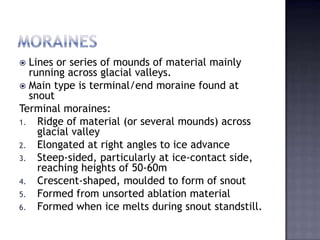
 Lines or series of mounds of material mainly
running across glacial valleys.
 Main type is terminal/end moraine found at
snout
Terminal moraines:
1. Ridge of material (or several mounds) across
glacial valley
2. Elongated at right angles to ice advance
3. Steep-sided, particularly at ice-contact side,
reaching heights of 50-60m
4. Crescent-shaped, moulded to form of snout
5. Formed from unsorted ablation material
6. Formed when ice melts during snout standstill.
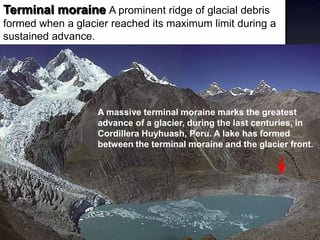
Terminal moraine A prominent ridge of glacial debris
formed when a glacier reached its maximum limit during a
sustained advance.
A massive terminal moraine marks the greatest
advance of a glacier, during the last centuries, in
Cordillera Huyhuash, Peru. A lake has formed
between the terminal moraine and the glacier front.
 As glacier retreats, a series of moraines
forms along valley, marking points where the
retreat halted for some time
 If there is climate cooling, previously
deposited moraine may be shunted up into a
mound called a ‘push moraine’
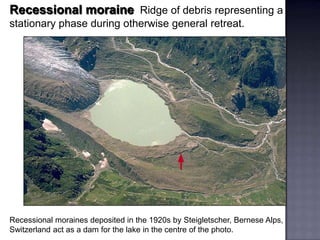
Recessional moraine Ridge of debris representing a
stationary phase during otherwise general retreat.
Recessional moraines deposited in the 1920s by Steigletscher, Bernese Alps,
Switzerland act as a dam for the lake in the centre of the photo.
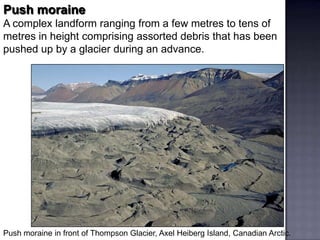
Push moraine
A complex landform ranging from a few metres to tens of
metres in height comprising assorted debris that has been
pushed up by a glacier during an advance.
Push moraine in front of Thompson Glacier, Axel Heiberg Island, Canadian Arctic.
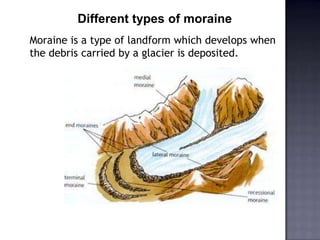
Different types of moraine
Moraine is a type of landform which develops when
the debris carried by a glacier is deposited.
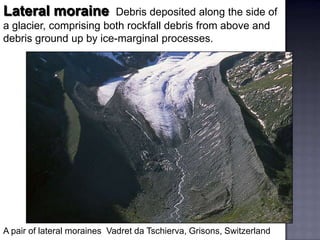
Lateral moraine Debris deposited along the side of
a glacier, comprising both rockfall debris from above and
debris ground up by ice-marginal processes.
A pair of lateral moraines Vadret da Tschierva, Grisons, Switzerland
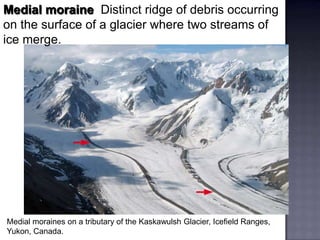
Medial moraine Distinct ridge of debris occurring
on the surface of a glacier where two streams of
ice merge.
Medial moraines on a tributary of the Kaskawulsh Glacier, Icefield Ranges,
Yukon, Canada.
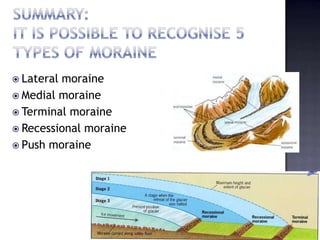
 Lateral moraine
 Medial moraine
 Terminal moraine
 Recessional moraine
 Push moraine
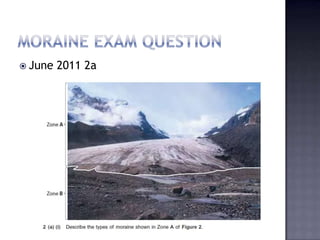
 June 2011 2a
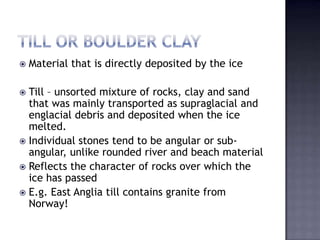
 Material that is directly deposited by the ice
 Till – unsorted mixture of rocks, clay and sand
that was mainly transported as supraglacial and
englacial debris and deposited when the ice
melted.
 Individual stones tend to be angular or sub-
angular, unlike rounded river and beach material
 Reflects the character of rocks over which the
ice has passed
 E.g. East Anglia till contains granite from
Norway!
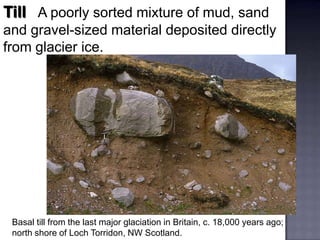
Till A poorly sorted mixture of mud, sand
and gravel-sized material deposited directly
from glacier ice.
Basal till from the last major glaciation in Britain, c. 18,000 years ago;
north shore of Loch Torridon, NW Scotland.
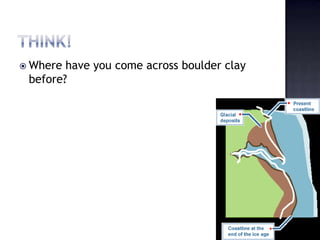
 Where have you come across boulder clay
before?
 Lodgement till – subglacial material that was
deposited by the actively moving glacier. A
drumlin is a typical feature formed from this
material
 Ablation till – produced at the snout when
the ice melts. Terminal (end) push and
recessional moraines are formed from
ablation till
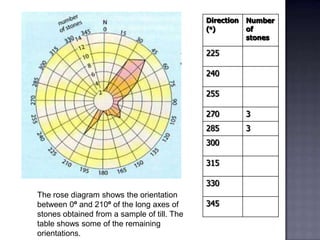
Direction
(o)
Number
of
stones
225
240
255
270 3
285 3
300
315
330
345
The rose diagram shows the orientation
between 0º and 210º of the long axes of
stones obtained from a sample of till. The
table shows some of the remaining
orientations.
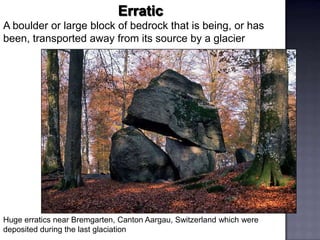
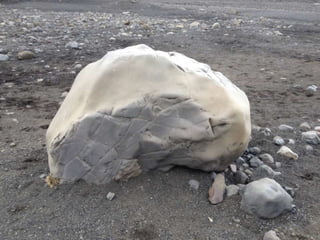
 A large block of rock that has been moved
from one area and deposited in another
which has a very different geology
Erratic
A boulder or large block of bedrock that is being, or has
been, transported away from its source by a glacier
Huge erratics near Bremgarten, Canton Aargau, Switzerland which were
deposited during the last glaciation
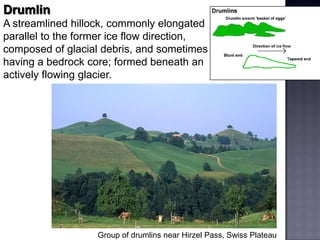
Drumlin
A streamlined hillock, commonly elongated
parallel to the former ice flow direction,
composed of glacial debris, and sometimes
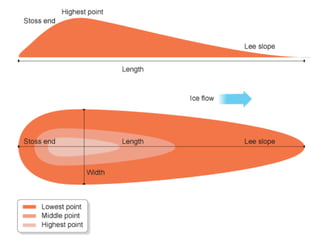
having a bedrock core; formed beneath an
actively flowing glacier.
Group of drumlins near Hirzel Pass, Swiss Plateau
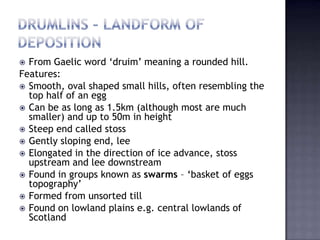
 From Gaelic word ‘druim’ meaning a rounded hill.
Features:
 Smooth, oval shaped small hills, often resembling the
top half of an egg
 Can be as long as 1.5km (although most are much
smaller) and up to 50m in height
 Steep end called stoss
 Gently sloping end, lee
 Elongated in the direction of ice advance, stoss
upstream and lee downstream
 Found in groups known as swarms – ‘basket of eggs
topography’
 Formed from unsorted till
 Found on lowland plains e.g. central lowlands of
Scotland
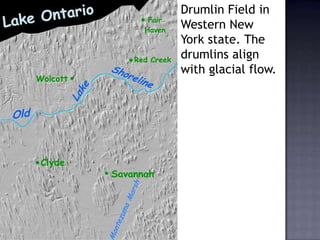
Drumlin Field in
Western New
York state. The
drumlins align
with glacial flow.
 Drumlins form underneath the ice
 The ice is overloaded with debris and then
streamlined by ice advance?
 Indicative of low flow?
 Tell us direction of ice movement
 There are different theories of their
formation:
1. Sub-glacial deformation
2. Subglacial floods
‘The most popular and featured theory relates to the
glacier being overloaded by moraine in contrast to the
energy it has and so struggles to cope with transporting
such an amount in the lower parts of its course. Thus, the
moraine is deposited. The characteristic elongated shape is
thought to be related to the direction of movement of the
ice with the blunt end facing the oncoming ice and the
tapered end being in the lee of it. Moraine contained within
the drumlin tends to be oriented to reflect this pattern. It
is believed that obstacles (possibly outcrops of resistant
rock – as rock cores have been noted in some drumlins) in
the path of the glacier may be responsible – encouraging
the deposited material to be moulded into the
characteristic elongated shape. This theory of subglacial
deformation is the more written-about alternative. Other
ideas consider the role of glacial meltwater – where this is
seen as being responsible for eroding large hollows beneath
the ice and their subsequent in-filling led to the drumlins.’
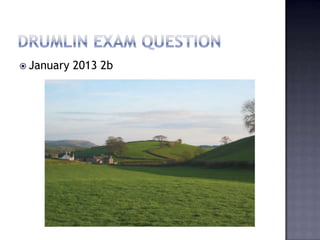
 January 2013 2b
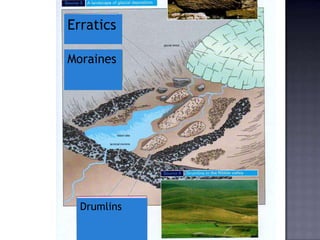
Erratics
Moraines
Drumlins

Glacial transportation and deposition

  • 1.
    Destination: understand howmoraine is transported and deposited to form landforms Route: examine the different types of moraine, drumlins, glacial till and erratics. Identify, describe and explain them.
  • 2.
     Match thefeature to the correct description and explanation…
  • 3.
     Glaciers transportlarge amounts of debris.  The debris may be derived from rockfalls on the valley sides.  It can be transported on the surface of the glacier (supraglacial debris).  It can be buried within the ice (englacial)  It may be at the base of the glacier (subglacial)  It will eventually be deposited, mainly by melting at the snout
  • 4.
    Processes of Glacialtransport As well as eroding the rock over which it flows, a valley glacier is also capable of transporting large amounts of debris.
  • 5.
    Transport of debris- supraglacial
  • 7.
    Glacier sole The lowerfew metres of a glacier that contain debris picked up from the bed. Rhonegletscher, Swiss Alps. blue ice of the glacier sole bedrock with some loose debris deposited on it
  • 8.
    Small parts ofthe glacier bed are visible inside an ice cave at the front of Rhone Glacier, Switzerland. The ice is moving from left to right. Glacier bed Bedrock, or debris, over which the glacier flows.
  • 9.
    Subglacial debris Debris whichhas been released from ice at the base of a glacier. Individual stones usually show signs of rounding as a result of abrasion at the contact between ice and bedrock. Taylor Glacier, Victoria Land, Antarctica, showing the formation of subglacial debris (basal till) that has melted out from the dark striped basal ice layer
  • 10.
     Lines orseries of mounds of material mainly running across glacial valleys.  Main type is terminal/end moraine found at snout Terminal moraines: 1. Ridge of material (or several mounds) across glacial valley 2. Elongated at right angles to ice advance 3. Steep-sided, particularly at ice-contact side, reaching heights of 50-60m 4. Crescent-shaped, moulded to form of snout 5. Formed from unsorted ablation material 6. Formed when ice melts during snout standstill.
  • 11.
    Terminal moraine Aprominent ridge of glacial debris formed when a glacier reached its maximum limit during a sustained advance. A massive terminal moraine marks the greatest advance of a glacier, during the last centuries, in Cordillera Huyhuash, Peru. A lake has formed between the terminal moraine and the glacier front.
  • 12.
     As glacierretreats, a series of moraines forms along valley, marking points where the retreat halted for some time  If there is climate cooling, previously deposited moraine may be shunted up into a mound called a ‘push moraine’
  • 13.
    Recessional moraine Ridgeof debris representing a stationary phase during otherwise general retreat. Recessional moraines deposited in the 1920s by Steigletscher, Bernese Alps, Switzerland act as a dam for the lake in the centre of the photo.
  • 14.
    Push moraine A complexlandform ranging from a few metres to tens of metres in height comprising assorted debris that has been pushed up by a glacier during an advance. Push moraine in front of Thompson Glacier, Axel Heiberg Island, Canadian Arctic.
  • 15.
    Different types ofmoraine Moraine is a type of landform which develops when the debris carried by a glacier is deposited.
  • 16.
    Lateral moraine Debrisdeposited along the side of a glacier, comprising both rockfall debris from above and debris ground up by ice-marginal processes. A pair of lateral moraines Vadret da Tschierva, Grisons, Switzerland
  • 18.
    Medial moraine Distinctridge of debris occurring on the surface of a glacier where two streams of ice merge. Medial moraines on a tributary of the Kaskawulsh Glacier, Icefield Ranges, Yukon, Canada.
  • 19.
     Lateral moraine Medial moraine  Terminal moraine  Recessional moraine  Push moraine
  • 20.
  • 23.
     Material thatis directly deposited by the ice  Till – unsorted mixture of rocks, clay and sand that was mainly transported as supraglacial and englacial debris and deposited when the ice melted.  Individual stones tend to be angular or sub- angular, unlike rounded river and beach material  Reflects the character of rocks over which the ice has passed  E.g. East Anglia till contains granite from Norway!
  • 24.
    Till A poorlysorted mixture of mud, sand and gravel-sized material deposited directly from glacier ice. Basal till from the last major glaciation in Britain, c. 18,000 years ago; north shore of Loch Torridon, NW Scotland.
  • 25.
     Where haveyou come across boulder clay before?
  • 26.
     Lodgement till– subglacial material that was deposited by the actively moving glacier. A drumlin is a typical feature formed from this material  Ablation till – produced at the snout when the ice melts. Terminal (end) push and recessional moraines are formed from ablation till
  • 27.
    Direction (o) Number of stones 225 240 255 270 3 285 3 300 315 330 345 Therose diagram shows the orientation between 0º and 210º of the long axes of stones obtained from a sample of till. The table shows some of the remaining orientations.
  • 28.
     A largeblock of rock that has been moved from one area and deposited in another which has a very different geology
  • 29.
    Erratic A boulder orlarge block of bedrock that is being, or has been, transported away from its source by a glacier Huge erratics near Bremgarten, Canton Aargau, Switzerland which were deposited during the last glaciation
  • 31.
    Drumlin A streamlined hillock,commonly elongated parallel to the former ice flow direction, composed of glacial debris, and sometimes having a bedrock core; formed beneath an actively flowing glacier. Group of drumlins near Hirzel Pass, Swiss Plateau
  • 32.
     From Gaelicword ‘druim’ meaning a rounded hill. Features:  Smooth, oval shaped small hills, often resembling the top half of an egg  Can be as long as 1.5km (although most are much smaller) and up to 50m in height  Steep end called stoss  Gently sloping end, lee  Elongated in the direction of ice advance, stoss upstream and lee downstream  Found in groups known as swarms – ‘basket of eggs topography’  Formed from unsorted till  Found on lowland plains e.g. central lowlands of Scotland
  • 33.
    Drumlin Field in WesternNew York state. The drumlins align with glacial flow.
  • 35.
     Drumlins formunderneath the ice  The ice is overloaded with debris and then streamlined by ice advance?  Indicative of low flow?  Tell us direction of ice movement  There are different theories of their formation: 1. Sub-glacial deformation 2. Subglacial floods
  • 36.
    ‘The most popularand featured theory relates to the glacier being overloaded by moraine in contrast to the energy it has and so struggles to cope with transporting such an amount in the lower parts of its course. Thus, the moraine is deposited. The characteristic elongated shape is thought to be related to the direction of movement of the ice with the blunt end facing the oncoming ice and the tapered end being in the lee of it. Moraine contained within the drumlin tends to be oriented to reflect this pattern. It is believed that obstacles (possibly outcrops of resistant rock – as rock cores have been noted in some drumlins) in the path of the glacier may be responsible – encouraging the deposited material to be moulded into the characteristic elongated shape. This theory of subglacial deformation is the more written-about alternative. Other ideas consider the role of glacial meltwater – where this is seen as being responsible for eroding large hollows beneath the ice and their subsequent in-filling led to the drumlins.’
  • 37.
  • 38.