Sedimentary Structure
CONTENTS
• INTRODUCTION
• CLASSIFICATION
• PHYSICAL STRUCTURES
• CHEMICAL STRUCTURES
• BIOGENIC STRUCTURES
• APPLICATION.
• CONCLUSION
• REFERENCE
INTRODUCTION
• Sedimentary structure are those structure
formed during sediment deposition.
• The sedimentary structure are phenomenon of
macroscopic scale and we can watch them in
the openings and big specimens.
• They are visible tanks to changes of textural
features and mineralogical composition.
Classification
• Morphologic Classification : It is based on the form
or geometry and place of occurrence of sedimentary
structure.
• Genetic classification : It is based on the process,
involved in the formation or sedimentary structure.
PHYSICAL STRUCTURES(PRIMARY)
Formed at the time of sedimentation
A. BEDDING GEOMETRY
Arrangement of sedimentary rocks in beds or layers of
varieng thickness and character.
1.Lamination:
Beds less than 1cm
is called as laminae.They
are charecterised by fine
Grained sediments.
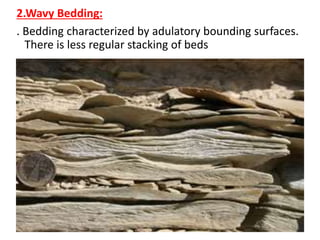
2.Wavy Bedding:
. Bedding characterized by adulatory bounding surfaces.
There is less regular stacking of beds
B. BEDDING OF INTERNAL STRUCTURES:
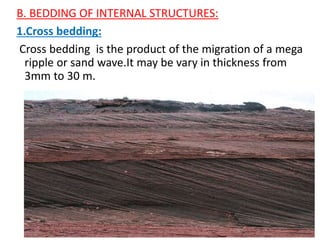
1.Cross bedding:
Cross bedding is the product of the migration of a mega
ripple or sand wave.It may be vary in thickness from
3mm to 30 m.
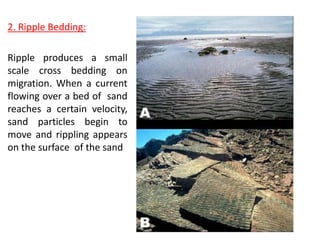
2. Ripple Bedding:
Ripple produces a small
scale cross bedding on
migration. When a current
flowing over a bed of sand
reaches a certain velocity,
sand particles begin to
move and rippling appears
on the surface of the sand
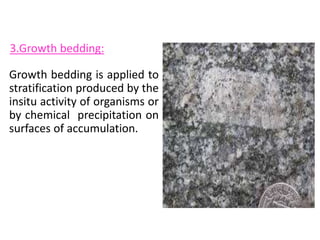
Growth bedding is applied to
stratification produced by the
insitu activity of organisms or
by chemical precipitation on
surfaces of accumulation.
3.Growth bedding:
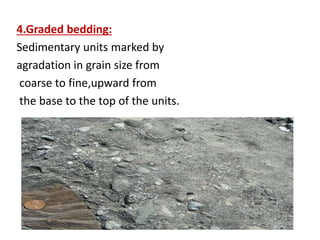
4.Graded bedding:
Sedimentary units marked by
agradation in grain size from
coarse to fine,upward from
the base to the top of the units.
C.BEDDING PLANE MARKINGS :
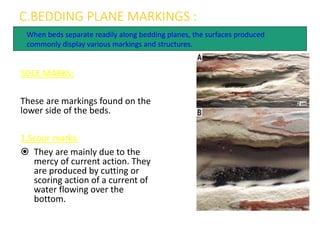
SOLE MARKS:
These are markings found on the
lower side of the beds.
1.Scour marks:
 They are mainly due to the
mercy of current action. They
are produced by cutting or
scoring action of a current of
water flowing over the
bottom.
When beds separate readily along bedding planes, the surfaces produced
commonly display various markings and structures.
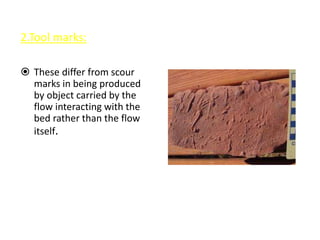
2.Tool marks:
 These differ from scour
marks in being produced
by object carried by the
flow interacting with the
bed rather than the flow
itself.
SURFACE MARKS:
Markings present on the surface of beds
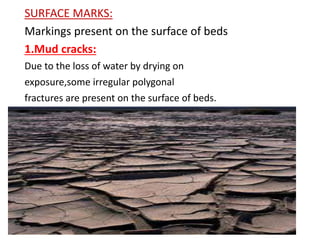
1.Mud cracks:
Due to the loss of water by drying on
exposure,some irregular polygonal
fractures are present on the surface of beds.
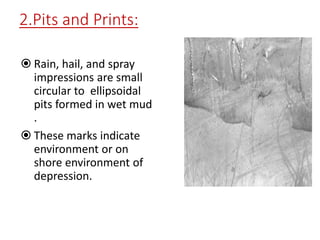
2.Pits and Prints:
 Rain, hail, and spray
impressions are small
circular to ellipsoidal
pits formed in wet mud
.
 These marks indicate
environment or on
shore environment of
depression.
D.DEFORMED STRUCTURES :
Gravitational displacements may occur during
sedimentation or shortly there after, which deform or
alter the depositional structure.
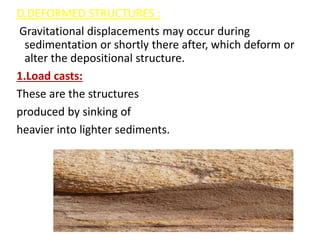
1.Load casts:
These are the structures
produced by sinking of
heavier into lighter sediments.
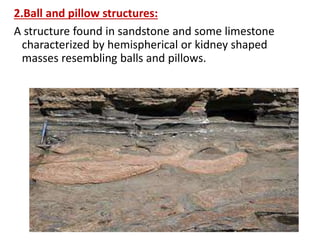
2.Ball and pillow structures:
A structure found in sandstone and some limestone
characterized by hemispherical or kidney shaped
masses resembling balls and pillows.
CHEMICAL SEDIMENTARY
STRUCTURES
The structures formed by chemical processes such as
oxidation,reduction,precipitation and evaporation,etc.
A.SOLUTION STRUCTURES:
Formed by the action of solutions.
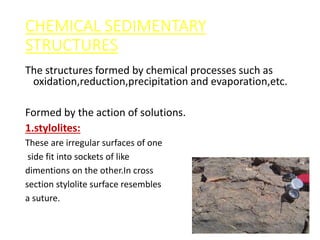
1.stylolites:
These are irregular surfaces of one
side fit into sockets of like
dimentions on the other.In cross
section stylolite surface resembles
a suture.
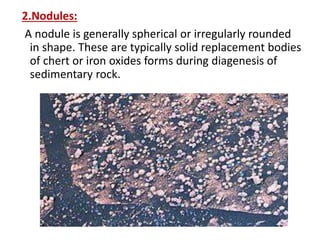
2.Nodules:
A nodule is generally spherical or irregularly rounded
in shape. These are typically solid replacement bodies
of chert or iron oxides forms during diagenesis of
sedimentary rock.
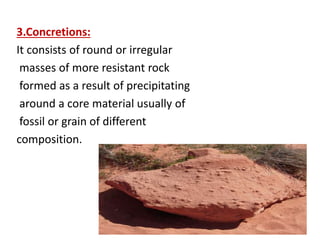
3.Concretions:
It consists of round or irregular
masses of more resistant rock
formed as a result of precipitating
around a core material usually of
fossil or grain of different
composition.
C. COMPOSITE STRUCTURES:
1.Geodes:
Geodes are essentially rock cavities or vugs with internal crystal
formations or concentric banding.The exterior of the most
common geodes is generally limestone or related carbonate
rock while the interior contains quartz crystals and or by
chalcedony deposits.
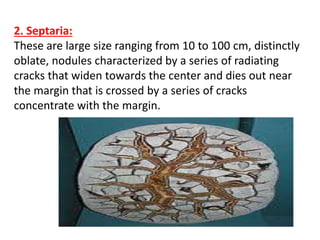
2. Septaria:
These are large size ranging from 10 to 100 cm, distinctly
oblate, nodules characterized by a series of radiating
cracks that widen towards the center and dies out near
the margin that is crossed by a series of cracks
concentrate with the margin.
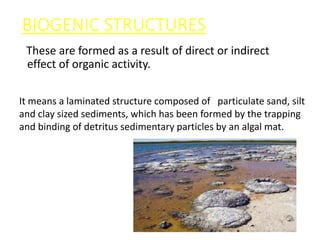
BIOGENIC STRUCTURES
These are formed as a result of direct or indirect
effect of organic activity.
Stromatolites:
It means a laminated structure composed of particulate sand, silt
and clay sized sediments, which has been formed by the trapping
and binding of detritus sedimentary particles by an algal mat.
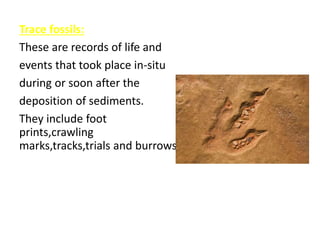
Trace fossils:
These are records of life and
events that took place in-situ
during or soon after the
deposition of sediments.
They include foot
prints,crawling
marks,tracks,trials and burrows.
• They reflect upon the nature of the environment
during sedimentation.
• The style and orientation of ripple marks may also
be used as an indicator of which direction the
water was flowing at the time of sedimentation.
• Biological structures are useful in places to
determine stratigraphic order in a vertical
overturned sequence.
Applications
CONCLUSION
• The formation of sedimentary structures
involves the cooperative operations of processes
like weathering, erosion, transportation and
deposition of sediments as well as solution and
precipitation and also the accumulation of
organic remains.
• The sedimentary structures are large scale
features and the study of them help us to
understand the environment of deposition,
ancient life activities, stratigraphic order of beds,
palaeo-current flow direction, etc.
REFERENCE
• Pettijohn, E. J.(1984):SEDIMENTARY ROCKS., CBS Publishers and
distributors, Delhi., III edition 100-132.
• J.D.Collinson & D.B. Thompson (1982) : SEDIMENTARY
STRUCTURES. George Allen& Unvin (publishers) Ltd, London, UK; p
1-18
• Blatt, Middleton, Murray: ORIGIN OF SEDIMENTARY ROCKS.
Prentice hall (U.S.A.), 2002, P 127-193
WEBSITES
• www.wikipedia .com
• www.britanica online .com
• www.geology.about.com
Thank you

Sedimentary structure

  • 1.
  • 2.
    CONTENTS • INTRODUCTION • CLASSIFICATION •PHYSICAL STRUCTURES • CHEMICAL STRUCTURES • BIOGENIC STRUCTURES • APPLICATION. • CONCLUSION • REFERENCE
  • 3.
    INTRODUCTION • Sedimentary structureare those structure formed during sediment deposition. • The sedimentary structure are phenomenon of macroscopic scale and we can watch them in the openings and big specimens. • They are visible tanks to changes of textural features and mineralogical composition.
  • 4.
    Classification • Morphologic Classification: It is based on the form or geometry and place of occurrence of sedimentary structure. • Genetic classification : It is based on the process, involved in the formation or sedimentary structure.
  • 5.
    PHYSICAL STRUCTURES(PRIMARY) Formed atthe time of sedimentation A. BEDDING GEOMETRY Arrangement of sedimentary rocks in beds or layers of varieng thickness and character. 1.Lamination: Beds less than 1cm is called as laminae.They are charecterised by fine Grained sediments.
  • 6.
    2.Wavy Bedding: . Beddingcharacterized by adulatory bounding surfaces. There is less regular stacking of beds
  • 7.
    B. BEDDING OFINTERNAL STRUCTURES: 1.Cross bedding: Cross bedding is the product of the migration of a mega ripple or sand wave.It may be vary in thickness from 3mm to 30 m.
  • 8.
    2. Ripple Bedding: Rippleproduces a small scale cross bedding on migration. When a current flowing over a bed of sand reaches a certain velocity, sand particles begin to move and rippling appears on the surface of the sand
  • 9.
    Growth bedding isapplied to stratification produced by the insitu activity of organisms or by chemical precipitation on surfaces of accumulation. 3.Growth bedding:
  • 10.
    4.Graded bedding: Sedimentary unitsmarked by agradation in grain size from coarse to fine,upward from the base to the top of the units.
  • 11.
    C.BEDDING PLANE MARKINGS: SOLE MARKS: These are markings found on the lower side of the beds. 1.Scour marks:  They are mainly due to the mercy of current action. They are produced by cutting or scoring action of a current of water flowing over the bottom. When beds separate readily along bedding planes, the surfaces produced commonly display various markings and structures.
  • 12.
    2.Tool marks:  Thesediffer from scour marks in being produced by object carried by the flow interacting with the bed rather than the flow itself.
  • 13.
    SURFACE MARKS: Markings presenton the surface of beds 1.Mud cracks: Due to the loss of water by drying on exposure,some irregular polygonal fractures are present on the surface of beds.
  • 14.
    2.Pits and Prints: Rain, hail, and spray impressions are small circular to ellipsoidal pits formed in wet mud .  These marks indicate environment or on shore environment of depression.
  • 15.
    D.DEFORMED STRUCTURES : Gravitationaldisplacements may occur during sedimentation or shortly there after, which deform or alter the depositional structure. 1.Load casts: These are the structures produced by sinking of heavier into lighter sediments.
  • 16.
    2.Ball and pillowstructures: A structure found in sandstone and some limestone characterized by hemispherical or kidney shaped masses resembling balls and pillows.
  • 17.
    CHEMICAL SEDIMENTARY STRUCTURES The structuresformed by chemical processes such as oxidation,reduction,precipitation and evaporation,etc. A.SOLUTION STRUCTURES: Formed by the action of solutions. 1.stylolites: These are irregular surfaces of one side fit into sockets of like dimentions on the other.In cross section stylolite surface resembles a suture.
  • 18.
    2.Nodules: A nodule isgenerally spherical or irregularly rounded in shape. These are typically solid replacement bodies of chert or iron oxides forms during diagenesis of sedimentary rock.
  • 19.
    3.Concretions: It consists ofround or irregular masses of more resistant rock formed as a result of precipitating around a core material usually of fossil or grain of different composition.
  • 20.
    C. COMPOSITE STRUCTURES: 1.Geodes: Geodesare essentially rock cavities or vugs with internal crystal formations or concentric banding.The exterior of the most common geodes is generally limestone or related carbonate rock while the interior contains quartz crystals and or by chalcedony deposits.
  • 21.
    2. Septaria: These arelarge size ranging from 10 to 100 cm, distinctly oblate, nodules characterized by a series of radiating cracks that widen towards the center and dies out near the margin that is crossed by a series of cracks concentrate with the margin.
  • 22.
    BIOGENIC STRUCTURES These areformed as a result of direct or indirect effect of organic activity. Stromatolites: It means a laminated structure composed of particulate sand, silt and clay sized sediments, which has been formed by the trapping and binding of detritus sedimentary particles by an algal mat.
  • 23.
    Trace fossils: These arerecords of life and events that took place in-situ during or soon after the deposition of sediments. They include foot prints,crawling marks,tracks,trials and burrows.
  • 24.
    • They reflectupon the nature of the environment during sedimentation. • The style and orientation of ripple marks may also be used as an indicator of which direction the water was flowing at the time of sedimentation. • Biological structures are useful in places to determine stratigraphic order in a vertical overturned sequence. Applications
  • 25.
    CONCLUSION • The formationof sedimentary structures involves the cooperative operations of processes like weathering, erosion, transportation and deposition of sediments as well as solution and precipitation and also the accumulation of organic remains. • The sedimentary structures are large scale features and the study of them help us to understand the environment of deposition, ancient life activities, stratigraphic order of beds, palaeo-current flow direction, etc.
  • 26.
    REFERENCE • Pettijohn, E.J.(1984):SEDIMENTARY ROCKS., CBS Publishers and distributors, Delhi., III edition 100-132. • J.D.Collinson & D.B. Thompson (1982) : SEDIMENTARY STRUCTURES. George Allen& Unvin (publishers) Ltd, London, UK; p 1-18 • Blatt, Middleton, Murray: ORIGIN OF SEDIMENTARY ROCKS. Prentice hall (U.S.A.), 2002, P 127-193 WEBSITES • www.wikipedia .com • www.britanica online .com • www.geology.about.com
  • 27.