A glacier is a large body of

snow and ice. We find them
in high-up places (the Swiss
alps) and in places that are
far north or south, like the
Arctic and Antarctic.
Each glacier has built up over
many years in places where
snow has fallen but not
melted. Snow turns to ice as
it collects in layers. The
weight of the ice means that
it starts to slip down
mountain sides over time.
As moving ice creeps into the
warmer climate of lowland
regions, melting takes place.
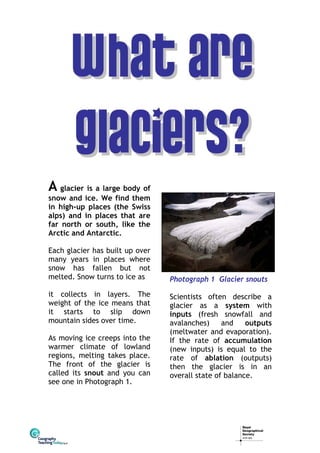
The front of the glacier is
called its snout and you can
see one in Photograph 1.

Photograph 1 Glacier snouts
Scientists often describe a
glacier as a system with
inputs (fresh snowfall and
avalanches)
and
outputs
(meltwater and evaporation).
If the rate of accumulation
(new inputs) is equal to the
rate of ablation (outputs)
then the glacier is in an
overall state of balance.
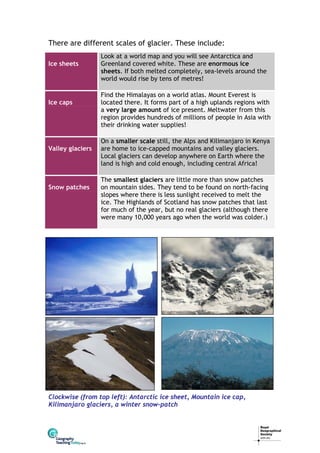
There are different scales of glacier. These include:
Ice sheets

Ice caps

Valley glaciers

Snow patches

Look at a world map and you will see Antarctica and
Greenland covered white. These are enormous ice
sheets. If both melted completely, sea-levels around the
world would rise by tens of metres!
Find the Himalayas on a world atlas. Mount Everest is
located there. It forms part of a high uplands regions with
a very large amount of ice present. Meltwater from this
region provides hundreds of millions of people in Asia with
their drinking water supplies!
On a smaller scale still, the Alps and Kilimanjaro in Kenya
are home to ice-capped mountains and valley glaciers.
Local glaciers can develop anywhere on Earth where the
land is high and cold enough, including central Africa!
The smallest glaciers are little more than snow patches
on mountain sides. They tend to be found on north-facing
slopes where there is less sunlight received to melt the
ice. The Highlands of Scotland has snow patches that last
for much of the year, but no real glaciers (although there
were many 10,000 years ago when the world was colder.)

Clockwise (from top left): Antarctic ice sheet, Mountain ice cap,
Kilimanjaro glaciers, a winter snow-patch
Why do glaciers advance
and retreat?
If annual rates of snowmelt
begin to exceed annual
melting rates, then a glacier
will increase in size and it
will advance down-valley
under gravity. This is what
happens during Ice Ages.
However, if the reverse
occurs and annual melting
begins to exceed fresh
snowfall, then the glacier will
shrink, causing the snout
(end) of the glacier to appear
to retreat up-slope. This is
happening to many glaciers
today, on account of global
warming.

Some natural causes of
glacial
retreat
and
advance
Sunspot activity
The sun’s output varies
slightly between decades,
due to the existence of sunspots. Cycles of eleven and
twenty-two years have been
suggested.
High levels of sunspot activity
actually increase annual rates
of melting.
Volcanic eruptions
The eruption of Tambora in
the spring of 1815 in
Indonesia is thought to have
ejected an amazing 200 cubic
kilometre of dust into the
atmosphere.
This insulated the earth from
the sun’s rays, causing
temperatures in the Alps to
fall by 1°C, leading to a short
period of glacial advance
across the world.
Ice Ages
On a much longer time-scale,
changes in the earth’s orbit
around the sun are thought to
contribute to the onset of Ice
Ages – periods of Earth history
where ice advances into
region such as the UK that
are not normally glaciated.

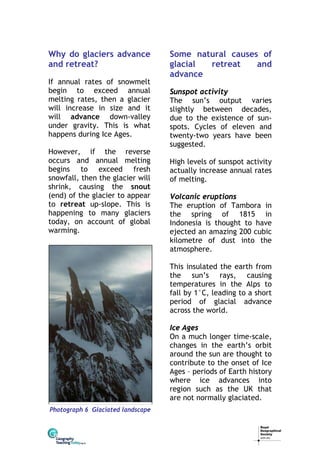
Photograph 6 Glaciated landscape
These cycles last for tens of
thousand of years or longer.
First suggested by a man
called Milankovitch, these
periods of orbital change
trigger a series of climatic
impacts that in the past
resulted in much of the world
becoming covered with ice.

The
global
problem

warming

Most of the world’s scientific
community now believe that
human use of fossil fuels has
lead to a measurable global
rise in temperatures and
rates of melting of ice.
Glaciers in Argentina and
Chile are melting at double
the rate of 1975 due to global
warming,
according
to
Californian researchers.

Text © RGS-IBG/Simon Oakes 2008 Photos
© T. Cole and RGS-IBG except: (i) snow
patch © www.flickr.com/photos/
tedandjen/2625250343/; (ii) ice
mountains ©www.flickr.com/photos/
faisalsaeed/212339449/

What are glaciers?

  • 1.
    A glacier isa large body of snow and ice. We find them in high-up places (the Swiss alps) and in places that are far north or south, like the Arctic and Antarctic. Each glacier has built up over many years in places where snow has fallen but not melted. Snow turns to ice as it collects in layers. The weight of the ice means that it starts to slip down mountain sides over time. As moving ice creeps into the warmer climate of lowland regions, melting takes place. The front of the glacier is called its snout and you can see one in Photograph 1. Photograph 1 Glacier snouts Scientists often describe a glacier as a system with inputs (fresh snowfall and avalanches) and outputs (meltwater and evaporation). If the rate of accumulation (new inputs) is equal to the rate of ablation (outputs) then the glacier is in an overall state of balance.
  • 2.
    There are differentscales of glacier. These include: Ice sheets Ice caps Valley glaciers Snow patches Look at a world map and you will see Antarctica and Greenland covered white. These are enormous ice sheets. If both melted completely, sea-levels around the world would rise by tens of metres! Find the Himalayas on a world atlas. Mount Everest is located there. It forms part of a high uplands regions with a very large amount of ice present. Meltwater from this region provides hundreds of millions of people in Asia with their drinking water supplies! On a smaller scale still, the Alps and Kilimanjaro in Kenya are home to ice-capped mountains and valley glaciers. Local glaciers can develop anywhere on Earth where the land is high and cold enough, including central Africa! The smallest glaciers are little more than snow patches on mountain sides. They tend to be found on north-facing slopes where there is less sunlight received to melt the ice. The Highlands of Scotland has snow patches that last for much of the year, but no real glaciers (although there were many 10,000 years ago when the world was colder.) Clockwise (from top left): Antarctic ice sheet, Mountain ice cap, Kilimanjaro glaciers, a winter snow-patch
  • 3.
    Why do glaciersadvance and retreat? If annual rates of snowmelt begin to exceed annual melting rates, then a glacier will increase in size and it will advance down-valley under gravity. This is what happens during Ice Ages. However, if the reverse occurs and annual melting begins to exceed fresh snowfall, then the glacier will shrink, causing the snout (end) of the glacier to appear to retreat up-slope. This is happening to many glaciers today, on account of global warming. Some natural causes of glacial retreat and advance Sunspot activity The sun’s output varies slightly between decades, due to the existence of sunspots. Cycles of eleven and twenty-two years have been suggested. High levels of sunspot activity actually increase annual rates of melting. Volcanic eruptions The eruption of Tambora in the spring of 1815 in Indonesia is thought to have ejected an amazing 200 cubic kilometre of dust into the atmosphere. This insulated the earth from the sun’s rays, causing temperatures in the Alps to fall by 1°C, leading to a short period of glacial advance across the world. Ice Ages On a much longer time-scale, changes in the earth’s orbit around the sun are thought to contribute to the onset of Ice Ages – periods of Earth history where ice advances into region such as the UK that are not normally glaciated. Photograph 6 Glaciated landscape
  • 4.
    These cycles lastfor tens of thousand of years or longer. First suggested by a man called Milankovitch, these periods of orbital change trigger a series of climatic impacts that in the past resulted in much of the world becoming covered with ice. The global problem warming Most of the world’s scientific community now believe that human use of fossil fuels has lead to a measurable global rise in temperatures and rates of melting of ice. Glaciers in Argentina and Chile are melting at double the rate of 1975 due to global warming, according to Californian researchers. Text © RGS-IBG/Simon Oakes 2008 Photos © T. Cole and RGS-IBG except: (i) snow patch © www.flickr.com/photos/ tedandjen/2625250343/; (ii) ice mountains ©www.flickr.com/photos/ faisalsaeed/212339449/