Key idea: distinctive land forms result from different processes Landforms resulting from erosion – characteristics and formation of corries, arêtes, pyramidal peaks, truncated spurs, glacial troughs and hanging valleys. Landforms resulting from transportation and deposition – drumlins, lateral, medial, ground and terminal moraine.
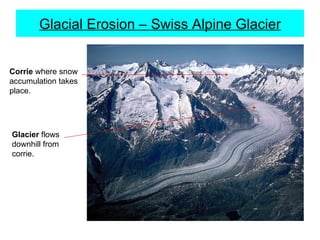
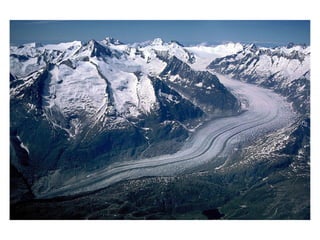
Glacial Erosion – Swiss Alpine Glacier Corrie  where snow accumulation takes place. Glacier  flows downhill from corrie.
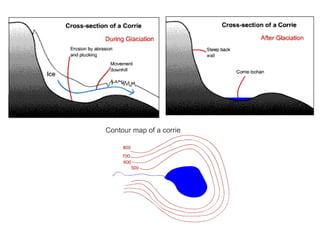
Corries (=cirque, cwm) Start as sheltered hollows near the top of a mountain Snow collects in the hollow (snow fields = neves).  The weight of the snow compacts the base of the snow patch to form glacier ice  Ice moves downhill due to gravity As it moves it plucks rocks from the back wall and the hollow is deepened by process of abrasion Plucking and freeze thaw make the back wall steep.  The loosened rocks fall on to the glacier to form moraine. The glacier becomes thicker away from the back wall.  Thicker ice can erode more than thinner ice, so the floor of the corrie is deepened.  At the same time the glacier is moving due to rotational slip which deepens the hollow. The rotational movement also means that the ice is moving upwards near the mouth of the corrie.  Ice erodes less at the front edge and so a corrie lip is formed When the ice malts a small lake may form behind the lip.  This is called a corrie lake or tarn
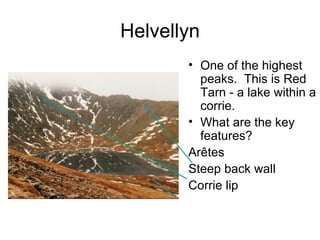
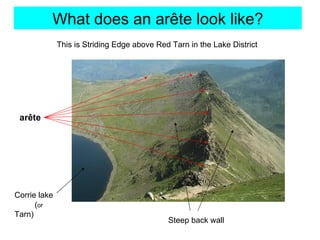
Helvellyn One of the highest peaks.  This is Red Tarn - a lake within a corrie.  What are the key features? Arêtes Steep back wall  Corrie lip
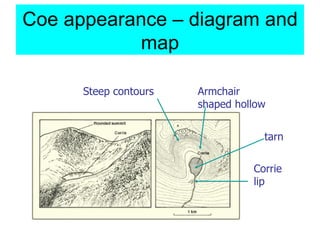
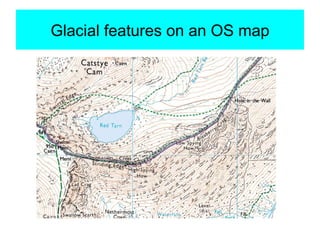
Coe appearance – diagram and map Steep contours Armchair shaped hollow Corrie lip tarn
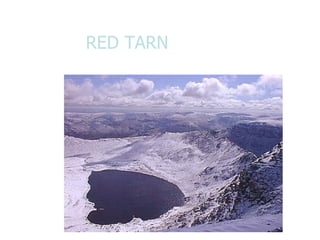
RED TARN
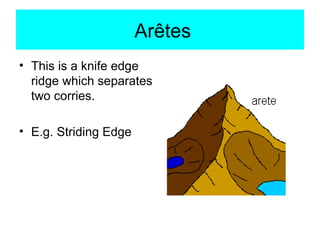
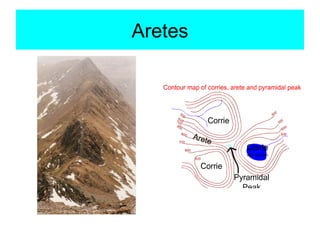
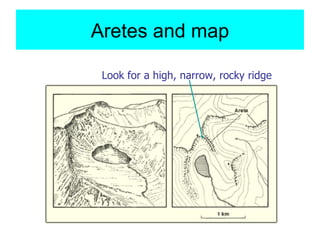
Arêtes This is a knife edge ridge which separates two corries. E.g. Striding Edge
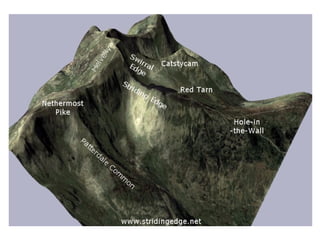
What does an  arête  look like? Steep back wall Corrie lake  ( or  Tarn) This is Striding Edge above Red Tarn in the Lake District  arête
 
Aretes
Aretes and map Look for a high, narrow, rocky ridge
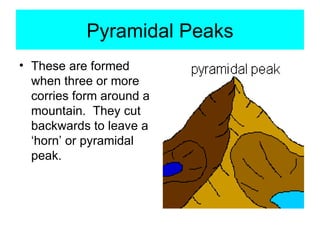
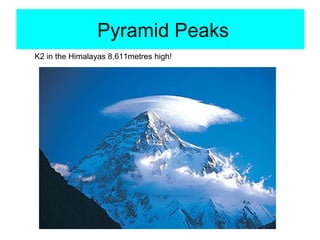
Pyramidal Peaks These are formed when three or more corries form around a mountain.  They cut backwards to leave a ‘horn’ or pyramidal peak.
Glacial features on an OS map
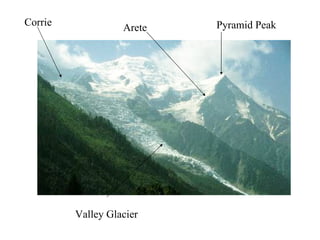
Pyramid Peak Arete Valley Glacier Corrie
 
Pyramid Peaks K2 in the Himalayas 8,611metres high!
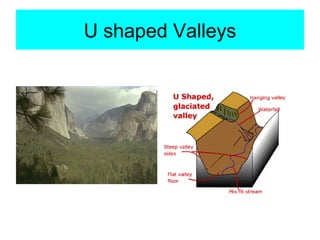
U shaped Valleys
 
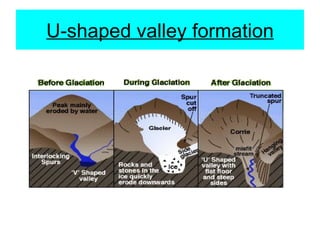
U-shaped valley formation
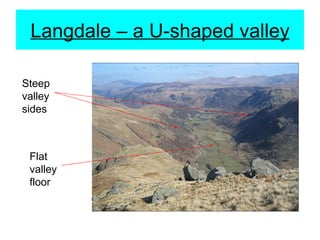
Langdale – a U-shaped valley Steep valley sides Flat valley floor
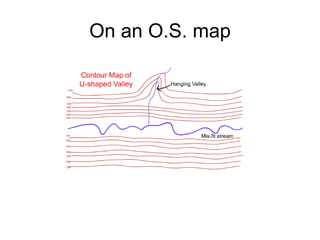
On an O.S. map
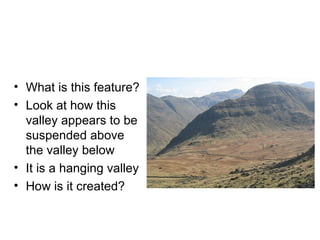
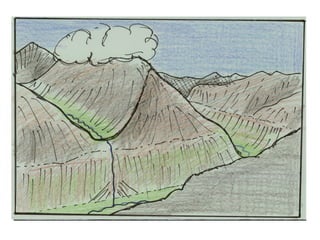
What is this feature? Look at how this valley appears to be suspended above the valley below It is a hanging valley How is it created?
 
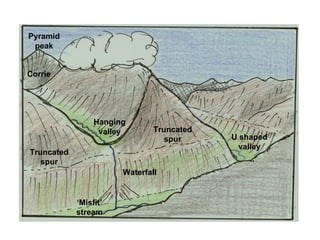
Receding tributary glacier Medial moraines Former height of glacier Main valley glacier Hanging valley Truncated spur U shaped valley ‘ Misfit’ stream Waterfall Corrie Pyramid peak Truncated spur

Glaciation Lesson 4

  • 1.
    Key idea: distinctiveland forms result from different processes Landforms resulting from erosion – characteristics and formation of corries, arêtes, pyramidal peaks, truncated spurs, glacial troughs and hanging valleys. Landforms resulting from transportation and deposition – drumlins, lateral, medial, ground and terminal moraine.
  • 2.
    Glacial Erosion –Swiss Alpine Glacier Corrie where snow accumulation takes place. Glacier flows downhill from corrie.
  • 3.
    Corries (=cirque, cwm)Start as sheltered hollows near the top of a mountain Snow collects in the hollow (snow fields = neves). The weight of the snow compacts the base of the snow patch to form glacier ice Ice moves downhill due to gravity As it moves it plucks rocks from the back wall and the hollow is deepened by process of abrasion Plucking and freeze thaw make the back wall steep. The loosened rocks fall on to the glacier to form moraine. The glacier becomes thicker away from the back wall. Thicker ice can erode more than thinner ice, so the floor of the corrie is deepened. At the same time the glacier is moving due to rotational slip which deepens the hollow. The rotational movement also means that the ice is moving upwards near the mouth of the corrie. Ice erodes less at the front edge and so a corrie lip is formed When the ice malts a small lake may form behind the lip. This is called a corrie lake or tarn
  • 4.
    Helvellyn One ofthe highest peaks. This is Red Tarn - a lake within a corrie. What are the key features? Arêtes Steep back wall Corrie lip
  • 5.
    Coe appearance –diagram and map Steep contours Armchair shaped hollow Corrie lip tarn
  • 6.
  • 7.
    Arêtes This isa knife edge ridge which separates two corries. E.g. Striding Edge
  • 8.
    What does an arête look like? Steep back wall Corrie lake ( or Tarn) This is Striding Edge above Red Tarn in the Lake District arête
  • 9.
  • 10.
  • 11.
    Aretes and mapLook for a high, narrow, rocky ridge
  • 12.
    Pyramidal Peaks Theseare formed when three or more corries form around a mountain. They cut backwards to leave a ‘horn’ or pyramidal peak.
  • 13.
  • 14.
    Pyramid Peak AreteValley Glacier Corrie
  • 15.
  • 16.
    Pyramid Peaks K2in the Himalayas 8,611metres high!
  • 17.
  • 18.
  • 19.
  • 20.
    Langdale – aU-shaped valley Steep valley sides Flat valley floor
  • 21.
  • 22.
    What is thisfeature? Look at how this valley appears to be suspended above the valley below It is a hanging valley How is it created?
  • 23.
  • 24.
    Receding tributary glacierMedial moraines Former height of glacier Main valley glacier Hanging valley Truncated spur U shaped valley ‘ Misfit’ stream Waterfall Corrie Pyramid peak Truncated spur