E R O S I O N L A N D F O R M S
Glacial Landforms
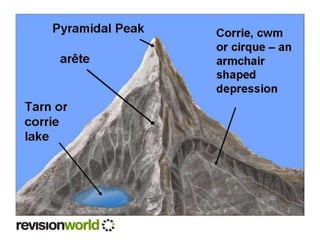
Cirques/Corries
 Formation
 Snow falls unto a hollow
 As more snow falls the original layer
becomes firn (if it lasted longer than
one calendar year)
 Over thousand of years the pressure
build and the fin becomes glacier ice
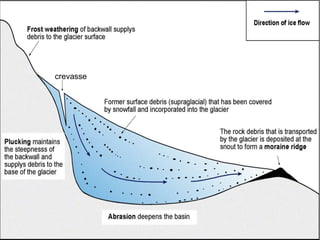
 abrasion, plucking and freeze-thaw
action will gradually make the hollow
bigger
 Gravity encourages the glacier to
move downwards
 rotational slip can cause the ice to
pull away from the back wall creating
a crevasse
 Some of this debris is deposited at
the edge of the corrie, building up
the lip
 If the ice melts at the bottom of the
cirque then a small lake called a tarn
is formed
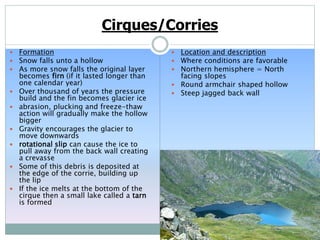
 Location and description
 Where conditions are favorable
 Northern hemisphere = North
facing slopes
 Round armchair shaped hollow
 Steep jagged back wall
crevasse
Arêtes and Pyramidal Peaks
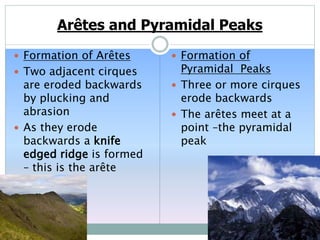
 Formation of Arêtes
 Two adjacent cirques
are eroded backwards
by plucking and
abrasion
 As they erode
backwards a knife
edged ridge is formed
– this is the arête
 Formation of
Pyramidal Peaks
 Three or more cirques
erode backwards
 The arêtes meet at a
point –the pyramidal
peak
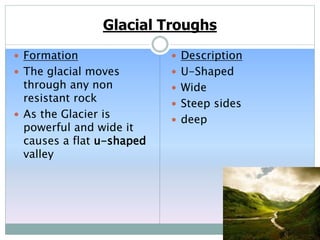
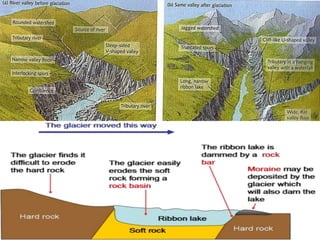
Glacial Troughs
 Formation
 The glacial moves
through any non
resistant rock
 As the Glacier is
powerful and wide it
causes a flat u-shaped
valley
 Description
 U-Shaped
 Wide
 Steep sides
 deep
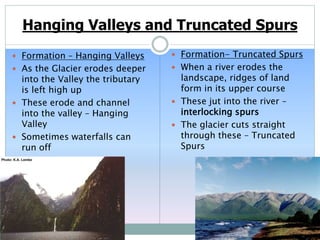
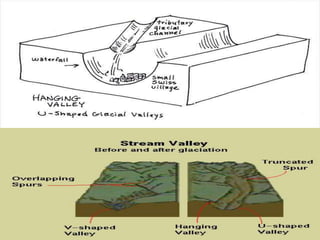
Hanging Valleys and Truncated Spurs
 Formation – Hanging Valleys
 As the Glacier erodes deeper
into the Valley the tributary
is left high up
 These erode and channel
into the valley – Hanging
Valley
 Sometimes waterfalls can
run off
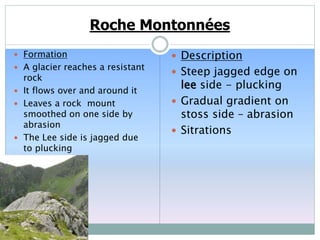
 Formation- Truncated Spurs
 When a river erodes the
landscape, ridges of land
form in its upper course
 These jut into the river –
interlocking spurs
 The glacier cuts straight
through these – Truncated
Spurs
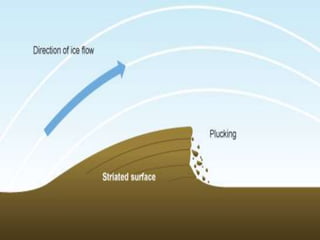
Roche Montonnées
 Formation
 A glacier reaches a resistant
rock
 It flows over and around it
 Leaves a rock mount
smoothed on one side by
abrasion
 The Lee side is jagged due
to plucking
 Description
 Steep jagged edge on
lee side - plucking
 Gradual gradient on
stoss side – abrasion
 Sitrations
D E P O S I T I O N L A N D F O R M S
Glacial Landforms
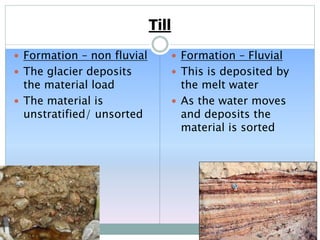
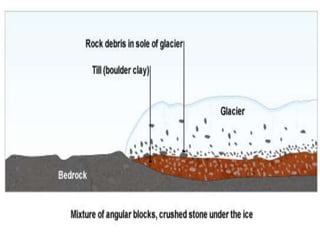
Till
 Formation – non fluvial
 The glacier deposits
the material load
 The material is
unstratified/ unsorted
 Formation – Fluvial
 This is deposited by
the melt water
 As the water moves
and deposits the
material is sorted
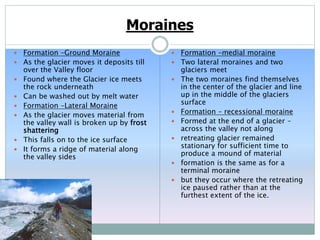
Moraines
 Formation –Ground Moraine
 As the glacier moves it deposits till
over the Valley floor
 Found where the Glacier ice meets
the rock underneath
 Can be washed out by melt water
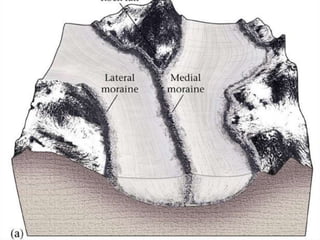
 Formation –Lateral Moraine
 As the glacier moves material from
the valley wall is broken up by frost
shattering
 This falls on to the ice surface
 It forms a ridge of material along
the valley sides
 Formation –medial moraine
 Two lateral moraines and two
glaciers meet
 The two moraines find themselves
in the center of the glacier and line
up in the middle of the glaciers
surface
 Formation – recessional moraine
 Formed at the end of a glacier –
across the valley not along
 retreating glacier remained
stationary for sufficient time to
produce a mound of material
 formation is the same as for a
terminal moraine
 but they occur where the retreating
ice paused rather than at the
furthest extent of the ice.
Moraines
 Formation – Push moraines
 Can only be formed by a glacier that has
retreated and advanced
 Evidence that the climate became poor
after a warm period
 Material that has already been deposited
is pushed into a pile as it advances
 Most moraine material was deposited by
falling down not pushing up, there are
characteristic differences in the
orientation of rocks
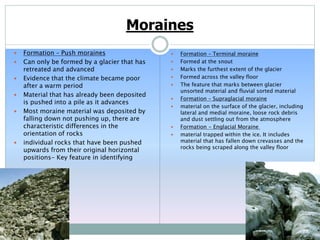
 individual rocks that have been pushed
upwards from their original horizontal
positions- Key feature in identifying
 Formation – Terminal moraine
 Formed at the snout
 Marks the furthest extent of the glacier
 Formed across the valley floor
 The feature that marks between glacier
unsorted material and fluvial sorted material
 Formation – Supraglacial moraine
 material on the surface of the glacier, including
lateral and medial moraine, loose rock debris
and dust settling out from the atmosphere
 Formation - Englacial Moraine
 material trapped within the ice. It includes
material that has fallen down crevasses and the
rocks being scraped along the valley floor
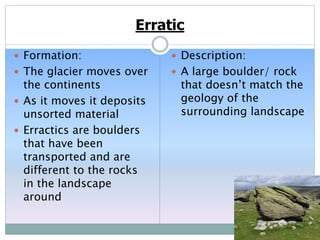
Erratic
 Formation:
 The glacier moves over
the continents
 As it moves it deposits
unsorted material
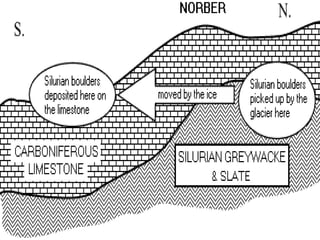
 Erractics are boulders
that have been
transported and are
different to the rocks
in the landscape
around
 Description:
 A large boulder/ rock
that doesn’t match the
geology of the
surrounding landscape
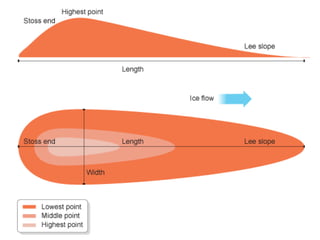
Drumlins
 Formation
 As the glacier moves it
deposits till often over
an object
 This till builds up and
forms an elongated
slope
 The Stoss end is steep as
most of the material is
deposited as the glacier
moves the deposits
reduce creating a more
gradual slope
 Description
 Steep Stoss end
 Gentle Lee Slope
 can reach a kilometre or
more in length
 500m or so in width
 over 50m in height
 The exact formation is
unknown – the one on
the left is the accepted
one
G L A C I A L F L U V I A L
Glacial Landforms
Kames and Kames Terraces
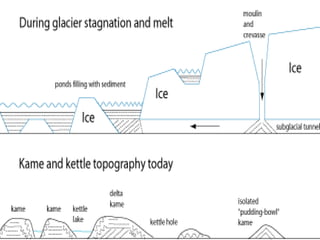
 Formation of Kames:
 Mounds of sediment that are
deposited along the front of a
stationary or slow moving
glacier
 The sediment consists of
sands and gravels
 builds up into mounds as the
ice melts and more sediment
is deposited on top of old
debris.
 Often, a kame will collapse
when the ice melts back and
leaves the mound
unsupported
 Formation of Kames Terraces:
 Also formed of sands and
gravels
 Form along the side not at the
snout
 Formed by actions of
meltwater streams alongside
the glacier
 The valley warms up in the
summer and melts the ice
nearest it
 This forms a depression/
trough where the meltwater
flows
 They become sorted of they
are deposited by water – can
be distinguished from lateral
moraines
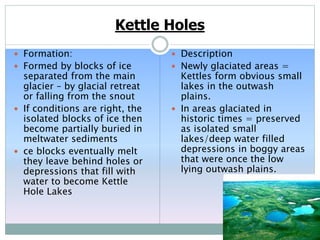
Kettle Holes
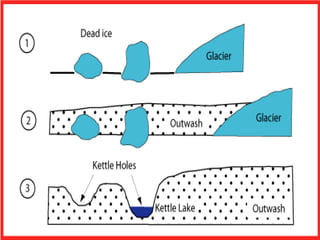
 Formation:
 Formed by blocks of ice
separated from the main
glacier – by glacial retreat
or falling from the snout
 If conditions are right, the
isolated blocks of ice then
become partially buried in
meltwater sediments
 ce blocks eventually melt
they leave behind holes or
depressions that fill with
water to become Kettle
Hole Lakes
 Description
 Newly glaciated areas =
Kettles form obvious small
lakes in the outwash
plains.
 In areas glaciated in
historic times = preserved
as isolated small
lakes/deep water filled
depressions in boggy areas
that were once the low
lying outwash plains.
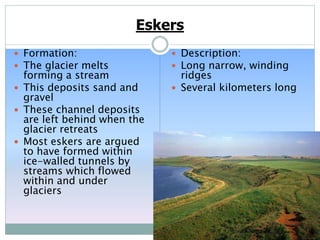
Eskers
 Formation:
 The glacier melts
forming a stream
 This deposits sand and
gravel
 These channel deposits
are left behind when the
glacier retreats
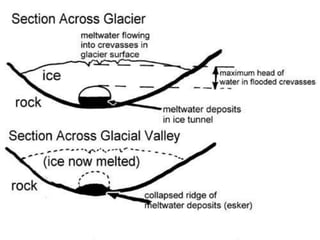
 Most eskers are argued
to have formed within
ice-walled tunnels by
streams which flowed
within and under
glaciers
 Description:
 Long narrow, winding
ridges
 Several kilometers long
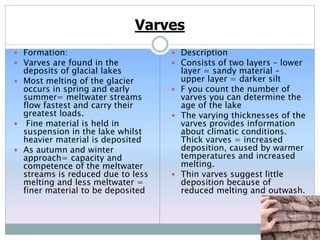
Varves
 Formation:
 Varves are found in the
deposits of glacial lakes
 Most melting of the glacier
occurs in spring and early
summer= meltwater streams
flow fastest and carry their
greatest loads.
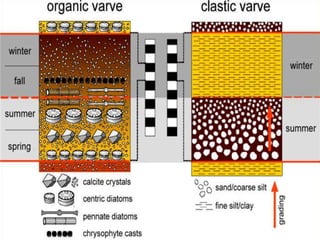
 Fine material is held in
suspension in the lake whilst
heavier material is deposited
 As autumn and winter
approach= capacity and
competence of the meltwater
streams is reduced due to less
melting and less meltwater =
finer material to be deposited
 Description
 Consists of two layers – lower
layer = sandy material –
upper layer = darker silt
 F you count the number of
varves you can determine the
age of the lake
 The varying thicknesses of the
varves provides information
about climatic conditions.
Thick varves = increased
deposition, caused by warmer
temperatures and increased
melting.
 Thin varves suggest little
deposition because of
reduced melting and outwash.
P E R I G L A C I A L L A N D F O R M S
Glacial Landforms
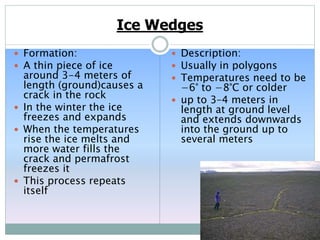
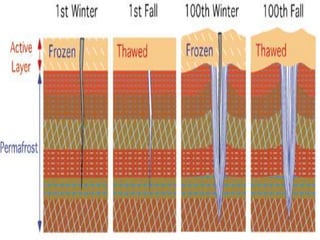
Ice Wedges
 Formation:
 A thin piece of ice
around 3-4 meters of
length (ground)causes a
crack in the rock
 In the winter the ice
freezes and expands
 When the temperatures
rise the ice melts and
more water fills the
crack and permafrost
freezes it
 This process repeats
itself
 Description:
 Usually in polygons
 Temperatures need to be
−6° to −8°C or colder
 up to 3–4 meters in
length at ground level
and extends downwards
into the ground up to
several meters
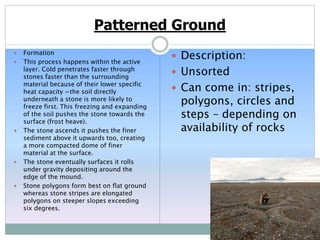
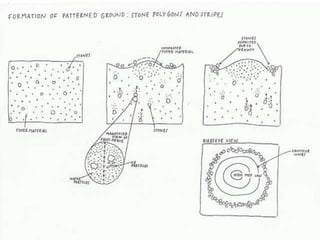
Patterned Ground
 Formation
 This process happens within the active
layer. Cold penetrates faster through
stones faster than the surrounding
material because of their lower specific
heat capacity =the soil directly
underneath a stone is more likely to
freeze first. This freezing and expanding
of the soil pushes the stone towards the
surface (frost heave).
 The stone ascends it pushes the finer
sediment above it upwards too, creating
a more compacted dome of finer
material at the surface.
 The stone eventually surfaces it rolls
under gravity depositing around the
edge of the mound.
 Stone polygons form best on flat ground
whereas stone stripes are elongated
polygons on steeper slopes exceeding
six degrees.
 Description:
 Unsorted
 Can come in: stripes,
polygons, circles and
steps – depending on
availability of rocks
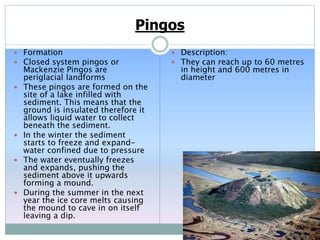
Pingos
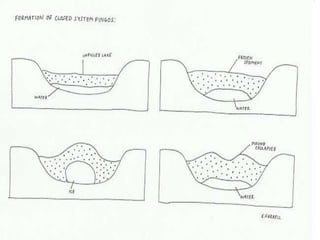
 Formation
 Closed system pingos or
Mackenzie Pingos are
periglacial landforms
 These pingos are formed on the
site of a lake infilled with
sediment. This means that the
ground is insulated therefore it
allows liquid water to collect
beneath the sediment.
 In the winter the sediment
starts to freeze and expand-
water confined due to pressure
 The water eventually freezes
and expands, pushing the
sediment above it upwards
forming a mound.
 During the summer in the next
year the ice core melts causing
the mound to cave in on itself
leaving a dip.
 Description:
 They can reach up to 60 metres
in height and 600 metres in
diameter
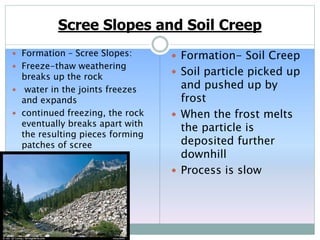
Scree Slopes and Soil Creep
 Formation – Scree Slopes:
 Freeze-thaw weathering
breaks up the rock
 water in the joints freezes
and expands
 continued freezing, the rock
eventually breaks apart with
the resulting pieces forming
patches of scree
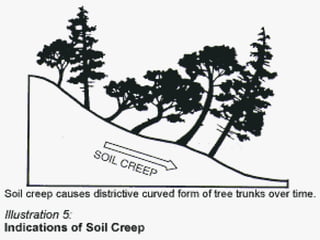
 Formation- Soil Creep
 Soil particle picked up
and pushed up by
frost
 When the frost melts
the particle is
deposited further
downhill
 Process is slow
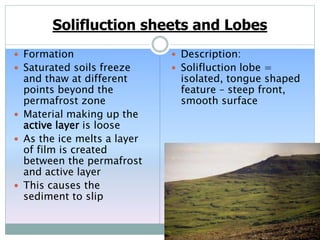
Solifluction sheets and Lobes
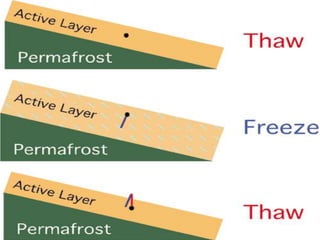
 Formation
 Saturated soils freeze
and thaw at different
points beyond the
permafrost zone
 Material making up the
active layer is loose
 As the ice melts a layer
of film is created
between the permafrost
and active layer
 This causes the
sediment to slip
 Description:
 Solifluction lobe =
isolated, tongue shaped
feature – steep front,
smooth surface
BY KATIE ANN SHEEHAN
Glacial Landforms
Powerpoint

Glacial landforms AS Level Geography

  • 1.
    E R OS I O N L A N D F O R M S Glacial Landforms
  • 2.
    Cirques/Corries  Formation  Snowfalls unto a hollow  As more snow falls the original layer becomes firn (if it lasted longer than one calendar year)  Over thousand of years the pressure build and the fin becomes glacier ice  abrasion, plucking and freeze-thaw action will gradually make the hollow bigger  Gravity encourages the glacier to move downwards  rotational slip can cause the ice to pull away from the back wall creating a crevasse  Some of this debris is deposited at the edge of the corrie, building up the lip  If the ice melts at the bottom of the cirque then a small lake called a tarn is formed  Location and description  Where conditions are favorable  Northern hemisphere = North facing slopes  Round armchair shaped hollow  Steep jagged back wall
  • 3.
  • 4.
    Arêtes and PyramidalPeaks  Formation of Arêtes  Two adjacent cirques are eroded backwards by plucking and abrasion  As they erode backwards a knife edged ridge is formed – this is the arête  Formation of Pyramidal Peaks  Three or more cirques erode backwards  The arêtes meet at a point –the pyramidal peak
  • 6.
    Glacial Troughs  Formation The glacial moves through any non resistant rock  As the Glacier is powerful and wide it causes a flat u-shaped valley  Description  U-Shaped  Wide  Steep sides  deep
  • 8.
    Hanging Valleys andTruncated Spurs  Formation – Hanging Valleys  As the Glacier erodes deeper into the Valley the tributary is left high up  These erode and channel into the valley – Hanging Valley  Sometimes waterfalls can run off  Formation- Truncated Spurs  When a river erodes the landscape, ridges of land form in its upper course  These jut into the river – interlocking spurs  The glacier cuts straight through these – Truncated Spurs
  • 10.
    Roche Montonnées  Formation A glacier reaches a resistant rock  It flows over and around it  Leaves a rock mount smoothed on one side by abrasion  The Lee side is jagged due to plucking  Description  Steep jagged edge on lee side - plucking  Gradual gradient on stoss side – abrasion  Sitrations
  • 12.
    D E PO S I T I O N L A N D F O R M S Glacial Landforms
  • 13.
    Till  Formation –non fluvial  The glacier deposits the material load  The material is unstratified/ unsorted  Formation – Fluvial  This is deposited by the melt water  As the water moves and deposits the material is sorted
  • 15.
    Moraines  Formation –GroundMoraine  As the glacier moves it deposits till over the Valley floor  Found where the Glacier ice meets the rock underneath  Can be washed out by melt water  Formation –Lateral Moraine  As the glacier moves material from the valley wall is broken up by frost shattering  This falls on to the ice surface  It forms a ridge of material along the valley sides  Formation –medial moraine  Two lateral moraines and two glaciers meet  The two moraines find themselves in the center of the glacier and line up in the middle of the glaciers surface  Formation – recessional moraine  Formed at the end of a glacier – across the valley not along  retreating glacier remained stationary for sufficient time to produce a mound of material  formation is the same as for a terminal moraine  but they occur where the retreating ice paused rather than at the furthest extent of the ice.
  • 16.
    Moraines  Formation –Push moraines  Can only be formed by a glacier that has retreated and advanced  Evidence that the climate became poor after a warm period  Material that has already been deposited is pushed into a pile as it advances  Most moraine material was deposited by falling down not pushing up, there are characteristic differences in the orientation of rocks  individual rocks that have been pushed upwards from their original horizontal positions- Key feature in identifying  Formation – Terminal moraine  Formed at the snout  Marks the furthest extent of the glacier  Formed across the valley floor  The feature that marks between glacier unsorted material and fluvial sorted material  Formation – Supraglacial moraine  material on the surface of the glacier, including lateral and medial moraine, loose rock debris and dust settling out from the atmosphere  Formation - Englacial Moraine  material trapped within the ice. It includes material that has fallen down crevasses and the rocks being scraped along the valley floor
  • 18.
    Erratic  Formation:  Theglacier moves over the continents  As it moves it deposits unsorted material  Erractics are boulders that have been transported and are different to the rocks in the landscape around  Description:  A large boulder/ rock that doesn’t match the geology of the surrounding landscape
  • 20.
    Drumlins  Formation  Asthe glacier moves it deposits till often over an object  This till builds up and forms an elongated slope  The Stoss end is steep as most of the material is deposited as the glacier moves the deposits reduce creating a more gradual slope  Description  Steep Stoss end  Gentle Lee Slope  can reach a kilometre or more in length  500m or so in width  over 50m in height  The exact formation is unknown – the one on the left is the accepted one
  • 22.
    G L AC I A L F L U V I A L Glacial Landforms
  • 23.
    Kames and KamesTerraces  Formation of Kames:  Mounds of sediment that are deposited along the front of a stationary or slow moving glacier  The sediment consists of sands and gravels  builds up into mounds as the ice melts and more sediment is deposited on top of old debris.  Often, a kame will collapse when the ice melts back and leaves the mound unsupported  Formation of Kames Terraces:  Also formed of sands and gravels  Form along the side not at the snout  Formed by actions of meltwater streams alongside the glacier  The valley warms up in the summer and melts the ice nearest it  This forms a depression/ trough where the meltwater flows  They become sorted of they are deposited by water – can be distinguished from lateral moraines
  • 25.
    Kettle Holes  Formation: Formed by blocks of ice separated from the main glacier – by glacial retreat or falling from the snout  If conditions are right, the isolated blocks of ice then become partially buried in meltwater sediments  ce blocks eventually melt they leave behind holes or depressions that fill with water to become Kettle Hole Lakes  Description  Newly glaciated areas = Kettles form obvious small lakes in the outwash plains.  In areas glaciated in historic times = preserved as isolated small lakes/deep water filled depressions in boggy areas that were once the low lying outwash plains.
  • 27.
    Eskers  Formation:  Theglacier melts forming a stream  This deposits sand and gravel  These channel deposits are left behind when the glacier retreats  Most eskers are argued to have formed within ice-walled tunnels by streams which flowed within and under glaciers  Description:  Long narrow, winding ridges  Several kilometers long
  • 29.
    Varves  Formation:  Varvesare found in the deposits of glacial lakes  Most melting of the glacier occurs in spring and early summer= meltwater streams flow fastest and carry their greatest loads.  Fine material is held in suspension in the lake whilst heavier material is deposited  As autumn and winter approach= capacity and competence of the meltwater streams is reduced due to less melting and less meltwater = finer material to be deposited  Description  Consists of two layers – lower layer = sandy material – upper layer = darker silt  F you count the number of varves you can determine the age of the lake  The varying thicknesses of the varves provides information about climatic conditions. Thick varves = increased deposition, caused by warmer temperatures and increased melting.  Thin varves suggest little deposition because of reduced melting and outwash.
  • 31.
    P E RI G L A C I A L L A N D F O R M S Glacial Landforms
  • 32.
    Ice Wedges  Formation: A thin piece of ice around 3-4 meters of length (ground)causes a crack in the rock  In the winter the ice freezes and expands  When the temperatures rise the ice melts and more water fills the crack and permafrost freezes it  This process repeats itself  Description:  Usually in polygons  Temperatures need to be −6° to −8°C or colder  up to 3–4 meters in length at ground level and extends downwards into the ground up to several meters
  • 34.
    Patterned Ground  Formation This process happens within the active layer. Cold penetrates faster through stones faster than the surrounding material because of their lower specific heat capacity =the soil directly underneath a stone is more likely to freeze first. This freezing and expanding of the soil pushes the stone towards the surface (frost heave).  The stone ascends it pushes the finer sediment above it upwards too, creating a more compacted dome of finer material at the surface.  The stone eventually surfaces it rolls under gravity depositing around the edge of the mound.  Stone polygons form best on flat ground whereas stone stripes are elongated polygons on steeper slopes exceeding six degrees.  Description:  Unsorted  Can come in: stripes, polygons, circles and steps – depending on availability of rocks
  • 36.
    Pingos  Formation  Closedsystem pingos or Mackenzie Pingos are periglacial landforms  These pingos are formed on the site of a lake infilled with sediment. This means that the ground is insulated therefore it allows liquid water to collect beneath the sediment.  In the winter the sediment starts to freeze and expand- water confined due to pressure  The water eventually freezes and expands, pushing the sediment above it upwards forming a mound.  During the summer in the next year the ice core melts causing the mound to cave in on itself leaving a dip.  Description:  They can reach up to 60 metres in height and 600 metres in diameter
  • 38.
    Scree Slopes andSoil Creep  Formation – Scree Slopes:  Freeze-thaw weathering breaks up the rock  water in the joints freezes and expands  continued freezing, the rock eventually breaks apart with the resulting pieces forming patches of scree  Formation- Soil Creep  Soil particle picked up and pushed up by frost  When the frost melts the particle is deposited further downhill  Process is slow
  • 40.
    Solifluction sheets andLobes  Formation  Saturated soils freeze and thaw at different points beyond the permafrost zone  Material making up the active layer is loose  As the ice melts a layer of film is created between the permafrost and active layer  This causes the sediment to slip  Description:  Solifluction lobe = isolated, tongue shaped feature – steep front, smooth surface
  • 42.
    BY KATIE ANNSHEEHAN Glacial Landforms Powerpoint