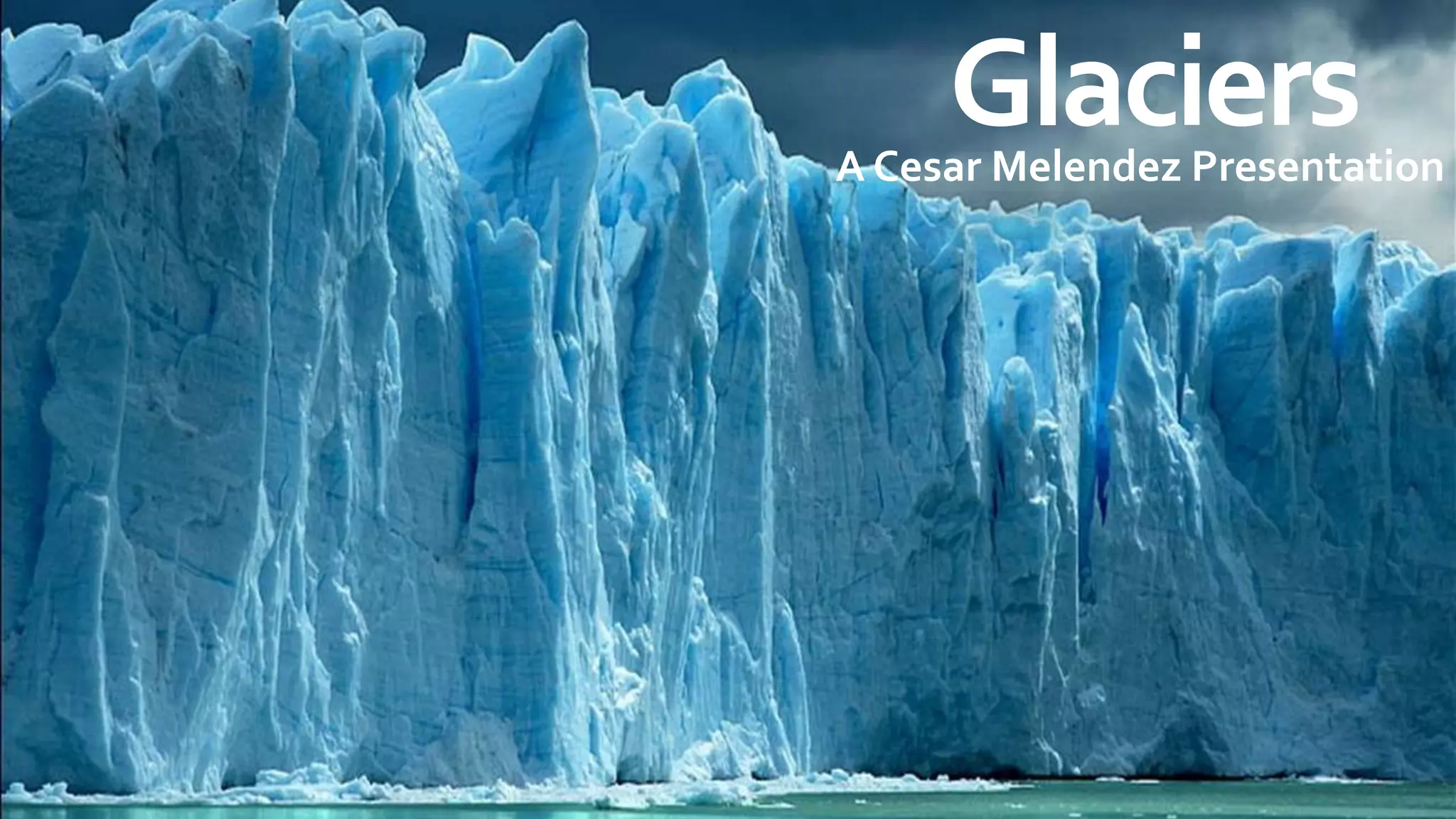
GlaciersA Cesar Melendez Presentation
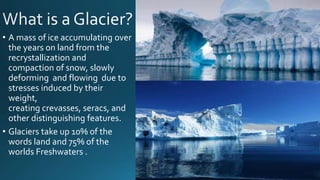
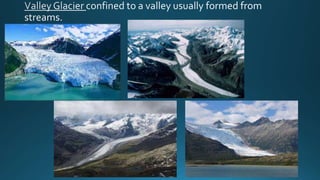
• A mass of ice accumulating over
the years on land from the
recrystallization and
compaction of snow, slowly
deforming and flowing due to
stresses induced by their
weight,
creating crevasses, seracs, and
other distinguishing features.
• Glaciers take up 10% of the
words land and 75% of the
worlds Freshwaters .
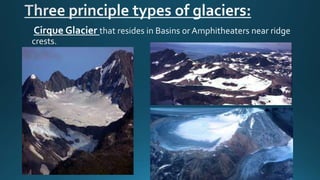
Cirque Glacier
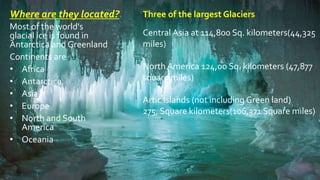
Where are they located?
Most of the world's
glacial ice is found in
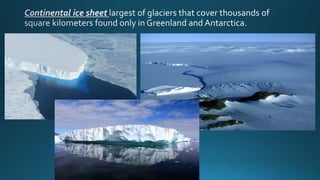
Antarctica and Greenland
Continents are
• Africa
• Antarctica
• Asia
• Europe
• North and South
America
• Oceania
Three of the largest Glaciers
Central Asia at 114,800 Sq. kilometers(44,325
miles)
North America 124,00 Sq. kilometers (47,877
square miles)
Artic Islands (not including Green land)
275, Square kilometers(106,371 Square miles)
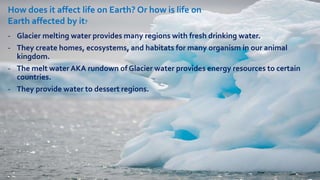
- Glacier melting water provides many regions with fresh drinking water.
- They create homes, ecosystems, and habitats for many organism in our animal
kingdom.
- The melt water AKA rundown of Glacier water provides energy resources to certain
countries.
- They provide water to dessert regions.
How does it affect life on Earth? Or how is life on
Earth affected by it?
Glaciers are being threatened
everyday!
The biggest threat to Glaciers is Global Warming
- Global warming is melting our Glaciers creating sea levels to rise
dramatically
- Melting Glaciers also means that the habitants will lose their home and way
of life creating tragedy in ecosystems across the world.
- Many regions will lose their fresh water source
- Many regions near the oceans and seas will become flooded and non-
existent.
- Contribute to the cause of eliminating green house gases by monitoring your personal carbon footprint
- Corporations need and should adopt environmental ethics and promote and implement better measures to
reduce greenhouse gases
- People should look into alternate energy resources that do emit green house gases into the atmosphere such
has solar and turbine energy.
Sources:
1. "National Snow and Ice Data Center." All About Glaciers. Advancing Knowledge of Earth's Frozen Regions, 2015. Web.
10 Nov. 2015. https://nsidc.org/cryosphere/glaciers/questions/what.html
2. "Glaciers and Icecaps: Storehouses of Freshwater." Glaciers and Icecaps, the USGSWater Science School Water-
information Site. Ed. Howard Perlman. U.S. Department of the Interior, 7 Aug. 2015. Web. 10 Nov. 2015.
http://water.usgs.gov/edu/earthglacier.html.
3. "Glacier Facts." WWF -.WorldWildife Fund, 2015.Web. 1 Dec. 2015.
http://wwf.panda.org/about_our_earth/aboutcc/problems/impacts/glaciers/glacier_facts/
4. Fraser, Barbara. "Melting in the Andes: Goodbye Glaciers." Nature.com. Nature Publishing Group, 7 Nov. 2012. Web. 1
Dec. 2015. http://www.nature.com/news/melting-in-the-andes-goodbye-glaciers-1.11759
5. Davies, Bethan. "An Introduction to Glacier Mass Balance." An Introduction to Glacier Mass Balance Comments.
Antartic Glaciers, 16 Mar. 2015.Web. 1 Dec. 2015. http://www.antarcticglaciers.org/modern-glaciers/introduction-
glacier-mass-balance/

Cesar melendez Glaciers PPT

  • 1.
  • 2.
    • A massof ice accumulating over the years on land from the recrystallization and compaction of snow, slowly deforming and flowing due to stresses induced by their weight, creating crevasses, seracs, and other distinguishing features. • Glaciers take up 10% of the words land and 75% of the worlds Freshwaters .
  • 3.
  • 6.
    Where are theylocated? Most of the world's glacial ice is found in Antarctica and Greenland Continents are • Africa • Antarctica • Asia • Europe • North and South America • Oceania Three of the largest Glaciers Central Asia at 114,800 Sq. kilometers(44,325 miles) North America 124,00 Sq. kilometers (47,877 square miles) Artic Islands (not including Green land) 275, Square kilometers(106,371 Square miles)
  • 7.
    - Glacier meltingwater provides many regions with fresh drinking water. - They create homes, ecosystems, and habitats for many organism in our animal kingdom. - The melt water AKA rundown of Glacier water provides energy resources to certain countries. - They provide water to dessert regions. How does it affect life on Earth? Or how is life on Earth affected by it?
  • 8.
    Glaciers are beingthreatened everyday! The biggest threat to Glaciers is Global Warming - Global warming is melting our Glaciers creating sea levels to rise dramatically - Melting Glaciers also means that the habitants will lose their home and way of life creating tragedy in ecosystems across the world. - Many regions will lose their fresh water source - Many regions near the oceans and seas will become flooded and non- existent.
  • 9.
    - Contribute tothe cause of eliminating green house gases by monitoring your personal carbon footprint - Corporations need and should adopt environmental ethics and promote and implement better measures to reduce greenhouse gases - People should look into alternate energy resources that do emit green house gases into the atmosphere such has solar and turbine energy.
  • 10.
    Sources: 1. "National Snowand Ice Data Center." All About Glaciers. Advancing Knowledge of Earth's Frozen Regions, 2015. Web. 10 Nov. 2015. https://nsidc.org/cryosphere/glaciers/questions/what.html 2. "Glaciers and Icecaps: Storehouses of Freshwater." Glaciers and Icecaps, the USGSWater Science School Water- information Site. Ed. Howard Perlman. U.S. Department of the Interior, 7 Aug. 2015. Web. 10 Nov. 2015. http://water.usgs.gov/edu/earthglacier.html. 3. "Glacier Facts." WWF -.WorldWildife Fund, 2015.Web. 1 Dec. 2015. http://wwf.panda.org/about_our_earth/aboutcc/problems/impacts/glaciers/glacier_facts/ 4. Fraser, Barbara. "Melting in the Andes: Goodbye Glaciers." Nature.com. Nature Publishing Group, 7 Nov. 2012. Web. 1 Dec. 2015. http://www.nature.com/news/melting-in-the-andes-goodbye-glaciers-1.11759 5. Davies, Bethan. "An Introduction to Glacier Mass Balance." An Introduction to Glacier Mass Balance Comments. Antartic Glaciers, 16 Mar. 2015.Web. 1 Dec. 2015. http://www.antarcticglaciers.org/modern-glaciers/introduction- glacier-mass-balance/