
Glacial Deposition and Landforms
Lower Sixth
Starter
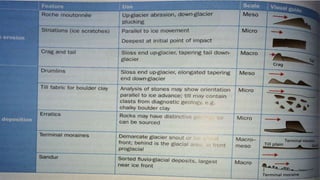
• Using examples, describe and explain how smaller
features of glacial erosion can be found superimposed on
to larger features (8)
• Draw an annotated picture of three macro features
explaining their development
Glacial Debris
• Glaciers generally deposit their load under 3
circumstances:
1. When the velocity is reduced
2. They become overloaded with debris
3. When Ablation increases
• Debris underneath the ice is called ‘till’ and this can be
transported hundreds of miles and into areas where there
is different geology
Glacial Debris
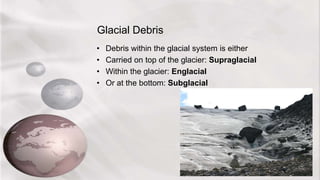
• Debris within the glacial system is either
• Carried on top of the glacier: Supraglacial
• Within the glacier: Englacial
• Or at the bottom: Subglacial
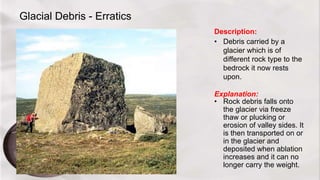
Glacial Debris - Erratics
Description:
• Debris carried by a
glacier which is of
different rock type to the
bedrock it now rests
upon.
Explanation:
• Rock debris falls onto
the glacier via freeze
thaw or plucking or
erosion of valley sides. It
is then transported on or
in the glacier and
deposited when ablation
increases and it can no
longer carry the weight.
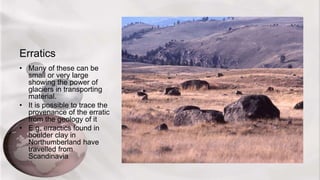
Erratics
• Many of these can be
small or very large
showing the power of
glaciers in transporting
material.
• It is possible to trace the
provenance of the erratic
from the geology of it
• E.g. erractics found in
boulder clay in
Northumberland have
travelled from
Scandinavia
Processes of glacial deposition
• The main processes are as follows:
1. Lodgement (subglacial material becomes lodged in the
glacier bed e.g. Drumlin)
2. Ablation (glacier melts and is no longer able to carry the
debris and so dumps it (e.g. terminal moraine)
3. Deformation (Where weak bedrock is moved by the
glacier as it turns to sediment (Rock flour)
4. Flow (Occurs is high meltwater content causes the
glacier debris to creep/ slide or flow during deposition
also produces rock flour - outwash)
• All of these processes produce till or boulder clay allowing
scientists to analyse the different depositional processes
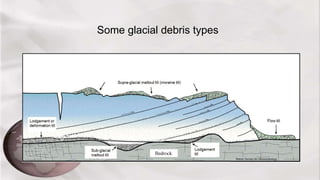
Some glacial debris types
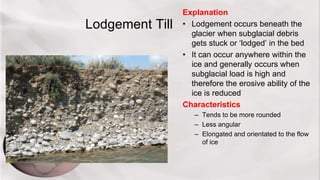
Lodgement Till
Explanation
• Lodgement occurs beneath the
glacier when subglacial debris
gets stuck or ‘lodged’ in the bed
• It can occur anywhere within the
ice and generally occurs when
subglacial load is high and
therefore the erosive ability of the
ice is reduced
Characteristics
– Tends to be more rounded
– Less angular
– Elongated and orientated to the flow
of ice
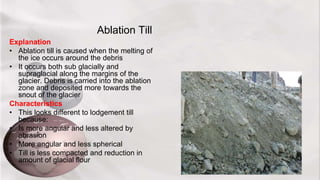
Ablation Till
Explanation
• Ablation till is caused when the melting of
the ice occurs around the debris
• It occurs both sub glacially and
supraglacial along the margins of the
glacier. Debris is carried into the ablation
zone and deposited more towards the
snout of the glacier
Characteristics
• This looks different to lodgement till
because:
• Is more angular and less altered by
abrasion
• More angular and less spherical
• Till is less compacted and reduction in
amount of glacial flour
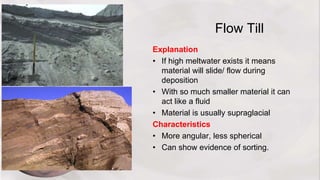
Flow Till
Explanation
• If high meltwater exists it means
material will slide/ flow during
deposition
• With so much smaller material it can
act like a fluid
• Material is usually supraglacial
Characteristics
• More angular, less spherical
• Can show evidence of sorting.
Lodgement Till Ablation Till Flow Till
Particle shape Rounded edges, spherical*,
striated and faceted (many
sided)
Rounded edges, spherical,
striated and faceted
Mostly angulated and not striated
Material Elongated particles are
aligned with flow direction
Elongated particles are aligned
with flow direction (but less
than lodgement)
Variable. Individual flow packages
may show a flow fabric.
Packing Dense and well consolidated Dense and well consolidated
(but less than lodgement)
Poorly consolidated
Lithology Local rock types dominate Local rock types dominate Variable
Structure Structureless Normally structureless but
sometimes stratified
May see evidence of individual
flows
Exercise: Page 75 & 77 (Oxford Book)
• Answer Question 1a – 1d
• Carry out a Chi Squared Test on data Question (c)
Glacial Debris
• There are several landforms that you will need to learn and consist of:
• Landforms formed subglacially and those formed from ice contact (at the ice
margin)
• Depositional lowland features
ICE CONTACT FEATURES
Lateral moraine Terminal moraine
Medial moraine Drumlins
Recessional moraine
DEPOSITIONAL LOWLAND FEATURES:
Till plains Lodgement till
Ablation till
In groups
• Research and find out about each these and be ready to
explain their creation to the rest of the class
ICE CONTACT FEATURES
Lateral moraine Terminal moraine
Medial moraine Drumlins
Recessional moraine
DEPOSITIONAL LOWLAND FEATURES:
Till plains Lodgement till
Ablation till
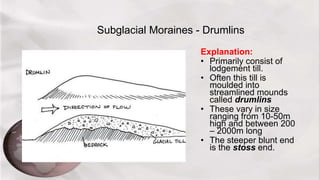
Subglacial Moraines - Drumlins
Explanation:
• Primarily consist of
lodgement till.
• Often this till is
moulded into
streamlined mounds
called drumlins
• These vary in size
ranging from 10-50m
high and between 200
– 2000m long
• The steeper blunt end
is the stoss end.
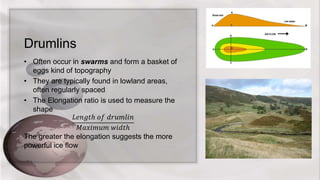
Drumlins
• Often occur in swarms and form a basket of
eggs kind of topography
• They are typically found in lowland areas,
often regularly spaced
• The Elongation ratio is used to measure the
shape
𝐿𝑒𝑛𝑔𝑡ℎ 𝑜𝑓 𝑑𝑟𝑢𝑚𝑙𝑖𝑛
𝑀𝑎𝑥𝑖𝑚𝑢𝑚 𝑤𝑖𝑑𝑡ℎ
The greater the elongation suggests the more
powerful ice flow
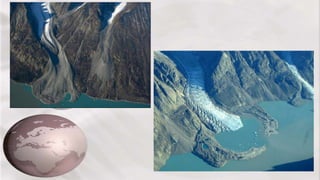
Ice-Marginal Moraines
• These occur at the edges of glaciers
• Most are linear in nature
• They generally occur at the lateral (sides) or terminal
(end) of the glacier
– Lateral
– Medial
– Terminal
– Recessional
– Hummocky
– All of these are linear in topography except for hummocky which is
non-linear.
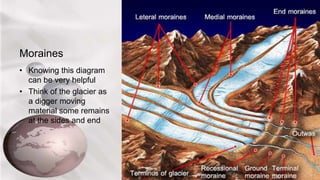
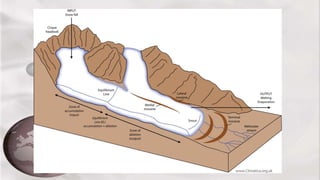
Moraines
• Knowing this diagram
can be very helpful
• Think of the glacier as
a digger moving
material some remains
at the sides and end
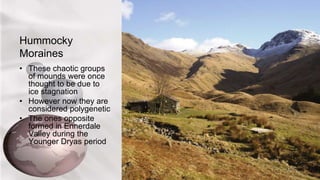
Hummocky
Moraines
• These chaotic groups
of mounds were once
thought to be due to
ice stagnation
• However now they are
considered polygenetic
• The ones opposite
formed in Ennerdale
Valley during the
Younger Dryas period
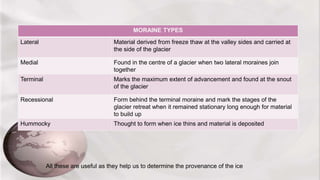
MORAINE TYPES
Lateral Material derived from freeze thaw at the valley sides and carried at
the side of the glacier
Medial Found in the centre of a glacier when two lateral moraines join
together
Terminal Marks the maximum extent of advancement and found at the snout
of the glacier
Recessional Form behind the terminal moraine and mark the stages of the
glacier retreat when it remained stationary long enough for material
to build up
Hummocky Thought to form when ice thins and material is deposited
All these are useful as they help us to determine the provenance of the ice
Lesson 6   glacial deposition and landforms

Lesson 6 glacial deposition and landforms

  • 1.
    Glacial Deposition andLandforms Lower Sixth
  • 2.
    Starter • Using examples,describe and explain how smaller features of glacial erosion can be found superimposed on to larger features (8) • Draw an annotated picture of three macro features explaining their development
  • 3.
    Glacial Debris • Glaciersgenerally deposit their load under 3 circumstances: 1. When the velocity is reduced 2. They become overloaded with debris 3. When Ablation increases • Debris underneath the ice is called ‘till’ and this can be transported hundreds of miles and into areas where there is different geology
  • 4.
    Glacial Debris • Debriswithin the glacial system is either • Carried on top of the glacier: Supraglacial • Within the glacier: Englacial • Or at the bottom: Subglacial
  • 5.
    Glacial Debris -Erratics Description: • Debris carried by a glacier which is of different rock type to the bedrock it now rests upon. Explanation: • Rock debris falls onto the glacier via freeze thaw or plucking or erosion of valley sides. It is then transported on or in the glacier and deposited when ablation increases and it can no longer carry the weight.
  • 6.
    Erratics • Many ofthese can be small or very large showing the power of glaciers in transporting material. • It is possible to trace the provenance of the erratic from the geology of it • E.g. erractics found in boulder clay in Northumberland have travelled from Scandinavia
  • 7.
    Processes of glacialdeposition • The main processes are as follows: 1. Lodgement (subglacial material becomes lodged in the glacier bed e.g. Drumlin) 2. Ablation (glacier melts and is no longer able to carry the debris and so dumps it (e.g. terminal moraine) 3. Deformation (Where weak bedrock is moved by the glacier as it turns to sediment (Rock flour) 4. Flow (Occurs is high meltwater content causes the glacier debris to creep/ slide or flow during deposition also produces rock flour - outwash) • All of these processes produce till or boulder clay allowing scientists to analyse the different depositional processes
  • 8.
  • 9.
    Lodgement Till Explanation • Lodgementoccurs beneath the glacier when subglacial debris gets stuck or ‘lodged’ in the bed • It can occur anywhere within the ice and generally occurs when subglacial load is high and therefore the erosive ability of the ice is reduced Characteristics – Tends to be more rounded – Less angular – Elongated and orientated to the flow of ice
  • 10.
    Ablation Till Explanation • Ablationtill is caused when the melting of the ice occurs around the debris • It occurs both sub glacially and supraglacial along the margins of the glacier. Debris is carried into the ablation zone and deposited more towards the snout of the glacier Characteristics • This looks different to lodgement till because: • Is more angular and less altered by abrasion • More angular and less spherical • Till is less compacted and reduction in amount of glacial flour
  • 11.
    Flow Till Explanation • Ifhigh meltwater exists it means material will slide/ flow during deposition • With so much smaller material it can act like a fluid • Material is usually supraglacial Characteristics • More angular, less spherical • Can show evidence of sorting.
  • 12.
    Lodgement Till AblationTill Flow Till Particle shape Rounded edges, spherical*, striated and faceted (many sided) Rounded edges, spherical, striated and faceted Mostly angulated and not striated Material Elongated particles are aligned with flow direction Elongated particles are aligned with flow direction (but less than lodgement) Variable. Individual flow packages may show a flow fabric. Packing Dense and well consolidated Dense and well consolidated (but less than lodgement) Poorly consolidated Lithology Local rock types dominate Local rock types dominate Variable Structure Structureless Normally structureless but sometimes stratified May see evidence of individual flows
  • 13.
    Exercise: Page 75& 77 (Oxford Book) • Answer Question 1a – 1d • Carry out a Chi Squared Test on data Question (c)
  • 14.
    Glacial Debris • Thereare several landforms that you will need to learn and consist of: • Landforms formed subglacially and those formed from ice contact (at the ice margin) • Depositional lowland features ICE CONTACT FEATURES Lateral moraine Terminal moraine Medial moraine Drumlins Recessional moraine DEPOSITIONAL LOWLAND FEATURES: Till plains Lodgement till Ablation till
  • 16.
    In groups • Researchand find out about each these and be ready to explain their creation to the rest of the class ICE CONTACT FEATURES Lateral moraine Terminal moraine Medial moraine Drumlins Recessional moraine DEPOSITIONAL LOWLAND FEATURES: Till plains Lodgement till Ablation till
  • 17.
    Subglacial Moraines -Drumlins Explanation: • Primarily consist of lodgement till. • Often this till is moulded into streamlined mounds called drumlins • These vary in size ranging from 10-50m high and between 200 – 2000m long • The steeper blunt end is the stoss end.
  • 18.
    Drumlins • Often occurin swarms and form a basket of eggs kind of topography • They are typically found in lowland areas, often regularly spaced • The Elongation ratio is used to measure the shape 𝐿𝑒𝑛𝑔𝑡ℎ 𝑜𝑓 𝑑𝑟𝑢𝑚𝑙𝑖𝑛 𝑀𝑎𝑥𝑖𝑚𝑢𝑚 𝑤𝑖𝑑𝑡ℎ The greater the elongation suggests the more powerful ice flow
  • 20.
    Ice-Marginal Moraines • Theseoccur at the edges of glaciers • Most are linear in nature • They generally occur at the lateral (sides) or terminal (end) of the glacier – Lateral – Medial – Terminal – Recessional – Hummocky – All of these are linear in topography except for hummocky which is non-linear.
  • 21.
    Moraines • Knowing thisdiagram can be very helpful • Think of the glacier as a digger moving material some remains at the sides and end
  • 22.
    Hummocky Moraines • These chaoticgroups of mounds were once thought to be due to ice stagnation • However now they are considered polygenetic • The ones opposite formed in Ennerdale Valley during the Younger Dryas period
  • 23.
    MORAINE TYPES Lateral Materialderived from freeze thaw at the valley sides and carried at the side of the glacier Medial Found in the centre of a glacier when two lateral moraines join together Terminal Marks the maximum extent of advancement and found at the snout of the glacier Recessional Form behind the terminal moraine and mark the stages of the glacier retreat when it remained stationary long enough for material to build up Hummocky Thought to form when ice thins and material is deposited All these are useful as they help us to determine the provenance of the ice