 Introduction
 Fluvial Processes
 Stages Of River
 Young Stage
 Classification of valley
 Maturity Stage
 Meanders
 Old Stage
 Alluvial Fan
 Rejuvenation
 Drainage Pattern
 Conclusion
 “As the different erosional agents act upon the earth’s
surface there is produced an orderly sequence of land forms”
orderly sequence of erosional features are formed at different
stages in fluvial processes.
 Fluvial processes: The set of mechanisms that operate as a
result of water flow within a stream channel, bringing about
the erosion, transfer, and deposition of sediment.
 Fluvial process is Exogenetic processes which includes
 River Erosion
 River Transportation
 River Deposition
 Erosion processes include the displacement of bed particles
through drag and lift forces; abrasion, causing the wearing
away of bed and banks as mobile agencies obtain and remove
rock debris
 Transportation: processes include the transfer of material in
solution and suspension, and by saltation.
 Deposition: is the geological process by which sediments,
soil, and rocks is added to a landform or land mass.
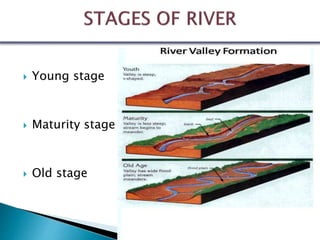
 Young stage
 Maturity stage
 Old stage
 It has steep sided and narrow v-shaped valley created by
vertical erosion
 Characterized by waterfalls and rapids
 Water is often quit clear because the river is not carrying
much load in suspension
 Stream meandering may exist in youth but the meanders in
valleys incised below the upland surface
 Waterfalls or rapids may exist where stream courses cross
beds of particularly resistant rock
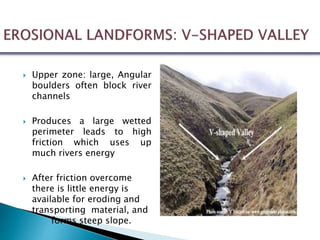
 Upper zone: large, Angular
boulders often block river
channels
 Produces a large wetted
perimeter leads to high
friction which uses up
much rivers energy
 After friction overcome
there is little energy is
available for eroding and
transporting material, and
forms steep slope.
Genetic classification:
 Consequent valley: it is one whose course was supposedly
determined by the initial slope of the land newly created
 Subsequent valley: these are valleys whose course have been
shifted from the original consequent ones to belts of more
erodible rocks
 Insequent valley: these are valleys which show no apparent
adjustment to structural or lithological control
These valleys are classified on the basis of geologic structure:
 Homoclinal valleys: it is also known as strike valleys which follow
beds of weaker rock along the flanks of folds
 Anticline valleys: these are valleys which follow the axes of
breached anticlines
 Synclinal valleys: the axes of synclines
 Fault valleys: the streams follow depressions consequent upon
faulting
 Fault line valleys: they are subsequent valleys following in fault
line
cont’d..
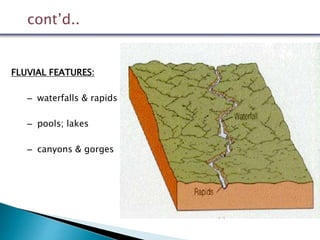
FLUVIAL FEATURES:
– waterfalls & rapids
– pools; lakes
– canyons & gorges
 A long, deep, narrow valley
with steep cliff walls.
 It cut into the Earth by
running water .
 It often having a stream at
the bottom.
Colorado River of state : Arizona
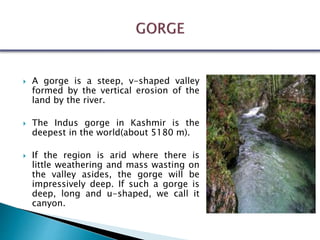
 A gorge is a steep, v-shaped valley
formed by the vertical erosion of the
land by the river.
 The Indus gorge in Kashmir is the
deepest in the world(about 5180 m).
 If the region is arid where there is
little weathering and mass wasting on
the valley asides, the gorge will be
impressively deep. If such a gorge is
deep, long and u-shaped, we call it
canyon.
 Waterfall: a steep drop in the course of a river it has a high
head of water and a characteristic plunge pool at the base
waterfalls often form when a band of resistant rocks,
 Knick point : a sharp irregularity in a stream-channel profile,
commonly caused by abrupt changes in bedrock resistance
and at which waterfalls starts
 Plunge pool: also known as waterfall lake is a pool, lake, or
pond that is small in diameter, but deep. Plunge pools can
remain after the waterfall has ceased to exist or the stream
has been diverted.
 Are depressions that are eroded
in to the land rock of the
streamed by abrasice action of
the sediment load.
 When a stream is full, the swirling
water can cause sand and pebbles
to scour out smooth, cylindrical
or bowl-shaped depression in
hard rock
 Tend to form in spots where the
rock is a little weaker than the
surrounding rock.They may
contain certain sand or an
assortment of beautifully rounded
pebbles.
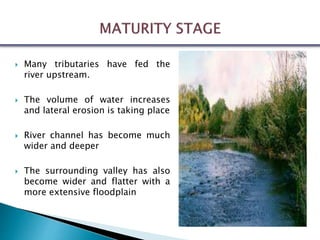
 Many tributaries have fed the
river upstream.
 The volume of water increases
and lateral erosion is taking place
 River channel has become much
wider and deeper
 The surrounding valley has also
become wider and flatter with a
more extensive floodplain
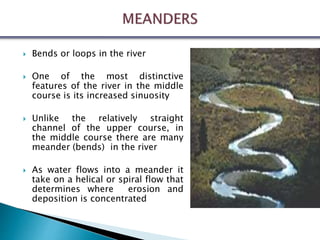
 Bends or loops in the river
 One of the most distinctive
features of the river in the middle
course is its increased sinuosity
 Unlike the relatively straight
channel of the upper course, in
the middle course there are many
meander (bends) in the river
 As water flows into a meander it
take on a helical or spiral flow that
determines where erosion and
deposition is concentrated
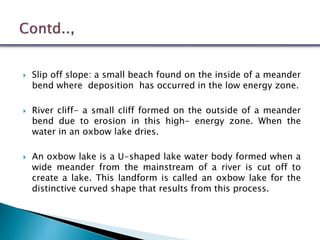
 Slip off slope: a small beach found on the inside of a meander
bend where deposition has occurred in the low energy zone.
 River cliff- a small cliff formed on the outside of a meander
bend due to erosion in this high- energy zone. When the
water in an oxbow lake dries.
 An oxbow lake is a U-shaped lake water body formed when a
wide meander from the mainstream of a river is cut off to
create a lake. This landform is called an oxbow lake for the
distinctive curved shape that results from this process.
 Final stage of a river is reached when the river is flowing on
more or less flat surface.
 The speed so low that no net erosion occurs any more.
Erosion on the slopes is balanced by deposition on the
floodplains.
 Peneplain- a flat and relatively featureless landscape with
minimal relief; considered to be the end product of the
geomorphic cycle. Peneplain means “ almost a plain the
process is known as peneplanation.
 From now on the rivers just sweep over the floodplain and
rework the sedimement, creating various floodplain features.
Isolated remnants of resistant bedrock may rise over the
peneplain surface, the so called inselbergs.
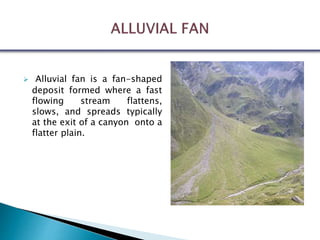
 Alluvial fan is a fan-shaped
deposit formed where a fast
flowing stream flattens,
slows, and spreads typically
at the exit of a canyon onto a
flatter plain.
 Old or mature stage landforms may be uplifted due to climate
change or tectonic activity
 Entrenched meanders are the result
 Entrenched meander: a winding, sinuous stream valley with
abrupt sides.
 Because the river is moving on a flat surface, deposits
sediments at the bed often act as barriers to free flow of
water making it to form meanders
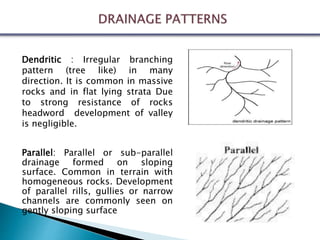
Dendritic : Irregular branching
pattern (tree like) in many
direction. It is common in massive
rocks and in flat lying strata Due
to strong resistance of rocks
headword development of valley
is negligible.
Parallel: Parallel or sub-parallel
drainage formed on sloping
surface. Common in terrain with
homogeneous rocks. Development
of parallel rills, gullies or narrow
channels are commonly seen on
gently sloping surface
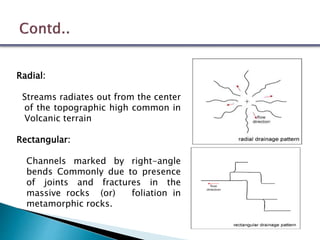
Radial:
Streams radiates out from the center
of the topographic high common in
Volcanic terrain
Rectangular:
Channels marked by right-angle
bends Commonly due to presence
of joints and fractures in the
massive rocks (or) foliation in
metamorphic rocks.
Geomorphologic processes like fluvial,
glacial, Aeolian, coastal, acts upon the earth
bringing changes on the morphology of the earth.
In these fluvial process plays an important role.
Three stages of fluvial process, youth, maturity and
old stages can be observed over a span of time.
They create specific landforms like valleys,
streams, flood plain, peneplain, canyon, alluvial fan
etc. at different stage. Thus fluvial processes
through much light on the previous geological
events
1. 2002-william D Thornbury-Principles of
geomorphology- new age international
publishers.282-297
 G.B.Mahapatra; The Text Book of Physical Geology
;CBS publishers & distributors pvt.ltd; 214-242
 Parbin Singh; General & Engineering Geology ;
Katson Education Series; 56-80
1. www.wikipedia.com
Fluvial process

Fluvial process

  • 2.
     Introduction  FluvialProcesses  Stages Of River  Young Stage  Classification of valley  Maturity Stage  Meanders  Old Stage  Alluvial Fan  Rejuvenation  Drainage Pattern  Conclusion
  • 3.
     “As thedifferent erosional agents act upon the earth’s surface there is produced an orderly sequence of land forms” orderly sequence of erosional features are formed at different stages in fluvial processes.
  • 4.
     Fluvial processes:The set of mechanisms that operate as a result of water flow within a stream channel, bringing about the erosion, transfer, and deposition of sediment.  Fluvial process is Exogenetic processes which includes  River Erosion  River Transportation  River Deposition
  • 5.
     Erosion processesinclude the displacement of bed particles through drag and lift forces; abrasion, causing the wearing away of bed and banks as mobile agencies obtain and remove rock debris  Transportation: processes include the transfer of material in solution and suspension, and by saltation.  Deposition: is the geological process by which sediments, soil, and rocks is added to a landform or land mass.
  • 6.
     Young stage Maturity stage  Old stage
  • 7.
     It hassteep sided and narrow v-shaped valley created by vertical erosion  Characterized by waterfalls and rapids  Water is often quit clear because the river is not carrying much load in suspension  Stream meandering may exist in youth but the meanders in valleys incised below the upland surface  Waterfalls or rapids may exist where stream courses cross beds of particularly resistant rock
  • 8.
     Upper zone:large, Angular boulders often block river channels  Produces a large wetted perimeter leads to high friction which uses up much rivers energy  After friction overcome there is little energy is available for eroding and transporting material, and forms steep slope.
  • 9.
    Genetic classification:  Consequentvalley: it is one whose course was supposedly determined by the initial slope of the land newly created  Subsequent valley: these are valleys whose course have been shifted from the original consequent ones to belts of more erodible rocks  Insequent valley: these are valleys which show no apparent adjustment to structural or lithological control
  • 10.
    These valleys areclassified on the basis of geologic structure:  Homoclinal valleys: it is also known as strike valleys which follow beds of weaker rock along the flanks of folds  Anticline valleys: these are valleys which follow the axes of breached anticlines  Synclinal valleys: the axes of synclines  Fault valleys: the streams follow depressions consequent upon faulting  Fault line valleys: they are subsequent valleys following in fault line
  • 11.
    cont’d.. FLUVIAL FEATURES: – waterfalls& rapids – pools; lakes – canyons & gorges
  • 12.
     A long,deep, narrow valley with steep cliff walls.  It cut into the Earth by running water .  It often having a stream at the bottom. Colorado River of state : Arizona
  • 13.
     A gorgeis a steep, v-shaped valley formed by the vertical erosion of the land by the river.  The Indus gorge in Kashmir is the deepest in the world(about 5180 m).  If the region is arid where there is little weathering and mass wasting on the valley asides, the gorge will be impressively deep. If such a gorge is deep, long and u-shaped, we call it canyon.
  • 14.
     Waterfall: asteep drop in the course of a river it has a high head of water and a characteristic plunge pool at the base waterfalls often form when a band of resistant rocks,  Knick point : a sharp irregularity in a stream-channel profile, commonly caused by abrupt changes in bedrock resistance and at which waterfalls starts  Plunge pool: also known as waterfall lake is a pool, lake, or pond that is small in diameter, but deep. Plunge pools can remain after the waterfall has ceased to exist or the stream has been diverted.
  • 15.
     Are depressionsthat are eroded in to the land rock of the streamed by abrasice action of the sediment load.  When a stream is full, the swirling water can cause sand and pebbles to scour out smooth, cylindrical or bowl-shaped depression in hard rock  Tend to form in spots where the rock is a little weaker than the surrounding rock.They may contain certain sand or an assortment of beautifully rounded pebbles.
  • 16.
     Many tributarieshave fed the river upstream.  The volume of water increases and lateral erosion is taking place  River channel has become much wider and deeper  The surrounding valley has also become wider and flatter with a more extensive floodplain
  • 17.
     Bends orloops in the river  One of the most distinctive features of the river in the middle course is its increased sinuosity  Unlike the relatively straight channel of the upper course, in the middle course there are many meander (bends) in the river  As water flows into a meander it take on a helical or spiral flow that determines where erosion and deposition is concentrated
  • 18.
     Slip offslope: a small beach found on the inside of a meander bend where deposition has occurred in the low energy zone.  River cliff- a small cliff formed on the outside of a meander bend due to erosion in this high- energy zone. When the water in an oxbow lake dries.  An oxbow lake is a U-shaped lake water body formed when a wide meander from the mainstream of a river is cut off to create a lake. This landform is called an oxbow lake for the distinctive curved shape that results from this process.
  • 19.
     Final stageof a river is reached when the river is flowing on more or less flat surface.  The speed so low that no net erosion occurs any more. Erosion on the slopes is balanced by deposition on the floodplains.  Peneplain- a flat and relatively featureless landscape with minimal relief; considered to be the end product of the geomorphic cycle. Peneplain means “ almost a plain the process is known as peneplanation.  From now on the rivers just sweep over the floodplain and rework the sedimement, creating various floodplain features. Isolated remnants of resistant bedrock may rise over the peneplain surface, the so called inselbergs.
  • 21.
     Alluvial fanis a fan-shaped deposit formed where a fast flowing stream flattens, slows, and spreads typically at the exit of a canyon onto a flatter plain.
  • 22.
     Old ormature stage landforms may be uplifted due to climate change or tectonic activity  Entrenched meanders are the result  Entrenched meander: a winding, sinuous stream valley with abrupt sides.  Because the river is moving on a flat surface, deposits sediments at the bed often act as barriers to free flow of water making it to form meanders
  • 23.
    Dendritic : Irregularbranching pattern (tree like) in many direction. It is common in massive rocks and in flat lying strata Due to strong resistance of rocks headword development of valley is negligible. Parallel: Parallel or sub-parallel drainage formed on sloping surface. Common in terrain with homogeneous rocks. Development of parallel rills, gullies or narrow channels are commonly seen on gently sloping surface
  • 24.
    Radial: Streams radiates outfrom the center of the topographic high common in Volcanic terrain Rectangular: Channels marked by right-angle bends Commonly due to presence of joints and fractures in the massive rocks (or) foliation in metamorphic rocks.
  • 25.
    Geomorphologic processes likefluvial, glacial, Aeolian, coastal, acts upon the earth bringing changes on the morphology of the earth. In these fluvial process plays an important role. Three stages of fluvial process, youth, maturity and old stages can be observed over a span of time. They create specific landforms like valleys, streams, flood plain, peneplain, canyon, alluvial fan etc. at different stage. Thus fluvial processes through much light on the previous geological events
  • 26.
    1. 2002-william DThornbury-Principles of geomorphology- new age international publishers.282-297  G.B.Mahapatra; The Text Book of Physical Geology ;CBS publishers & distributors pvt.ltd; 214-242  Parbin Singh; General & Engineering Geology ; Katson Education Series; 56-80 1. www.wikipedia.com