1
CONTENT
INTRODUCTION
GEOSYNCLINES
 HISTORY OF GEOSYNCLINES
TYPES OF GEOSYNCLINES
MECHANISM OF MOUNTAIN FORMATION
CONCLUSION
REFERENCE
21/10/2011 2
Introduction
 Geosynclines refers to thick pile of sediments that
were deposited in a deep marine basin & subsequently
compressed, deformed& uplifted in to a mountain range
, with associated volcanism .
The filling of a geosynclines with tons of sediment is
accompanied in the late stages of deposition by
folding, and faulting of the deposits.
Intrusion of crystalline igneous rock and regional
uplift It is then transformed into a belt of folded
mountains.
21/10/2011 3
History of geosyncline
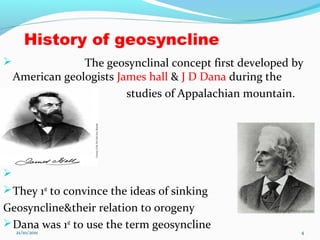
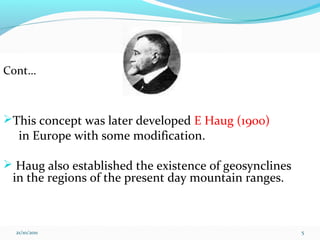
 The geosynclinal concept first developed by
American geologists James hall & J D Dana during the
 studies of Appalachian mountain.

They 1st
to convince the ideas of sinking
Geosyncline&their relation to orogeny
Dana was 1st
to use the term geosyncline
21/10/2011 4
Cont…
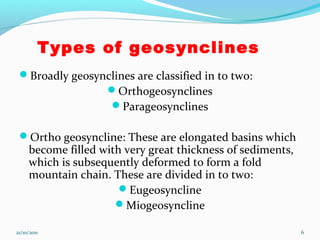
This concept was later developed E Haug (1900)
in Europe with some modification.
 Haug also established the existence of geosynclines
in the regions of the present day mountain ranges.
21/10/2011 5
Types of geosynclines
Broadly geosynclines are classified in to two:
Orthogeosynclines
Parageosynclines
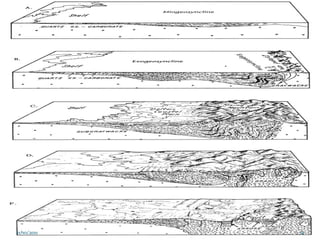
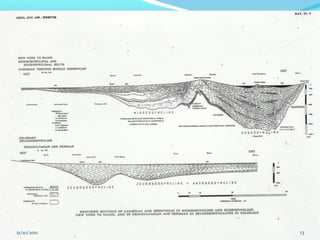
Ortho geosyncline: These are elongated basins which
become filled with very great thickness of sediments,
which is subsequently deformed to form a fold
mountain chain. These are divided in to two:
Eugeosyncline
Miogeosyncline
21/10/2011 6
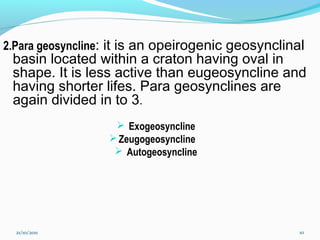
Eugeosyncline:
 These are found far away from continental crust. In
these geosyncline, the pile of sediments are found with
an abundance of volcanic rock; these are formed at some
distance from the shield area.
Eugeosynclinal rocks include thick sequence of grey
wack,chert,slate and sub marine lavas. Here the
deposits are more deformed and metamorphosed and
intruded by small to large igneous plutons.
21/10/2011 7
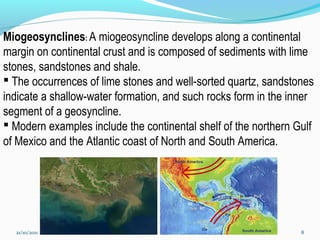
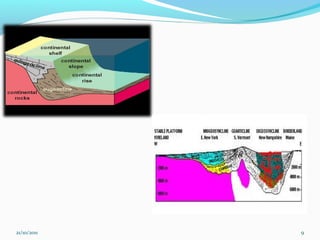
Miogeosynclines: A miogeosyncline develops along a continental
margin on continental crust and is composed of sediments with lime
stones, sandstones and shale.
 The occurrences of lime stones and well-sorted quartz, sandstones
indicate a shallow-water formation, and such rocks form in the inner
segment of a geosyncline.
 Modern examples include the continental shelf of the northern Gulf
of Mexico and the Atlantic coast of North and South America.
21/10/2011 8
21/10/2011 9
2.Para geosyncline: it is an opeirogenic geosynclinal
basin located within a craton having oval in
shape. It is less active than eugeosyncline and
having shorter lifes. Para geosynclines are
again divided in to 3.
 Exogeosyncline
Zeugogeosyncline
 Autogeosyncline
21/10/2011 10
Exogeosyncline: It is a parageosyncline that lies along the
cratonal border and obtains its clastic sediments from erosion of
the orthogeosynclinal belt outside the craton. It is also known as
delta geosyncline.
 Zeugogeosyncline: A geosyncline in a craton or stable area,
within which is also an uplifted area, receiving clastic sediments.
Also known as yoked basin.
Autogeosyncline: It is a parageosyncline located as isolated
depositional centre within a craton and gave sediments from distant
cratons.
21/10/2011 11
21/10/2011 12
21/10/2011 13
Charles schuchert(1923)has recognized three
types of geosynclines
 monogeosyncline: This is a long relatively narrow
sinking structural basin, similar to that postulated by Dana
&Hall situated either with continent or just on its borders. A
monogeosyncline gives rise to a single mountain ranges.
eg:appalchian geosyncline of America.
CHARLES
SCHUCHERT(1923)
classification
21/10/2011 14
Polygeosyncline: This is a complex of a
number of monogeosyncline whose axes are more
or less parallel to each other. Polygeosynclines are
relatively wider, long enduring & give rise to
mountain ranges.
e.g.: rocky mountain orogeny
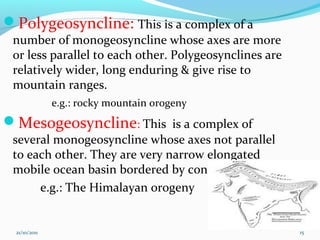
Mesogeosyncline: This is a complex of
several monogeosyncline whose axes not parallel
to each other. They are very narrow elongated
mobile ocean basin bordered by continents.
e.g.: The Himalayan orogeny
21/10/2011 15
Mechanism of mountain
formation
(Geosynclinal Theory)
21/10/2011 16
Geosynclinal Theory
According to geosynclinal theory
Folded mountain originate in three phases over a very
long period of time of millions of years.
1.geosynclinal phase(evolution of geosyncline)
2.tectonic phase( revolution of geosyncline )
3.orogenic phase( collapse of geosyncline)
21/10/2011 17
Geosynclinal phase
formation of geosyncline & accumulation of
sediments in an elongated lens-like shape to
estimated thickness of 10000 to20000 m. As the
sediments get accumulated the floor of the
geosyncline begin to subside due to continuosly
increasing weight on it.
21/10/2011 18
Tectonic phase
when the sediment become deeply
buried in considerably warmer zone, their
strength gets reduced by heat & pressure and
become plastic and yield to deforming
compressive forces by folding.
21/10/2011 19
Orogenic phase
The elevated foreland slowly encroach on
the geosyncline like the jaws of a vice exterting
great horizontal compressive force on the
sediments. By this sediments get further folded
followed by igneous activity, emplacement of
dikes & batholiths and upheaval give rise to
mountain ranges of tens of thousands of meters
elevation.
21/10/2011 20
conclusion
Geosynclines is a subsiding linear trough that was caused
during accumulation of succeeding sediments and volcanic
rocks.
 sediments were deposited in a deep marine basin &
subsequently compressed, deformed& uplifted in to a
mountain range , with associated volcanism .
 The geosynclinal theory is of fundamental importance to
sedimentation, petrology, geomorphology, ore deposits,
structural geology, geophysics, and in fact all branches of
geological science.
21/10/2011 21
B S Sathya narayanaswamy (1994), structural geology , Dhanpat rai and sons
publications, p.p-168 to 170.
Girija bhushan mahapatra (2008), A text book of geology(with special
reference to India), cbs publications
,p.p-30 to32
• L U De Sitter (1956),structural geology, McGraw hill book company,p.p-
349-355
• Jean Aubouin(1965),geosyncline,ELSEUIER publisher company,p.p-18-
19,26-29
• Websites
www.goole.com
www.wikepedia .com
reference
21/10/2011 22

Geosyncline

  • 1.
  • 2.
    CONTENT INTRODUCTION GEOSYNCLINES  HISTORY OFGEOSYNCLINES TYPES OF GEOSYNCLINES MECHANISM OF MOUNTAIN FORMATION CONCLUSION REFERENCE 21/10/2011 2
  • 3.
    Introduction  Geosynclines refersto thick pile of sediments that were deposited in a deep marine basin & subsequently compressed, deformed& uplifted in to a mountain range , with associated volcanism . The filling of a geosynclines with tons of sediment is accompanied in the late stages of deposition by folding, and faulting of the deposits. Intrusion of crystalline igneous rock and regional uplift It is then transformed into a belt of folded mountains. 21/10/2011 3
  • 4.
    History of geosyncline The geosynclinal concept first developed by American geologists James hall & J D Dana during the  studies of Appalachian mountain.  They 1st to convince the ideas of sinking Geosyncline&their relation to orogeny Dana was 1st to use the term geosyncline 21/10/2011 4
  • 5.
    Cont… This concept waslater developed E Haug (1900) in Europe with some modification.  Haug also established the existence of geosynclines in the regions of the present day mountain ranges. 21/10/2011 5
  • 6.
    Types of geosynclines Broadlygeosynclines are classified in to two: Orthogeosynclines Parageosynclines Ortho geosyncline: These are elongated basins which become filled with very great thickness of sediments, which is subsequently deformed to form a fold mountain chain. These are divided in to two: Eugeosyncline Miogeosyncline 21/10/2011 6
  • 7.
    Eugeosyncline:  These arefound far away from continental crust. In these geosyncline, the pile of sediments are found with an abundance of volcanic rock; these are formed at some distance from the shield area. Eugeosynclinal rocks include thick sequence of grey wack,chert,slate and sub marine lavas. Here the deposits are more deformed and metamorphosed and intruded by small to large igneous plutons. 21/10/2011 7
  • 8.
    Miogeosynclines: A miogeosynclinedevelops along a continental margin on continental crust and is composed of sediments with lime stones, sandstones and shale.  The occurrences of lime stones and well-sorted quartz, sandstones indicate a shallow-water formation, and such rocks form in the inner segment of a geosyncline.  Modern examples include the continental shelf of the northern Gulf of Mexico and the Atlantic coast of North and South America. 21/10/2011 8
  • 9.
  • 10.
    2.Para geosyncline: itis an opeirogenic geosynclinal basin located within a craton having oval in shape. It is less active than eugeosyncline and having shorter lifes. Para geosynclines are again divided in to 3.  Exogeosyncline Zeugogeosyncline  Autogeosyncline 21/10/2011 10
  • 11.
    Exogeosyncline: It isa parageosyncline that lies along the cratonal border and obtains its clastic sediments from erosion of the orthogeosynclinal belt outside the craton. It is also known as delta geosyncline.  Zeugogeosyncline: A geosyncline in a craton or stable area, within which is also an uplifted area, receiving clastic sediments. Also known as yoked basin. Autogeosyncline: It is a parageosyncline located as isolated depositional centre within a craton and gave sediments from distant cratons. 21/10/2011 11
  • 12.
  • 13.
  • 14.
    Charles schuchert(1923)has recognizedthree types of geosynclines  monogeosyncline: This is a long relatively narrow sinking structural basin, similar to that postulated by Dana &Hall situated either with continent or just on its borders. A monogeosyncline gives rise to a single mountain ranges. eg:appalchian geosyncline of America. CHARLES SCHUCHERT(1923) classification 21/10/2011 14
  • 15.
    Polygeosyncline: This isa complex of a number of monogeosyncline whose axes are more or less parallel to each other. Polygeosynclines are relatively wider, long enduring & give rise to mountain ranges. e.g.: rocky mountain orogeny Mesogeosyncline: This is a complex of several monogeosyncline whose axes not parallel to each other. They are very narrow elongated mobile ocean basin bordered by continents. e.g.: The Himalayan orogeny 21/10/2011 15
  • 16.
  • 17.
    Geosynclinal Theory According togeosynclinal theory Folded mountain originate in three phases over a very long period of time of millions of years. 1.geosynclinal phase(evolution of geosyncline) 2.tectonic phase( revolution of geosyncline ) 3.orogenic phase( collapse of geosyncline) 21/10/2011 17
  • 18.
    Geosynclinal phase formation ofgeosyncline & accumulation of sediments in an elongated lens-like shape to estimated thickness of 10000 to20000 m. As the sediments get accumulated the floor of the geosyncline begin to subside due to continuosly increasing weight on it. 21/10/2011 18
  • 19.
    Tectonic phase when thesediment become deeply buried in considerably warmer zone, their strength gets reduced by heat & pressure and become plastic and yield to deforming compressive forces by folding. 21/10/2011 19
  • 20.
    Orogenic phase The elevatedforeland slowly encroach on the geosyncline like the jaws of a vice exterting great horizontal compressive force on the sediments. By this sediments get further folded followed by igneous activity, emplacement of dikes & batholiths and upheaval give rise to mountain ranges of tens of thousands of meters elevation. 21/10/2011 20
  • 21.
    conclusion Geosynclines is asubsiding linear trough that was caused during accumulation of succeeding sediments and volcanic rocks.  sediments were deposited in a deep marine basin & subsequently compressed, deformed& uplifted in to a mountain range , with associated volcanism .  The geosynclinal theory is of fundamental importance to sedimentation, petrology, geomorphology, ore deposits, structural geology, geophysics, and in fact all branches of geological science. 21/10/2011 21
  • 22.
    B S Sathyanarayanaswamy (1994), structural geology , Dhanpat rai and sons publications, p.p-168 to 170. Girija bhushan mahapatra (2008), A text book of geology(with special reference to India), cbs publications ,p.p-30 to32 • L U De Sitter (1956),structural geology, McGraw hill book company,p.p- 349-355 • Jean Aubouin(1965),geosyncline,ELSEUIER publisher company,p.p-18- 19,26-29 • Websites www.goole.com www.wikepedia .com reference 21/10/2011 22