
GEOMETRY 
4-5 Using indirect reasoning 
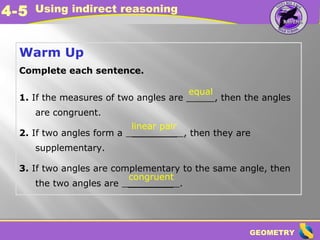
Warm Up 
Complete each sentence. 
1. If the measures of two angles are _____, then the angles 
are congruent. 
2. If two angles form a ________ , then they are 
supplementary. 
3. If two angles are complementary to the same angle, then 
the two angles are ________ . 
equal 
linear pair 
congruent
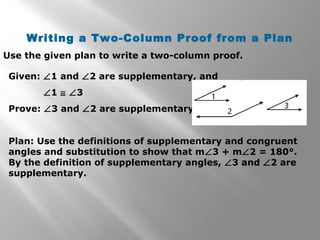
Writing a Two-Column Proof from a Plan 
Use the given plan to write a two-column proof. 
Given: Ð1 and Ð2 are supplementary, and 
Ð1 @ Ð3 
Prove: Ð3 and Ð2 are supplementary. 
Plan: Use the definitions of supplementary and congruent 
angles and substitution to show that mÐ3 + mÐ2 = 180°. 
By the definition of supplementary angles, Ð3 and Ð2 are 
supplementary.
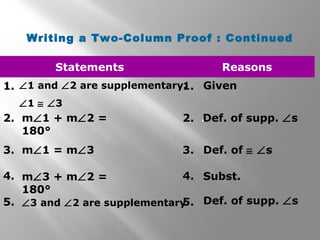
Writing a Two-Column Proof : Continued 
Statements Reasons 
Ð1 and Ð2 are supplementary. 
Ð1 @ Ð3 
1. 1. 
2. 2. . 
3. . 3. 
4. 4. 
5. 5. 
Given 
mÐ1 + mÐ2 = 
180° 
Def. of supp. Ðs 
mÐ1 = mÐ3 
mÐ3 + mÐ2 = 
180° 
Ð3 and Ð2 are supplementary 
Def. of @ Ðs 
Subst. 
Def. of supp. Ðs
TEACH! Writing a Two-Column Proof 
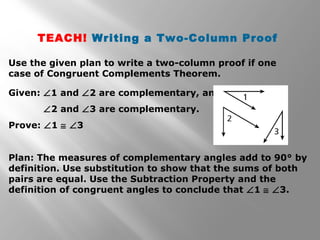
Use the given plan to write a two-column proof if one 
case of Congruent Complements Theorem. 
Given: Ð1 and Ð2 are complementary, and 
Ð2 and Ð3 are complementary. 
Prove: Ð1 @ Ð3 
Plan: The measures of complementary angles add to 90° by 
definition. Use substitution to show that the sums of both 
pairs are equal. Use the Subtraction Property and the 
definition of congruent angles to conclude that Ð1 @ Ð3.
TEACH! Continued 
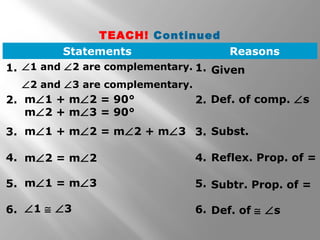
Statements Reasons 
Ð1 and Ð2 are complementary. 
Ð2 and Ð3 are complementary. 
1. 1. 
2. 2. . 
3. . 3. 
4. 4. 
5. 5. 
6. 6. 
Given 
mÐ1 + mÐ2 = 90° 
mÐ2 + mÐ3 = 90° 
Def. of comp. Ðs 
mÐ1 + mÐ2 = mÐ2 + mÐ3 
mÐ2 = mÐ2 
mÐ1 = mÐ3 
Subst. 
Reflex. Prop. of = 
Subtr. Prop. of = 
Ð1 @ Ð3 Def. of @ Ðs
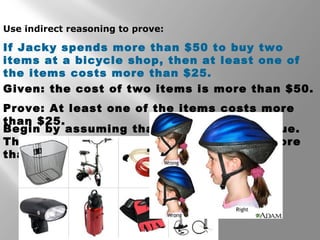
Use indirect reasoning to prove: 
If Jacky spends more than $50 to buy two 
items at a bicycle shop, then at least one of 
the items costs more than $25. 
Given: the cost of two items is more than $50. 
Prove: At least one of the items costs more 
than $25. 
Begin by assuming that the opposite is true. 
That is assume that neither item costs more 
than $25.
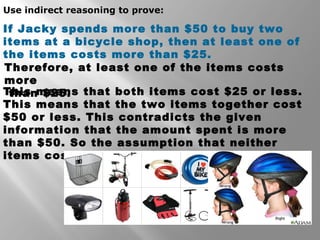
Use indirect reasoning to prove: 
If Jacky spends more than $50 to buy two 
items at a bicycle shop, then at least one of 
the items costs more than $25. 
Given: the cost of two items is more than $50. 
Prove: At least one of the items costs more 
Btheagnin $ b2y5 .assuming that the opposite is true. 
That is assume that neither item costs more 
tThhains m$2e5a.ns that both items cost $25 or less. 
This means that the two items together cost 
$50 or less. This contradicts the given 
information that the amount spent is more 
than $50. So the assumption that neither 
items cost more than $25 must be incorrect.
Use indirect reasoning to prove: 
If Jacky spends more than $50 to buy two 
items at a bicycle shop, then at least one of 
the items costs more than $25. 
Therefore, at least one of the items costs 
more 
than $25. 
This means that both items cost $25 or less. 
This means that the two items together cost 
$50 or less. This contradicts the given 
information that the amount spent is more 
than $50. So the assumption that neither 
items cost more than $25 must be incorrect.
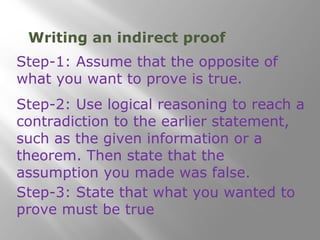
Writing an indirect proof 
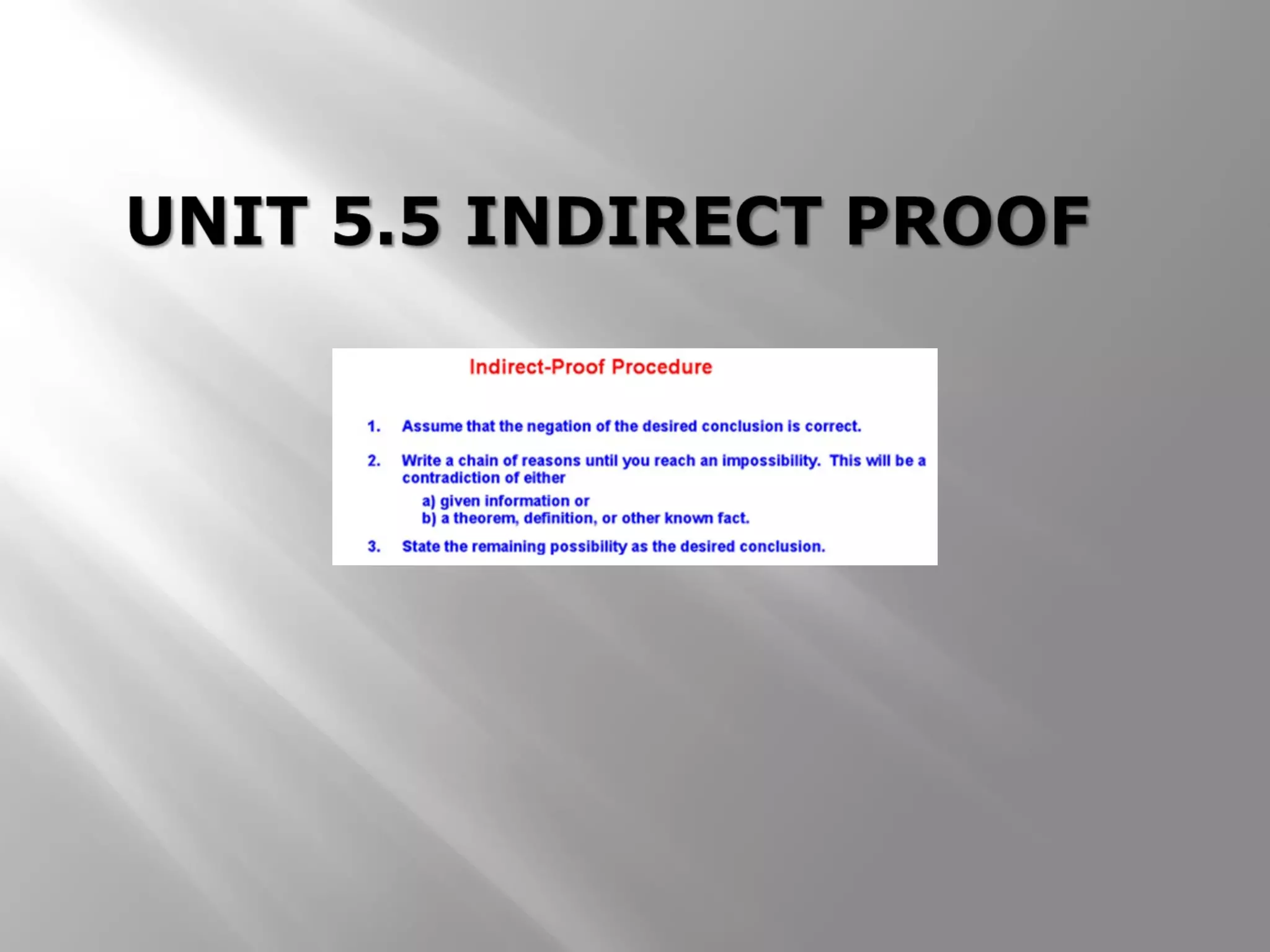
Step-1: Assume that the opposite of 
what you want to prove is true. 
Step-2: Use logical reasoning to reach a 
contradiction to the earlier statement, 
such as the given information or a 
theorem. Then state that the 
assumption you made was false. 
Step-3: State that what you wanted to 
prove must be true
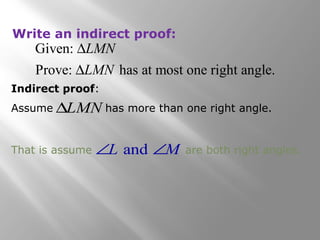
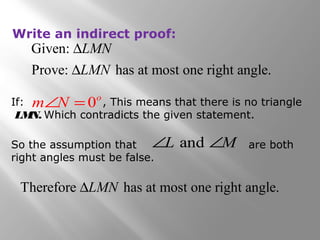
Write an indirect proof: 
LMN 
LMN 
D 
D 
DLMN 
Given: 
Prove: has at most one right angle. 
Indirect proof: 
Assume has more than one right angle. 
That is assume Ð L a n d Ð M are both right angles.
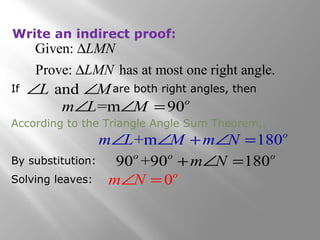
Write an indirect proof: 
LMN 
LMN 
D 
D 
Given: 
Prove: has at most one right angle. 
ÐL and ÐM 
If are both right angles, then 
mÐL=mÐM =90o 
According to the Triangle Angle Sum Theorem,. 
mÐL+mÐM +mÐN =180o 
By substitution: 90o+90o +mÐN =180o 
Solving leaves: mÐN =0o
Write an indirect proof: 
LMN 
LMN 
D 
D 
Given: 
Prove: has at most one right angle. 
mÐN =0o 
If: , This means that there is no triangle 
LMN. Which contradicts the given statement. 
ÐL and ÐM 
So the assumption that are both 
right angles must be false. 
Therefore DLMN has at most one right angle.
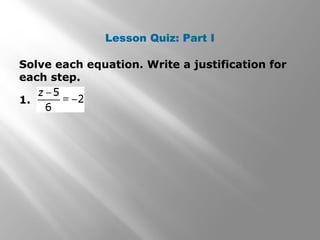
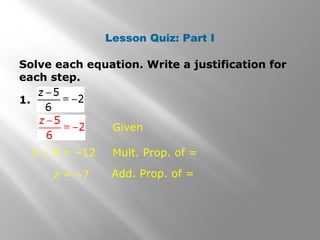
Lesson Quiz: Part I 
Solve each equation. Write a justification for 
each step. 
1.
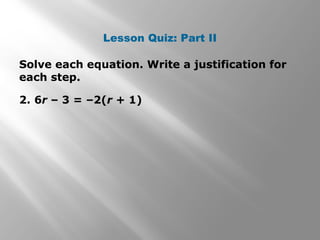
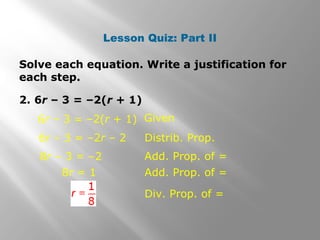
Lesson Quiz: Part II 
Solve each equation. Write a justification for 
each step. 
2. 6r – 3 = –2(r + 1)
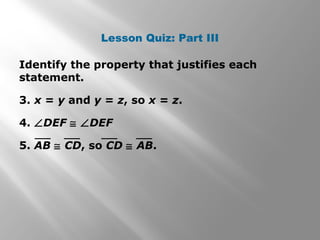
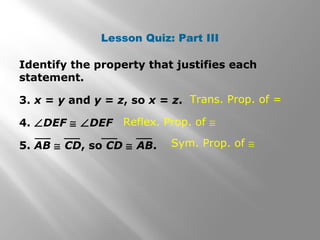
Lesson Quiz: Part III 
Identify the property that justifies each 
statement. 
3. x = y and y = z, so x = z. 
4. ÐDEF @ ÐDEF 
5. AB @ CD, so CD @ AB.
Lesson Quiz: Part I 
Solve each equation. Write a justification for 
each step. 
1. 
Given 
z – 5 = –12 Mult. Prop. of = 
z = –7 Add. Prop. of =
Lesson Quiz: Part II 
Solve each equation. Write a justification for 
each step. 
2. 6r – 3 = –2(r + 1) 
Given 
6r – 3 = –2r – 2 
8r – 3 = –2 
Distrib. Prop. 
Add. Prop. of = 
6r – 3 = –2(r + 1) 
8r = 1 Add. Prop. of = 
Div. Prop. of =
Lesson Quiz: Part III 
Identify the property that justifies each 
statement. 
3. x = y and y = z, so x = z. 
4. ÐDEF @ ÐDEF 
5. AB @ CD, so CD @ AB. 
Trans. Prop. of = 
Reflex. Prop. of @ 
Sym. Prop. of @
All rights belong to their 
respective owners. 
Copyright Disclaimer Under 
Section 107 of the Copyright 
Act 1976, allowance is made 
for "fair use" for purposes 
such as criticism, comment, 
news reporting, TEACHING, 
scholarship, and research. 
Fair use is a use permitted by 
copyright statute that might 
otherwise be infringing. 
Non-profit, EDUCATIONAL or 
personal use tips the balance 
in favor of fair use.

Geometry unit 5.5

  • 2.
    GEOMETRY 4-5 Usingindirect reasoning Warm Up Complete each sentence. 1. If the measures of two angles are _____, then the angles are congruent. 2. If two angles form a ________ , then they are supplementary. 3. If two angles are complementary to the same angle, then the two angles are ________ . equal linear pair congruent
  • 3.
    Writing a Two-ColumnProof from a Plan Use the given plan to write a two-column proof. Given: Ð1 and Ð2 are supplementary, and Ð1 @ Ð3 Prove: Ð3 and Ð2 are supplementary. Plan: Use the definitions of supplementary and congruent angles and substitution to show that mÐ3 + mÐ2 = 180°. By the definition of supplementary angles, Ð3 and Ð2 are supplementary.
  • 4.
    Writing a Two-ColumnProof : Continued Statements Reasons Ð1 and Ð2 are supplementary. Ð1 @ Ð3 1. 1. 2. 2. . 3. . 3. 4. 4. 5. 5. Given mÐ1 + mÐ2 = 180° Def. of supp. Ðs mÐ1 = mÐ3 mÐ3 + mÐ2 = 180° Ð3 and Ð2 are supplementary Def. of @ Ðs Subst. Def. of supp. Ðs
  • 5.
    TEACH! Writing aTwo-Column Proof Use the given plan to write a two-column proof if one case of Congruent Complements Theorem. Given: Ð1 and Ð2 are complementary, and Ð2 and Ð3 are complementary. Prove: Ð1 @ Ð3 Plan: The measures of complementary angles add to 90° by definition. Use substitution to show that the sums of both pairs are equal. Use the Subtraction Property and the definition of congruent angles to conclude that Ð1 @ Ð3.
  • 6.
    TEACH! Continued StatementsReasons Ð1 and Ð2 are complementary. Ð2 and Ð3 are complementary. 1. 1. 2. 2. . 3. . 3. 4. 4. 5. 5. 6. 6. Given mÐ1 + mÐ2 = 90° mÐ2 + mÐ3 = 90° Def. of comp. Ðs mÐ1 + mÐ2 = mÐ2 + mÐ3 mÐ2 = mÐ2 mÐ1 = mÐ3 Subst. Reflex. Prop. of = Subtr. Prop. of = Ð1 @ Ð3 Def. of @ Ðs
  • 7.
    Use indirect reasoningto prove: If Jacky spends more than $50 to buy two items at a bicycle shop, then at least one of the items costs more than $25. Given: the cost of two items is more than $50. Prove: At least one of the items costs more than $25. Begin by assuming that the opposite is true. That is assume that neither item costs more than $25.
  • 8.
    Use indirect reasoningto prove: If Jacky spends more than $50 to buy two items at a bicycle shop, then at least one of the items costs more than $25. Given: the cost of two items is more than $50. Prove: At least one of the items costs more Btheagnin $ b2y5 .assuming that the opposite is true. That is assume that neither item costs more tThhains m$2e5a.ns that both items cost $25 or less. This means that the two items together cost $50 or less. This contradicts the given information that the amount spent is more than $50. So the assumption that neither items cost more than $25 must be incorrect.
  • 9.
    Use indirect reasoningto prove: If Jacky spends more than $50 to buy two items at a bicycle shop, then at least one of the items costs more than $25. Therefore, at least one of the items costs more than $25. This means that both items cost $25 or less. This means that the two items together cost $50 or less. This contradicts the given information that the amount spent is more than $50. So the assumption that neither items cost more than $25 must be incorrect.
  • 10.
    Writing an indirectproof Step-1: Assume that the opposite of what you want to prove is true. Step-2: Use logical reasoning to reach a contradiction to the earlier statement, such as the given information or a theorem. Then state that the assumption you made was false. Step-3: State that what you wanted to prove must be true
  • 11.
    Write an indirectproof: LMN LMN D D DLMN Given: Prove: has at most one right angle. Indirect proof: Assume has more than one right angle. That is assume Ð L a n d Ð M are both right angles.
  • 12.
    Write an indirectproof: LMN LMN D D Given: Prove: has at most one right angle. ÐL and ÐM If are both right angles, then mÐL=mÐM =90o According to the Triangle Angle Sum Theorem,. mÐL+mÐM +mÐN =180o By substitution: 90o+90o +mÐN =180o Solving leaves: mÐN =0o
  • 13.
    Write an indirectproof: LMN LMN D D Given: Prove: has at most one right angle. mÐN =0o If: , This means that there is no triangle LMN. Which contradicts the given statement. ÐL and ÐM So the assumption that are both right angles must be false. Therefore DLMN has at most one right angle.
  • 14.
    Lesson Quiz: PartI Solve each equation. Write a justification for each step. 1.
  • 15.
    Lesson Quiz: PartII Solve each equation. Write a justification for each step. 2. 6r – 3 = –2(r + 1)
  • 16.
    Lesson Quiz: PartIII Identify the property that justifies each statement. 3. x = y and y = z, so x = z. 4. ÐDEF @ ÐDEF 5. AB @ CD, so CD @ AB.
  • 17.
    Lesson Quiz: PartI Solve each equation. Write a justification for each step. 1. Given z – 5 = –12 Mult. Prop. of = z = –7 Add. Prop. of =
  • 18.
    Lesson Quiz: PartII Solve each equation. Write a justification for each step. 2. 6r – 3 = –2(r + 1) Given 6r – 3 = –2r – 2 8r – 3 = –2 Distrib. Prop. Add. Prop. of = 6r – 3 = –2(r + 1) 8r = 1 Add. Prop. of = Div. Prop. of =
  • 19.
    Lesson Quiz: PartIII Identify the property that justifies each statement. 3. x = y and y = z, so x = z. 4. ÐDEF @ ÐDEF 5. AB @ CD, so CD @ AB. Trans. Prop. of = Reflex. Prop. of @ Sym. Prop. of @
  • 20.
    All rights belongto their respective owners. Copyright Disclaimer Under Section 107 of the Copyright Act 1976, allowance is made for "fair use" for purposes such as criticism, comment, news reporting, TEACHING, scholarship, and research. Fair use is a use permitted by copyright statute that might otherwise be infringing. Non-profit, EDUCATIONAL or personal use tips the balance in favor of fair use.