Congruent Triangle Proofs
The student is able to (I can):
• Determine what additional information is needed to prove
two triangles congruent by a given theorem
• Create two-column proofs to show that two triangles are
congruent
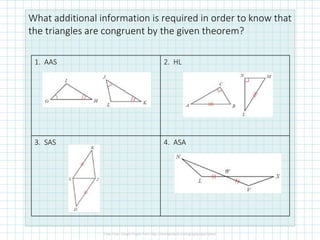
What additional information is required in order to know that
the triangles are congruent by the given theorem?
1. AAS 2. HL
3. SAS 4. ASA
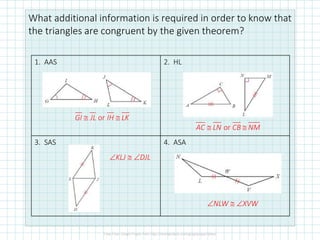
What additional information is required in order to know that
the triangles are congruent by the given theorem?
1. AAS 2. HL
3. SAS 4. ASA
orGI JL IH LK≅ ≅
orAC LN CB NM≅ ≅
∠KLJ ≅ ∠DJL
∠NLW ≅ ∠XVW
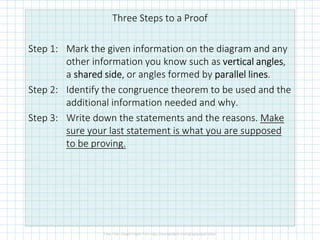
When you are creating a proof, you list the information that
you are given, list any other information you can deduce, and
then whatever it is you are trying to prove.
It is equally important that you give reasons for each step
that you list, whether you are listing given information or
information you have deduced using theorems and
postulates.
While congruent triangle proofs can be a little challenging, I
have a basic three-step method that I use to set them up.
Three Steps to a Proof
Step 1: Mark the given information on the diagram and any
other information you know such as verticalverticalverticalvertical anglesanglesanglesangles,
a sharedsharedsharedshared sidesidesideside, or angles formed by parallel linesparallel linesparallel linesparallel lines.
Step 2: Identify the congruence theorem to be used and the
additional information needed and why.
Step 3: Write down the statements and the reasons. Make
sure your last statement is what you are supposed
to be proving.
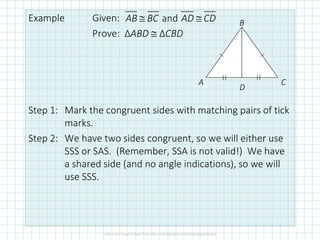
Example Given:
Prove: ΔABD ≅ ΔCBD
Step 1: Mark the congruent sides with matching pairs of tick
marks.
≅ ≅andAB BC AD CD
A
B
C
D
Example Given:
Prove: ΔABD ≅ ΔCBD
Step 1: Mark the congruent sides with matching pairs of tick
marks.
Step 2: We have two sides congruent, so we will either use
SSS or SAS. (Remember, SSA is not valid!) We have
a shared side (and no angle indications), so we will
use SSS.
andAB BC AD CD≅ ≅
A
B
C
D
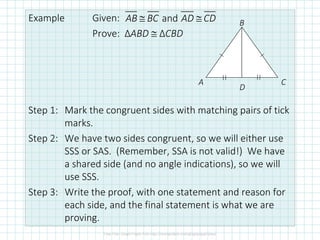
Example Given:
Prove: ΔABD ≅ ΔCBD
Step 1: Mark the congruent sides with matching pairs of tick
marks.
Step 2: We have two sides congruent, so we will either use
SSS or SAS. (Remember, SSA is not valid!) We have
a shared side (and no angle indications), so we will
use SSS.
Step 3: Write the proof, with one statement and reason for
each side, and the final statement is what we are
proving.
andAB BC AD CD≅ ≅
A
B
C
D
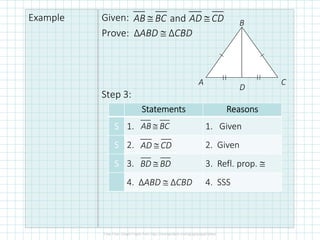
Example Given:
Prove: ΔABD ≅ ΔCBD
Step 3:
andAB BC AD CD≅ ≅
A
B
C
D
StatementsStatementsStatementsStatements ReasonsReasonsReasonsReasons
SSSS 1. 1. Given
SSSS 2. 2. Given
SSSS 3. 3. Refl. prop. ≅
4. ΔABD ≅ ΔCBD 4. SSS
AB BC≅
AD CD≅
BD BD≅
Remember, any definition, theorem, or postulate we have
worked with this year is fair game on a proof, but here are
the most common ones we will use:
• Reflexive property of congruence (Refl. prop. ≅)
(Use on shared sides or shared angles)
• Vertical angles theorem (Vert. ∠s ≅)
• Midpoint theorem (Midpt. thm)
• Segment and/or angle bisectors
• Any of the parallel line theorems
– Corresponding angles (Corr. ∠s ≅)
– Alternate interior angles (Alt. int. ∠s ≅)
– Alternate exterior angles (Alt.ext. ∠s ≅)

5.3 Congruent Triangle Proofs

  • 1.
    Congruent Triangle Proofs Thestudent is able to (I can): • Determine what additional information is needed to prove two triangles congruent by a given theorem • Create two-column proofs to show that two triangles are congruent
  • 2.
    What additional informationis required in order to know that the triangles are congruent by the given theorem? 1. AAS 2. HL 3. SAS 4. ASA
  • 3.
    What additional informationis required in order to know that the triangles are congruent by the given theorem? 1. AAS 2. HL 3. SAS 4. ASA orGI JL IH LK≅ ≅ orAC LN CB NM≅ ≅ ∠KLJ ≅ ∠DJL ∠NLW ≅ ∠XVW
  • 4.
    When you arecreating a proof, you list the information that you are given, list any other information you can deduce, and then whatever it is you are trying to prove. It is equally important that you give reasons for each step that you list, whether you are listing given information or information you have deduced using theorems and postulates. While congruent triangle proofs can be a little challenging, I have a basic three-step method that I use to set them up.
  • 5.
    Three Steps toa Proof Step 1: Mark the given information on the diagram and any other information you know such as verticalverticalverticalvertical anglesanglesanglesangles, a sharedsharedsharedshared sidesidesideside, or angles formed by parallel linesparallel linesparallel linesparallel lines. Step 2: Identify the congruence theorem to be used and the additional information needed and why. Step 3: Write down the statements and the reasons. Make sure your last statement is what you are supposed to be proving.
  • 6.
    Example Given: Prove: ΔABD≅ ΔCBD Step 1: Mark the congruent sides with matching pairs of tick marks. ≅ ≅andAB BC AD CD A B C D
  • 7.
    Example Given: Prove: ΔABD≅ ΔCBD Step 1: Mark the congruent sides with matching pairs of tick marks. Step 2: We have two sides congruent, so we will either use SSS or SAS. (Remember, SSA is not valid!) We have a shared side (and no angle indications), so we will use SSS. andAB BC AD CD≅ ≅ A B C D
  • 8.
    Example Given: Prove: ΔABD≅ ΔCBD Step 1: Mark the congruent sides with matching pairs of tick marks. Step 2: We have two sides congruent, so we will either use SSS or SAS. (Remember, SSA is not valid!) We have a shared side (and no angle indications), so we will use SSS. Step 3: Write the proof, with one statement and reason for each side, and the final statement is what we are proving. andAB BC AD CD≅ ≅ A B C D
  • 9.
    Example Given: Prove: ΔABD≅ ΔCBD Step 3: andAB BC AD CD≅ ≅ A B C D StatementsStatementsStatementsStatements ReasonsReasonsReasonsReasons SSSS 1. 1. Given SSSS 2. 2. Given SSSS 3. 3. Refl. prop. ≅ 4. ΔABD ≅ ΔCBD 4. SSS AB BC≅ AD CD≅ BD BD≅
  • 10.
    Remember, any definition,theorem, or postulate we have worked with this year is fair game on a proof, but here are the most common ones we will use: • Reflexive property of congruence (Refl. prop. ≅) (Use on shared sides or shared angles) • Vertical angles theorem (Vert. ∠s ≅) • Midpoint theorem (Midpt. thm) • Segment and/or angle bisectors • Any of the parallel line theorems – Corresponding angles (Corr. ∠s ≅) – Alternate interior angles (Alt. int. ∠s ≅) – Alternate exterior angles (Alt.ext. ∠s ≅)