
Algebraic properties of equality are used in 
Geometry. 
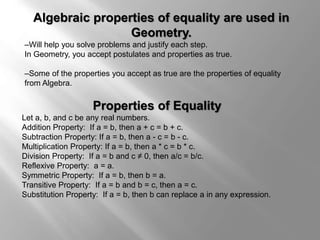
–Will help you solve problems and justify each step. 
In Geometry, you accept postulates and properties as true. 
–Some of the properties you accept as true are the properties of equality 
from Algebra. 
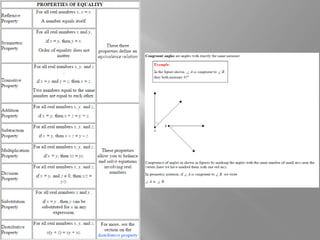
Properties of Equality 
Let a, b, and c be any real numbers. 
Addition Property: If a = b, then a + c = b + c. 
Subtraction Property: If a = b, then a - c = b - c. 
Multiplication Property: If a = b, then a * c = b * c. 
Division Property: If a = b and c ≠ 0, then a/c = b/c. 
Reflexive Property: a = a. 
Symmetric Property: If a = b, then b = a. 
Transitive Property: If a = b and b = c, then a = c. 
Substitution Property: If a = b, then b can replace a in any expression.
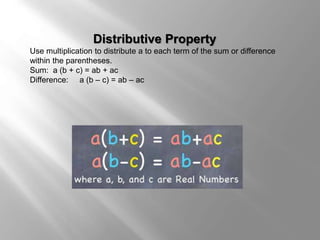
Distributive Property 
Use multiplication to distribute a to each term of the sum or difference 
within the parentheses. 
Sum: a (b + c) = ab + ac 
Difference: a (b – c) = ab – ac
Properties of Congruence 
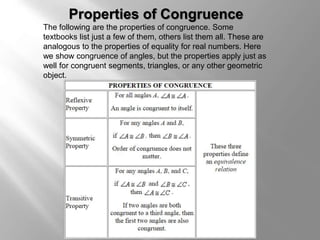
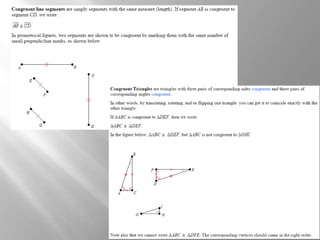
The following are the properties of congruence. Some 
textbooks list just a few of them, others list them all. These are 
analogous to the properties of equality for real numbers. Here 
we show congruence of angles, but the properties apply just as 
well for congruent segments, triangles, or any other geometric 
object.
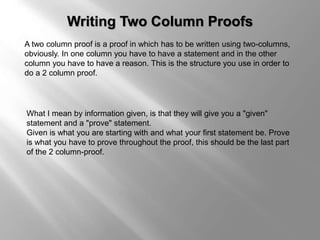
Writing Two Column Proofs 
A two column proof is a proof in which has to be written using two-columns, 
obviously. In one column you have to have a statement and in the other 
column you have to have a reason. This is the structure you use in order to 
do a 2 column proof. 
What I mean by information given, is that they will give you a "given" 
statement and a "prove" statement. 
Given is what you are starting with and what your first statement be. Prove 
is what you have to prove throughout the proof, this should be the last part 
of the 2 column-proof.
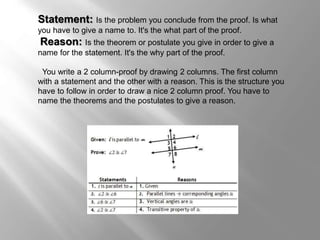
Statement: Is the problem you conclude from the proof. Is what 
you have to give a name to. It's the what part of the proof. 
Reason: Is the theorem or postulate you give in order to give a 
name for the statement. It's the why part of the proof. 
You write a 2 column-proof by drawing 2 columns. The first column 
with a statement and the other with a reason. This is the structure you 
have to follow in order to draw a nice 2 column proof. You have to 
name the theorems and the postulates to give a reason.
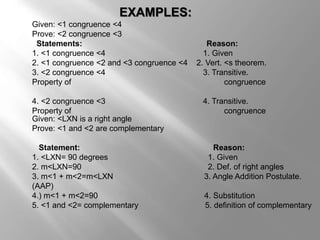
EXAMPLES: 
Given: <1 congruence <4 
Prove: <2 congruence <3 
Statements: Reason: 
1. <1 congruence <4 1. Given 
2. <1 congruence <2 and <3 congruence <4 2. Vert. <s theorem. 
3. <2 congruence <4 3. Transitive. 
Property of congruence 
4. <2 congruence <3 4. Transitive. 
Property of congruence 
Given: <LXN is a right angle 
Prove: <1 and <2 are complementary 
Statement: Reason: 
1. <LXN= 90 degrees 1. Given 
2. m<LXN=90 2. Def. of right angles 
3. m<1 + m<2=m<LXN 3. Angle Addition Postulate. 
(AAP) 
4.) m<1 + m<2=90 4. Substitution 
5. <1 and <2= complementary 5. definition of complementary
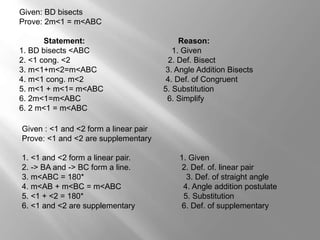
Given: BD bisects 
Prove: 2m<1 = m<ABC 
Statement: Reason: 
1. BD bisects <ABC 1. Given 
2. <1 cong. <2 2. Def. Bisect 
3. m<1+m<2=m<ABC 3. Angle Addition Bisects 
4. m<1 cong. m<2 4. Def. of Congruent 
5. m<1 + m<1= m<ABC 5. Substitution 
6. 2m<1=m<ABC 6. Simplify 
6. 2 m<1 = m<ABC 
Given : <1 and <2 form a linear pair 
Prove: <1 and <2 are supplementary 
1. <1 and <2 form a linear pair. 1. Given 
2. -> BA and -> BC form a line. 2. Def. of. linear pair 
3. m<ABC = 180* 3. Def. of straight angle 
4. m<AB + m<BC = m<ABC 4. Angle addition postulate 
5. <1 + <2 = 180* 5. Substitution 
6. <1 and <2 are supplementary 6. Def. of supplementary
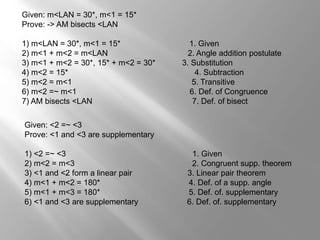
Given: m<LAN = 30*, m<1 = 15* 
Prove: -> AM bisects <LAN 
1) m<LAN = 30*, m<1 = 15* 1. Given 
2) m<1 + m<2 = m<LAN 2. Angle addition postulate 
3) m<1 + m<2 = 30*, 15* + m<2 = 30* 3. Substitution 
4) m<2 = 15* 4. Subtraction 
5) m<2 = m<1 5. Transitive 
6) m<2 =~ m<1 6. Def. of Congruence 
7) AM bisects <LAN 7. Def. of bisect 
Given: <2 =~ <3 
Prove: <1 and <3 are supplementary 
1) <2 =~ <3 1. Given 
2) m<2 = m<3 2. Congruent supp. theorem 
3) <1 and <2 form a linear pair 3. Linear pair theorem 
4) m<1 + m<2 = 180* 4. Def. of a supp. angle 
5) m<1 + m<3 = 180* 5. Def. of. supplementary 
6) <1 and <3 are supplementary 6. Def. of. supplementary
All rights belong to their respective owners. 
Copyright Disclaimer Under Section 107 of the Copyright Act 1976, 
allowance is made for "fair use" for purposes such as criticism, comment, 
news reporting, TEACHING, scholarship, and research. 
Fair use is a use permitted by copyright statute that might otherwise be 
infringing. 
Non-profit, EDUCATIONAL or personal use tips the balance in favor of 
fair use.

Geometry unit 2.5.ppt

  • 2.
    Algebraic properties ofequality are used in Geometry. –Will help you solve problems and justify each step. In Geometry, you accept postulates and properties as true. –Some of the properties you accept as true are the properties of equality from Algebra. Properties of Equality Let a, b, and c be any real numbers. Addition Property: If a = b, then a + c = b + c. Subtraction Property: If a = b, then a - c = b - c. Multiplication Property: If a = b, then a * c = b * c. Division Property: If a = b and c ≠ 0, then a/c = b/c. Reflexive Property: a = a. Symmetric Property: If a = b, then b = a. Transitive Property: If a = b and b = c, then a = c. Substitution Property: If a = b, then b can replace a in any expression.
  • 3.
    Distributive Property Usemultiplication to distribute a to each term of the sum or difference within the parentheses. Sum: a (b + c) = ab + ac Difference: a (b – c) = ab – ac
  • 4.
    Properties of Congruence The following are the properties of congruence. Some textbooks list just a few of them, others list them all. These are analogous to the properties of equality for real numbers. Here we show congruence of angles, but the properties apply just as well for congruent segments, triangles, or any other geometric object.
  • 7.
    Writing Two ColumnProofs A two column proof is a proof in which has to be written using two-columns, obviously. In one column you have to have a statement and in the other column you have to have a reason. This is the structure you use in order to do a 2 column proof. What I mean by information given, is that they will give you a "given" statement and a "prove" statement. Given is what you are starting with and what your first statement be. Prove is what you have to prove throughout the proof, this should be the last part of the 2 column-proof.
  • 8.
    Statement: Is theproblem you conclude from the proof. Is what you have to give a name to. It's the what part of the proof. Reason: Is the theorem or postulate you give in order to give a name for the statement. It's the why part of the proof. You write a 2 column-proof by drawing 2 columns. The first column with a statement and the other with a reason. This is the structure you have to follow in order to draw a nice 2 column proof. You have to name the theorems and the postulates to give a reason.
  • 9.
    EXAMPLES: Given: <1congruence <4 Prove: <2 congruence <3 Statements: Reason: 1. <1 congruence <4 1. Given 2. <1 congruence <2 and <3 congruence <4 2. Vert. <s theorem. 3. <2 congruence <4 3. Transitive. Property of congruence 4. <2 congruence <3 4. Transitive. Property of congruence Given: <LXN is a right angle Prove: <1 and <2 are complementary Statement: Reason: 1. <LXN= 90 degrees 1. Given 2. m<LXN=90 2. Def. of right angles 3. m<1 + m<2=m<LXN 3. Angle Addition Postulate. (AAP) 4.) m<1 + m<2=90 4. Substitution 5. <1 and <2= complementary 5. definition of complementary
  • 10.
    Given: BD bisects Prove: 2m<1 = m<ABC Statement: Reason: 1. BD bisects <ABC 1. Given 2. <1 cong. <2 2. Def. Bisect 3. m<1+m<2=m<ABC 3. Angle Addition Bisects 4. m<1 cong. m<2 4. Def. of Congruent 5. m<1 + m<1= m<ABC 5. Substitution 6. 2m<1=m<ABC 6. Simplify 6. 2 m<1 = m<ABC Given : <1 and <2 form a linear pair Prove: <1 and <2 are supplementary 1. <1 and <2 form a linear pair. 1. Given 2. -> BA and -> BC form a line. 2. Def. of. linear pair 3. m<ABC = 180* 3. Def. of straight angle 4. m<AB + m<BC = m<ABC 4. Angle addition postulate 5. <1 + <2 = 180* 5. Substitution 6. <1 and <2 are supplementary 6. Def. of supplementary
  • 11.
    Given: m<LAN =30*, m<1 = 15* Prove: -> AM bisects <LAN 1) m<LAN = 30*, m<1 = 15* 1. Given 2) m<1 + m<2 = m<LAN 2. Angle addition postulate 3) m<1 + m<2 = 30*, 15* + m<2 = 30* 3. Substitution 4) m<2 = 15* 4. Subtraction 5) m<2 = m<1 5. Transitive 6) m<2 =~ m<1 6. Def. of Congruence 7) AM bisects <LAN 7. Def. of bisect Given: <2 =~ <3 Prove: <1 and <3 are supplementary 1) <2 =~ <3 1. Given 2) m<2 = m<3 2. Congruent supp. theorem 3) <1 and <2 form a linear pair 3. Linear pair theorem 4) m<1 + m<2 = 180* 4. Def. of a supp. angle 5) m<1 + m<3 = 180* 5. Def. of. supplementary 6) <1 and <3 are supplementary 6. Def. of. supplementary
  • 12.
    All rights belongto their respective owners. Copyright Disclaimer Under Section 107 of the Copyright Act 1976, allowance is made for "fair use" for purposes such as criticism, comment, news reporting, TEACHING, scholarship, and research. Fair use is a use permitted by copyright statute that might otherwise be infringing. Non-profit, EDUCATIONAL or personal use tips the balance in favor of fair use.