Section 2-6
ProvingAngle Relationships
Essential Questions
How do you write proofs involving supplementary and
complementary angles?
How do you write proofs involving congruent and
right angles?
More Postulates and Theorems
Protractor Postulate:
AngleAddition Postulate:
Supplement Theorem:
More Postulates and Theorems
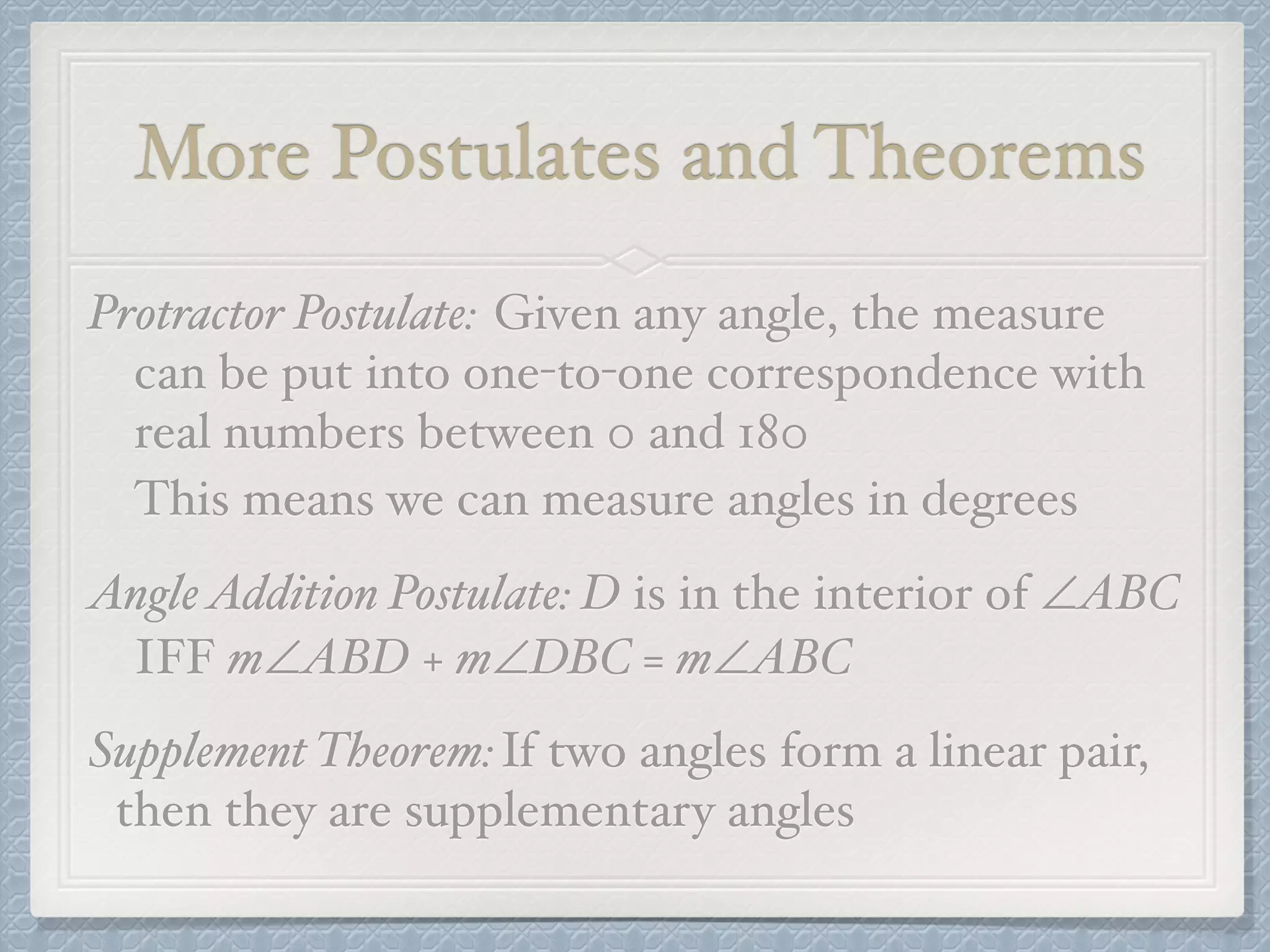
Protractor Postulate: Given any angle, the measure
can be put into one-to-one correspondence with
real numbers between 0 and 180
AngleAddition Postulate:
Supplement Theorem:
More Postulates and Theorems
Protractor Postulate: Given any angle, the measure
can be put into one-to-one correspondence with
real numbers between 0 and 180
This means we can measure angles in degrees
AngleAddition Postulate:
Supplement Theorem:
More Postulates and Theorems
Protractor Postulate: Given any angle, the measure
can be put into one-to-one correspondence with
real numbers between 0 and 180
This means we can measure angles in degrees
AngleAddition Postulate: D is in the interior of ∠ABC
IFF m∠ABD + m∠DBC = m∠ABC
Supplement Theorem:
More Postulates and Theorems
Protractor Postulate: Given any angle, the measure
can be put into one-to-one correspondence with
real numbers between 0 and 180
This means we can measure angles in degrees
AngleAddition Postulate: D is in the interior of ∠ABC
IFF m∠ABD + m∠DBC = m∠ABC
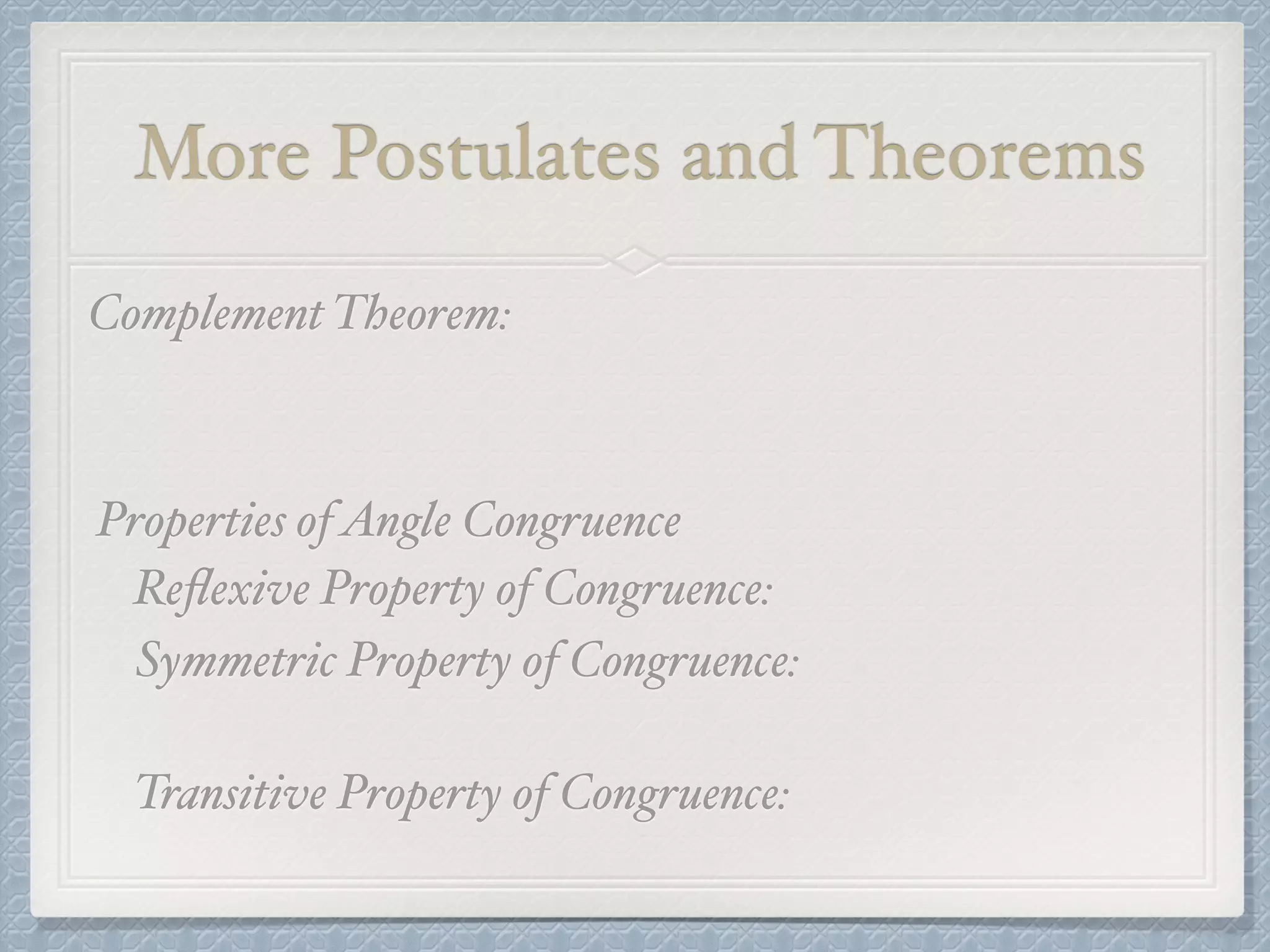
Supplement Theorem:If two angles form a linear pair,
then they are supplementary angles
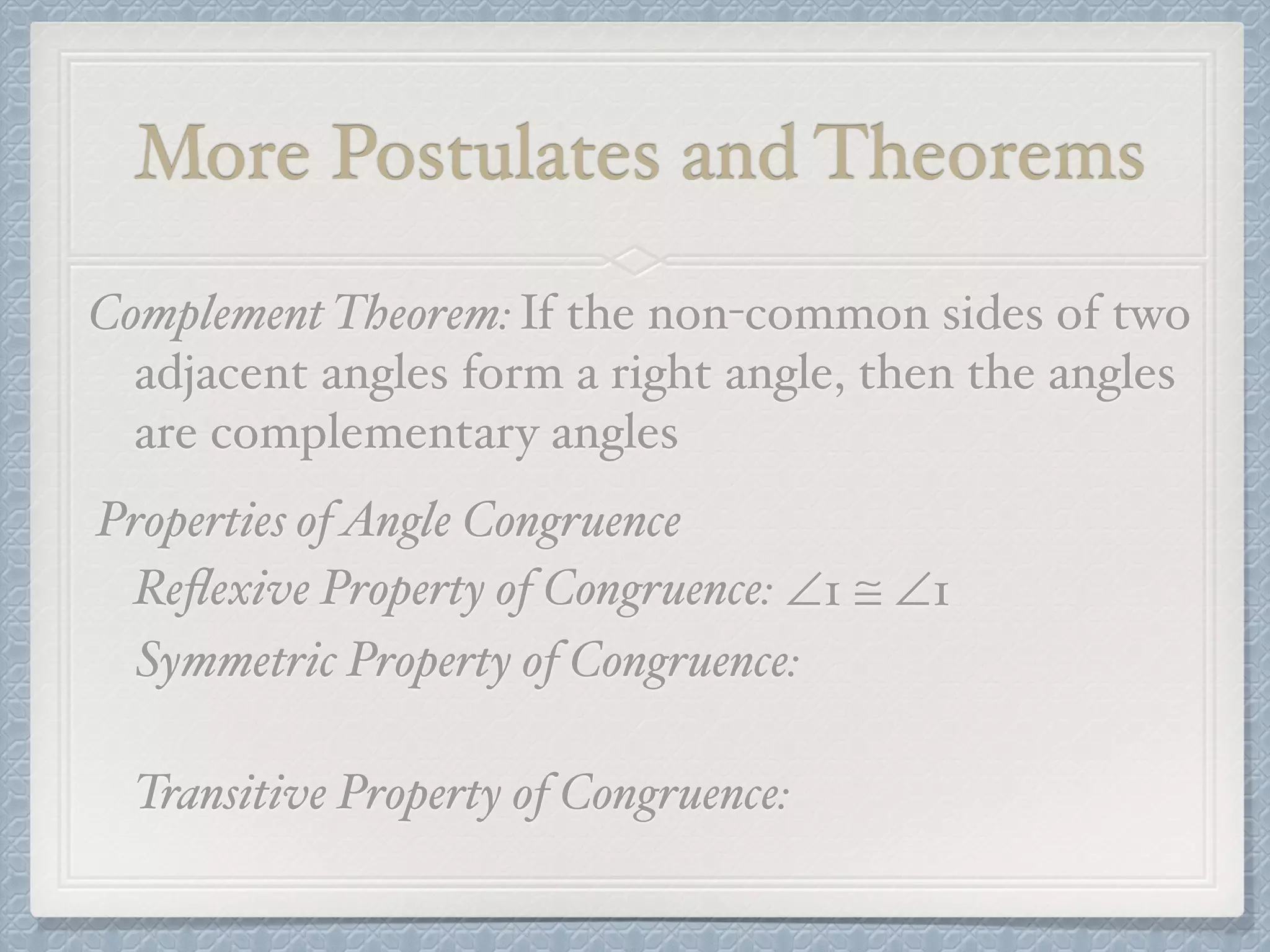
More Postulates and Theorems
Complement Theorem:
Properties ofAngle Congruence
Reflexive Property of Congruence:
Symmetric Property of Congruence:
Transitive Property of Congruence:
More Postulates and Theorems
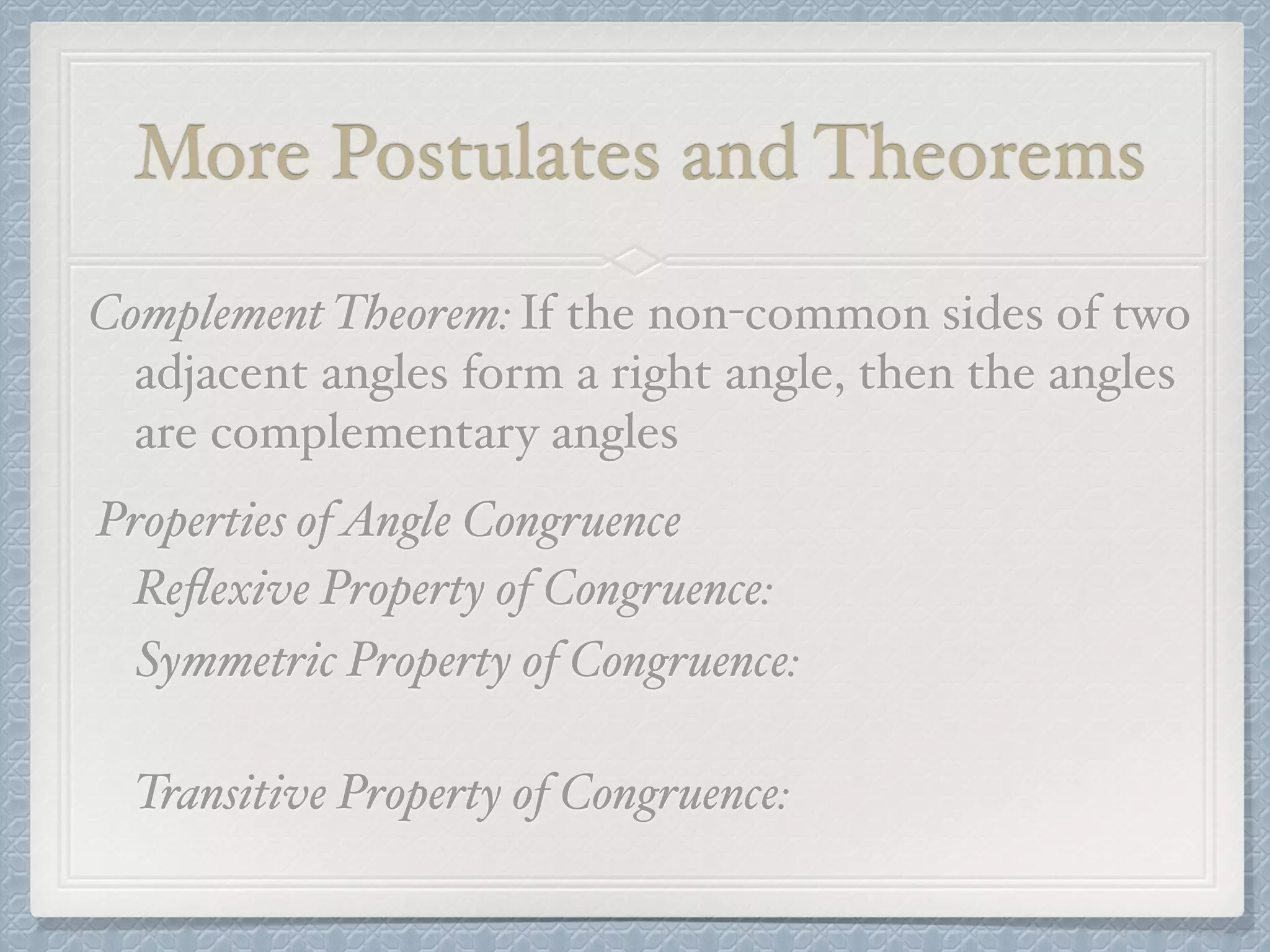
Complement Theorem:If the non-common sides of two
adjacent angles form a right angle, then the angles
are complementary angles
Properties ofAngle Congruence
Reflexive Property of Congruence:
Symmetric Property of Congruence:
Transitive Property of Congruence:
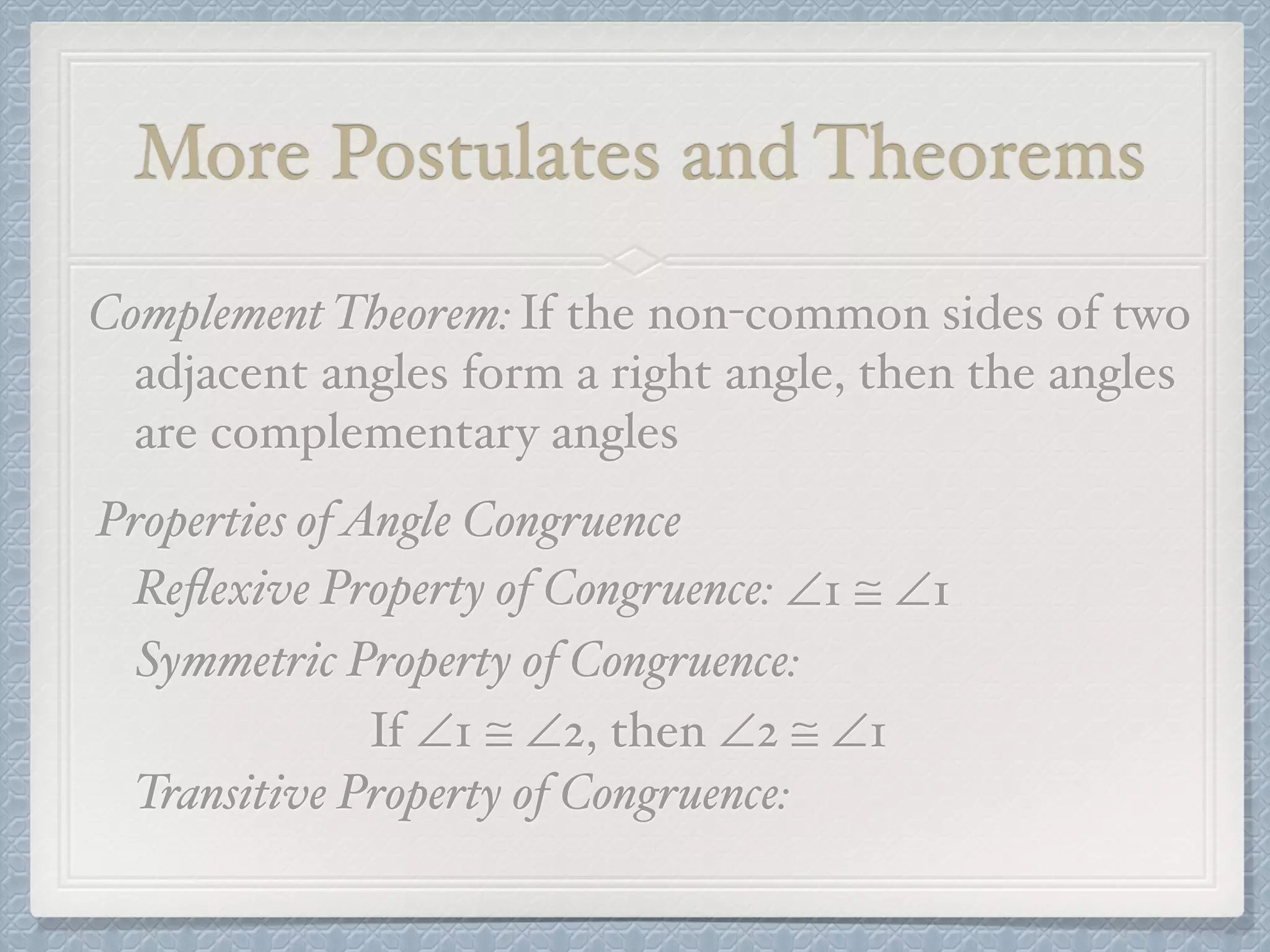
More Postulates and Theorems
Complement Theorem:If the non-common sides of two
adjacent angles form a right angle, then the angles
are complementary angles
Properties ofAngle Congruence
Reflexive Property of Congruence: ∠1 ≅ ∠1
Symmetric Property of Congruence:
Transitive Property of Congruence:
More Postulates and Theorems
Complement Theorem:If the non-common sides of two
adjacent angles form a right angle, then the angles
are complementary angles
Properties ofAngle Congruence
Reflexive Property of Congruence: ∠1 ≅ ∠1
Symmetric Property of Congruence:
If ∠1 ≅ ∠2, then ∠2 ≅ ∠1
Transitive Property of Congruence:
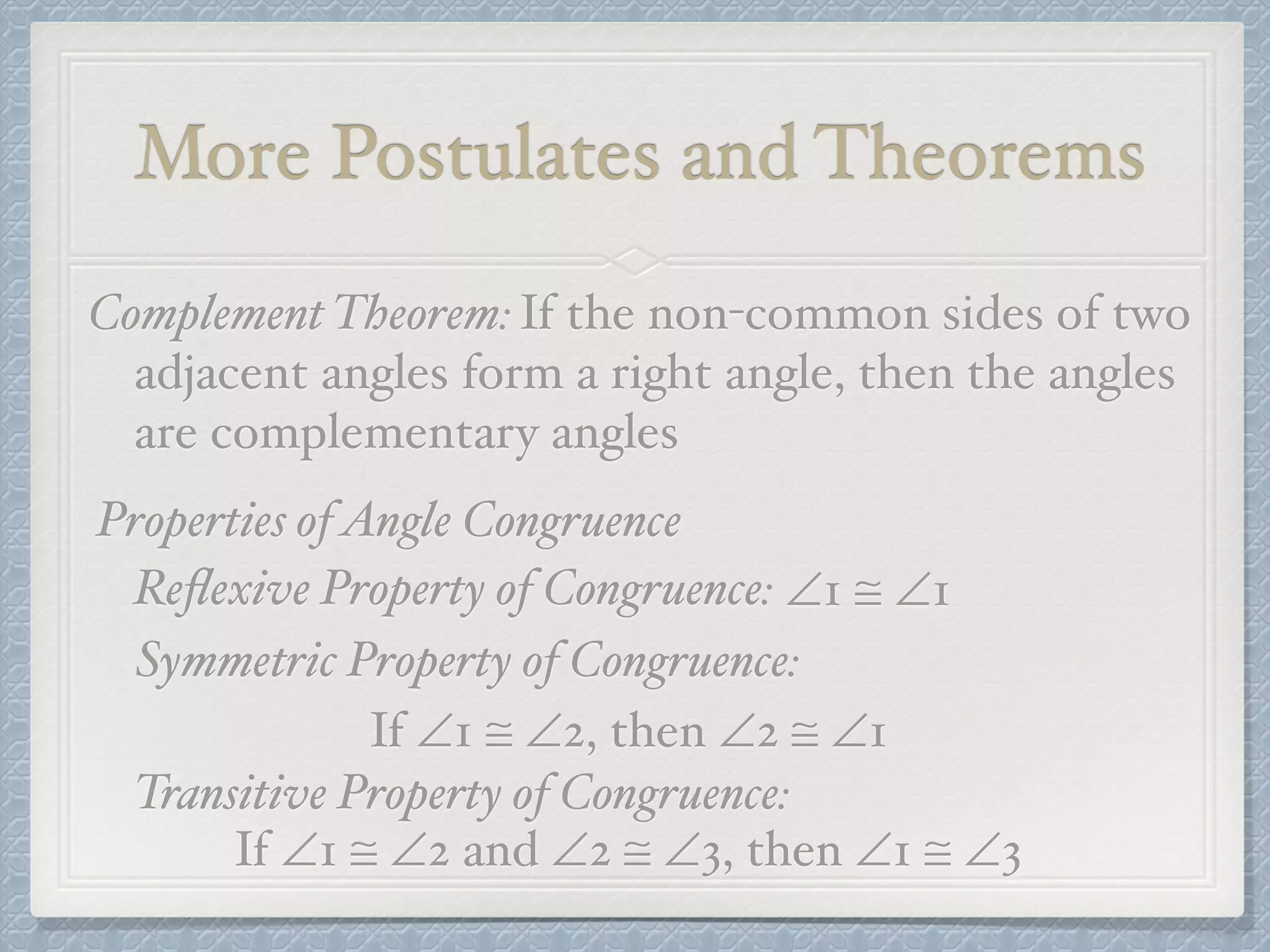
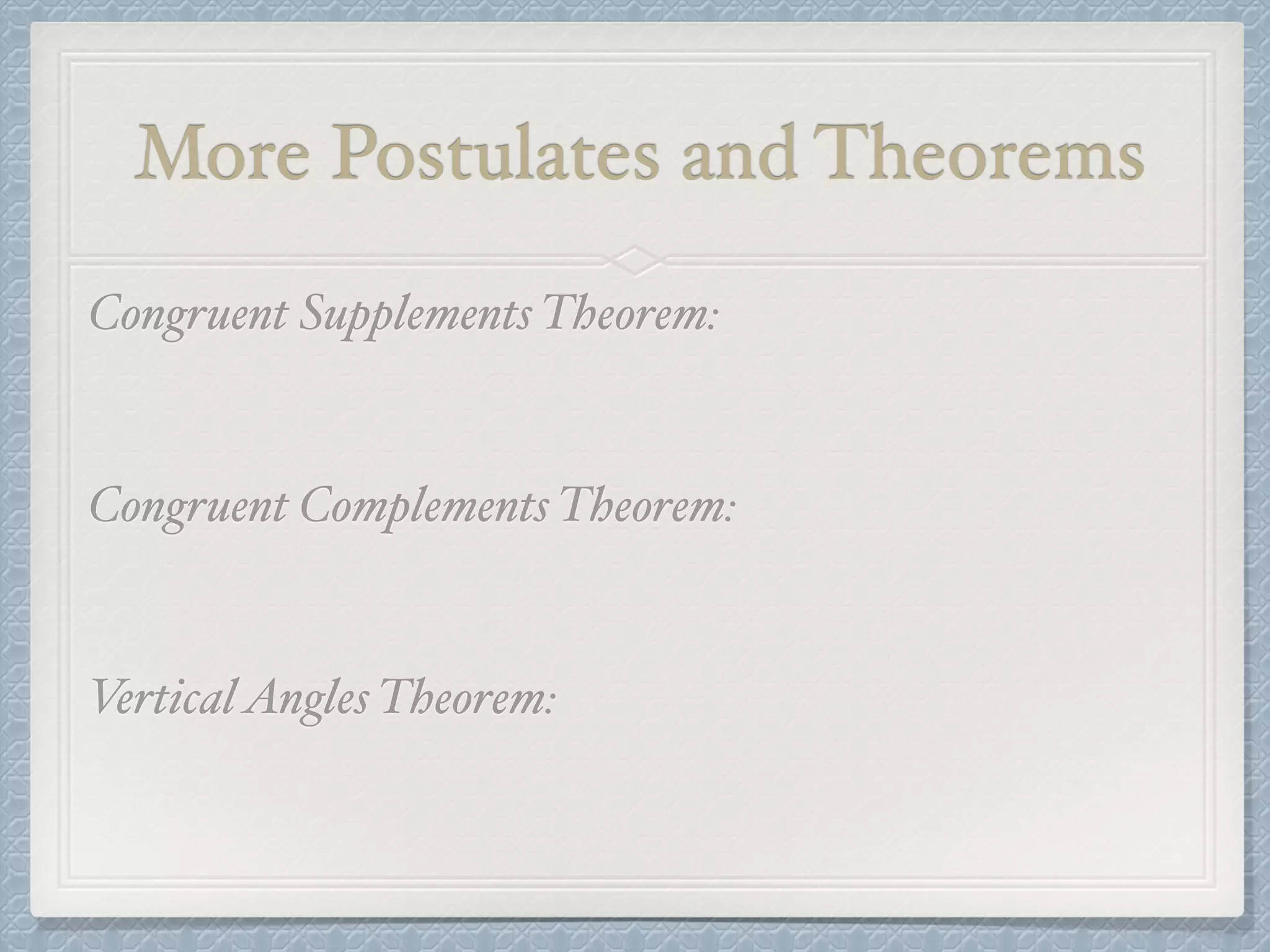
More Postulates and Theorems
Complement Theorem:If the non-common sides of two
adjacent angles form a right angle, then the angles
are complementary angles
Properties ofAngle Congruence
Reflexive Property of Congruence: ∠1 ≅ ∠1
Symmetric Property of Congruence:
If ∠1 ≅ ∠2, then ∠2 ≅ ∠1
Transitive Property of Congruence:
If ∠1 ≅ ∠2 and ∠2 ≅ ∠3, then ∠1 ≅ ∠3
More Postulates and Theorems
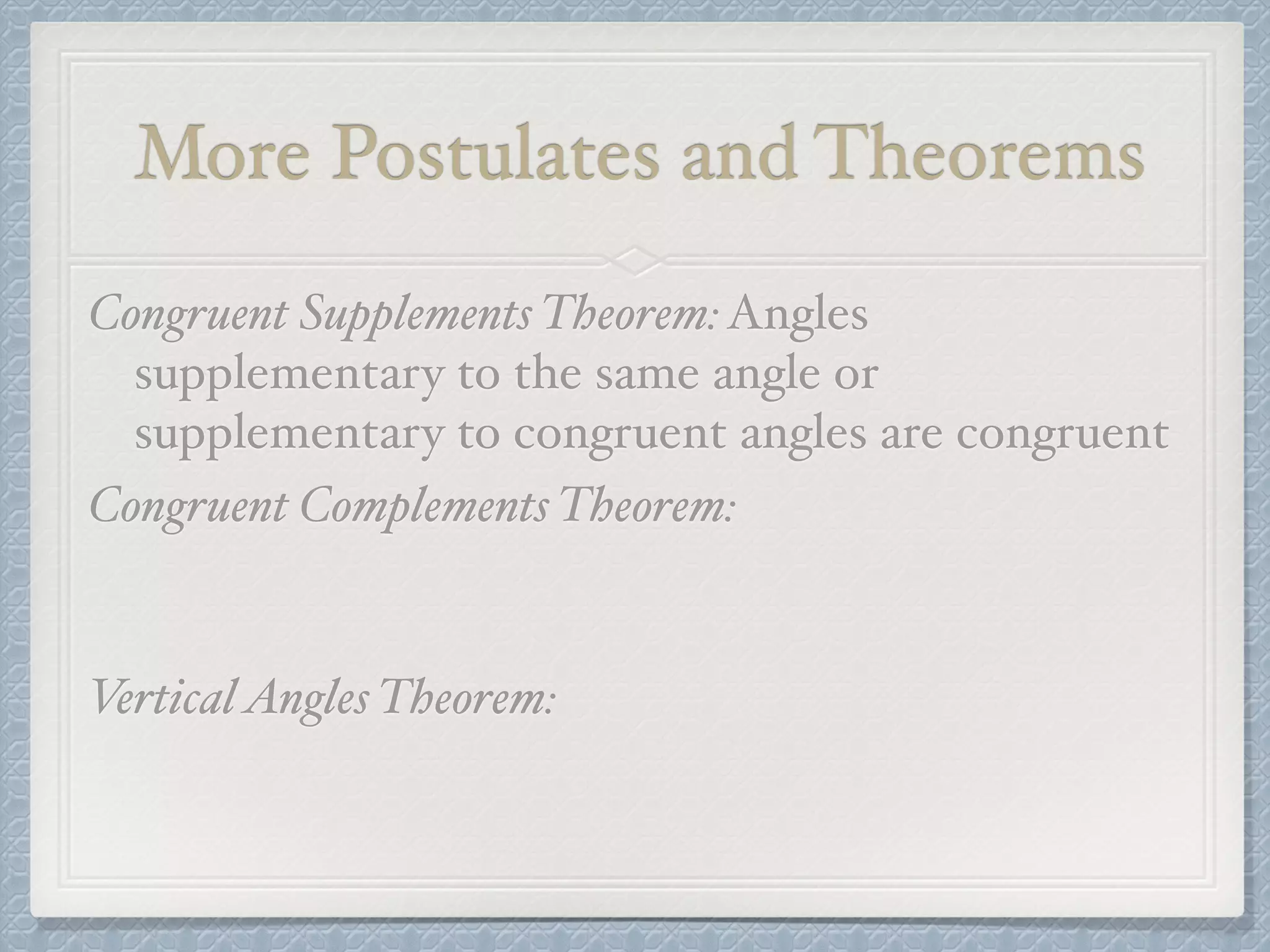
Congruent Supplements Theorem:
Congruent Complements Theorem:
VerticalAngles Theorem:
More Postulates and Theorems
Congruent Supplements Theorem:Angles
supplementary to the same angle or
supplementary to congruent angles are congruent
Congruent Complements Theorem:
VerticalAngles Theorem:
More Postulates and Theorems
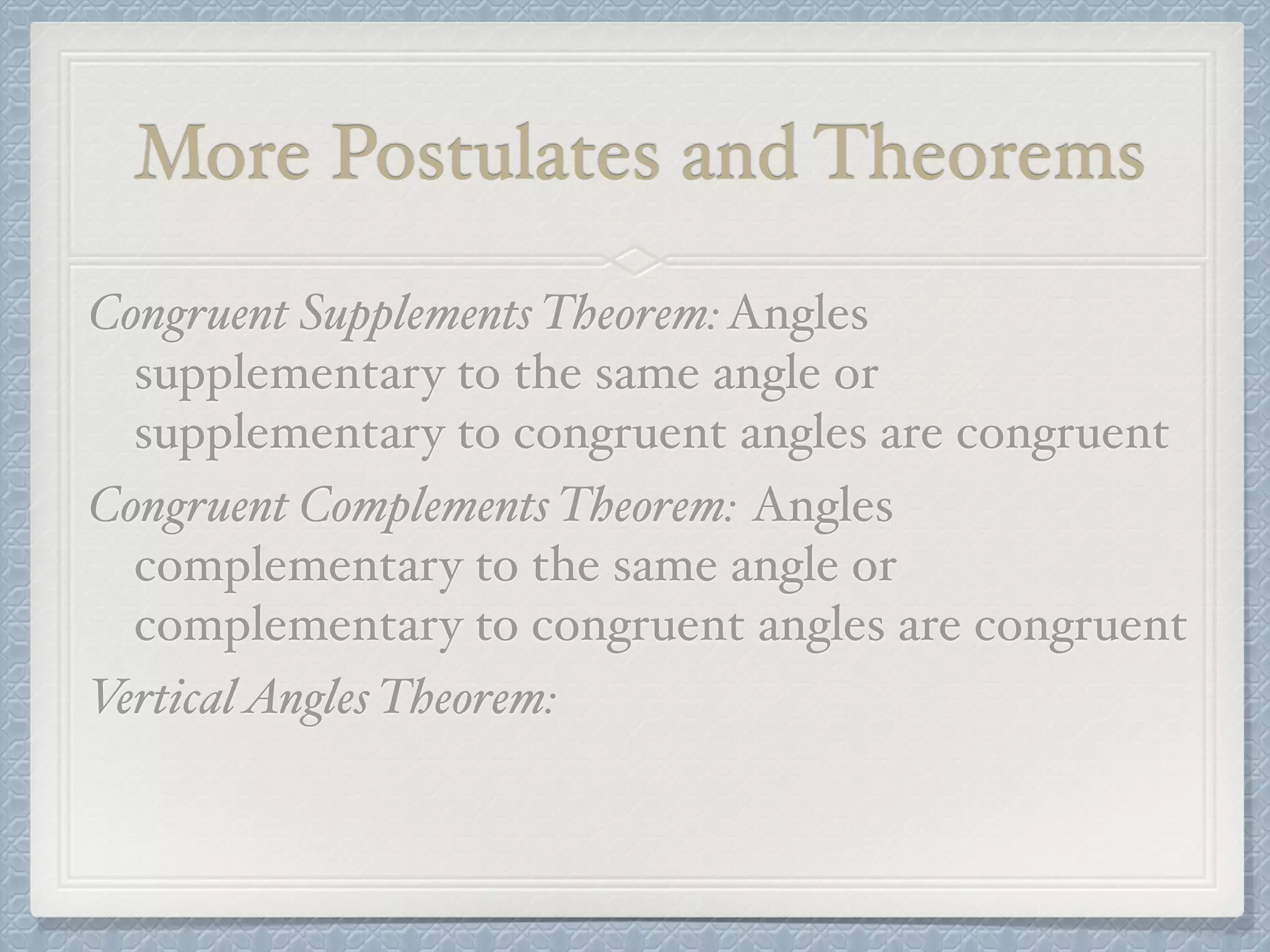
Congruent Supplements Theorem:Angles
supplementary to the same angle or
supplementary to congruent angles are congruent
Congruent Complements Theorem: Angles
complementary to the same angle or
complementary to congruent angles are congruent
VerticalAngles Theorem:
More Postulates and Theorems
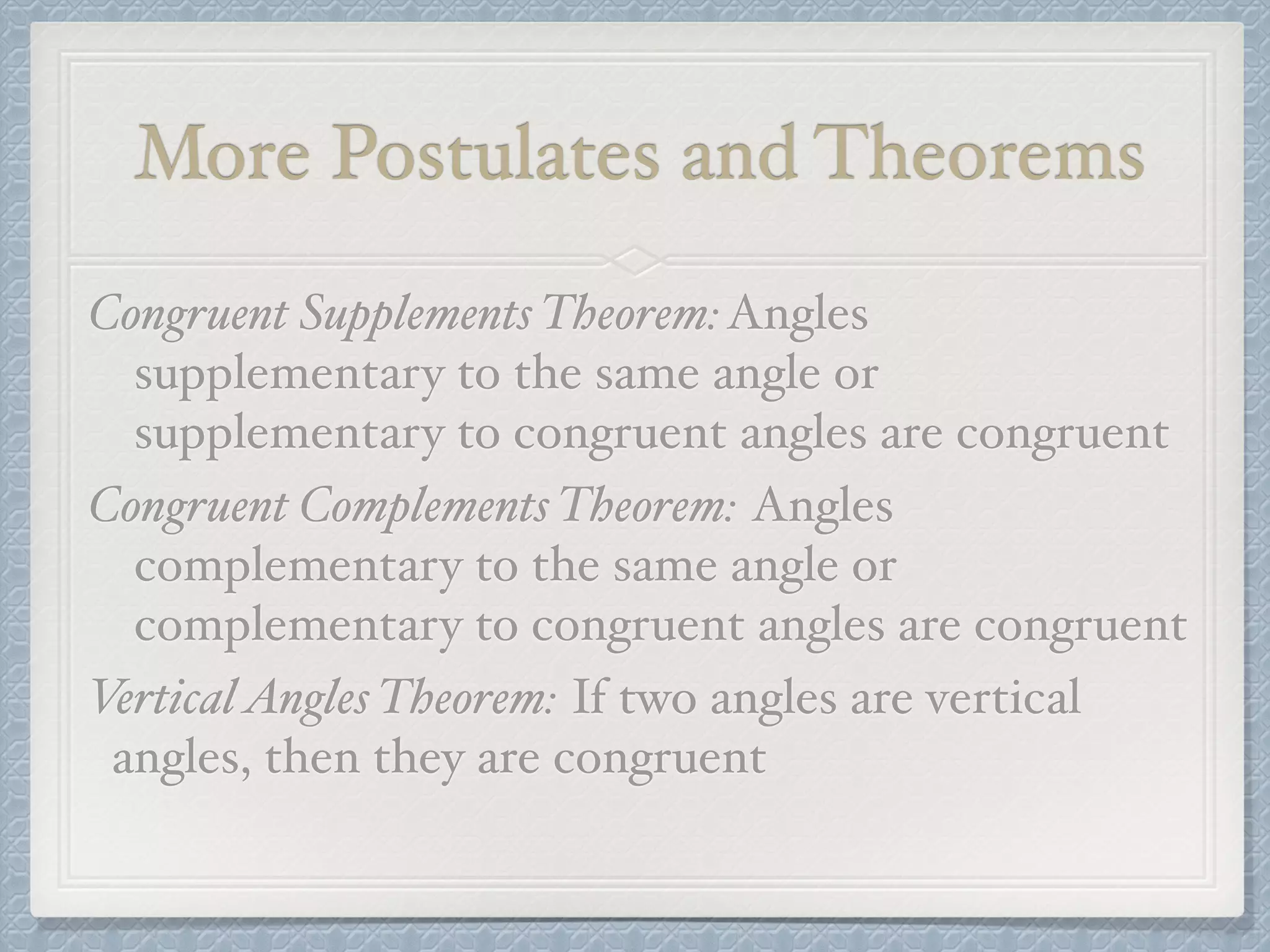
Congruent Supplements Theorem:Angles
supplementary to the same angle or
supplementary to congruent angles are congruent
Congruent Complements Theorem: Angles
complementary to the same angle or
complementary to congruent angles are congruent
VerticalAngles Theorem: If two angles are vertical
angles, then they are congruent
EVEN
More Postulates and Theorems
RightAngle Theorems
Theorem 2.9:
Theorem 2.10:
Theorem 2.11:
Theorem 2.12:
Theorem 2.13:
EVEN
More Postulates and Theorems
RightAngle Theorems
Theorem 2.9: Perpendicular lines intersect to form
four right angles
Theorem 2.10:
Theorem 2.11:
Theorem 2.12:
Theorem 2.13:
EVEN
More Postulates and Theorems
RightAngle Theorems
Theorem 2.9: Perpendicular lines intersect to form
four right angles
Theorem 2.10:All right angles are congruent
Theorem 2.11:
Theorem 2.12:
Theorem 2.13:
EVEN
More Postulates and Theorems
RightAngle Theorems
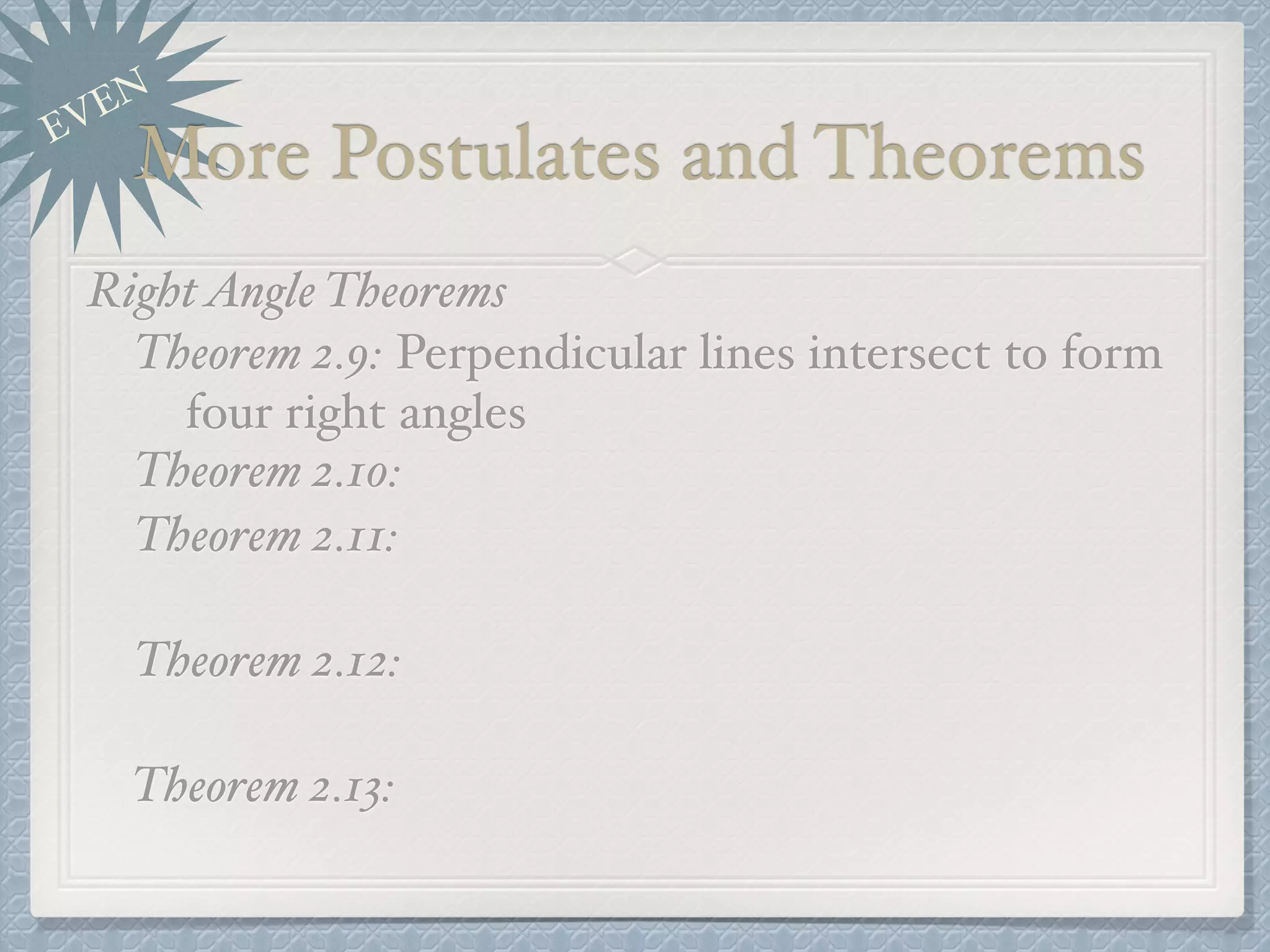
Theorem 2.9: Perpendicular lines intersect to form
four right angles
Theorem 2.10:All right angles are congruent
Theorem 2.11: Perpendicular lines form congruent
adjacent angles
Theorem 2.12:
Theorem 2.13:
EVEN
More Postulates and Theorems
RightAngle Theorems
Theorem 2.9: Perpendicular lines intersect to form
four right angles
Theorem 2.10:All right angles are congruent
Theorem 2.11: Perpendicular lines form congruent
adjacent angles
Theorem 2.12:If two angles are congruent and
supplementary, then each angle is a right angle
Theorem 2.13:
EVEN
More Postulates and Theorems
RightAngle Theorems
Theorem 2.9: Perpendicular lines intersect to form
four right angles
Theorem 2.10:All right angles are congruent
Theorem 2.11: Perpendicular lines form congruent
adjacent angles
Theorem 2.12:If two angles are congruent and
supplementary, then each angle is a right angle
Theorem 2.13: If two congruent angles form a linear
pair, then they are right angles
Example 1
Using a protractor, a construction worker measures that the
angle a beam makes with the ceiling is 42°. What is the
measure of the angle that the beam makes with the wall?
Example 1
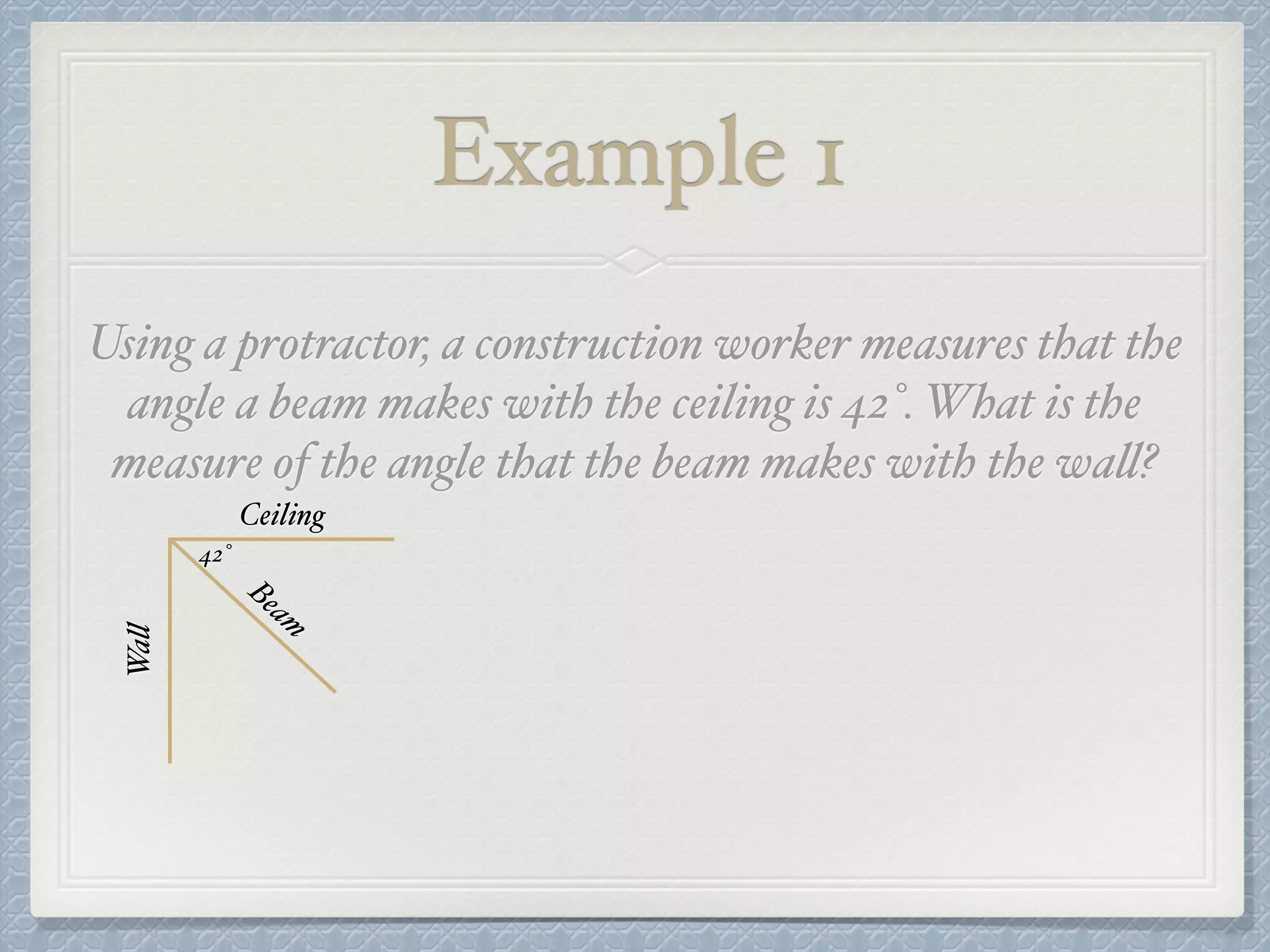
Using a protractor, a construction worker measures that the
angle a beam makes with the ceiling is 42°. What is the
measure of the angle that the beam makes with the wall?
Ceiling
Wall
Beam
42°
Example 1
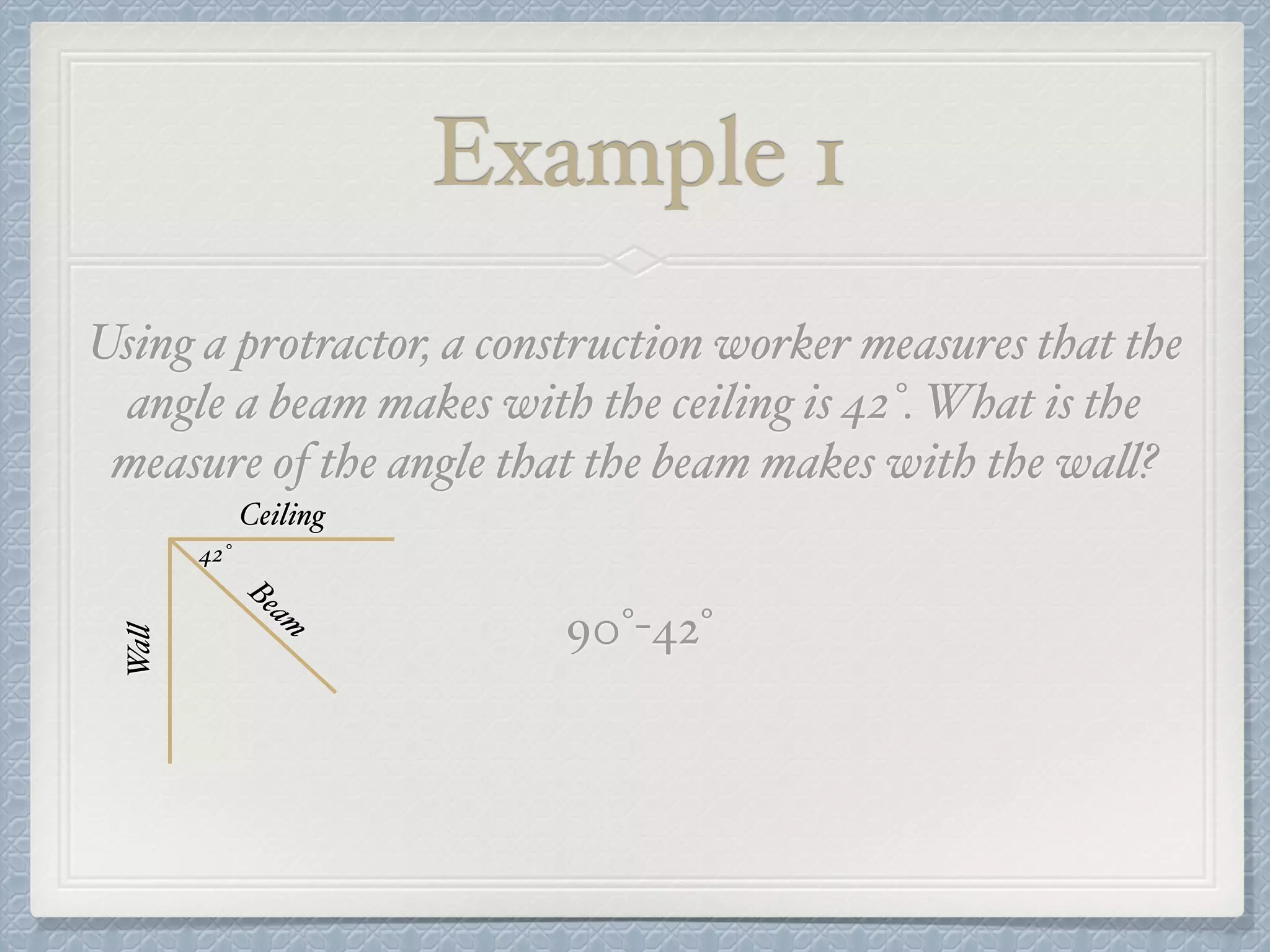
Using a protractor, a construction worker measures that the
angle a beam makes with the ceiling is 42°. What is the
measure of the angle that the beam makes with the wall?
Ceiling
Wall
Beam
42°
90°-42°
Example 1
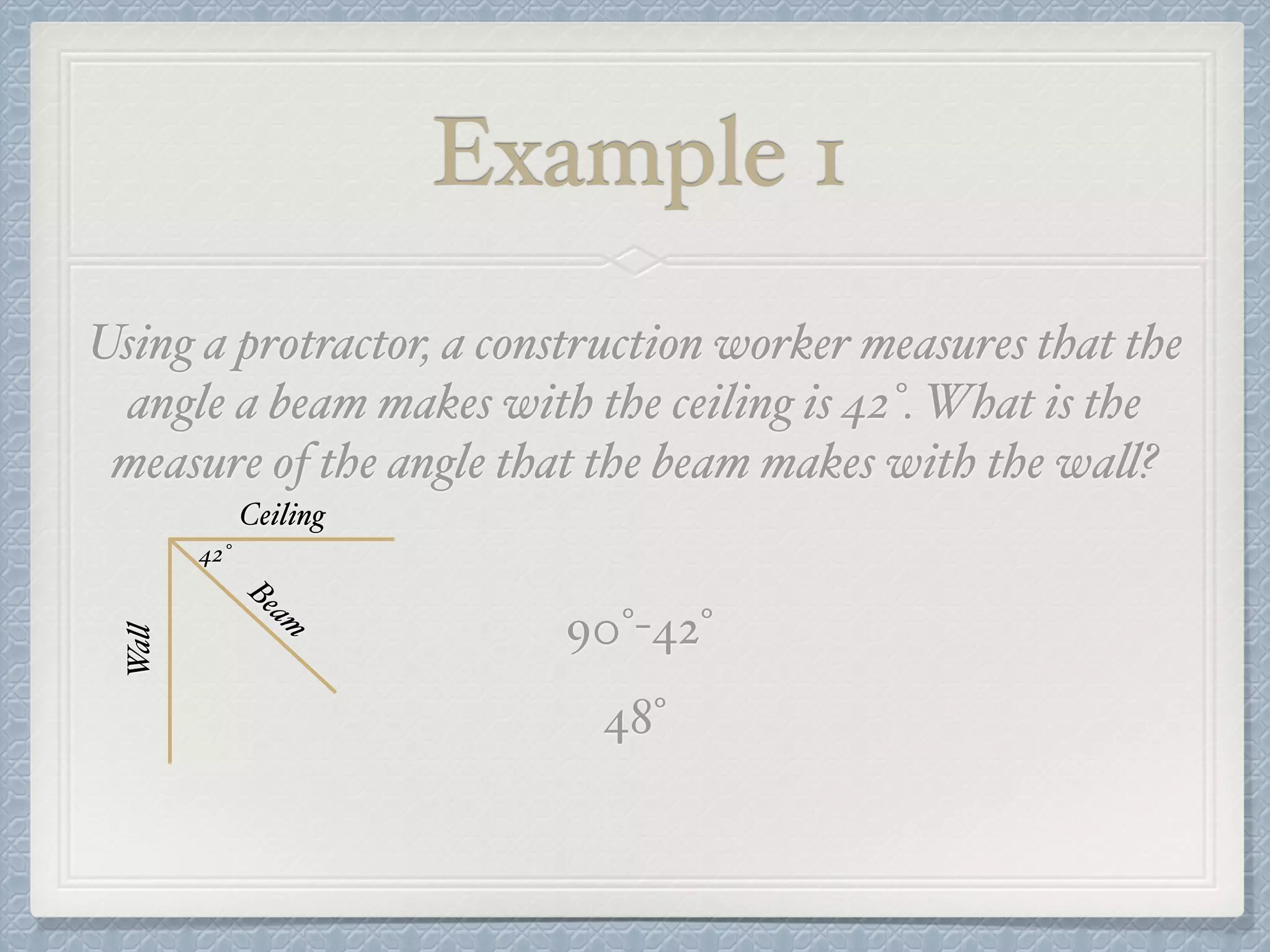
Using a protractor, a construction worker measures that the
angle a beam makes with the ceiling is 42°. What is the
measure of the angle that the beam makes with the wall?
Ceiling
Wall
Beam
42°
90°-42°
48°
Example 2
At 4:00 on an analog clock, the angle between the hour and
minute hands of a clock is 120°. When the second hand
bisects the angle between the hour and minute hands, what
are the measures of the angles between the minute and
second hands and between the second and the hour hands?
Example 2
At 4:00 on an analog clock, the angle between the hour and
minute hands of a clock is 120°. When the second hand
bisects the angle between the hour and minute hands, what
are the measures of the angles between the minute and
second hands and between the second and the hour hands?
Since the larger angle of 120° is bisected, two smaller
angles of 60° are formed, and since those two angles
add up to the larger one, both angles we are looking
for have a measure of 60°.
Example 3
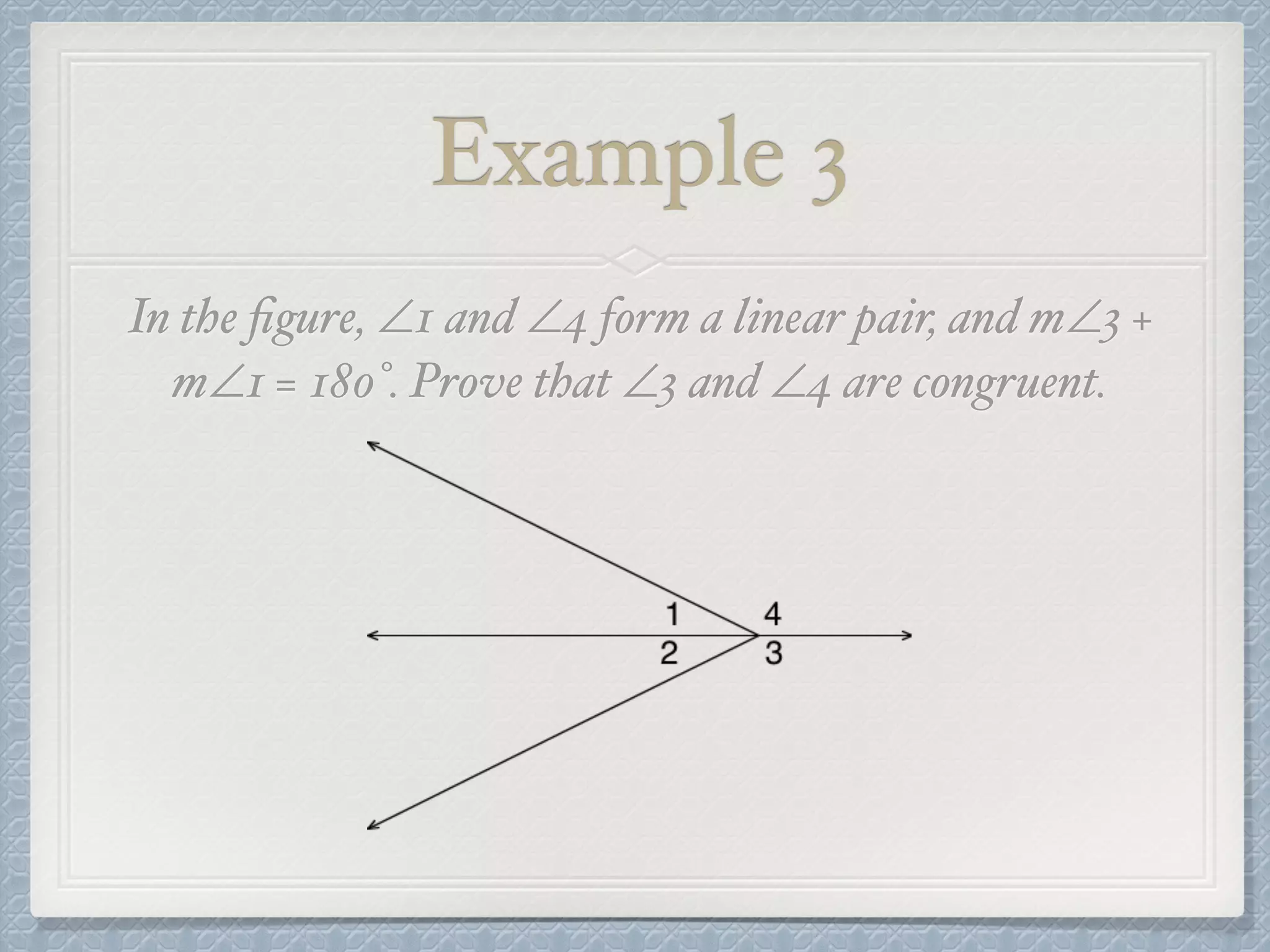
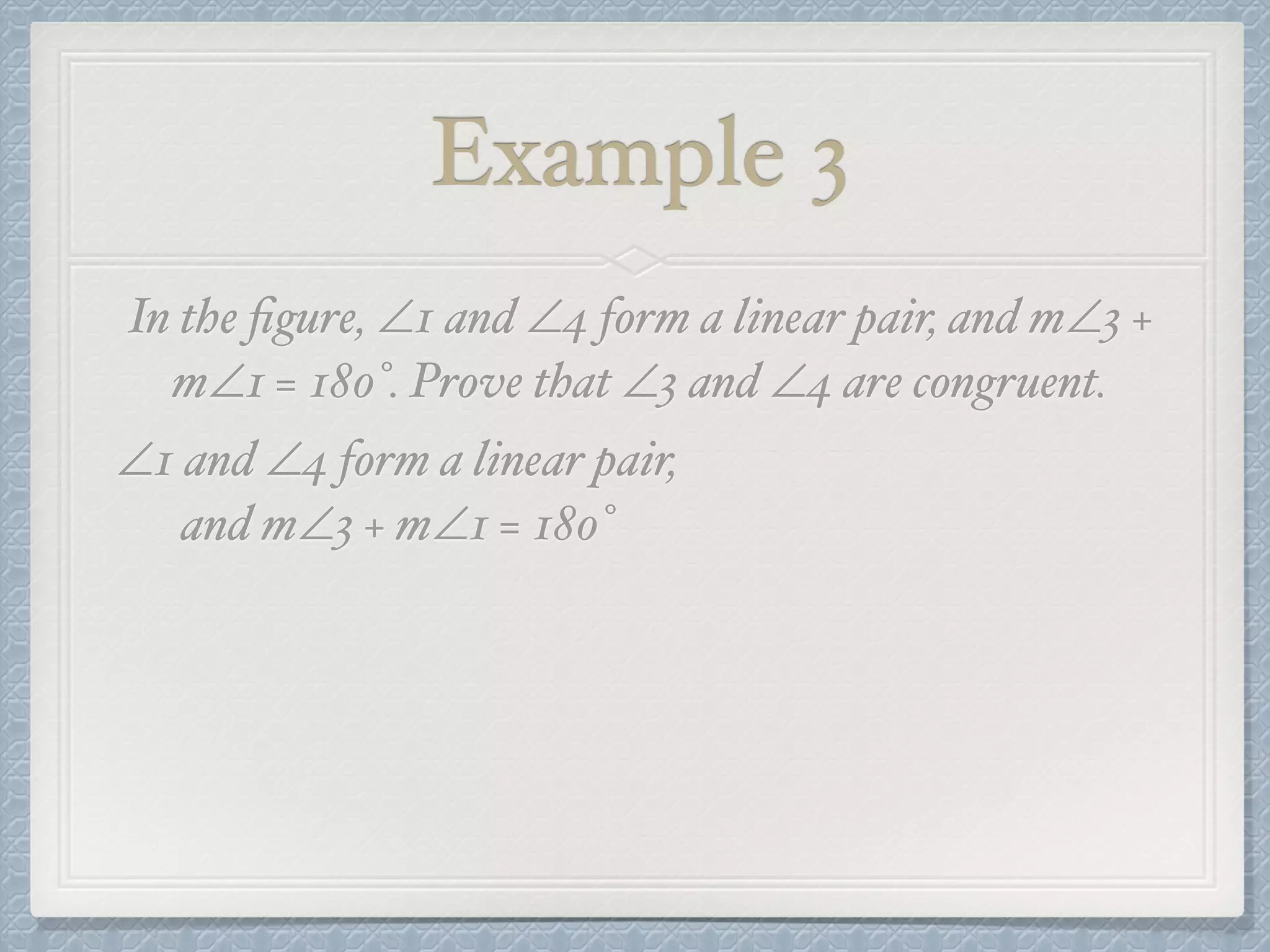
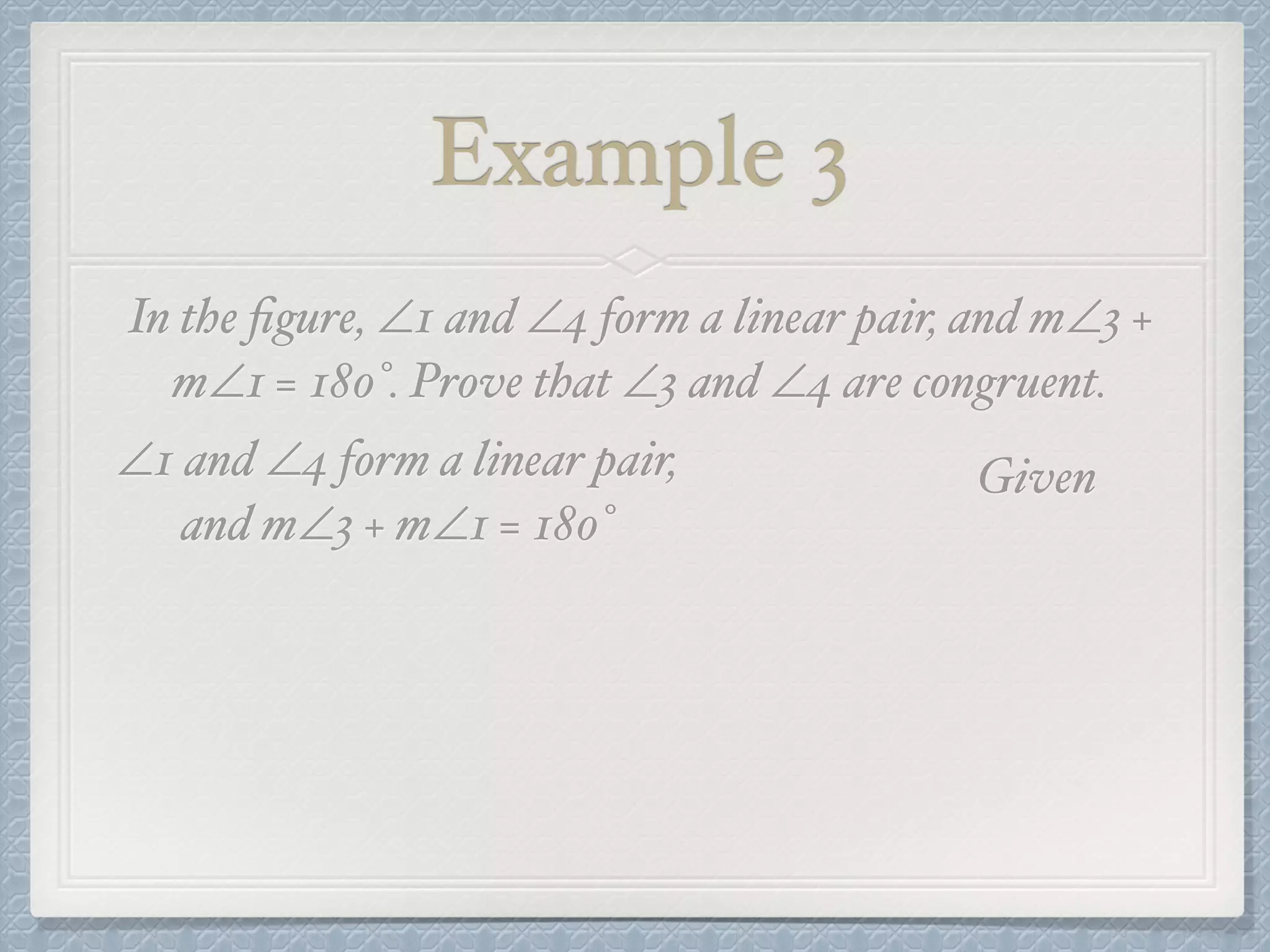
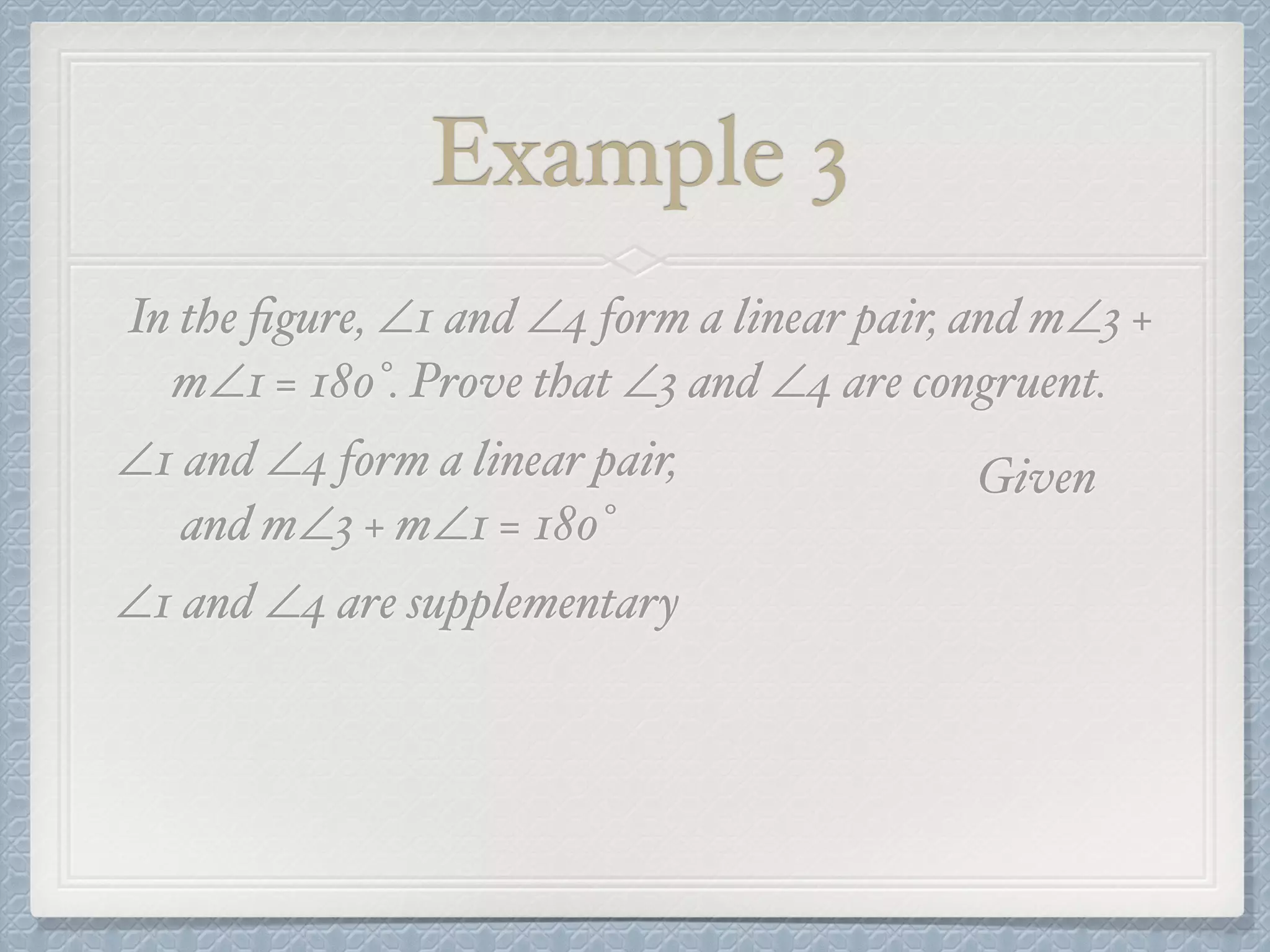
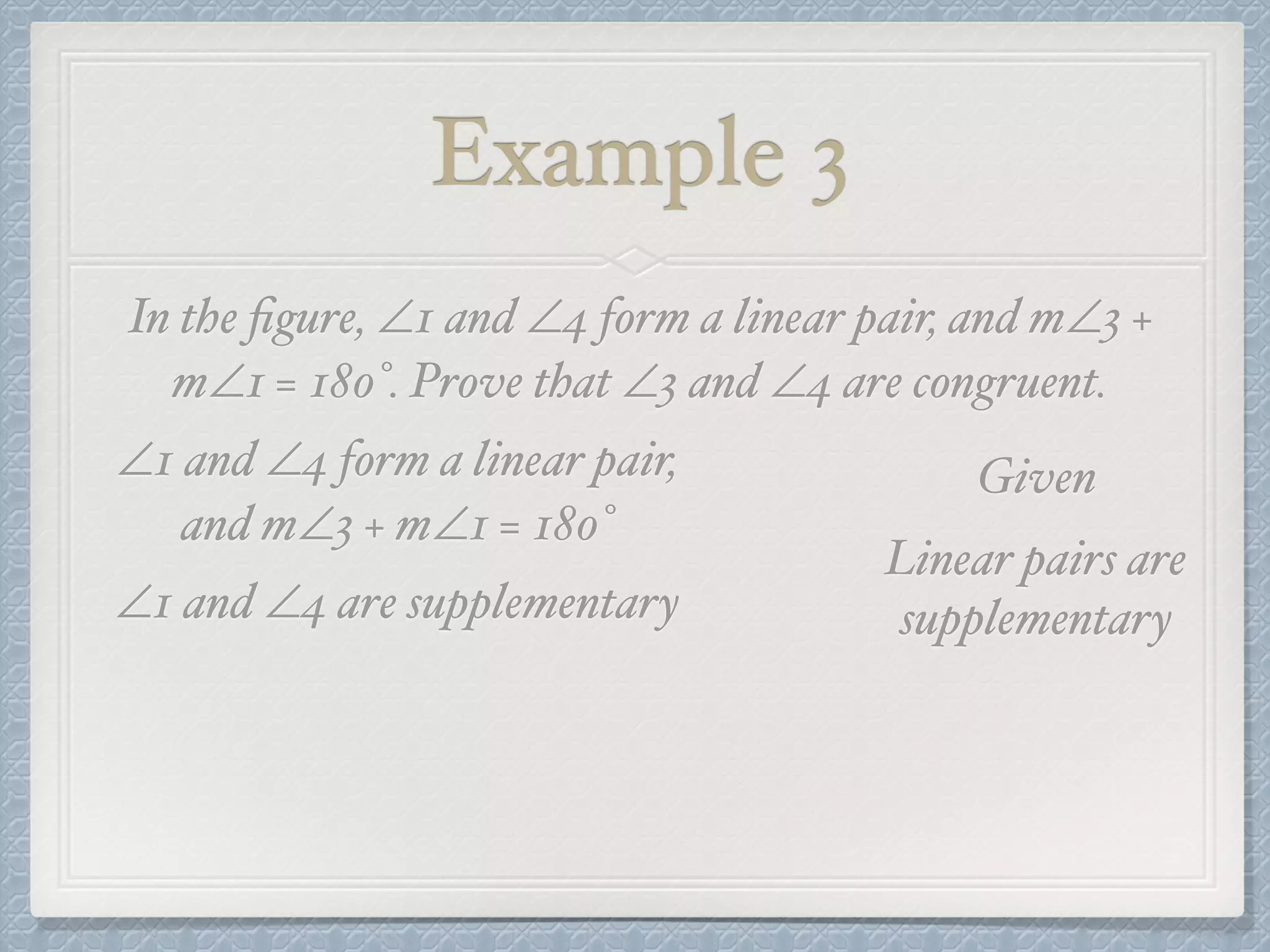
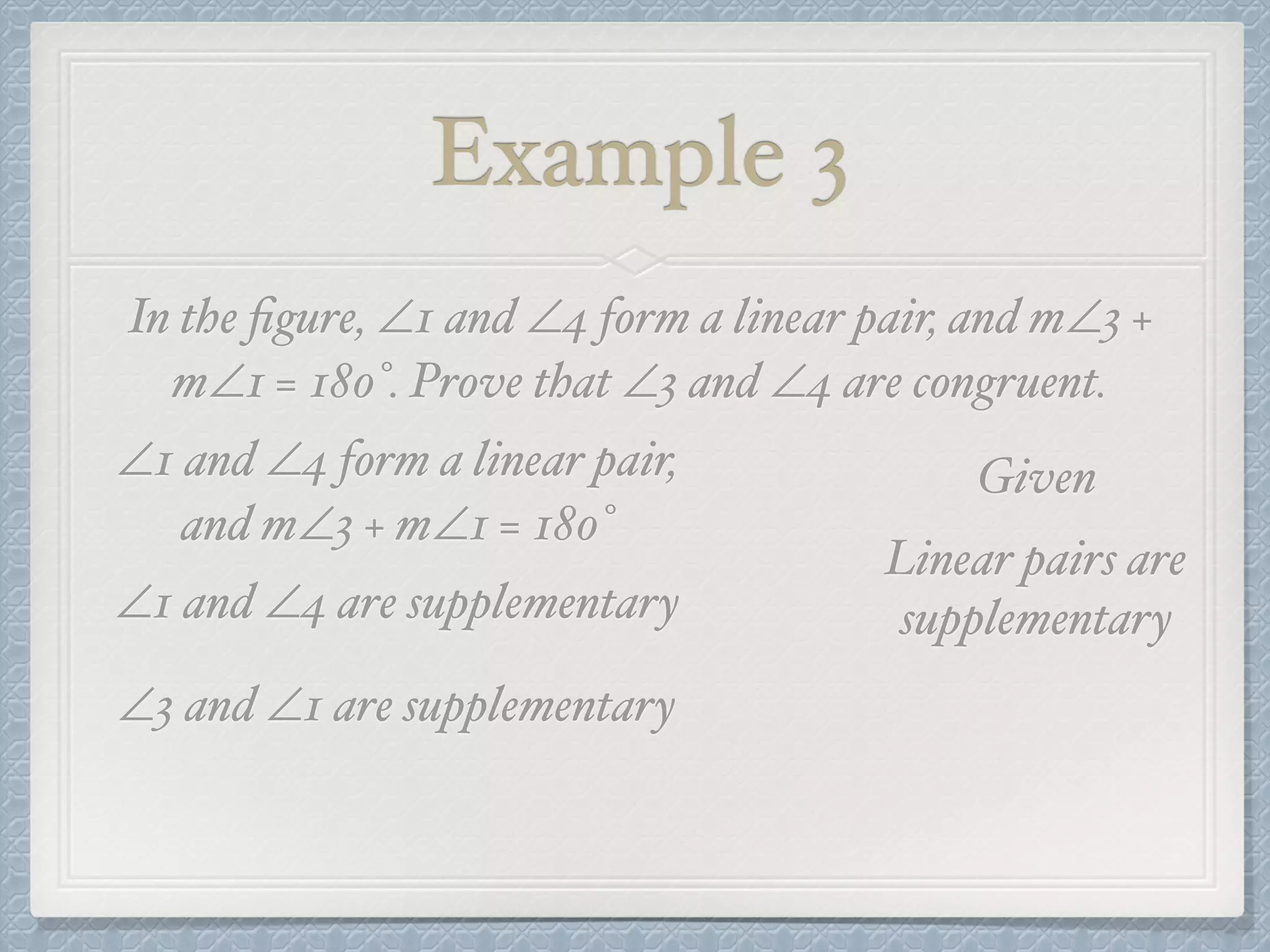
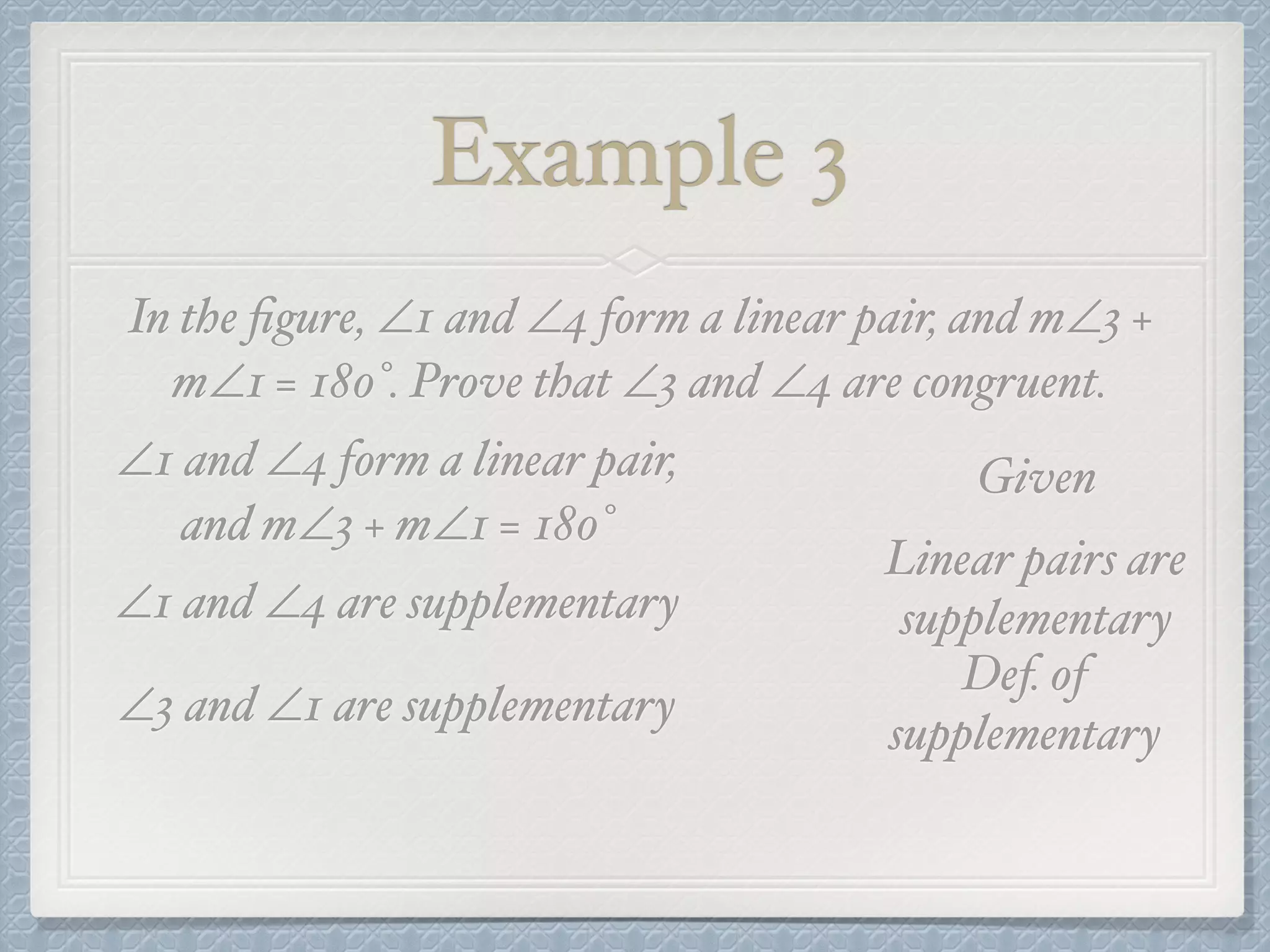
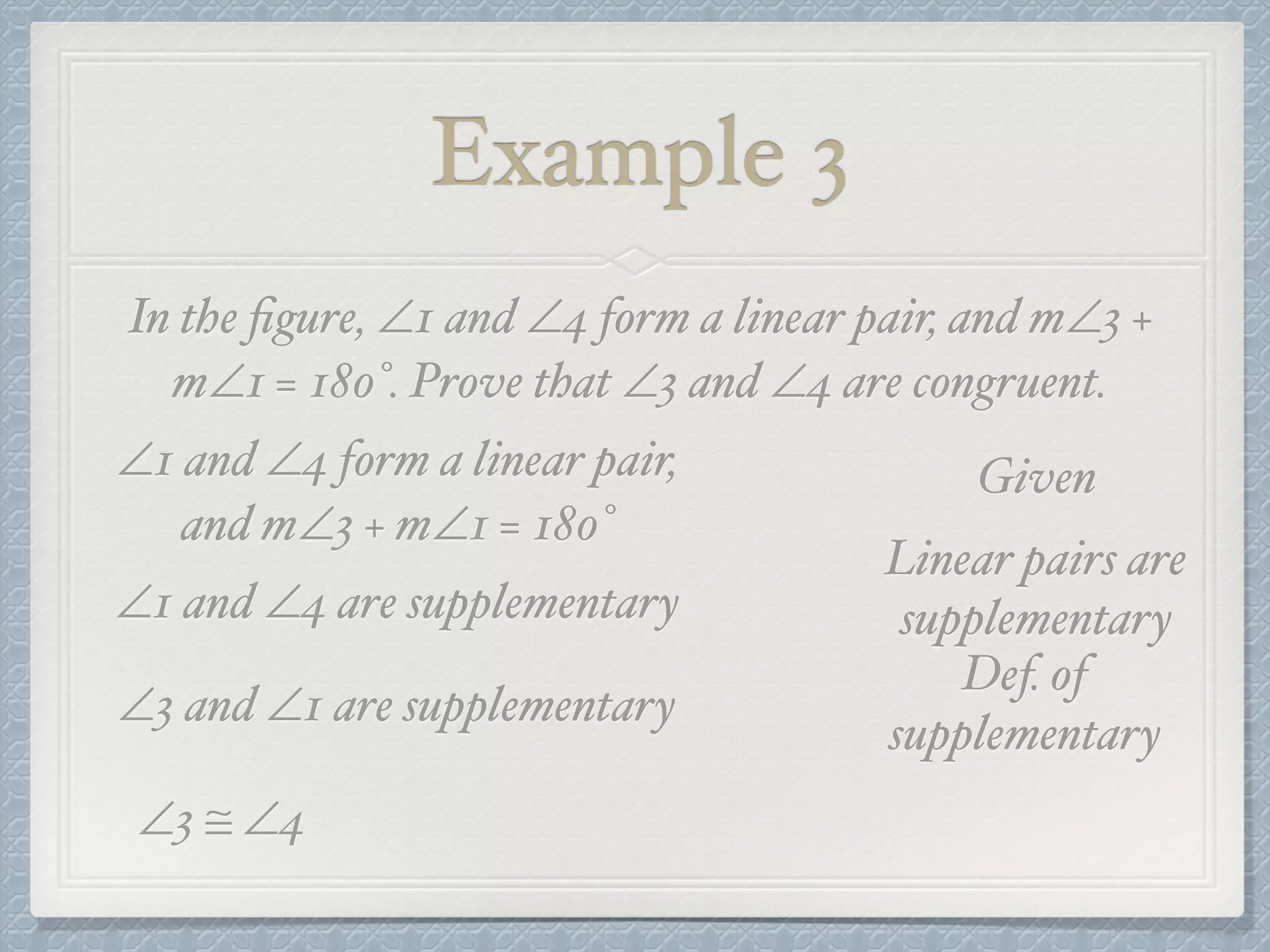
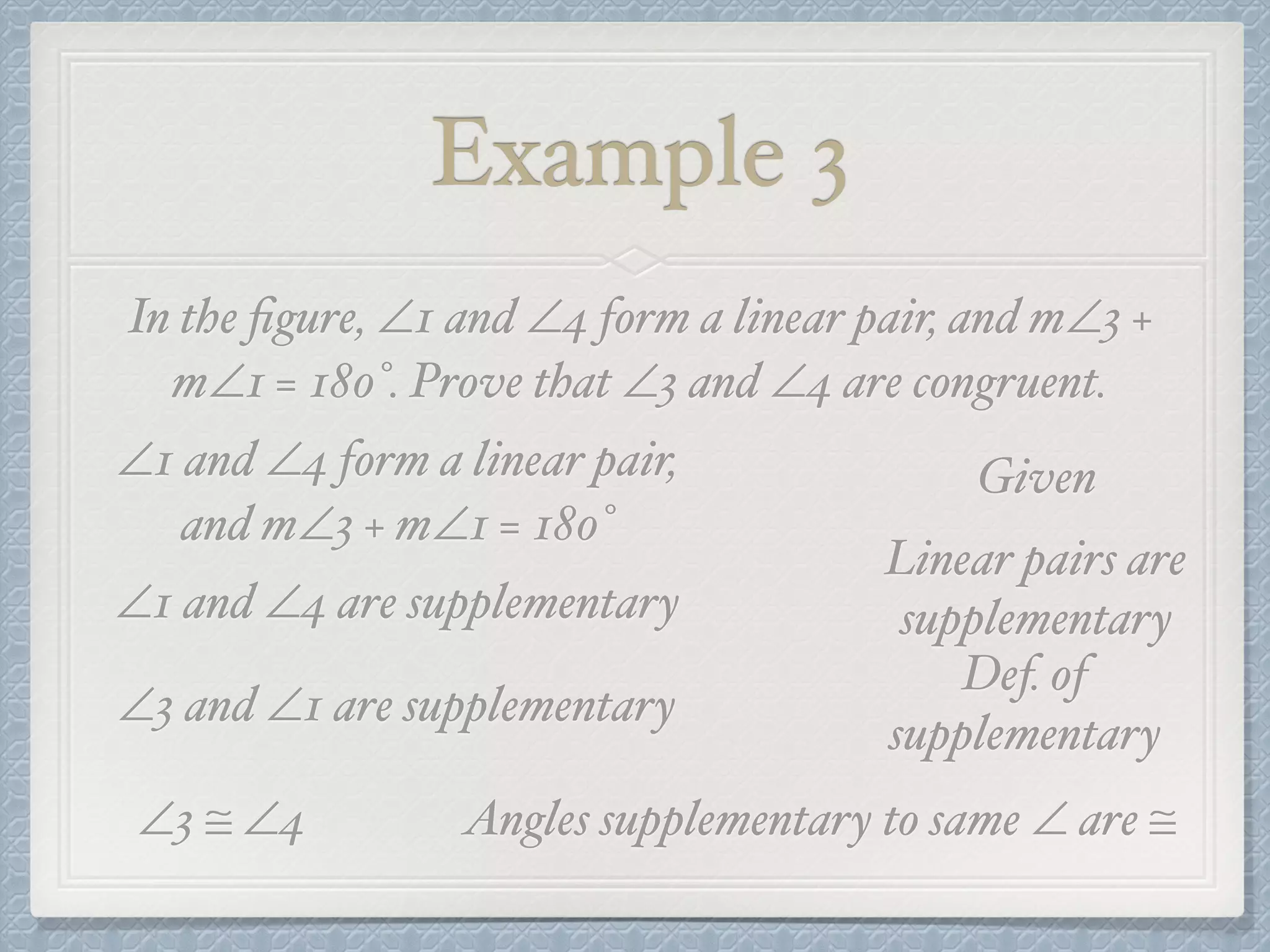
In the figure, ∠1 and ∠4 form a linear pair, and m∠3 +
m∠1 = 180°. Prove that ∠3 and ∠4 are congruent.
Example 3
In the figure, ∠1 and ∠4 form a linear pair, and m∠3 +
m∠1 = 180°. Prove that ∠3 and ∠4 are congruent.
Example 3
In the figure, ∠1 and ∠4 form a linear pair, and m∠3 +
m∠1 = 180°. Prove that ∠3 and ∠4 are congruent.
∠1 and ∠4 form a linear pair,
and m∠3 + m∠1 = 180°
Example 3
In the figure, ∠1 and ∠4 form a linear pair, and m∠3 +
m∠1 = 180°. Prove that ∠3 and ∠4 are congruent.
∠1 and ∠4 form a linear pair,
and m∠3 + m∠1 = 180°
Given
Example 3
In the figure, ∠1 and ∠4 form a linear pair, and m∠3 +
m∠1 = 180°. Prove that ∠3 and ∠4 are congruent.
∠1 and ∠4 form a linear pair,
and m∠3 + m∠1 = 180°
Given
∠1 and ∠4 are supplementary
Example 3
In the figure, ∠1 and ∠4 form a linear pair, and m∠3 +
m∠1 = 180°. Prove that ∠3 and ∠4 are congruent.
∠1 and ∠4 form a linear pair,
and m∠3 + m∠1 = 180°
Given
∠1 and ∠4 are supplementary
Linear pairs are
supplementary
Example 3
In the figure, ∠1 and ∠4 form a linear pair, and m∠3 +
m∠1 = 180°. Prove that ∠3 and ∠4 are congruent.
∠1 and ∠4 form a linear pair,
and m∠3 + m∠1 = 180°
Given
∠1 and ∠4 are supplementary
Linear pairs are
supplementary
∠3 and ∠1 are supplementary
Example 3
In the figure, ∠1 and ∠4 form a linear pair, and m∠3 +
m∠1 = 180°. Prove that ∠3 and ∠4 are congruent.
∠1 and ∠4 form a linear pair,
and m∠3 + m∠1 = 180°
Given
∠1 and ∠4 are supplementary
Linear pairs are
supplementary
∠3 and ∠1 are supplementary
Def. of
supplementary
Example 3
In the figure, ∠1 and ∠4 form a linear pair, and m∠3 +
m∠1 = 180°. Prove that ∠3 and ∠4 are congruent.
∠1 and ∠4 form a linear pair,
and m∠3 + m∠1 = 180°
Given
∠1 and ∠4 are supplementary
Linear pairs are
supplementary
∠3 and ∠1 are supplementary
Def. of
supplementary
∠3 ≅ ∠4
Example 3
In the figure, ∠1 and ∠4 form a linear pair, and m∠3 +
m∠1 = 180°. Prove that ∠3 and ∠4 are congruent.
∠1 and ∠4 form a linear pair,
and m∠3 + m∠1 = 180°
Given
∠1 and ∠4 are supplementary
Linear pairs are
supplementary
∠3 and ∠1 are supplementary
Def. of
supplementary
∠3 ≅ ∠4 Angles supplementary to same ∠ are ≅

Geometry Section 2-6

  • 1.
  • 2.
    Essential Questions How doyou write proofs involving supplementary and complementary angles? How do you write proofs involving congruent and right angles?
  • 3.
    More Postulates andTheorems Protractor Postulate: AngleAddition Postulate: Supplement Theorem:
  • 4.
    More Postulates andTheorems Protractor Postulate: Given any angle, the measure can be put into one-to-one correspondence with real numbers between 0 and 180 AngleAddition Postulate: Supplement Theorem:
  • 5.
    More Postulates andTheorems Protractor Postulate: Given any angle, the measure can be put into one-to-one correspondence with real numbers between 0 and 180 This means we can measure angles in degrees AngleAddition Postulate: Supplement Theorem:
  • 6.
    More Postulates andTheorems Protractor Postulate: Given any angle, the measure can be put into one-to-one correspondence with real numbers between 0 and 180 This means we can measure angles in degrees AngleAddition Postulate: D is in the interior of ∠ABC IFF m∠ABD + m∠DBC = m∠ABC Supplement Theorem:
  • 7.
    More Postulates andTheorems Protractor Postulate: Given any angle, the measure can be put into one-to-one correspondence with real numbers between 0 and 180 This means we can measure angles in degrees AngleAddition Postulate: D is in the interior of ∠ABC IFF m∠ABD + m∠DBC = m∠ABC Supplement Theorem:If two angles form a linear pair, then they are supplementary angles
  • 8.
    More Postulates andTheorems Complement Theorem: Properties ofAngle Congruence Reflexive Property of Congruence: Symmetric Property of Congruence: Transitive Property of Congruence:
  • 9.
    More Postulates andTheorems Complement Theorem:If the non-common sides of two adjacent angles form a right angle, then the angles are complementary angles Properties ofAngle Congruence Reflexive Property of Congruence: Symmetric Property of Congruence: Transitive Property of Congruence:
  • 10.
    More Postulates andTheorems Complement Theorem:If the non-common sides of two adjacent angles form a right angle, then the angles are complementary angles Properties ofAngle Congruence Reflexive Property of Congruence: ∠1 ≅ ∠1 Symmetric Property of Congruence: Transitive Property of Congruence:
  • 11.
    More Postulates andTheorems Complement Theorem:If the non-common sides of two adjacent angles form a right angle, then the angles are complementary angles Properties ofAngle Congruence Reflexive Property of Congruence: ∠1 ≅ ∠1 Symmetric Property of Congruence: If ∠1 ≅ ∠2, then ∠2 ≅ ∠1 Transitive Property of Congruence:
  • 12.
    More Postulates andTheorems Complement Theorem:If the non-common sides of two adjacent angles form a right angle, then the angles are complementary angles Properties ofAngle Congruence Reflexive Property of Congruence: ∠1 ≅ ∠1 Symmetric Property of Congruence: If ∠1 ≅ ∠2, then ∠2 ≅ ∠1 Transitive Property of Congruence: If ∠1 ≅ ∠2 and ∠2 ≅ ∠3, then ∠1 ≅ ∠3
  • 13.
    More Postulates andTheorems Congruent Supplements Theorem: Congruent Complements Theorem: VerticalAngles Theorem:
  • 14.
    More Postulates andTheorems Congruent Supplements Theorem:Angles supplementary to the same angle or supplementary to congruent angles are congruent Congruent Complements Theorem: VerticalAngles Theorem:
  • 15.
    More Postulates andTheorems Congruent Supplements Theorem:Angles supplementary to the same angle or supplementary to congruent angles are congruent Congruent Complements Theorem: Angles complementary to the same angle or complementary to congruent angles are congruent VerticalAngles Theorem:
  • 16.
    More Postulates andTheorems Congruent Supplements Theorem:Angles supplementary to the same angle or supplementary to congruent angles are congruent Congruent Complements Theorem: Angles complementary to the same angle or complementary to congruent angles are congruent VerticalAngles Theorem: If two angles are vertical angles, then they are congruent
  • 17.
    EVEN More Postulates andTheorems RightAngle Theorems Theorem 2.9: Theorem 2.10: Theorem 2.11: Theorem 2.12: Theorem 2.13:
  • 18.
    EVEN More Postulates andTheorems RightAngle Theorems Theorem 2.9: Perpendicular lines intersect to form four right angles Theorem 2.10: Theorem 2.11: Theorem 2.12: Theorem 2.13:
  • 19.
    EVEN More Postulates andTheorems RightAngle Theorems Theorem 2.9: Perpendicular lines intersect to form four right angles Theorem 2.10:All right angles are congruent Theorem 2.11: Theorem 2.12: Theorem 2.13:
  • 20.
    EVEN More Postulates andTheorems RightAngle Theorems Theorem 2.9: Perpendicular lines intersect to form four right angles Theorem 2.10:All right angles are congruent Theorem 2.11: Perpendicular lines form congruent adjacent angles Theorem 2.12: Theorem 2.13:
  • 21.
    EVEN More Postulates andTheorems RightAngle Theorems Theorem 2.9: Perpendicular lines intersect to form four right angles Theorem 2.10:All right angles are congruent Theorem 2.11: Perpendicular lines form congruent adjacent angles Theorem 2.12:If two angles are congruent and supplementary, then each angle is a right angle Theorem 2.13:
  • 22.
    EVEN More Postulates andTheorems RightAngle Theorems Theorem 2.9: Perpendicular lines intersect to form four right angles Theorem 2.10:All right angles are congruent Theorem 2.11: Perpendicular lines form congruent adjacent angles Theorem 2.12:If two angles are congruent and supplementary, then each angle is a right angle Theorem 2.13: If two congruent angles form a linear pair, then they are right angles
  • 23.
    Example 1 Using aprotractor, a construction worker measures that the angle a beam makes with the ceiling is 42°. What is the measure of the angle that the beam makes with the wall?
  • 24.
    Example 1 Using aprotractor, a construction worker measures that the angle a beam makes with the ceiling is 42°. What is the measure of the angle that the beam makes with the wall? Ceiling Wall Beam 42°
  • 25.
    Example 1 Using aprotractor, a construction worker measures that the angle a beam makes with the ceiling is 42°. What is the measure of the angle that the beam makes with the wall? Ceiling Wall Beam 42° 90°-42°
  • 26.
    Example 1 Using aprotractor, a construction worker measures that the angle a beam makes with the ceiling is 42°. What is the measure of the angle that the beam makes with the wall? Ceiling Wall Beam 42° 90°-42° 48°
  • 27.
    Example 2 At 4:00on an analog clock, the angle between the hour and minute hands of a clock is 120°. When the second hand bisects the angle between the hour and minute hands, what are the measures of the angles between the minute and second hands and between the second and the hour hands?
  • 28.
    Example 2 At 4:00on an analog clock, the angle between the hour and minute hands of a clock is 120°. When the second hand bisects the angle between the hour and minute hands, what are the measures of the angles between the minute and second hands and between the second and the hour hands? Since the larger angle of 120° is bisected, two smaller angles of 60° are formed, and since those two angles add up to the larger one, both angles we are looking for have a measure of 60°.
  • 29.
    Example 3 In thefigure, ∠1 and ∠4 form a linear pair, and m∠3 + m∠1 = 180°. Prove that ∠3 and ∠4 are congruent.
  • 30.
    Example 3 In thefigure, ∠1 and ∠4 form a linear pair, and m∠3 + m∠1 = 180°. Prove that ∠3 and ∠4 are congruent.
  • 31.
    Example 3 In thefigure, ∠1 and ∠4 form a linear pair, and m∠3 + m∠1 = 180°. Prove that ∠3 and ∠4 are congruent. ∠1 and ∠4 form a linear pair, and m∠3 + m∠1 = 180°
  • 32.
    Example 3 In thefigure, ∠1 and ∠4 form a linear pair, and m∠3 + m∠1 = 180°. Prove that ∠3 and ∠4 are congruent. ∠1 and ∠4 form a linear pair, and m∠3 + m∠1 = 180° Given
  • 33.
    Example 3 In thefigure, ∠1 and ∠4 form a linear pair, and m∠3 + m∠1 = 180°. Prove that ∠3 and ∠4 are congruent. ∠1 and ∠4 form a linear pair, and m∠3 + m∠1 = 180° Given ∠1 and ∠4 are supplementary
  • 34.
    Example 3 In thefigure, ∠1 and ∠4 form a linear pair, and m∠3 + m∠1 = 180°. Prove that ∠3 and ∠4 are congruent. ∠1 and ∠4 form a linear pair, and m∠3 + m∠1 = 180° Given ∠1 and ∠4 are supplementary Linear pairs are supplementary
  • 35.
    Example 3 In thefigure, ∠1 and ∠4 form a linear pair, and m∠3 + m∠1 = 180°. Prove that ∠3 and ∠4 are congruent. ∠1 and ∠4 form a linear pair, and m∠3 + m∠1 = 180° Given ∠1 and ∠4 are supplementary Linear pairs are supplementary ∠3 and ∠1 are supplementary
  • 36.
    Example 3 In thefigure, ∠1 and ∠4 form a linear pair, and m∠3 + m∠1 = 180°. Prove that ∠3 and ∠4 are congruent. ∠1 and ∠4 form a linear pair, and m∠3 + m∠1 = 180° Given ∠1 and ∠4 are supplementary Linear pairs are supplementary ∠3 and ∠1 are supplementary Def. of supplementary
  • 37.
    Example 3 In thefigure, ∠1 and ∠4 form a linear pair, and m∠3 + m∠1 = 180°. Prove that ∠3 and ∠4 are congruent. ∠1 and ∠4 form a linear pair, and m∠3 + m∠1 = 180° Given ∠1 and ∠4 are supplementary Linear pairs are supplementary ∠3 and ∠1 are supplementary Def. of supplementary ∠3 ≅ ∠4
  • 38.
    Example 3 In thefigure, ∠1 and ∠4 form a linear pair, and m∠3 + m∠1 = 180°. Prove that ∠3 and ∠4 are congruent. ∠1 and ∠4 form a linear pair, and m∠3 + m∠1 = 180° Given ∠1 and ∠4 are supplementary Linear pairs are supplementary ∠3 and ∠1 are supplementary Def. of supplementary ∠3 ≅ ∠4 Angles supplementary to same ∠ are ≅