Chemistry – science that deals with matter and the changes that matter undergoes Macroscopic – all around us Microscopic – air, molecules, etc
Scientific Problem Solving 3 Step Process 1.  state problem and make observations (qualitative vs. quantitative) 2.  formulate a possible solution 3.  perform experiments to test hypothesis
Theory vs. Law Theory – gives a universally accepted explanation of the problem Law – state what general behavior is observed that occurs normally
States of Matter All matter has 2 characteristics Has mass and occupies space 3 types:  solid, liquid, gas Solids – definite shape and volume; packed tightly together; vibrate gently around fixed positions Liquids – no shape of own; fill container; definite volume; particles are free to move Gases – no shape or definite volume; particles spread apart; filling all space in container
Physical and Chemical Properties and Changes Physical Property:  color, odor, density, hardness, solubility, melting point, boiling point Physical Change:  chemical composition always remains the same.  Ex. Phase changes (2 less known ones are sublimation (solid to gas) and deposition (gas to solid) Chemical Property:  reacts with acid, reacts with base, oxidation and reduction Chemical Change:  won’t go back to original substance.  Ex. combustion
E, C, M Element – pure substance that cannot be broken down any further…..single substance from periodic table Compound – pure substance that cannot be broken down by physical means; formed when elements bond together….have fixed composition Mixture – varying composition and is made up of a number of pure substances. Homogeneous – uniform composition Heterogeneous – varying composition
Measurement Scientific Notation The number of places the decimal point has moved determines the power of 10 Decimal moves left = positive power Decimal moves right = negative power 42000 = 4.2 x 10 4 0.00012 = 1.2 x 10 -4
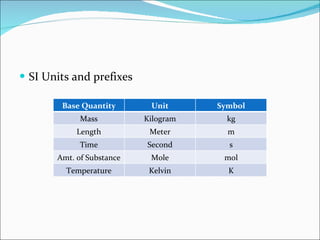
SI Units and prefixes Base Quantity Unit Symbol Mass Kilogram kg Length Meter m Time Second s Amt. of Substance Mole mol Temperature Kelvin K
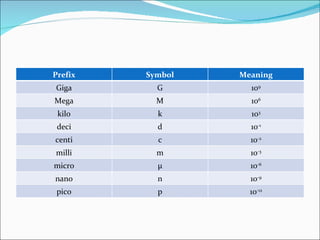
Prefix Symbol Meaning Giga G 10 9 Mega M 10 6 kilo k 10 3 deci d 10 -1 centi c 10 -2 milli m 10 -3 micro μ 10 -6 nano n 10 -9 pico p 10 -12
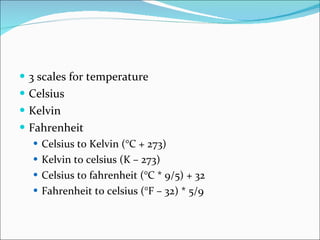
3 scales for temperature Celsius Kelvin Fahrenheit Celsius to Kelvin (°C + 273) Kelvin to celsius (K – 273) Celsius to fahrenheit (°C * 9/5) + 32 Fahrenheit to celsius (°F – 32) * 5/9
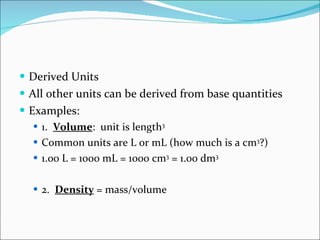
Derived Units All other units can be derived from base quantities Examples: 1.  Volume :  unit is length 3 Common units are L or mL (how much is a cm 3 ?) 1.00 L = 1000 mL = 1000 cm 3  = 1.00 dm 3 2.  Density  = mass/volume
Uncertainty When reading the scale on a piece of lab equipment, there is always a degree of uncertainty Estimate must be made to record the final digit This “uncertain” digit is recorded by using the +/- scale Rounding – don’t round until the end of a calculation
Significant Figures Remember the Atlantic and Pacific rule In Calculations Multiplying and dividing:  limit answer to least number of sig figs used Adding and subtracting:  limit answer to same number of decimal places that appear in the original data with fewest number of decimal places
Accuracy vs. Precision Accuracy – relates to how close the measured value is to the actual value of the quantity Precision – how close 2 or more measurements of the same quantity are to one another
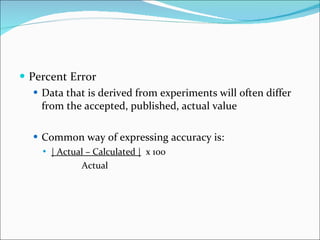
Percent Error Data that is derived from experiments will often differ from the accepted, published, actual value Common way of expressing accuracy is: | Actual – Calculated |   x 100   Actual

Chemistry- JIB Topic 1 Matter and Measurement

  • 1.
  • 2.
    Chemistry – sciencethat deals with matter and the changes that matter undergoes Macroscopic – all around us Microscopic – air, molecules, etc
  • 3.
    Scientific Problem Solving3 Step Process 1. state problem and make observations (qualitative vs. quantitative) 2. formulate a possible solution 3. perform experiments to test hypothesis
  • 4.
    Theory vs. LawTheory – gives a universally accepted explanation of the problem Law – state what general behavior is observed that occurs normally
  • 5.
    States of MatterAll matter has 2 characteristics Has mass and occupies space 3 types: solid, liquid, gas Solids – definite shape and volume; packed tightly together; vibrate gently around fixed positions Liquids – no shape of own; fill container; definite volume; particles are free to move Gases – no shape or definite volume; particles spread apart; filling all space in container
  • 6.
    Physical and ChemicalProperties and Changes Physical Property: color, odor, density, hardness, solubility, melting point, boiling point Physical Change: chemical composition always remains the same. Ex. Phase changes (2 less known ones are sublimation (solid to gas) and deposition (gas to solid) Chemical Property: reacts with acid, reacts with base, oxidation and reduction Chemical Change: won’t go back to original substance. Ex. combustion
  • 7.
    E, C, MElement – pure substance that cannot be broken down any further…..single substance from periodic table Compound – pure substance that cannot be broken down by physical means; formed when elements bond together….have fixed composition Mixture – varying composition and is made up of a number of pure substances. Homogeneous – uniform composition Heterogeneous – varying composition
  • 8.
    Measurement Scientific NotationThe number of places the decimal point has moved determines the power of 10 Decimal moves left = positive power Decimal moves right = negative power 42000 = 4.2 x 10 4 0.00012 = 1.2 x 10 -4
  • 9.
    SI Units andprefixes Base Quantity Unit Symbol Mass Kilogram kg Length Meter m Time Second s Amt. of Substance Mole mol Temperature Kelvin K
  • 10.
    Prefix Symbol MeaningGiga G 10 9 Mega M 10 6 kilo k 10 3 deci d 10 -1 centi c 10 -2 milli m 10 -3 micro μ 10 -6 nano n 10 -9 pico p 10 -12
  • 11.
    3 scales fortemperature Celsius Kelvin Fahrenheit Celsius to Kelvin (°C + 273) Kelvin to celsius (K – 273) Celsius to fahrenheit (°C * 9/5) + 32 Fahrenheit to celsius (°F – 32) * 5/9
  • 12.
    Derived Units Allother units can be derived from base quantities Examples: 1. Volume : unit is length 3 Common units are L or mL (how much is a cm 3 ?) 1.00 L = 1000 mL = 1000 cm 3 = 1.00 dm 3 2. Density = mass/volume
  • 13.
    Uncertainty When readingthe scale on a piece of lab equipment, there is always a degree of uncertainty Estimate must be made to record the final digit This “uncertain” digit is recorded by using the +/- scale Rounding – don’t round until the end of a calculation
  • 14.
    Significant Figures Rememberthe Atlantic and Pacific rule In Calculations Multiplying and dividing: limit answer to least number of sig figs used Adding and subtracting: limit answer to same number of decimal places that appear in the original data with fewest number of decimal places
  • 15.
    Accuracy vs. PrecisionAccuracy – relates to how close the measured value is to the actual value of the quantity Precision – how close 2 or more measurements of the same quantity are to one another
  • 16.
    Percent Error Datathat is derived from experiments will often differ from the accepted, published, actual value Common way of expressing accuracy is: | Actual – Calculated | x 100 Actual